
Click the link below the picture
.
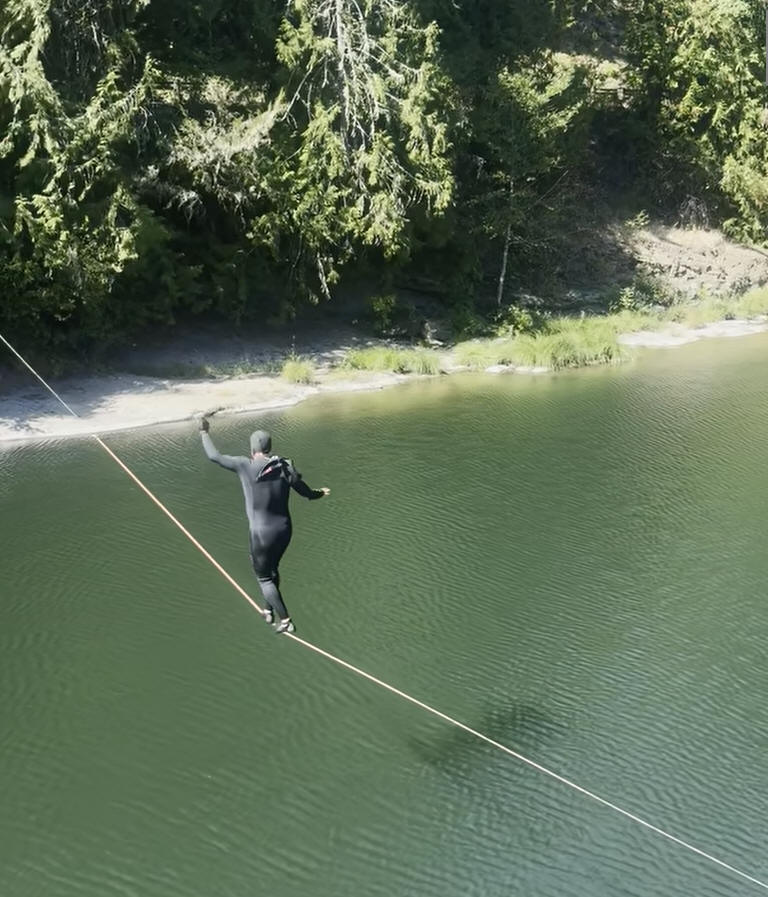
Like many men his age, Adam Grosowsky begins his workouts with stretching. What comes next is a bit more unusual: He wrestles himself into a wet suit and swims across the Row River, near his home in Eugene, Ore. Then he sets up a slackline and really gets to work: walking, turning and swaying on a thin band of webbing 15 feet above the river, surrounded by a cathedral of old-growth trees.
Mr. Grosowsky, 67, helped invent the sport of slacklining back in the late 1970s. It’s harder for him these days — but a lifetime of training has helped.
“As you get older, you realize how much you took for granted,” he said. Your balance, he added, “starts to erode, and you kind of have to keep restoring it, revisiting it every day.”
Balance isn’t a single skill but rather several physical, sensory, and cognitive systems working together. As the body ages, those systems can weaken. But there are exercises and habits that can help — and it turns out that balance junkies like Mr. Grosowsky have a lot to teach the rest of us about how to age well.
Understand what goes into balance.
“I think probably the biggest misconception about balance is that there’s a magic bullet — do a few exercises and you’ll be good to go,” said Laurie King, a neurology professor at Oregon Health & Science University and co-director of the Balance Disorders Laboratory. “Think of those few exercises as a starting point, learn about the systems that help control balance, and choose activities that target those areas.”
Balance depends on three systems working together: vision, the inner ear (vestibular system) and proprioception. But balance is more than just sensory, Dr. King explained, and relies on adequate strength, flexibility and coordination.
“People may feel there’s nothing they can do as balance declines with age, but the evidence is strong that exercise can improve balance,” Dr. King said. “It’s never too late to start.”
Start with strength and flexibility.
The first step in building to more stability is strengthening. Certainly that was true for Angela Fuller, 46, who had always felt too fragile to exercise because of a back injury in her 20s. But five years ago, she discovered adult gymnastics, and today she competes in gymnastics and teaches Zumba and HIIT classes in her hometown, Highlands Ranch, Colo.
She encourages her students to follow a slow and steady path using simple, classic movements — push-ups, air squats, lunges, sit-to-stands and planks. One of her favorite exercises is the bird dog. “It strengthens core stability — another huge part of balance,” she said.
Judi Oyama, 66, agrees, but favors single-leg Romanian deadlifts and one-mile runs while wearing a weighted vest near her home in Aptos, Calif. For Ms. Oyama, the world’s oldest competitive female skateboarder, training and maintaining balance are crucial.
Engage different balance systems.
As you grow stronger and become comfortable doing basic strength and flexibility moves, begin to incorporate exercises that engage multiple balance systems related to body position, movement, and spatial orientation.
Start with basic static moves such as tree pose and standing in tandem (with one foot directly in front of the other, heel to toe). Then practice dynamic balance by moving in different directions — forward, backward or side to side — and changing your pace by speeding up and slowing down.
Ms. Oyama balances a foam pad on her head, crouches in a skateboard stance, and mimics the side-to-side arm movements of slalom skateboarding without letting the pad fall. This trains her to use her core and keep her body aligned as she shifts from side to side, she explained.
Mr. Grosowsky said you can practice many slackline balance skills without leaving the ground. Try walking back and forth, balance beam style, on a long strip of blue painter’s tape on the floor or on a two-by-four.
Standing on an uneven surface (a Bosu ball or foam pad) is another way to engage several balance systems at once. Increase the challenge and try it with your eyes closed.
“When you stand on an unstable surface with your eyes closed, you’re relying much more on your vestibular system, so you’re essentially training your brain to use that information more efficiently,” Dr. King said.
Always be mixing it up.
“If you do the same thing over and over, it’s not going to be helpful for your overall balance,” Dr. King said. “You have to mix it up and periodically change your routine.”
It also pays to choose activities that engage you mentally. “There’s a big overlay with cognition and balance, especially during walking, because we have to pay attention, make decisions, adjust our movements, speed up or slow down and respond to what is happening around us while staying upright,” she added. Tai chi and racket sports are good choices for this.
Over the years, Mr. Grosowsky has started juggling and even knife-throwing while slacklining. But down on the ground, his favorite tool for all-around balance and coordination is the hacky sack. He recommends starting with foot stalls — catching and balancing the bag on your foot. Too easy? See if you can master an around the world.
Or just dance. “When somebody wants to start testing their balance, I tell them to start dancing,” Ms. Fuller said. “Start by swaying side to side, and slowly add turns, kicks and hops. It helps so much with balance, cognition and mobility.”
Ms. Oyama agrees, though she prefers dancing on her longboard. “I’m listening to music, stepping foot over foot, spinning around in a pirouette, hopping on and off,” she said. “I feel very free and relaxed.”
.
 Amanda Lucier For The New York Times
.
.
Click the link below for the complete article:
.
__________________________________________


Leave a Reply