
Click the link below the picture
.
The U.S. federal debt has hit $40 trillion. Add the debt owed by U.S. states, corporations and consumers, and the figure rises to about $77 trillion in debt, set against an annual G.D.P. of about $32 trillion. The interest on all of it is compounding constantly. It’s not just the U.S., either. Globally, there is $350 trillion in debt, roughly treble global G.D.P. It’s like snowpack on a mountainside. It may look stable right now, but it’s creating the conditions for an avalanche. We are past the point where we can deal with our current debts in normal ways. The options open to us are extremely unlikely or highly destructive: Grow our way out of it, raise taxes, inflate the debt away, or wait for the economic fallout.
Ancient societies had another method to deal with debt. It was called an amargi — a blanket declaration of public debt cancellation. All public debts written off. Disappeared. It sounds laughable, I know. But, really, that’s just because the idea has been buried so deeply in history you’ve probably never heard of it. In the ancient world, it presented a pragmatic solution to an intractable problem. And now, faced with impossible-to-repay debts that are weighing down our economy, is the time to look at the amargi and the lessons it offers about how to think about finance.
The ancient Mesopotamians are credited with inventing money. They invented loans and compound interest. They understood this system and its propensity for breakdowns when debts spiraled. That’s why they invented something else, too. About 4,400 years ago, a Mesopotamian king named Enmetena issued an edict. Essentially all public debts, he declared, were canceled. (Amargi typically left debts between merchants in place.) People who had been sold into bondage were freed. Similar edicts gave back land to farmers who had lost it to creditors. The campaign itself was called “return to mother,” the origin of the Sumerian word “amargi.” The word loses something in the translation across eons and languages, but essentially it’s a synonym for “freedom.” The concept was codified in the Old Testament book of Leviticus, which decreed a “year of the Lord’s favor” every 50 years.
The amargi was a response to a persistent problem that was recognized in the ancient world: Debt compounded until it destabilized society. Get enough citizens sold into slavery and enough abandoned farms and society crumbles. Nobody to grow the crops. Nobody to serve in the armies. The amargi was a relief valve, a final rebalancing tool. It was declared in the ancient Near East regularly when new rulers came to power. These actions were magnanimous but also practical. They allowed society to reset rather than being forced into monetary collapse.
People who were owed money were, predictably, not always happy about the amargi. In Athens, the ruler Solon instituted a series of reforms around 594 B.C. that canceled debts. The changes were bitterly opposed by the ruling elite. Solon managed to make the reforms stick, but only after leaving town for a decade and making his people promise not to change the new laws in his absence. Three centuries later, a Spartan king wiped out debt by dragging all the city’s records into the public square and burning them. The city’s elite, aghast, had him arrested and hanged — along with his mother and grandmother. Another two centuries later, the Roman Gracchi brothers were both killed, largely in response to their proposed social reforms. After centuries of elite opposition, the amargi disappeared into obscurity.
The reason the practice often worked in the first place was because the ancient world understood something about our monetary system we have mostly forgotten: Money is an invented social construct. It isn’t real, not in the way a tree or a stone is real. The system of money and credit is a thing humans made up. It’s a record-keeping device for distributing resources. And since money is a human creation, we can alter it when needed.
It’s hard to predict what will happen if we don’t address our debt, but it’s not hard to predict that the outcome will be bad. Governments can borrow to cover up other problems only for so long. Sometimes what comes next is a hyperinflationary spiral and economic collapse, as in Zimbabwe or Weimar Germany. Sometimes it’s a national default that rocks financial markets, such as in Egypt and Anatolia under the Ottoman Empire in the 1870s. And sometimes it’s just a steadily slipping quality of life as debt saps people’s ability to build their own wealth.
Money represents resources, or at least access to resources. When so much of it is going to debt repayment, it means money that could be spent on goods or services is diverted. The federal government now spends over $1 trillion a year on debt interest — money that could otherwise be spent on roads, schools or health care. Rising debts also result in investors demanding higher interest rates to buy that debt; higher government debt rates push up rates across credit markets, including for mortgages. Public debt financing contributes to inflationary pressure, too.
Widespread public debt forgiveness should be taken seriously, at least as a mechanism to reframe economic thinking. While its recent track record is patchy — including both failed debt relief for developing countries and the extremely positive debt relief for the defeated Axis powers — it is an important tool for policymakers to consider. We are unlikely to see a modern amargi, but as a set of principles for reconsidering our relationship with money, its applicability is rich.
Our debts aren’t going to just disappear. Absent a conscious effort, we are just waiting for an increasingly likely economic meltdown. The ancient world had a different understanding of the nature of money, which is why debt forgiveness became a standard feature of their cultures. We need to start seeing money and debt the way people saw it back then: As a system to distribute resources that, like any system, can be periodically reset.
.
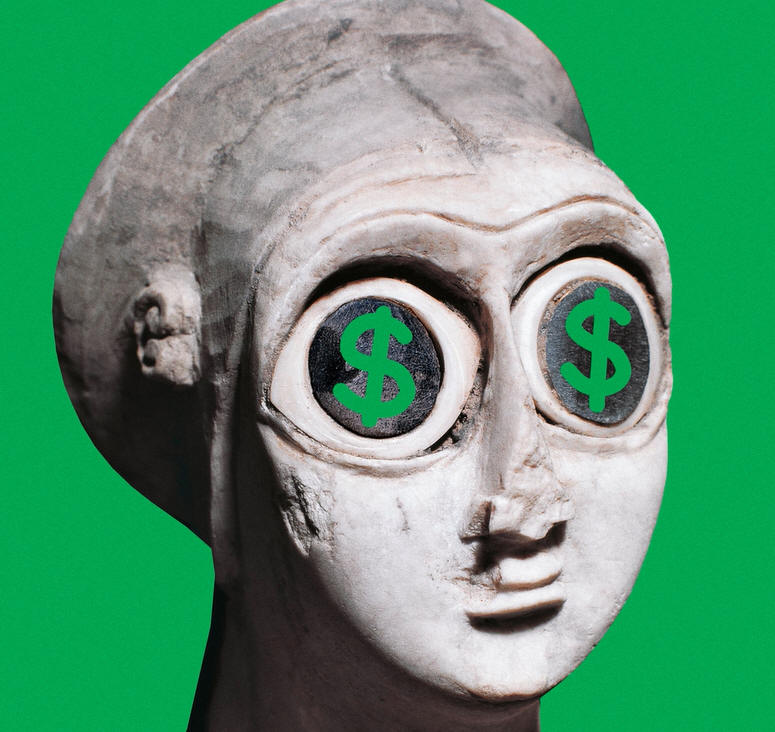 Illustration by The New York Times
.
.
Click the link below for the complete article:
.
__________________________________________


Leave a comment