
T’wina Nobles, Washington State Senator Representing the 28th Legislative District
Assorted human interest posts.
July 10, 2026
Business, Food For Thought, Human Interest, Political, Science, Technical amazon, business, Business News, current-events, Future, Hotels, human-rights, medicine, mental-health, research, Science, Science News, technology, Technology News, travel, vacation 4 Comments

Click the link below the picture
.
New York City loves an exclusive. And on just four evenings every year, Manhattan is treated to an iconic sunset display: Manhattanhenge.
On these special days, the sun’s light lines up perfectly with Manhattan’s East-West grid streets as it drops towards the horizon, causing it to appear centered among the corridors of skyscrapers.
The phenomenon is one of New York City’s most anticipated astronomical spectacles. It happens on two days in late May and two days in mid-July—although just one of the July dates will reveal the entire sun framed between skyscrapers. Here’s everything you need to know about the coming Manhattanhenge.
Where Did “Manhattanhenge” Come From?
Astrophysicist and television personality Neil deGrasse Tyson claims to have coined the term Manhattanhenge. The monicker is an apparent nod to Stonehenge, an ancient British monument which may have acted as a solar calendar and was the likely site of ancient rituals celebrating the solstice.
But unlike its namesake, Manhattanhenge has no celestial function. Instead, it is a happy accident of the Commissioners’ Plan of 1811, which rotated Manhattan’s street grid about 29 degrees east of true north , to follow the island’s natural orientation.
More than two centuries and many skyscrapers later, that decision is what makes Manhattanhenge possible.
Although we’re taught that the sun rises due east and sets due west, that’s only completely true twice a year, during the spring and fall equinoxes. For the rest of the year, the points at which the sun rises and sets slowly migrate along the horizon as the Earth orbits around the star. Twice each year, those points more or less align with Manhattan’s street grid.
How to See Manhattanhenge
Manhattanhenge will occur on Saturday, July 11 and on Sunday, July 12. On Saturday, viewers will see the entire glowing orb of the sun perfectly framed by buildings on either side at around 8:20 P.M. EDT. On Sunday, viewers will see just half the sun framed in such a way, at about 8:21 P.M. EDT.
For the best view of Manhattanhenge, head to one of Manhattan’s wide east-west streets that has an unobstructed view of the New Jersey horizon. The American Museum of Natural History’s Hayden Planetarium recommends 14th, 23rd, 34th, 42nd and 57th Streets. Of these options, 34th and 42nd offer especially striking views depending on where you are along the street, as the sun can be framed by the Empire State and Chrysler Buildings. It’s best to arrive at least 20 to 30 minutes early: the alignment lasts only a few minutes, and the best viewing spots fill up quickly. A partly cloudy forecast isn’t necessarily a dealbreaker. As long as the western horizon remains mostly clear and any clouds stay high overhead, you still have a good chance of catching the alignment. The moment may be brief, but it offers a rare reminder that even in the middle of one of the world’s busiest cities, the cosmos can stop you in your tracks.
.
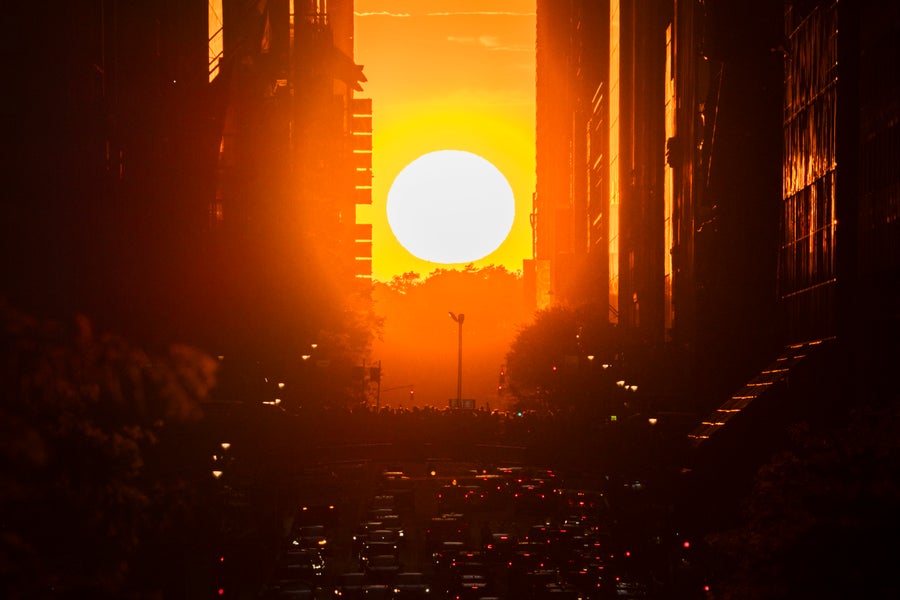
The sun sets along 42nd Street near Times Square, the day after “Manhattanhenge” on May 30, 2026, in New York City.
Craig T. Fruchtman/Getty Images
.
.
Click the link below for the complete article:
.
__________________________________________
July 10, 2026
Business, Food For Thought, Human Interest, Political, Science, Technical amazon, business, Business News, current-events, Future, Hotels, human-rights, medicine, mental-health, research, Science, Science News, technology, Technology News, travel, vacation Leave a comment

Click the link below the picture
.
The Department of Justice has published thousands more files related to its investigations into Jeffrey Epstein, including a case file that references a rape allegation involving President Donald Trump, as well as correspondence stating that Trump traveled on the convicted sex offender’s private jet “many more times than previously had been reported.”
Following the publication of an initial tranche of documents over the weekend, Tuesday’s release included a number of fully redacted files—similar to earlier disclosures that drew sharp criticism for the extent of their redactions. Nearly all of the files made public Tuesday contain at least some redactions, primarily of names and email addresses.
Unnamed victim alleges Trump raped her
Among the newly released materials is an FBI case file (EFTA00020518) dated October 2020 that contains an allegation of rape involving Trump. The document does not identify the source of the allegation, as names and other identifying details have been redacted.
The file references an account from a limousine driver, whose name has been redacted, who reported a “very concerning” phone conversation involving Trump while driving him to an airport in 1995. According to the document, Trump repeatedly said the name “Jeffrey” during the call and made references to “abusing some girl.”
The document further states that an unnamed individual alleged that “he raped me,” referring to Trump, and that “Donald J. Trump had raped her along with Jeffrey Epstein.” The statement continues: “Some girl with a funny name took me into a fancy hotel or building, that’s how it happened.”
Trump traveled on ‘at least eight’ Epstein flights
The release also includes an internal email stating that Trump traveled on Jeffrey Epstein’s private jet “many more times than previously had been reported” between 1993 and 1996. According to the email, Trump flew at least eight times during that period, including on one occasion when he was listed as traveling alone with Epstein and a 20-year-old passenger whose name has been redacted.
The email, sent by the Assistant U.S. Attorney General for the Southern District of New York on Jan. 7, 2020, says Trump flew “at least eight times” during the three-year time period, including when “we would expect to charge in a Maxwell case,” in reference to Ghislaine Maxwell, an accomplice of Epstein who is currently serving a 20-year sentence for trafficking underage girls.
The correspondence further details that on four of these flights Maxwell was in attendance and on another flight Trump, Epstein, and a 20-year-old passenger, whose name has been redacted, were the only passengers.
Two other flights saw two female passengers “who would be possible witnesses in a Maxwell case.” Being named in the files does not indicate any wrongdoing.
“We’ve just finished reviewing the full records (more than 100 pages of very small script) and didn’t want any of this to be a surprise down the road,” the email concludes.
A separate email from Aug. 2020 details voicemails from a woman in Australia, whose name has been redacted, that include claims of “crimes committed against her.”
The email, from a Special Assistant to the U.S. Attorney, reads: “She is talking about crimes committed against her. She claims to be a prisoner. She references Lisa Marie Presley, the British Royal Family, President Trump, and Jeffrey Epstein. Let me know what other actions I should take.”
A response from a redacted email address then reads: “We will be blocking the number from calling again and otherwise doing nothing further on our end because the caller is from a foreign country and because of international comity, we can’t respond.”
Epstein introduces a 14-year-old girl to Trump
In addition, there is a complaint (EFTA00019101) filed by an unnamed woman in January 2020 in the Southern District of New York. The plaintiff, named Jane Doe, details her alleged abuse at the hands of Epstein and Maxwell. The court document also includes details of a time when Epstein took the victim to meet Trump in 1994.
“Introducing 14-year-old Doe to Donald J. Trump, Epstein elbowed Trump, playfully asking him, referring to Doe, ‘This is a good one, right?’ Trump smiled and nodded in agreement. They both chuckled and Doe felt uncomfortable, but, at the time, was too young to understand why,” the document reads.
A case file from the FBI (EFTA00020508) about investigations into Epstein’s crimes includes another mention of Trump, in which he is accused of hosting a party for sex workers.
Possible suicide attempt by Epstein while in police custody
Another file shows records of a possible suicide attempt by Epstein while in police custody on July 23, 2019, two weeks after his arrest for sex trafficking charges and around two weeks before his death on Aug. 10. Other documents show that Epstein was put on suicide watch for the first two days following his arrest.
Last Friday’s initial release of files relating to the DOJ’s investigation into Epstein, which was published after the legal deadline set by Congress, included photos of former President Bill Clinton with Maxwell.
Photos released last week also include Epstein with late popstar Michael Jackson, a member of the Rolling Stones Mick Jagger. Inclusion in the photos does not suggest any wrongdoing.
The DOJ has faced criticism over its initial inclusion and subsequent redaction of an image that included President Donald Trump. The file was removed Saturday, alongside at least 14 other files.
.
 Donald Trump alongside his wife, Jeffrey Epstein, and Ghislaine Maxwell at the Mar-a-Lago club, Palm Beach, Florida, February 12, 2000.Davidoff Studios – Getty Images
.
.
Click the link below for the complete article:
.
__________________________________________
July 10, 2026
Business, Food For Thought, Human Interest, Political, Science, Technical amazon, business, Business News, current-events, Future, Hotels, human-rights, medicine, mental-health, research, Science, Science News, technology, Technology News, travel, vacation Leave a comment

Click the link below the picture
.
Here’s the good news: Green energy is getting better and cheaper, faster than we had ever dared hope.
This next sentence was unimaginable even a few years ago: In April, the energy think tank Ember found that all of the new electricity demand around the world in 2025 was met with green power. That is wild.
But here is the bad news: Climate change is accelerating. We’re discovering new ways that the climate system is more fragile, more sensitive to emissions, than we previously had thought.
We have not been talking that much about climate change lately, but that doesn’t mean it has stopped happening. Europe is in the midst of an extraordinary heat wave. The world is staring down the barrel of a powerful El Niño.
And climate politics is in almost total disarray. Donald Trump has gutted the Inflation Reduction Act. His administration is accelerating fossil fuel production and kneecapping green energy.
.
Archival clip of Donald Trump: Wind — it doesn’t work, I will tell you, aside from ruining our fields and our valleys and killing all the birds and being very weak and expensive.
.
But here’s the possibility, a bit of optimism: The advances in green technology make a new climate politics possible — one that doesn’t just talk about sacrifice and disaster prevention but presents decarbonization and green energy as a way station on the path to somewhere better.
Clean energy abundance, a new form of energetic wealth, the possibility of the left actually offering a future of more and better — not less and worse — was a hard case to make even a few years ago. But now we cannot only imagine it, we can see it, touch it, live in it. It is here.
So how do we talk about it? How do we make it happen?
Bill McKibben is the Schumann Distinguished Scholar in environmental studies at Middlebury College, the co-founder of the climate action group 350.org, as well as Third Act, which is organizing people over 60 on climate change. He is a contributing writer at The New Yorker. He writes the Substack, The Crucial Years, and his most recent book is “Here Comes the Sun: A Last Chance for the Climate and a Fresh Chance for Civilization.”
Ezra Klein: Bill McKibben, welcome back to the show.
Bill McKibben: Very good to be back with you.
You have a line that people still think of clean energy like Whole Foods energy — it’s virtuous, pricey, a bit of a flex — when, in fact, you say it has become the “Costco of energy.”
Tell me about that.
Cheap, available on the shelf in bulk, ready to go.
The stuff that we spent my whole lifetime calling alternative energy from the sun and the wind is now the obvious, common sense, straightforward way to produce power. Sometime earlier this decade, we passed some invisible line where it became cheaper to produce energy from the sun and the wind than from setting stuff on fire.
That’s a big line, by the way. Darwin said fire and language were the two things that marked our species. But now we live on a planet where the cheapest way to make energy is to point a sheet of glass at the sun.
.
 Advancements in renewable energy are paving the way for a new climate politics. The environmentalist Bill McKibben articulates some of the possibilities in this new era of energy abundance. CreditCredit…The New York Times
.
.
Click the link below for the complete article (sound on to listen):
.
__________________________________________
July 9, 2026
Business, Food For Thought, Human Interest, Political, Science, Technical amazon, business, Business News, current-events, Future, Hotels, human-rights, medicine, mental-health, research, Science, Science News, technology, Technology News, travel, vacation Leave a comment
Click the link below the picture
.
The evacuation of a skyscraper in Midtown Manhattan and the surrounding area was ordered on Tuesday after the building showed signs of potential collapse that may have been caused by overload, experts say.
The Fire Department of the City of New York (FDNY) said in a statement on Tuesday that it received a call to the building just before 8 A.M. EDT. When the FDNY arrived at 235 East 42nd Street, near Grand Central Terminal, it found at least two steel columns buckling on the 21st and 22nd floors and sagging flooring between the 21st and 26th floors.
Buckling steel columns are a well-known issue among the engineering community, says Gregoy Deierlein, a professor of structural engineering at Stanford University. Deierlein wouldn’t speculate on what specifically may have caused the buckling in this case. But he says it’s not uncommon for columns to become damaged or weakened. That, in turn, can lead floors above the weak points to sag as the column bends, he says.
“Imagine if you’re standing on the floor and you look over—the portion of the floor supported by that column would have dropped a little bit, so it’s going to look like a sagging floor,” Deierlein says.
When buildings like this skyscraper are constructed, engineers erect columns designed to support not just the weight of the building itself but also a certain amount of “live load” per square foot. That extra load includes the people using the building and any other contents. Deierlein says that sometimes the live load limit can be exceeded during renovations because construction materials may be stockpiled inside a building while work is ongoing.
“That could be a very concentrated live load, which could be enough load to overcome the column strength,” he says. “Then the question is, is the column strength enough for what it should have been designed for? Or it could have been a combination of the column wasn’t quite strong enough for what it was designed for, and then you add a lot of load to it.”
While several stories were being added to the building as part of the renovation, Magued Iskaner, a professor in the civil, urban and environmental engineering department at the New York University Tandon School of Engineering, says he would be “very surprised” if this wasn’t taken into account during the planning stages.
“One of the most common reasons for increase of load is that the load gets transferred from one area of a building to a new area,” he adds. “All of these people could have done these things correctly, but the presumed capacity of a column is off simply because there was a latent defect that nobody knew about.”
The most likely point of failure for load-bearing infrastructure is at the joints which connect components, says Doug Holmes, an engineering professor at Boston University. Those connections are “where a significant amount of shearing forces are exerted—think a bolt shearing off—and in the buckling of columns. But, of course, if there is corrosion or wear or damage, any of the components along the load path can be a source of failure.”
The 37-story tower, which formerly served as the New York City headquarters of pharmaceutical giant Pfizer, is in the middle of a $75 million conversion from offices into a luxury apartment project, with some 1,600 units planned.
The conversion from offices to residential is a joint project by David Werner Real Estate Investments and MetroLoft. In a comment reported by the New York Times, MetroLoft said: “The safety of everyone at and surrounding the building is our number one priority.”
In an update sent to Scientific American on Wednesday, a MetroLoft spokesperson said a team had worked with the Department of Buildings (DOB) to stabilize the affected columns, and the DOB had confirmed the structure’s stability. They added that the issue had only affected 30 units and the building was at no time under threat of collapse.
“We are in the process of addressing the issue and will fully rebuild this portion of the building in tandem with ongoing construction,” the spokesperson said. “We remain on schedule, and this work will not delay delivery of the building as it is such a small portion of the project. We are working around the clock so that operations can resume and life in the area can return to normal.”
Gensler, the architecture firm leading the project, did not immediately reply to a request for comment.
Engineers from the DOB have also been deployed to the scene, and the FDNY is reportedly using drones to further examine the building.
The New York Times and other outlets report that emergency beams and other supporting structures are being installed in an effort take pressure off the affected columns. Deierlein says that these measures are needed in the short term—at least until the cause of the damage can be ascertained. But a permanent replacement of the columns “is not an easy thing in an existing building like this.”
.
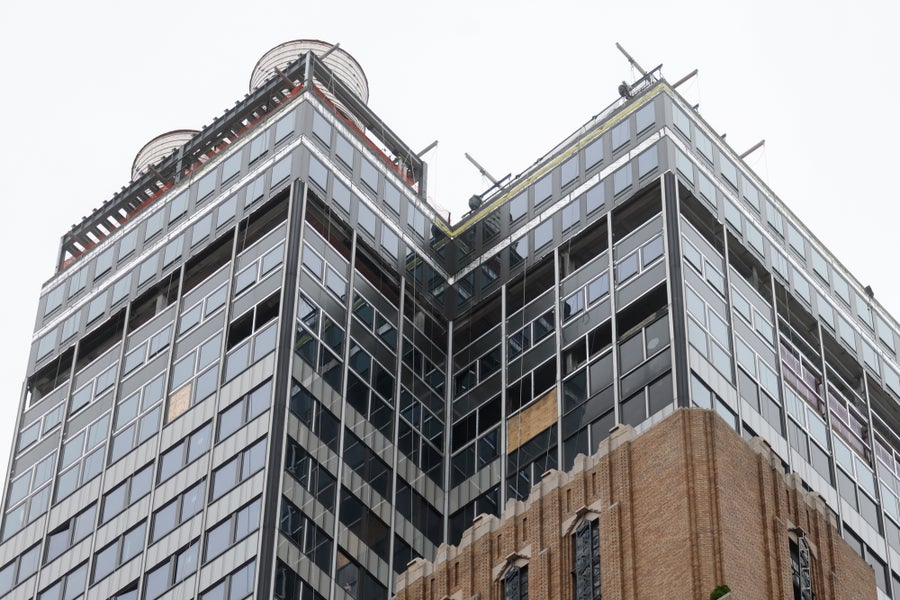
235 East 42nd Street after reports of falling debris in New York City on Tuesday, July 7, 2026. Michael Nagle/Bloomberg via Getty Images
.
.
Click the link below for the complete article:
.
__________________________________________
July 9, 2026
Business, Food For Thought, Human Interest, Political, Science, Technical amazon, business, Business News, current-events, Future, Hotels, human-rights, medicine, mental-health, research, Science, Science News, technology, Technology News, travel, vacation Leave a comment
Click the link below the picture
.
The Trump Administration is promoting a new, privately owned “network” of gas stations that are selling fuel at prices notably below national and regional averages.
“The FIRST Freedom Fuel Network gas station has LANDED in Philadelphia, lowering the price at the pump to $3.47 for our 47th President,” the White House announced on X on Tuesday. “President Trump is leading the charge to lower gas prices this summer – putting more money in your pocket.”
By comparison, the average regular gas price as of Thursday was $3.84 per gallon nationwide and $3.99 per gallon in Pennsylvania, according to AAA.
President Donald Trump first announced the opening of the gas stations in a Truth Social post last week, in which he said a “VERY smart Retailer, located throughout the Northeast” was behind them and was opening up the stations “because they love the U.S.A.”
So far, the “Freedom Fuel Network” has launched 25 stations, adorned with decals of the American flag and advertising cheap gas. Twenty are located in Pennsylvania and another five in New Jersey, according to the network’s website.
The Freedom Fuel Network is a private company, a White House official confirms to TIME, and owns all 25 locations.
“The Administration is not involved in the company, nor has the Administration given the company any funding,” a White House official tells TIME. “There is no other entity or person subsidizing the lower gasoline costs.”
Few other details have been made public about the initiative, including about who’s behind the venture and how the business is operating behind the lower prices.
“The President has called for companies to lower their prices at the pump; this company responded to the President’s call for action,” the White House official says. “They are simply reducing their margin to make prices at the pump more affordable for drivers in Philadelphia and New Jersey. This retailer is taking the lead; others should follow.”
The Philadelphia Inquirer reported that the first location, opened on Tuesday, was converted from a previous Sunoco station in Dresher, Pennsylvania. Patrick De Hann, head of petroleum analysis at GasBuddy, a tech company that helps people find cheaper gas, told the outlet that the pricing model of Freedom Fuel could not be profitable.
“Stations selling at this price- it’s not sustainable,” De Haan said. “Generally, when losses happen, somebody’s got to pay for it.”
Democratic Rep. Jim McGovern of Massachusetts accused the Trump Administration of running the gas stations and suggested that such involvement in the initiative would be hypocritical, referencing the Administration’s critiques of New York Mayor Zohran Mamdani’s proposal for public grocery stores.
“Government-subsidized grocery stores = Communism. Government run gas stations = Freedom. Got it,” the congressman wrote on X in response to the White House’s Tuesday announcement.
Earlier in his second term, Trump assured Americans that gas prices would “soon” drop below $2 per gallon.
The President’s war with Iran, however, has caused prices to surge in recent months. Amid the spike, he has repeatedly promised that the increase is temporary and prices will drop again before long, and sparked controversy in May when he dismissed the rising costs as “peanuts.”
Last month, the President accused oil companies of price gouging and called for a Department of Justice investigation. “The big oil companies are not dropping their price at the pump commensurate with the sharply lower prices they are paying for oil,” he said. “Those prices are dropping like a rock! In other words, customers are being ‘gouged.’”
.
 Customers pump gas at a Freedom Fuel Network station in Dresher, Pennsylvania, on July 8, 2026.Joe Lamberti—Getty Images
.
.
Click the link below for the complete article:
.
__________________________________________
July 9, 2026
Business, Food For Thought, Human Interest, Political, Science, Technical amazon, business, Business News, current-events, Future, Hotels, human-rights, medicine, mental-health, research, Science, Science News, technology, Technology News, travel, vacation Leave a comment
Click the link below the picture
.
Federal immigration agents who killed a man during a traffic stop in Houston on Tuesday had been searching for a different person, according to a Department of Homeland Security spokeswoman.
The targets of the ICE investigation were two people from Guatemala, one of whom the agents believed was in a white van being driven by the man, Lorenzo Salgado Araujo, according to two people with knowledge of the matter who were not permitted to speak about the case.
But the Guatemalan immigrants were not in the van. Mr. Araujo, a Mexican immigrant who had lived in the United States without authorization for 35 years, was on his way to work with three other men.
When agents tried to stop the vehicle, the encounter quickly escalated, and an agent shot Mr. Araujo in the abdomen. He died at a hospital hours later.
Homeland security officials said Mr. Araujo had tried to use his vehicle as a weapon, though no video or other evidence for that claim has emerged.
Federal agents had surveilled an address connected to one of the two Guatemalans weeks before and had seen two white vans at the property, the spokeswoman said in a statement. When they returned to the address on Tuesday, she said, “they observed a white van with an individual who resembled the target,” and initiated the traffic stop.
The agents were not wearing body cameras, according to the spokeswoman. Before trying to stop the van, the agents had looked into its owner and learned it was Mr. Araujo, who did not have legal status in the United States, according to the two people familiar with the case.
The shooting is part of a growing number of similar violent interactions involving civilians and immigration agents. More than 20 people have been shot at since September, nearly all of them in their cars. Some cases have been fatal. The shooting also comes as the Trump administration has ramped up its deportation campaign.
The killing of Mr. Araujo has incited outrage in Texas and beyond. Mr. Araujo’s sons said during a news briefing on Wednesday that they believed their father tried to get away because he was being chased by unmarked cars. Ronaldo Salgado, his oldest son, and a growing number of elected officials and immigration activists have demanded an independent inquiry.
“This is outrageous to me, and this is ridiculous to hear that no one in that van was a target of any sort of investigation,” Mr. Salgado said in response to the news that his father was not being sought by federal agents.
Federal authorities had said earlier that agents with ICE stopped a vehicle around 6:50 a.m. on Tuesday and tried to arrest Mr. Araujo, whom they described as an “illegal alien.” ICE alleged that Mr. Araujo “weaponized his vehicle” and tried to run over the agent, who then fired at him.
The other passengers in Mr. Araujo’s vehicle, according to a person familiar with the case, were Jose Trinidad Rojas Pliego, Daniel Tirado Pantoja and Victor Hugo Salgado Araujo, the victim’s younger brother.
Dominga Aguilar Salgado, who is married to a third Araujo brother, said the family has not talked to Victor Hugo Salgado Araujo, who remains in immigration detention in Conroe, Texas, outside Houston.
“Imagine, one of them died, and the other is in a detention center,” Ms. Salgado said. “The family is going through a lot. He saw what really happened.”
During the news briefing Wednesday, Ronaldo Salgado held back tears as he described seeing a video showing his father in agony moments after he was injured. Videos on social media and from news outlets appear to show immigration agents hovering over a man holding his abdominal area. Other images showed another man on the ground with his hands behind his back as someone screamed in pain.
.
 Hundreds of community members held a rally and candlelight vigil for Lorenzo Salgado Araujo, an undocumented immigrant from Mexico who was killed after an encounter with federal agents in Houston. Credit…Meridith Kohut for The New York Times
.
.
Click the link below for the complete article:
.
__________________________________________
July 8, 2026
Business, Food For Thought, Human Interest, Political, Science, Technical amazon, business, Business News, current-events, Future, Hotels, human-rights, medicine, mental-health, research, Science, Science News, technology, Technology News, travel, vacation Leave a comment
Click the link below the picture
.
Less time sleeping may mean more time sitting down—and more weight gained, according to a new study.
The research, published in Annals of Internal Medicine on Monday, found that getting just 90 minutes less sleep each night for six weeks led study participants to sit around more and gain weight.
This study included 95 people who typically slept seven or eight hours each night. After the six weeks of sleep deprivation, however, the participants had gained about a pound, on average, and their sedentary time had increased by an average of 17 minutes. Men and postmenopausal women became the most sedentary, spending an average of 30 extra minutes sitting each day.
This isn’t the first time researchers have connected sleep to weight, and particularly to obesity. In fact, not getting enough shut-eye is linked to increased risk of cardiovascular disease and other health problems, and more sedentary people are also at higher risk for chronic diseases. But many previous studies exploring sleep and weight have been conducted in labs—meaning they often take place over just a few days—and have involved far more drastic reductions in sleep, such as allowing participants a mere four hours of sleep over three days.
Short sleep-restriction studies don’t reflect the effects of chronic behavior that leads to these issues, says Marie-Pierre St-Onge, the study’s senior author and a professor of nutritional medicine at Columbia University Irving Medical Center. She argues that a six-week experiment conducted outside the lab and involving milder sleep restrictions is a more accurate representation of the realities of chronic mild sleep deprivation, which roughly 30 percent of adults experience, according to the authors.
“It’s a more naturalistic experiment; it more closely aligns with what we see, and it provides a message that’s directly applicable to what people actually feel,” she says.
In separate studies involving the same participants, she and her team have found that a decrease in sleep can raise the risk of type 2 diabetes and heart problems among certain groups.
The study stands out because it shows that lack of sleep is both associated with excess weight and that it causes weight gain, says Jean-Philippe Chaput, a senior scientist at the Children’s Hospital of Eastern Ontario, who studies sleep health and obesity and was not involved in this research.
“It shows what we already know in a more robust study design,” Chaput says.
One pound of weight gain over six weeks may not seem like a lot, Chaput adds, but it could become more significant if participants kept the same habits for many more months or years.
St-Onge hopes to focus her future research on potential interventions and the positive impact of getting enough sleep, she says.
“It’s easy to say that if you restrict your sleep, you have bad health outcomes. But the goal in life is not to do something bad to see if it has bad outcomes,” she says. “The goal in life is to do something good and then determine if it has healthful outcomes. So I think we should do a lot more of that now that we know that short sleep is not good.”
.
 Sulukhana Boonyarithsripong/Getty Images
.
.
Click the link below for the complete article:
.
__________________________________________
July 8, 2026
Business, Food For Thought, Human Interest, Political, Science, Technical amazon, business, Business News, current-events, Future, Hotels, human-rights, medicine, mental-health, research, Science, Science News, technology, Technology News, travel, vacation Leave a comment

Click the link below the picture
.
NEED TO KNOW
Michael Thompson, 56, was found guilty of raping and murdering his estranged wife, Kimberley Thompson, 43, after a six-week trial
Prosecutors said he suffocated Kimberley before staging the scene to make it appear she had died by suicide and posting to her social media accounts
Jurors also convicted Thompson of two counts of perverting the course of justice. He is scheduled to be sentenced next week
A man has been found guilty of raping and murdering his estranged wife after prosecutors said he killed her and then staged the scene to make it appear she had died by suicide.
Michael Thompson, 56, was convicted Wednesday of the rape and murder of Kimberley Thompson, 43, following a six-week trial at Nottingham Crown Court in England, according to a Northamptonshire Police press release and the BBC.
Jurors also found Thompson guilty of two counts of perverting the course of justice for attempting to cover up both the rape and the murder, according to the press release.
Prosecutors alleged Thompson raped and suffocated Kimberley sometime between midnight and 3:30 a.m. on Aug. 9, 2025, at the Northampton home the couple still shared despite having separated two years earlier, according to the press release.
The couple had been married for 19 years but were in the process of divorcing. The court heard Kimberley had started a new relationship, was planning to move out of the home and had requested about £65,000 as part of their divorce settlement, according to the BBC and Northamptonshire Police.
Following the murder, Thompson staged Kimberley’s bedroom to make it appear she had taken her own life, posted messages on her social media accounts and called East Midlands Ambulance Service at about 5:30 a.m., according to the Northamptonshire Police press release.
Authorities were initially told Kimberley had consumed alcohol and tablets before she was found unresponsive, the BBC reported. But a post-mortem examination found no alcohol in her system and only low levels of caffeine, paracetamol and codeine, according to the outlet.
Kimberley’s family and friends told investigators they did not believe she had died by suicide and described a history of domestic abuse during her marriage, prompting police to launch a murder investigation on Aug. 12, according to Northamptonshire Police and the BBC.
“It became clear throughout our investigation that Kim had been subjected to domestic abuse for much of her relationship with Thompson, with manipulation, coercive control and physical violence the norm,” Detective Chief Inspector Torie Harrison, who led the investigation, said in a statement.
“Over the years Thompson stripped Kim’s confidence away but in the time since their separation, friends and family began to see the old Kim re-emerging with a renewed enthusiasm for life.”
Harrison said Thompson “brutally rape[d] and murder[ed]” Kimberley before taking time to stage her death “in order to make people believe she had committed suicide.”
The detective also said the investigation revealed Kimberley had contacted a domestic abuse support service in 2013 but later withdrew her complaint because she feared what would happen if she reported the abuse, according to the press release.
Thompson is scheduled to be sentenced next week, per the BBC.
.
 Kimberley Thompson Credit: Northamptonshire Police
.
.
Click the link below for the complete article:
.
__________________________________________
July 8, 2026
Business, Food For Thought, Human Interest, Political, Science, Technical amazon, business, Business News, current-events, Future, Hotels, human-rights, medicine, mental-health, research, Science, Science News, technology, Technology News, travel, vacation Leave a comment

Click the link below the picture
.
President Trump’s head-spinning appearance at the NATO Summit in Ankara on Wednesday began with him insulting vast swaths of Europe during the morning sessions and finished just hours later with him declaring that the whole thing had been one big kumbaya session.
“I just want to say there was tremendous love in that room,” he said at a news conference not long after he had said repeatedly that “I’m not happy with NATO.”
Describing his meetings behind closed doors, he boasted: “They said, ‘Sir, we love you.’ These are grown people saying that. Isn’t that nice?”
“Maybe they’re trying to get to me, and in a way, they did,” he said. “Because there was tremendous unity in that room.”
There did, in fact, appear to be some progress to come out of the summit.
NATO pledged $80 billion in military aid to Ukraine this year and next, though that represented a mix of both previous and new commitments. And Mr. Trump told President Volodymyr Zelensky of Ukraine that the United States would allow the country to manufacture Patriot air defense systems to protect itself from Russian missiles.
Despite saying last month that he would bring a gift that would make Mr. Erdogan “very happy,” the president said he still had a decision to make about whether to allow Turkey to purchase F-35 fighter jets. He said he had an “inclination” to do so because Turkey did not help Iran during the war with the United States and Israel, and because of what he has described as his deep friendship with its leader, President Recep Tayyip Erdogan.
Hundreds of journalists from around the world pushed, elbowed, and yelled at one another to make it into a soaring auditorium here in Ankara for the chance to ask a question of a freewheeling American president who might say anything.
“That’s a lot of press, wow,” Mr. Trump said, sounding amused, as he took to the lectern. His secretaries of state, defense and treasury stood stone-faced behind him as he pin-balled his way through all sorts of topics over the next 40 minutes.
The war with Iran flared up again while Mr. Trump was in Ankara, just 1,000 miles from Tehran, and the fighting dominated the news conference.
The president said that the cease-fire with Iran was likely over after the United States carried out airstrikes on Tuesday against several Iranian targets. The Pentagon said they were in response to Iranian attacks on commercial ships in the Strait of Hormuz. On Wednesday, Iran’s armed forces said they had attacked U.S. military sites in Bahrain and Kuwait.
Early in the day at the summit, Mr. Trump unleashed verbally on Iran, referring to the country as “scum” and its leaders as “sick people.”
He was particularly incensed by what he characterized as the Iranians’ dishonest, tricksy negotiating style. “There’s something wrong with them,” he fumed. “We said, ‘Go and do your funeral stuff,’ and instead of that, they start shooting rockets at ships.”
By “funeral stuff,” he meant the nationwide funeral procession attended by millions of people for Ayatollah Ali Khamenei, the supreme leader killed in the war Mr. Trump launched alongside Israel in February.
“They’re cuckoo,” Mr. Trump said, tapping an index finger against his cranium.
The NATO secretary general, Mark Rutte, sat impassively by his side, legs crossed, and hands clasped over one knee.
A major motif of this year’s summit involved European leaders deciding whether it was politically advantageous to at last dispense with the niceties and fight back against Mr. Trump, as the leaders of Spain and Italy have started to do. The time when all European heads of state tried to play nice with the mercurial American president is decidedly over.
Early in the day, Mr. Trump made more menacing comments about taking over Greenland, and repeatedly criticized Germany, Italy, Britain, and France for not helping the United States in its war with Iran.
Spain, in particular, came in for a drubbing from Mr. Trump on Wednesday morning. “I don’t want anything to do with Spain,” he said.
His spat with the Spaniards started when they refused Mr. Trump’s demand that European nations raise their military spending, then kicked into a higher gear after Spain denied the use of its military bases to U.S. forces attacking Iran.
.
 President Trump at the NATO summit in Ankara, Turkey, on Wednesday. Credit…Doug Mills/The New York Times
.
.
Click the link below for the complete article:
.
__________________________________________
Find the Best Forex Broker for Your Trading Success
AS HUMILDES OPINIÕES DE UMA MULHER DE CORAGEM QUE DIZ SIM À VIDA!
Să facem glume, nu război
In the world, human beings are facing various problems. People who are full of greed, anger, and ignorance are seen to be fighting with each other in words and deeds. As the fighting continues, various problems such as civil wars, wars of aggression, and wars of aggression are occurring. As world peace is being destroyed, humans are facing unbearable problems. Innocent children and women are not getting the rights they deserve and deserve. I can't think of one thing every time. What is it? The United Nations. If we look at the responsibilities and duties of the United Nations, I think it is not suitable for solving the problems that are happening in the world today. In fact, the United Nations and the World Security Council, such an organization must rule the world, must be able to give orders, and must have various ways to obey orders. There must be no organization that can influence more than that organization. There should be experts from each country. They can even dominate the superpowers like the US, China, and Britain. Only then will global peace be achieved quickly. Now, if a country with power develops more militarily, economically, or socially than its own country, then powerful countries will jealously seek out enemies and wage war. Or they will attack with fighter jets. In this, innocent people are losing their lives. No one understands the value of a life. You should think about how to achieve global peace by controlling these. If the US continues to be the permanent president of the UN, world peace will never be achieved. If you think carefully, no one sees that they are working for the common good, but for their own benefit, for the benefit of their own country. The permanent president of the UN and the Security Council has rejected this, As a young Rohingya, I have come to realize that only by electing the president and secretary from among the countries in the world through a secret ballot system and governing the world fairly can we achieve global peace. The United Nations and the Security Council are organizations in which any country must govern, give orders, and make them obey their orders. For example, only when a defendant is tried in court can we hold the leaders of the countries in check and control them, can we achieve global peace smoothly. Otherwise, it will not be easy for powerful countries to use various excuses to end this war every year, every year, for the benefit of themselves and their countries. No country's leaders pay any attention to the words of the United Nations and the Security Council. If we look at it in practice, look at the Rohingya issue. Myanmar is a small country. Even that country has been under siege for 8 years. What action can be taken? Why is the UN and the Security Council Powerless? Without such Power, how can the organization bring about global peace? Everyone should think about it. Whether there is a veto or a strong one, all countries in the world can only achieve global peace if they are subject to the UN and the Security Council. Seek peace in the quiet embrace of nature. Peace is an indispensable need of the human race. It is not as if one person can kill another person, and it is as if one country can attack another country, but instead of trying to build peace, we must try to destroy the peace now, and the world is getting hotter and is on the verge of collapse. I especially appeal to all the world experts to urgently try to bring about peace in all parts of the world. Mr, Noor Muhamed Arkhan Rohingya Youth Myanmar
Publicație umoristică dedicată glumeților de pretutindeni
Faith saved us from the savages that we were, losing faith makes us savages again
Where Trends Meet Truth
https://www.tangietwoods
Freelance poetry writing
Zalai Betti
INOVATION BLOG PEOPLE AND NEWS
Németh György
Konsultan Lingkungan Hidup di Lombok - NTB
Lea Krasznai (LeaArt21) – Idezetek (Idézetek) WordPress (Budapest, Hungary)
Appunti, spunti e passioni in liberta'
Gyorgy Nemeth
تعنى بتقديم نصائح للمعلمين المبتدئين، والطلبة الممتحنين، ومشاركة الاخرين تجربة الادخار في المال، بترشيد الاستهلاك المنزلي، وترتيب البيت، والحفاظ على البيئة، وتشجيع السيارات صديقةالبيئة، والسياحة والاسفار، ونماء رؤوس الاموال، والطب البديل وتشجيع التعليم الرقمي والذكاء الاصطناعي، والعناية بالنحل وتربية الاسماك، والاسثمار في رؤوس الاموال، الزراعة العضوية، والعناية باسنان الرضع، و صحة الحوامل، وتفسير القران
apprendre pour évoluer
Thoughts on books, language, meaning, and the culture around it.
Outdoor Recreation & Adventure in the Great Lakes Region
News, Info, Bio, Articles, Reviews, Lyrics, Technology, Science, Inspiration, Motivation, Philosphy and many more...
Christian Lifestyle Blogger
CEO and president of The Mullins Companies
Two Cultures. One Life. Endless Stories
Real Estate Development Specialist
¡Bienvenido de vuelta viajero!
so looking to the sky ¡ sing and from my heart to YOU ¡ bring...
CEO and Founder of Nsight Health
Catholic News, Prayers, HD Images, Rosary, Music, Videos, Holy Mass, Homily, Saints, Lyrics, Novenas, Retreats, Talks, Devotionals and Many More
Decoding Power. Defying Narratives.
A creative collaboration introducing the art of nature and nature's art.
The Home Of Entertainment News, Reviews and Reactions
•Whenever you are confronted with an opponent, conquer him with love.(Gandhi)
Algotrader at TRADING-CLUBS.COM
Film and Writing Festival for Comedy. Showcasing best of comedy short films at the FEEDBACK Film Festival. Plus, showcasing best of comedy novels, short stories, poems, screenplays (TV, short, feature) at the festival performed by professional actors.
Peace. Tranquility. Insanity.
Take a ride on the wild side
Découvre des musiques prometteuses (principalement) dans la sphère musicale française.
No tiene que Ser una Pesadilla.
Life in Kana-text (er... CONtext)
Where feelings meet metaphors and make questionable choices.
Finding hope and peace through writing, art, photography, and faith in Jesus.

