Of all the dietary supplements out there, creatine is perhaps the one with the most fervent fan base. Long a favorite among athletes looking for a workout boost, creatine has been credited with tamping down perimenopausal mood swings, controlling blood sugar, and perhaps even helping recovery from concussions.
But what does the science say? It’s important to note that creatine is a dietary supplement, and it is not regulated in the same way as medications, which need to go through rounds of clinical trials to gain approval for sale by the U.S. Food and Drug Administration. And the nutrition supplement market is notoriously rife with overblown claims and false advertising.
When it comes to creatine, however, experts say there is some solid evidence backing the supplement up.
Creatine is generally considered safe, and unlike many supplements, it has been studied for decades, particularly for its role in boosting strength and power in athletics, says Katherine Basbaum, a registered dietitian at the University of Virginia Health. In more recent years, some studies have suggested that creatine may support brain and muscle health as we age, too.
But it’s far from a “magic bullet,” cautions Bonnie Jortberg, a professor of family medicine at the University of Colorado Anschutz School of Medicine. “You’re not going to start taking creatine, then all of a sudden feel like a new person.”
To help sort the science from the hype, Scientific American spoke with health and nutrition experts about how creatine works and who might benefit the most from taking it.
What does creatine do to your body?
Creatine is a natural compound that your body produces and uses for energy, Basbaum explains. It’s made using three amino acids—arginine, glycine and methionine. You can also get creatine from your diet, by eating foods such as seafood and meats, or by taking a supplement, such as creatine monohydrate.
Once ingested, creatine gets converted into a compound called creatine phosphate (also known as phosphocreatine), which helps supply adenosine triphosphate, or ATP, to your muscles. “Your brain and your muscles need energy,” Basbaum says. Creatine helps provide a rapid-acting and immediately available source of ATP. That’s why creatine can help athletes: more ready-to-use energy means more power in the gym and potentially more muscle growth.
Is creatine FDA-approved?
Creatine monohydrate is the most-studied form of creatine. Still, the FDA doesn’t assess and approve dietary supplements in the same way as for drugs. Rather, the agency has designated creatine monohydrate as a “Generally Recognized as Safe” (GRAS) substance.
Decades of clinical evidence back that designation up. A 2025 analysis of more than 650 studies found creatine has no significant side effects compared with placebo. “The safety profile on creatines is very good,” says Richard Kreider, the first author on that paper and director of the Exercise & Sport Nutrition Lab at Texas A&M University.
Creatine is also among the most popular sports supplements in the world, and the tally of adverse events associated with creatine in international registries is “very tiny,” Kreider says—around 0.0007 percent of adverse event reports mentioned creatine, his team’s analysis found.
“There have now been, over the last 30 years, billions of servings, literally billions of servings, provided in dietary supplements. This is not new,” he says. (Kreider has conducted industry-sponsored creatine research and has served as an advisor for dietary supplement makers.)
What do we know—or not know—about creatine?
Overall, the strongest and most extensive evidence for creatine is as an “ergogenic aid” to support athletic performance, Basbaum says.
Research shows it may help you lift slightly heavier weights at the gym, for instance, or push out a few more repetitions or help your muscles recover faster afterward.
More recent evidence suggests creatine may help us stay healthy as we age, too. “What had started as a supplement for athletes and performance has now blossomed over the last 20 to 25 years into a supplement that clinical trials are showing efficacy in a number of therapeutic interventions,” Kreider says.
The most promising of these avenues is “active aging,” he says. As we get older, our muscles tend to get weaker. Research suggests creatine, when combined with resistance training, may help maintain strength and muscle mass and prevent falls and injuries such as hip fractures in older populations, Kreider says.
Creatine could also be helpful during perimenopause and menopause, when women may have a harder time building and maintaining muscle, Basbaum says.
There is also preliminary evidence to suggest creatine may help support brain cognition for women during this time of life, possibly by supplying more ATP to brain cells, Jortberg says.
“These are limited studies, but I think they’re promising. [Findings suggest] that creatine may be beneficial—‘may be’ is the keyword there—when it comes to mental cognition,” Jortberg adds.
To improve athletic performance, the International Society of Sports Nutrition recommends people take about three to five grams of creatine monohydrate per day. For more rapid results, some athletes might start with a “loading” period of about 0.3 gram per kilogram of creatine monohydrate for five to seven days, the organization says.
But the exact amount will vary based on your body’s needs.
Is there anyone who shouldn’t take creatine?
Experts were divided on this question. Creatine is generally considered safe, but Jortberg says that kidney problems could interfere with your body’s ability to process the supplement.
“People who might have any kind of a kidney issue or any kind of compromised kidney function should absolutely not be taking a creatine supplement,” she says.
Kreider, on the other hand, argues that those fears are overblown. “The fact is that there’s no evidence that creatine causes any adverse effect to kidney function, even in patients with kidney disease,” he says.
Still, the experts Scientific American spoke to agreed that if you’re interested in taking creatine, it’s best to consult a doctor first.
“Anytime you take a dietary supplement of any kind, it goes without saying that it’s good to check with your health care provider,” Basbaum says, “creatine or otherwise.”
Actress Sheryl Lee Ralph is making the most of her first-ever Paris Haute Couture Week. And, lucky for us, she’s documenting every fashionable moment along the way.
The Emmy Award-winning actress took to Instagram to share her excitement, telling followers she’s “having a grand time” during couture week. Between multiple outfit changes and full hair-and-makeup transformations for each show, the 69-year-old style icon joked that the whirlwind schedule is all part of the “fashion fun.”
For Stéphane Rolland, Ralph embraced the designer’s signature sculptural aesthetic in a sleek black, long-sleeved gown featuring a dramatic white chiffon detail cascading from the neckline. She completed the look with architectural platform heels and layered diamond necklaces that added just the right amount of sparkle.
At Georges Hobeika, she leaned into gilded glamour in a gold-toned ensemble adorned with leaf-inspired embellishments. Her monochromatic beauty look echoed the warm metallic palette, while spiral gold earrings, a diamond tennis bracelet, a Rolex watch, and statement rings completed the sophisticated styling.
For her final appearance at the Tony Ward Couture show, Ralph opted for an ethereal gold gown reminiscent of a modern-day Cinderella. The belted silhouette featured champagne-hued underlayers and shimmering silver embellishments throughout. Meanwhile, a sleek, slicked-back bun kept the focus on the intricately detailed dress.
Scroll ahead to see Sheryl Lee Ralph’s stunning looks from her stylish debut at Paris Haute Couture Week.
The Supreme Court last week expanded the powers of the unitary executive, raising fears among many that the presidency is becoming too strong. Yet as big as the ruling appears to be, it wasn’t even the most concerning news in the past month about the accumulation of unchecked power in the Oval Office.
The day after the court’s ruling, the Trump administration lifted restrictions it had imposed on access to top artificial intelligence models from Anthropic, a leading A.I. company, seemingly on the condition that the company submit to ongoing government oversight. On Tuesday, OpenAI finally announced that it will release broadly its new artificial intelligence model, GPT-5.6, access to which has been restricted at the request of the U.S. government. Only a limited set of customers — those approved by the Trump administration — have been allowed use of the A.I. tool.
These restrictions on the A.I. industry are the latest instance of the White House creating its own parallel administrative state, sidestepping Congress. Congress and the courts must push back.
The right vigorously criticizes government control of private industry as a kind of communist central planning. Many Republicans objected to a rent freeze by New York’s mayor, Zohran Mamdani — a policy that is being imposed through the public processes of a legally created oversight board. The president’s unauthorized intervention in private business poses an even more direct threat to free enterprise.
True, the Supreme Court’s ruling last week gave the president more authority over agencies that Congress had wanted to insulate from political interference, such as the Federal Trade Commission. But agency leaders must still follow clear rules that Congress has written into the law. By contrast, the Trump White House’s ad hoc interference in private business decisions — exemplified by but not limited to its recent meddling in the A.I. industry — has come without congressional sanction. President Trump is planning product releases and choosing customers of a key industry in our ostensibly free-market economy.
No legislation authorizes the White House’s recent moves to effectively regulate domestic A.I. customers and model release timing. Congress has yet to pass comprehensive A.I. safety legislation, and the Trump administration has spent most of the past year and a half discouraging necessary lawmaking. The White House has filled the gap it helped create with whatever rules it sees fit to impose at any given moment.
In a normal process, an agency such as the Federal Trade Commission exercises powers granted by Congress, subject to various forms of judicial review. If the agency exceeds the scope of its legal authority, the courts nullify its illegal actions. Only Congress writes the laws. The executive carries them out.
Justice Neil Gorsuch’s concurring opinion in last week’s ruling reminded us that the founders feared “when ‘the legislative and executive powers are united in the same person.’” Those fears should be especially great when unitary control is exerted over society-shaping technology.
On A.I., the White House has effectively created and put into effect its own mini-regulatory administration. The Trump administration’s directions to Anthropic and OpenAI follow its release last month of an executive order creating, by fiat, a regulatory framework for identifying “covered frontier models” and steering their release. The order contains some good ideas for Congress to consider, but it does not execute a law passed by Congress; it creates its own.
Apparently recognizing its lack of legal authority to do this, the Trump administration claims that compliance is “voluntary.” Yet few would believe a request from this White House is merely that. The Oval Office commands enormous power to threaten and cajole private companies into compliance. Indeed, the administration has already moved to exile Anthropic products from the Pentagon after the company failed to cooperate with the executive branch’s dictates.
After the Supreme Court ruling, the president has more power over the Federal Trade Commission and other agencies with oversight of these companies. The boost in presidential authority will enhance the White House’s ability to pressure businesses, which will want to avoid regulatory fights — even ones they are confident they would ultimately win in court. This dynamic, however, will not be new.
The A.I. business is not the only industry that Mr. Trump has subjected to his new form of unitary executive. Under pressure, the Japanese company Nippon Steel and U.S. Steel last year granted a special “golden share” to the American government as part of a national security review of Nippon Steel’s acquisition of the U.S. company. According to public reports, the White House now has authority over the company’s plant closures, headquarters moves and job transfers.
Senator Lindsey Graham died following a “brief and sudden illness,” his office says.
Graham, a prominent Republican from South Carolina, was 71.
A spokeswoman for Graham says he had just returned from a trip to Ukraine.
Graham was first elected to the U.S. Senate in 2002.
Senator Lindsey Graham has passed away, his office said Sunday.
“On the evening of Saturday, July 11, U.S. Senator Lindsey Graham passed away from a brief and sudden illness,” Graham’s office said in a statement on X.
Graham, a prominent Republican from South Carolina, was 71.
“Senator Graham’s family appreciates prayers at this time and asks for privacy during this incredibly difficult period,” his office added.
A spokeswoman for Graham told MS NOW that he had just returned from a trip to Ukraine. She had no additional information on the circumstances of his passing and said more information would become available in the coming days.
His Senate website described Graham as “a conservative problem-solver and one of the strongest proponents of a robust national defense.”
President Donald Trump said Graham was “one of the greatest people and Senators I have ever known.”
“He was always working, and was a true American Patriot. Lindsey will be greatly missed!!!” Trump said in a post on Truth Social.
Graham became a key ally of Trump, despite having warned against his nomination as the Republican candidate ahead of the 2016 election.
“If we nominate Trump, we will get destroyed…….and we will deserve it,” Graham wrote on social media on May 3, 2016.
Ukrainian President Volodymyr Zelenskyy said he was “deeply saddened” by the news of Graham’s death.
“He visited Ukraine ten times during the years of Russia’s full-scale invasion and was here with our people when it was most needed,” Zelenskyy said in a post on X.
Israeli Prime Minister Benjamin Netanyahu said he and his wife Sara were grieving “with the American people over the loss of our dear friend, Senator Lindsey Graham.”
“Lindsey understood that the security of Israel and America are inseparable. He devoted his life to defending America, strengthening our alliance and standing up for the free world,” Netanyahu said in a post on X.
Senate Majority Leader John Thune, R-S.D., said in a statement: “My heart is heavy this morning to learn of the passing of my friend and colleague, Senator Lindsey Graham.”
“He was a strong advocate for the United States and a strong ally to freedom-loving countries across the globe. He believed in the might of America to achieve good in the world and dedicated his life to advancing that cause.”
South Carolina Gov. Henry McMaster called Graham “the fiercest of fighters for South Carolina and America—and a loyal and steadfast friend.”
Graham was elected to the U.S. Senate in 2002 and was re-elected in 2008, 2014, and 2020. He had been running for re-election for a fifth six-year term. Under South Carolina law, McMaster has until Jan. 3, 2027, to fill Graham’s seat.
Graham served as Chairman of the Senate Budget Committee and as a member of the Senate Committee on Appropriations, Senate Judiciary Committee, and Senate Committee on Environment and Public Works.
Prior to serving in the Senate, Graham was elected to the House of Representatives in 1994.
Before being elected to Congress, Graham served in the U.S. Air Force, logging six-and-a-half years of active-duty service as an Air Force lawyer.
During the first Gulf War in the early 1990s, Graham was called to active duty and served as a Staff Judge Advocate, where he prepared service members for deployment to the Gulf region.
Graham retired from the Air Force Reserves in June 2015, having served his country in uniform for 33 years. He retired at the rank of Colonel.
A native South Carolinian, Graham grew up in a blue-collar family in the small town of Central, where his parents ran a restaurant and pool hall, according to his website. The first member of his family to go to college, Graham earned his undergraduate and law degrees from the University of South Carolina.
.
Sen. Lindsey Graham (R-SC) talks to reporters after speaking on the floor of the Senate Chamber at the U.S. Capitol on Jan. 30, 2026, in Washington, DC. Chip Somodevilla | Getty Images
The Hottest Place on Earth? Introduction Death Valley, located in eastern California and extending into Nevada, is one of the most extraordinary and extreme landscapes on Earth. Renowned for its vast salt flats, towering sand dunes, rugged mountains, and scorching temperatures, it is widely regarded as the hottest place on the planet. The valley gained […]
During World War II, when Allied forces—including those from the U.K., U.S. and Canada—landed on the beaches of Normandy in Operation Overlord, they took a critical step toward liberating Western Europe from Nazi control. But the planning for that maneuver was difficult. One of the challenges was that the Nazis were producing an unknown quantity of new tanks that were more powerful than older models. Intelligence agencies had to determine enemy tank production data, so they enlisted mathematicians.
During earlier fighting, the Allies had recovered several enemy tanks. Upon examination, they discovered serial numbers on some components. Statisticians then analyzed these sequences and made a startling discovery. Although the numbers on the chassis were divided into various unrelated intervals, the transmissions appeared to be numbered sequentially, as were the tank guns, heaters, road wheels, and turret engines. Using all the collected data, the experts could estimate how many new tanks the Nazis produced each month. Ultimately, the mathematical results for this so-called German tank problem were significantly closer to the truth than any other estimates.
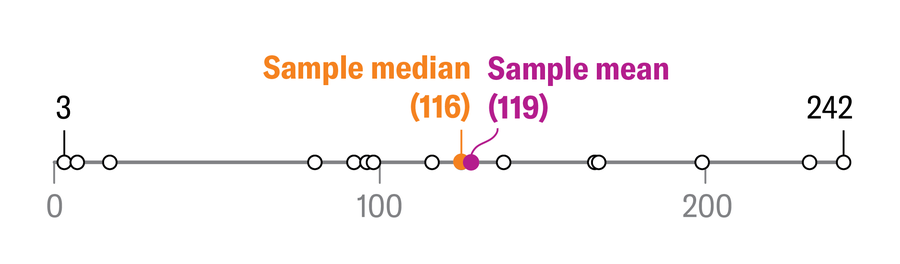
We can walk through the math together using a simplified set of numbers. Consider the following scenario: Suppose there are N = 271 tanks, numbered sequentially from 1 to 271. For the purposes of our thought experiment, you don’t know the number N, but you have managed to recover 15 enemy tanks, marked 3, 7, 17, 80, 92, 96, 98, 116, 125, 138, 166, 167, 199, 232 and 242. You can therefore assume that there are at least 242 generic tanks. But there could be more. To estimate N, assume that the 15 tanks captured were completely at random—an arbitrary sample of 15 numbers from N possible numbers.
Four Methods to Estimate the Number of German Tanks
You can estimate N by calculating the sample median. This is the number that lies exactly in the middle of the ordered list. The sample therefore contains as many values smaller than the median as it does values that are larger. In our example of 15 tanks, the median m’ is the eighth number, so m’ = 116. One possible estimate would be that the sample median m’ is the same as the median of the list of all N tanks.
For such an ascending list of N numbers, the median of all tanks, if N is odd, is: m = (N + 1) / 2. Therefore, we can make a first estimate of the total number, N₁, using the median m’: N₁ = 2m’ − 1 = 2 × 116 − 1 = 231. But the highest number in our sample is 242, so N must be larger.
The sample median (116) does not necessarily have to match the actual median (136).
Amanda Montañez
.
It might be better to consider the mean rather than the median. In a list 1, 2, 3, …, N, the median and mean are the same, but in a sample, these two values can differ.
The sample mean (or average) is obtained in this case by summing all the numbers (1,778) and dividing by how many there are, that is, 15. In this case, the mean, M ≈ 119. Using the same formula as for the median, a second estimate, N₂, for the number of tanks can be made: N₂ = 2M − 1 = 2 × 119 − 1 = 237. Unfortunately, this value is also below 242 and therefore cannot be correct.
The sample mean (119) is slightly larger than the median (116).
Amanda Montañez
.
To ensure that the estimate is not smaller than the largest number in the sample, you might assume that the same number of tanks were missed at the beginning of the list as at the end. This would mean adding the number of tanks preceding the smallest sample number to the largest number. The smallest number in the sample is 3, so two tanks preceded it, and the largest number is 242. This results in a third estimate: N3 = 2 + 242 = 244.
The result would be even more accurate, however, if you considered the average intervals of the numbers in the sample. So you calculate the average distance d between each number in the sample: d = 1/15 × [(nmin − 1) + (n1 − nmin − 1) + (n2 − n1 − 1) + … + (n13 − n12 − 1) + (nmax − n13 − 1)] = 1/15 × nmax − 1. The mean distance d, therefore, ultimately depends only on the largest number in our sample: d = 242/15 − 1 ≈ 15. This can now be added to nmax to obtain a fourth estimate: N4 = 257, which is quite close to the actual result (271).
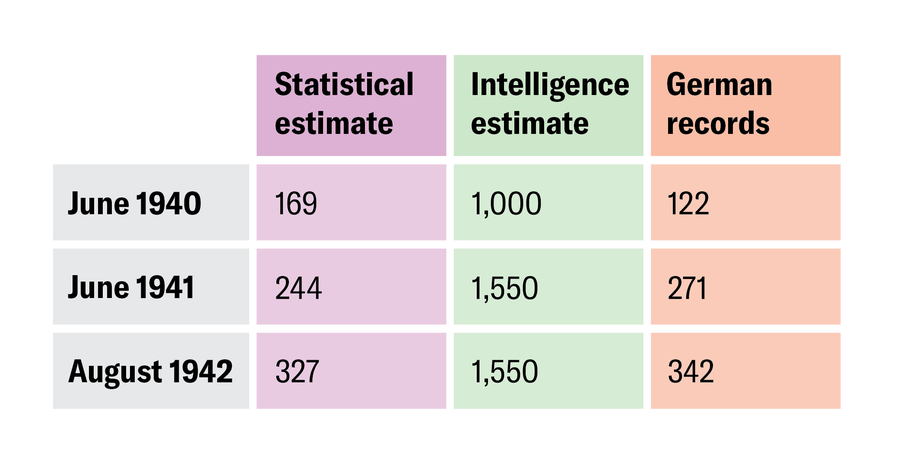
The Allied mathematicians used precisely this method to investigate German tank production with impressive success, compared with intelligence estimates, as this table from a 1947 journal article shows:
.
To go a step further, you can determine which method is best for these predictions using what mathematicians call Monte Carlo simulations. You set different values of N and randomly select different samples of size n, with which the two estimates N3 and N4 are determined. By repeatedly performing the experiment with a computer, you can examine the probability distributions of N3and N4, as well as their means and variances (a measure of spread). Doing this, you will find that both means will converge toward the actual value N—though the variance of N4 is smaller than that of N3. In other words, the Allied mathematicians picked the best mathematical strategy.
In 2024, hundreds of nurses gathered outside a Kaiser Permanente hospital in San Francisco, carrying signs that read: “Trust nurses, not AI.” As the nurses union started contract negotiations last year, the nonprofit health system’s adoption of artificial intelligence tools was one of the issues workers raised while picketing—and earlier this year, tens of thousands of Kaiser nurses went on strike alongside mental health professionals, largely to protest AI.
This has become a central issue for healthcare workers in California, and a report from Cal Matters this week reveals why they have pushed back on how they’re being asked to use AI on the job.
Former and current nurses at Kaiser revealed that their employer has started monitoring their performance closely with AI, evaluating them on how they responded to calls, and how long they spent on the phone with patients (which the company describes as “average handle time”). If their calls with patients crossed 15 minutes, nurses claimed they would be reprimanded or find that their monthly performance score was impacted.
Nurses said they were typically supposed to follow a script and offer only a few pieces of advice. Many were concerned that Kaiser’s approach to performance management would negatively affect patient care by forcing nurses to limit the length and scope of calls. They also noted that certain conversations—talking to new parents, for example, or patients who needed a translator—necessitated more time.
As one nurse told Cal Matters, citing a sensitive conversation with a patient that she felt required more care: “I had to ask myself: Am I going to get disciplined for going off script or saying more than what is necessary?”
According to Cal Matters, Kaiser also allegedly used AI to assess their tone or level of empathy. The tool was reportedly tested on nurses in 2024, but Kaiser stopped using it after nurses protested. Still, union representatives claimed that managers said they might eventually revive the program.
When reached for comment, a Kaiser spokesperson said the company “uses AI responsibly and with human oversight, always prioritizing patient safety, privacy, and equity. AI tools are designed to support our clinicians and care teams, not to replace them. Medical decisions remain in the hands of our clinicians.”
The spokesperson also denied that nurses were disciplined for taking calls that lasted longer than 15 minutes. “Kaiser Permanente does not use Average Handle Time to assess call response performance or enforce call time metrics. Any tools used in contact center settings support our quality assurance efforts and have human review and oversight. At Kaiser Permanente, our nurses are supported and empowered to take the time needed to deliver compassionate care and fully address each patient’s care needs. Our focus is always on ensuring we provide high-quality care through the use of evidence-based practices to achieve the best possible outcomes for our members.”
It’s not just nurses in California who are coming up against these AI systems. In a 2024 survey by National Nurses United—the largest union of registered nurses in the nation—half of workers said their employers were using algorithmic systems to analyze patient records. A notable number of them said their assessment of patients did not always line up with AI-generated guidance, and very often, they could not change the AI recommendations to reflect their opinion.
Healthcare workers in other states have expressed similar concerns over how AI is being used for performance management and in other ways that could potentially harm patients. In New York, the nurses’ union has repeatedly expressed concerns about the incursion of AI into healthcare. One hospital in New York City has been explicit about its alleged plans to replace nurses with AI-powered software. The widespread adoption of AI has also raised alarm bells in Tennessee, where a major for-profit health system—HCA Healthcare—has a controversial partnership with Palantir.
In other words, it’s not just office workers who are at risk of increased surveillance or likely to be impacted by AI’s growing role in performance management.
As one nurse put it to Cal Matters: “I’m not against the use of AI as long as it’s beneficial to the patient. But in this particular use, it’s to increase productivity, improve efficiency, and cut costs. Kaiser is forgetting we aren’t just a call center for customer support. We’re nurses, and we’re there to take care of patients.”
.
[Source Photo: Adobe Stock]
.
.
Click the link belowfor the complete article (sound on to listen):
The fatal shooting of a man this week by Immigration and Customs Enforcement agents in Houston has brought into focus an aggressive ramp-up of immigration arrests across the country that has largely occurred outside the public eye.
From large cities like Chicago and Las Vegas to small suburbs outside Milwaukee and San Antonio, immigrants have been picked up and detained at courthouses, ICE check-ins and traffic stops, with daily arrests doubling in the last week of June and continuing to climb.
“The operations have purposely been done behind the scenes,” said Getsy Hernandez, a community organizer with Escucha Mi Voz Iowa, an immigrant-led advocacy group in Iowa City.
Then on Tuesday, federal immigration agents killed Lorenzo Salgado Araujo, a Mexican construction worker and father of three who had lived in the country for more than 30 years without legal status. However, Mr. Salgado Araujo was not the initial target of the agents.
In the days since, the killing has galvanized thousands of protesters, led to calls from local leaders and Latino civil rights groups for independent investigations, and prompted promises of legal action from President Claudia Sheinbaum of Mexico.
Mr. Salgado Araujo was killed during a traffic stop by immigration agents who had been searching for a different person, according to a Department of Homeland Security spokeswoman. When agents tried to stop the vehicle, the encounter quickly escalated, and an agent shot Mr. Salgado Araujo in the abdomen. He died at a hospital hours later.
Homeland Security officials said Mr. Salgado Araujo had tried to use his vehicle as a weapon, though three men who witnessed the killing disputed that account and said the victim had never tried to run over a federal agent. No video of the shooting has emerged. The agents were not wearing body cameras, the spokeswoman has said.
The Houston shooting has dragged ICE and the tactics used by immigration agents back into the national spotlight. Federal officials are defending their actions as part of highly focused operations, but Latino community leaders and immigration lawyers argue the incident follows a string of violent confrontations that have accompanied the surge in arrests. These clashes, they say, show federal agents are continuing to use their most aggressive tactics.
Federal immigration agents have shot at more than 20 people since September, nearly all of them in their cars. Some of the shootings have been fatal.
The Trump administration is continuing to push for more deportations. A Republican-led package signed by President Trump last month has funded $31 billion for ICE activities, such as supporting local and state authorities that have signed cooperation partnerships with the agency, known as 287(g) agreements. For jurisdictions that refuse to cooperate, the funding package has earmarked another $350 million to expand enforcement operations.
In a period of five days at the end of June, ICE officers arrested more than 10,000 people, according to documents obtained by The New York Times. After a brief lull during the July 4 holiday weekend, arrests picked back up by Tuesday, the day Mr. Salgado Araujo was shot. From Tuesday through Thursday, ICE officers across the United States arrested more than 6,000 people, internal records show, a pace of about 2,000 arrests a day.
The effect of the push is being seen across the country.
In Chicago, immigrant rights groups and Hispanic community organizers in a news conference on Thursday had counted at least 70 people taken in three days, many around courthouses. Many of the immigrants apprehended had been charged with minor traffic violations or had been trying to make their appearances before immigration judges. Calls to one legal aid center alone had more than doubled to 1,700 in that time, organizers said.
.
Representative Sylvia Garcia spoke during a news conference on the case of Lorenzo Salgado Araujo in Houston on Friday. Credit…Ronaldo Schemidt/Agence France-Presse — Getty Images
In the world, human beings are facing various problems. People who are full of greed, anger, and ignorance are seen to be fighting with each other in words and deeds. As the fighting continues, various problems such as civil wars, wars of aggression, and wars of aggression are occurring. As world peace is being destroyed, humans are facing unbearable problems. Innocent children and women are not getting the rights they deserve and deserve. I can't think of one thing every time. What is it? The United Nations. If we look at the responsibilities and duties of the United Nations, I think it is not suitable for solving the problems that are happening in the world today. In fact, the United Nations and the World Security Council, such an organization must rule the world, must be able to give orders, and must have various ways to obey orders. There must be no organization that can influence more than that organization. There should be experts from each country. They can even dominate the superpowers like the US, China, and Britain. Only then will global peace be achieved quickly. Now, if a country with power develops more militarily, economically, or socially than its own country, then powerful countries will jealously seek out enemies and wage war. Or they will attack with fighter jets. In this, innocent people are losing their lives. No one understands the value of a life. You should think about how to achieve global peace by controlling these. If the US continues to be the permanent president of the UN, world peace will never be achieved. If you think carefully, no one sees that they are working for the common good, but for their own benefit, for the benefit of their own country. The permanent president of the UN and the Security Council has rejected this, As a young Rohingya, I have come to realize that only by electing the president and secretary from among the countries in the world through a secret ballot system and governing the world fairly can we achieve global peace. The United Nations and the Security Council are organizations in which any country must govern, give orders, and make them obey their orders. For example, only when a defendant is tried in court can we hold the leaders of the countries in check and control them, can we achieve global peace smoothly. Otherwise, it will not be easy for powerful countries to use various excuses to end this war every year, every year, for the benefit of themselves and their countries. No country's leaders pay any attention to the words of the United Nations and the Security Council. If we look at it in practice, look at the Rohingya issue. Myanmar is a small country. Even that country has been under siege for 8 years. What action can be taken? Why is the UN and the Security Council Powerless? Without such Power, how can the organization bring about global peace? Everyone should think about it. Whether there is a veto or a strong one, all countries in the world can only achieve global peace if they are subject to the UN and the Security Council. Seek peace in the quiet embrace of nature. Peace is an indispensable need of the human race. It is not as if one person can kill another person, and it is as if one country can attack another country, but instead of trying to build peace, we must try to destroy the peace now, and the world is getting hotter and is on the verge of collapse. I especially appeal to all the world experts to urgently try to bring about peace in all parts of the world. Mr, Noor Muhamed Arkhan Rohingya Youth Myanmar
Film and Writing Festival for Comedy. Showcasing best of comedy short films at the FEEDBACK Film Festival. Plus, showcasing best of comedy novels, short stories, poems, screenplays (TV, short, feature) at the festival performed by professional actors.


 Casimiro/Getty Images


 Pete Gamlen




 [Source Photo: Adobe Stock]
 Representative Sylvia Garcia spoke during a news conference on the case of Lorenzo Salgado Araujo in Houston on Friday. Credit…Ronaldo Schemidt/Agence France-Presse — Getty Images