.
Kendra Pierre-Louis: For Scientific American’s Science Quickly, I’m Kendra Pierre-Louis, in for Rachel Feltman.
Wildlife poaching is a serious issue in many parts of the world. One way of monitoring poaching activity is to put recorders in the forest to listen for gunshots.
Pierre-Louis: Computer programs that use AI can help detect the crack of a gun. But accuracy is still a huge challenge when the forest is such a noisy place.
Freelance wildlife writer Melissa Hobson met someone who may have experienced a breakthrough: a 17-year-old high schooler who built an AI model that can accurately pick out gunshots from other jungle sounds.
What impact could this model make on gun-based poaching? Here’s Melissa with more about how it might help save elephants and other animals from the threat of illegal hunting.
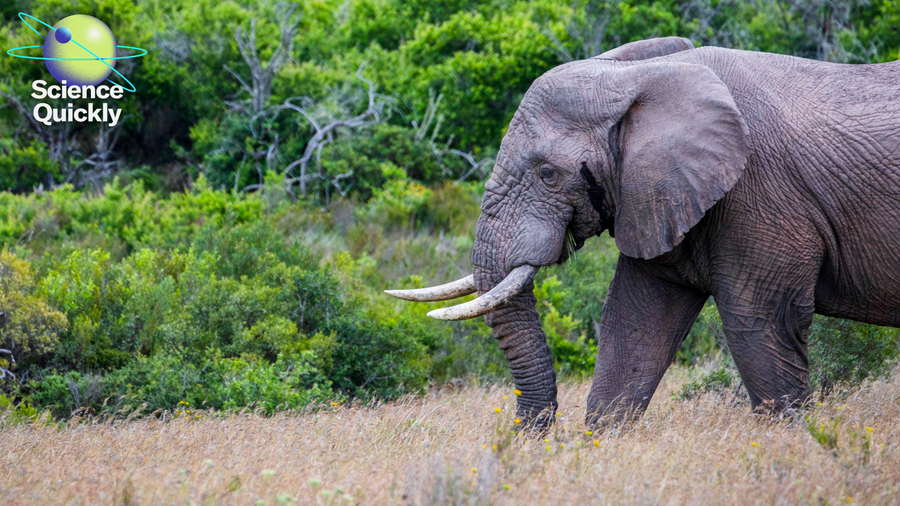
Melissa Hobson: That is the sound of an African forest elephant. To the untrained ear, it might be indistinguishable from noises made by the animal’s relative, the African savanna elephant.
Both species are under threat. But while African savanna elephants are endangered, forest elephants are critically endangered. They’re also highly elusive. Living in dense tropical rainforests in central Africa and parts of West Africa, they’re very hard to find and study.
Daniela Hedwig: As such, we don’t know much about the forest elephants, and it’s very difficult to exactly know how many there still are.
Hobson: That’s Daniela Hedwig, director of the Elephant Listening Project at the K. Lisa Yang Center for Conservation Bioacoustics at Cornell University.
Hedwig: Our goal is to use acoustic monitoring to contribute to the conservation of the central African rainforest. We have about almost 100 acoustic units spread out in the area, covering almost 2,000 square kilometers [roughly 772 square miles] combined.
Melissa Hobson: That is the sound of an African forest elephant. To the untrained ear, it might be indistinguishable from noises made by the animal’s relative, the African savanna elephant.
Both species are under threat. But while African savanna elephants are endangered, forest elephants are critically endangered. They’re also highly elusive. Living in dense tropical rainforests in central Africa and parts of West Africa, they’re very hard to find and study.
Daniela Hedwig: As such, we don’t know much about the forest elephants, and it’s very difficult to exactly know how many there still are.
Hobson: That’s Daniela Hedwig, director of the Elephant Listening Project at the K. Lisa Yang Center for Conservation Bioacoustics at Cornell University.
Hedwig: Our goal is to use acoustic monitoring to contribute to the conservation of the central African rainforest. We have about almost 100 acoustic units spread out in the area, covering almost 2,000 square kilometers [roughly 772 square miles] combined.
Hobson: These sound recorders are easily hidden, obscured by the tree branches. These devices enable the Elephant Listening Project to detect elephants through the rumbling vocalizations they use to communicate with one another, even when they’re kilometers apart.
Hobson: This helps the experts learn more about the animals’ lives and population numbers without even seeing them.
But the recording devices don’t just pick up elephant sounds.
Hedwig: Acoustic monitoring is really great at recording these soundscapes and getting this really amazing picture of biodiversity by eavesdropping on nature.
Hobson: They also hear the sounds of human activity and can be an effective way of combating illegal poaching.
Hobson: Illegal hunting poses a huge threat to animals such as elephants and rhinos. In many parts of Africa and Asia, anti-poaching patrols roam national parks, often working with other law enforcement agencies to apprehend armed hunters. It’s time-intensive and incredibly dangerous.
Hedwig: These are very, very brave people that are spending very large amounts of time in the forest under not fun circumstances, really jeopardizing their lives to protect biodiversity in the forest for their children and future generations.
Hobson: But how do the teams who are responsible for conservation efforts find a poacher in the vast expanse of, for example, an African national park?
Hedwig: Looking for poachers is basically like looking for a needle in the haystack.
Conservation managers. typically, they have informants in villages, and they have intelligence that tells them if there are certain activities ongoing. But catching [poachers] is very difficult.
Hobson: Trail cameras can help, but only up to a point.
Richard Hedley is a statistical ecologist at the Alberta Biodiversity Monitoring Institute in Edmonton, Canada. He explains the limitations of camera monitoring.
Richard Hedley: Trail cameras can only detect hunters in a very limited range immediately in front of the camera.
But what sometimes happens when people are monitoring hunting activity with cameras is that often the hunters don’t want to be photographed or don’t like to be photographed, so sometimes the cameras can be destroyed by hunters that don’t want to be photographed, or they can also be stolen because they need to be placed right next to a heavily used trail.
Hobson: Meanwhile, there are several benefits to using acoustic recording devices: they can be hidden high in the canopy and far from the trail, cover a wide area, and are relatively low-maintenance.
Hedwig: Acoustic monitoring is really—if not the only method that can help you to really, systematically and in an unbiased way, collect information on where gunshots were fired.
Hobson: In 2022, Richard was part of a team that published a research paper focused on detecting gunshots from acoustic monitoring recordings.
The study took place in the protected Cooking Lake–Blackfoot Provincial Recreation Area in central Alberta, Canada. At different times of the year, people hunt ducks, geese, deer, elk, and moose in this nearly 24,000-acre park.
Hedley: So we put out about 90 recording units across the protected area and set them to record, and then we went through the recordings to try to detect the gunshots as people were hunting within that park.
And so what we were able to show in the study was that acoustic monitoring can be a very effective tool for mapping out hunting activity.
Hobson: The recordings showed Richard and his colleagues where people tended to hunt: usually in the most accessible areas of the park, closer to the roads. The data also revealed that people generally stick to the park’s rule banning hunting on Sundays.
Hedley: So there [were] moderate levels of hunting from Monday to Friday, and then hunting activity really spiked on Saturdays and went down to practically zero on Sundays.
Hobson: At the time, there were several challenges related to audio monitoring.
Hedley: A gunshot itself might last one or two seconds, but might be embedded within hours or days or even weeks of recording from a location, so that really necessitates the use of computers to help us go through all of these recordings. There’s really no way that a human would be able to do that by themselves.
Hobson: And because the microphones can pick up sounds across long distances, gunshots from farther away can sometimes be faint and hard to hear.
Hobson: Both Richard’s and Daniela’s teams have encountered similar challenges while trying to listen for hunting activity, such as making out a gunshot amid a noisy soundscape.
Hedley: And people often think of nature as being quiet, but in fact, natural soundscapes can be incredibly complex. And the reality is, we’re often not trying to find a loud gunshot in a quiet recording, but sometimes we’re trying to find quiet gunshots in loud recordings, where there’s a lot of other things going on.
Hobson: Especially in a noisy jungle—against the backdrop of rain, wind, storms, rustling leaves and animals—it can be hard to tell the difference between the crack of a distant gun …Hobson: And twigs snapping.
Hobson: This means recorders often give false positives.
Certain noises are more easily confused with the sound of a firing gun.
Hedwig: And those are, most notably, breaking tree branches, sometimes also raindrops falling, even other monkey species—they sound very much like gunshots. [Laughs.]
Hedley: In our study we had quite a lot of beavers in the area, and they would slap their tail in the water, and that sometimes could sound like a gunshot in the distance. So the challenge is really to identify gunshots and distinguish them from all these other natural sources of sounds that are happening all at the same time.
We ended up throwing out a lot of the data and only looked at the loudest gunshots in the recording.
Hedwig: Our problem is that we do have detection algorithms, and we can make them so that they find the gunshots, but that comes at a cost, and that cost is that we’re detecting thousands and thousands of other signals that are not gunshots. That means that we need a person to actually look and listen to all the detections and make the final decision. And this is where acoustic monitoring and its potential really reaches a bottleneck.
Hobson: A high schooler from San Diego, California, thinks he may have found the answer. Naveen Dhar has created a neural network that picks up gunshots with relatively high levels of accuracy without also flagging the many other similar noises.
Here’s Naveen.
Naveen Dhar: I have always been interested in the natural world as far as I can remember, since, like, elementary school and then going through middle school and high school. And this whole project of building this neural network to detect poaching actually kind of started way back in eighth grade.
Hobson: At that time, Naveen was on a backpacking trip with his dad in California’s Channel Islands, where he learned about researchers who were studying the impact of sea urchins on the kelp forests there.
The scientists’ work involved lots of back-and-forth. They collected data in the field, traveled back to the mainland to upload the information and make decisions based on their findings, and then returned to the kelp forests to implement their solutions.
Dhar: I was just thinking, “There’s got to be a better way to get data that is faster than a sea urchin eating a kelp stem, right?” And so following that curiosity, I got into the fields of environmental sensing and, later on, bioacoustics, which is using sound to understand the natural environment.
Hobson: For a school paper in 11th grade, Naveen decided to study poaching and try to understand why it happens.
Dhar: I was really surprised to know that in some areas, for example, rhino-poaching rates from 2020 to 2023, they were actually rising, even though we have this 21st-century technology and we’re not living without the ability to monitor the world around us, right?
And so I was wondering, “Why is this still such a problem? Don’t we have the tools to enable rangers to effectively intercept and stop poachers?” And so I followed that rabbit hole for quite a while, and for the entirety of my junior year that was kind of what I was thinking about outside of school.
Hobson: It’s important to acknowledge that there are many social and economic issues that contribute to poaching.
Hedwig: It’s a very complex problem, you know, where poaching needs to be tackled from multiple angles.
In this context, we often talk about poachers, and we paint them so negatively, but I would like to say that the vast majority of people that are going in a national park to hunt are just, you know, people that are trying to make ends meet. We’re talking about people here that often don’t have much, and they’re trying to feed their children.
Hobson: Naveen, now 17, is well aware of the socioeconomic issues related to poaching. But given his existing interest in bioacoustics, he decided to look at the issue through this lens. His focus was on how acoustic recordings can help rangers prevent gun-based poaching.
He taught himself a programming language called Python and dove into the scientific literature to learn what had already been tried in the area of gunshot detection.
Existing detectors had some key problems, Naveen says.
Dhar: The detectors that were detecting the sounds of the gunshots, they either had too high of a false-positive rate to be deployed in the field—because otherwise it’s just like boy who cried wolf, you know; the rangers aren’t going to use the detector—and then also, the ones that were more accurate, they were specialized to one specific environment or habitat or dataset, and they were too computationally intensive to be run in real time.
Hobson: Instead, Naveen turned to neural networks, a type of machine learning model inspired by the way the human brain makes connections.
Dhar: And specifically, why deep learning, which is a type of neural network that uses many different layers of neural networks stacked on top of each other.
In this context, we often talk about poachers, and we paint them so negatively, but I would like to say that the vast majority of people that are going in a national park to hunt are just, you know, people that are trying to make ends meet. We’re talking about people here that often don’t have much, and they’re trying to feed their children.
Hobson: Naveen, now 17, is well aware of the socioeconomic issues related to poaching. But given his existing interest in bioacoustics, he decided to look at the issue through this lens. His focus was on how acoustic recordings can help rangers prevent gun-based poaching.
He taught himself a programming language called Python and dove into the scientific literature to learn what had already been tried in the area of gunshot detection.
Existing detectors had some key problems, Naveen says.
Dhar: The detectors that were detecting the sounds of the gunshots, they either had too high of a false-positive rate to be deployed in the field—because otherwise it’s just like boy who cried wolf, you know; the rangers aren’t going to use the detector—and then also, the ones that were more accurate, they were specialized to one specific environment or habitat or dataset, and they were too computationally intensive to be run in real time.
Hobson: Instead, Naveen turned to neural networks, a type of machine learning model inspired by the way the human brain makes connections.
Dhar: And specifically, why deep learning, which is a type of neural network that uses many different layers of neural networks stacked on top of each other.
Hedley: In the few short years since we did our study, neural networks have really emerged as being a dominant approach to signal classification, and they’ve shown a much better ability to reach almost humanlike performance in their ability to distinguish one sound from another.
Dhar: So what we actually do is we transform the sound into an image format. We take the sound and turn it into a spectrogram, which has the time on the x-axis, the frequency of the signal on the y-axis, and then you also have a third dimension, or the amplitude of each little coordinate in this x–y graph, which tells you how loud that specific time frequency was.
And so by converting our signals into spectrograms, we’re able to use neural network frameworks that are very efficient for image processing, and they have been really well-suited for this task because you can’t be sending your signals up to the cloud all the time. It’s just too power-intensive, right? So you need to have a detector that’s both accurate and also lightweight enough to run in real time.
Hobson: Other projects faced a problem called overfitting. That’s when a machine-learning model becomes too specialized to the dataset it was trained on.
This means it performs well with that specific situation but struggles with other datasets, such as sounds from a different habitat somewhere else in the world—for example, a model trained to detect gunshots in soundscapes from Belizean forests that couldn’t do the same with data from somewhere else in the world.
Dhar: We need these models to be able to pick up gunshots and recognize gunshots from any rainforest or habitat in the world, and each habitat comes with different acoustical properties, and the gunshots are gonna reverb differently.
Instead of taking a really large image-classification model and then fine-tuning it on this small dataset of gunshots from the rainforest, I decided to build something from the ground up.
Hobson: Naveen needed his model to understand exactly how a gunshot looks when it’s converted into a spectrogram. That’s a visual representation of the sound. The noise shows up as a clear spike followed by a fading pattern as the sound decays away.
Dhar: We wanna make sure that we capture that really sharp rise, right, and we don’t confuse it with, like, the fuzzy rise of thunder or something like that.
Hobson: Naveen says the model he developed was able to overcome these problems. It also had the benefit of being relatively small.
Dhar: Every neural network has a parameter count, which is, basically, you can think of it as, like, the amount of knobs that you’re turning to tune this model in order to better classify whatever you’re classifying. And some models, like ChatGPT, [have] many billions of parameters. This model was less than one million parameters.
But that actually helped it because it made sure it didn’t overfit to this dataset that I had. And that allowed it to, when it was only trained on a dataset from Belize, also detect gunshots from Africa and Vietnam because it wasn’t overfitting to this one specific dataset.
Hobson: To make sure the model could pick out gunshots in different habitats, Naveen also overlaid different examples of sounds from various recordings on top of his gunshot spectrograms.
The creation he made with Cornell for the Elephant Listening Project was incredibly accurate. Based on more than 30,000 recordings from Cameroon, the template detector the Cornell team used previously had a recall of around 87 percent—that refers to the proportion of gunshots it was able to pick out from the soundscape—and a precision of 0.084. The precision is how often the detector was right, meaning it didn’t produce false positives.
Hedwig: So there was, like, 90 percent of the detections we got were not gunshots.
Hobson: Naveen says that, using the same Cameroon dataset, the neural network he developed achieved a recall of 82 percent and a precision of 0.87. When trained on data from Belize, his model’s recall was 89 percent, and the precision was 0.93.
Dhar: And if we reduce the recall a little bit—if we’re willing to trade some of the fainter, larger-distance gunshots that were maybe, like, three kilometers [about 1.86 miles] away—then we can get pretty close to 100 percent precision, or 0 percent false positives.
Hobson: Improved accuracy brings the dream of real-time monitoring a step closer. This would make anti-poaching patrols more efficient and help them serve as better deterrents because it’s more likely potential poachers will get caught.
Hedwig: So it’s a win-win, you know? Anti-poaching patrols will be safer, and there will be less encounters that might be potentially dangerous with poachers that are often armed as well.
Hobson: Real-time acoustic monitoring could be a game changer.
Hedley: If you’re monitoring poaching, you need to know that the poaching is happening now, not six weeks ago. If you’re going to mount a response to poaching, you wanna be confident that you’re responding to an actual poaching event, rather than, say, a branch breaking in the forest.
Hobson: There are also a few logistical issues to consider before this approach can become a reality, including the technology’s storage space and battery life.
Hedwig: You need to power these recording units and the algorithms. Of course, solar would be a wonderful solution, but if you work under a closed canopy, you know, you cannot easily install solar systems.
Hobson: Processing all that data takes lots of computing power, which can slow things down. And these devices are often in remote locations where there isn’t good signal to transmit the information wirelessly back to the people who need it.
Satellite transmission is expensive and can be unreliable, and critters can also cause problems.
Hedwig: Termites and monkeys and squirrels, out of all animals out there [Laughs], really like to eat our equipment, too.
Hobson: Yet Daniela thinks we’re only a few years away from this form of monitoring becoming commonplace in tropical forests.
On top of clearly being incredibly talented, Naveen is also modest. He thinks he’s succeeded where others have struggled because the field of gunshot detection hasn’t received much attention in the past.
Dhar: I bet there are a lot of people, maybe, like, 10 years ag,o who could have solved this problem and created a very accurate neural network.
This neural network isn’t, like, this holy grail of something, you know, state of the art. It is better than the other neural networks and detectors that have been made in the past, but I guess it’s just because, you know, I’ve spent a lot of time in it. I really care about this issue.
Pierre-Louis: That’s all for today! Tune in on Monday for our weekly science news roundup.
Science Quickly is produced by me, Kendra Pierre-Louis, along with Fonda Mwangi, Sushmita Pathak, and Jeff DelViscio. This episode was reported and co-hosted by Melissa Hobson and edited by Alex Sugiura. Shayna Posses and Aaron Shattuck fact-check our show. Our theme music was composed by Dominic Smith. Subscribe to Scientific American for more up-to-date and in-depth science news.
For Scientific American, this is Kendra Pierre-Louis. Have a great weekend!
.
.
.





 Clearing Rubble in Tehran

 David Silverman/Getty Images
:max_bytes(150000):strip_icc()/Inexpensive-Heart-Healthy-Oil-FT-DGTL0226-02-4d7e0695db57462ebc849bad209f776b.jpg)
:max_bytes(150000):strip_icc()/Inexpensive-Heart-Healthy-Oil-FT-DGTL0226-01-b4a3aa64ea8e4baeb0e3d0549c43a3c7.jpg)