November 11, 2023
Mohenjo
Business, Food For Thought, Human Interest, Political, Science, Technical
amazon, business, Business News, current-events, Future, Hotels, human-rights, medicine, mental-health, research, Science, Science News, technology, Technology News, travel, vacation

Click the link below the picture
.
School board elections have become a new battleground in American politics, with typically non-partisan races becoming increasingly polarized and garnering national attention. That was true in this week’s election among a few closely watched counties. Julie Marsh, a professor of education policy at the University of Southern California, joins Geoff Bennett to discuss.
.
 School board elections have become a new battleground in American politics
.
.
Click the link below for the video:
.
__________________________________________
November 11, 2023
Mohenjo
Business, Food For Thought, Human Interest, Political, Science, Technical
amazon, business, Business News, current-events, Future, Hotels, human-rights, medicine, mental-health, research, Science, Science News, technology, Technology News, travel, vacation

Click the link below the picture
.
Pie pans or pie plates come in different materials, sizes, and shapes. And while they may seem mostly decorative, they do have an impact on how a pie turns out.
“With enough skill and know-how, you can truly use any type of pie plate and bake a great pie,” said baking guru Erin Jeanne McDowell, the author of The Book on Pie.
“That said, for beginners and less frequent pie bakers, the wrong pie pan can definitely make your job harder!” she added. Some materials hold, distribute, and retain heat better than others, and they can subtly affect how a pie bakes.
“A well-chosen pie pan won’t make your lattice any tighter or your cutouts any prettier, but it will definitely have a big impact on the mouthfeel of the pie, and how pleasant it is for your guests to eat,” agreed Jessica Leigh Clark-Bojin, a professional pie artist based in Vancouver, Canada.
Some pans can trap moisture under the filling, leading to the dreaded soggy bottom, every pie baker’s nightmare.
“The secret to perfectly cooked pies is conducting as much heat to the bottom of the pie pan as possible, as quickly as possible,” Clark-Bojin said.
“We want that moisture to evaporate before it has a chance to soak into the bottom layer of dough,” she added. That way, the outcome is a perfectly crisp and flaky shell all the way through.
So, which kind of pan best achieves these optimal results for what Clark-Bojin calls us “mortal bakers?” In general, a 9-inch diameter is the standard size for a pie pan. Deep-dish pans hold more filling and may bake differently, but these are usually specified in a recipe.
.
 amazon.com, amazon.com
.
.
Click the link below for the article:
.
__________________________________________
November 10, 2023
Mohenjo
Business, Food For Thought, Human Interest, Political, Science, Technical
amazon, business, Business News, current-events, Future, Hotels, human-rights, medicine, mental-health, research, Science, Science News, technology, Technology News, travel, vacation

Click the link below the picture
.
In 1988, in an elevator at a film festival in Havana, the director Oliver Stone was handed a copy of On the Trail of the Assassins, a newly published account of the murder of President John F. Kennedy. Stone admired Kennedy with an almost spiritual intensity and viewed his death on November 22, 1963 — 60 years ago this month — as a hard line in American history: the “before” hopeful and good; the “after” catastrophic. Yet he had never given much thought to the particulars of the assassination. “I believed that Lee Oswald shot the president,” he said. “I had no problem with that.” On the Trail of the Assassins, written by the Louisiana appellate judge Jim Garrison, proposed something darker. In 1963, Garrison had been district attorney of New Orleans, Oswald’s home in the months before the killing. He began an investigation and had soon traced the contours of a vast government conspiracy orchestrated by the CIA; Oswald was the “patsy” he famously claimed to be. Stone read Garrison’s book three times, bought the film rights, and took them to Warner Bros. “I was hot at the time,” Stone told me. “I could write my own ticket, within reason.” The studio gave him $40 million to make a movie.
The resulting film, JFK, was a scandal well before it came anywhere near a theater. “Some insults to intelligence and decency rise (sink?) far enough to warrant objection,” the Chicago Tribune columnist Jon Margolis wrote just as shooting began. “Such an insult now looms. It is JFK.” Newsweek called the film “a work of propaganda,” as did Jack Valenti, the head of the Motion Picture Association of America, who specifically likened Stone to the Nazi filmmaker Leni Riefenstahl. “It could spoil a generation of American politics,” Senator Daniel Patrick Moynihan wrote in the Washington Post.
Critics objected in particular to Stone’s ennoblement of Garrison, whose investigation was widely viewed, including by many conspiracy theorists, as a farce. And yet some of the response to the film looked an awful lot like a form of repression, a slightly desperate refusal to acknowledge that the official version of the Kennedy assassination had never been especially convincing. One week after the assassination and five days after Oswald himself was killed by nightclub owner Jack Ruby, President Lyndon Johnson convened a panel of seven “very distinguished citizens,” led by Chief Justice Earl Warren of the Supreme Court, to investigate. Ten months later, the Warren Commission concluded that Oswald, firing three shots from the sixth floor of the Texas School Book Depository, had killed Kennedy entirely on his own for reasons impossible to state. Notwithstanding JFK’s distortions — “It’s a Hollywood movie,” Stone pointed out — the film noted quite accurately that the Warren Commission seemed to be contradicted by its own evidence.
.
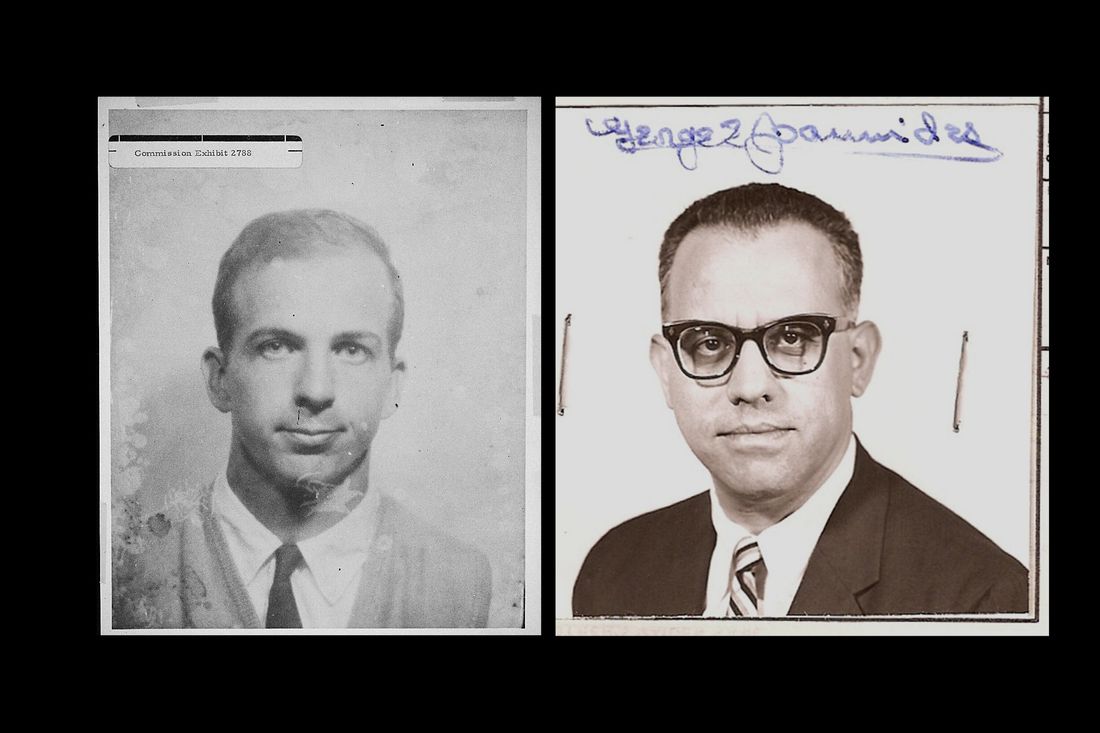 Lee Harvey Oswald and CIA officer George Joannides. Photo: JFK Assassination Records Collection (Oswald) & CIA FOIA files (Joannides)
.
.
Click the link below for the article:
.
__________________________________________
November 10, 2023
Mohenjo
Business, Food For Thought, Human Interest, Political, Science, Technical
amazon, business, Business News, current-events, Future, Hotels, human-rights, medicine, mental-health, research, Science, Science News, technology, Technology News, travel, vacation

Click the link below the picture
.
People warned me before I came to Tel Aviv a few days ago that the Israel of Oct. 7 is an Israel that I’ve never been to before. They were right. It is a place in which Israelis have never lived before, a nation that Israeli generals have never had to protect before, an ally that America has never had to defend before — certainly not with the urgency and resolve that would lead a U.S. president to fly over and buck up the whole nation.
After traveling around Israel and the West Bank, I now understand why so much has changed. It is crystal clear to me that Israel is in real danger — more danger than at any other time since its War of Independence in 1948. And it’s for three key reasons:
First, Israel is facing threats from a set of enemies who combine medieval theocratic worldviews with 21st-century weaponry — and are no longer organized as small bands of militiamen but as modern armies with brigades, battalions, cyber-capabilities, long-range rockets, drones, and technical support. I am speaking about Iranian-backed Hamas, Hezbollah, Islamic militias in Iraq, and the Houthis in Yemen — and now even the openly Hamas-embracing Vladimir Putin. These foes have long been there, but all of them seemed to surface together like dragons during this conflict, threatening Israel with a 360-degree war all at once.
How does a modern democracy live with such a threat? This is exactly the question these demonic forces wanted to instill in the mind of every Israeli. They are not seeking a territorial compromise with the Jewish state. Their goal is to collapse the confidence of Israelis that their defense and intelligence services can protect them from surprise attacks across their borders — so Israelis will, first, move away from the border regions, and then they will move out of the country altogether.
I am stunned by how many Israelis now feel this danger personally, no matter where they live — starting with a friend who lives in Jerusalem telling me that she and her husband just got gun licenses to have pistols at home. No one is going to snatch their children and take them into a tunnel. Hamas, alas, has tunneled fear into many, many Israeli heads far from the Gaza border.
.
 Amir Levy/Getty Images
.
.
Click the link below for the article:
.
__________________________________________
November 9, 2023
Mohenjo
Business, Food For Thought, Human Interest, Political, Science
amazon, business, Business News, current-events, Future, Hotels, human-rights, medicine, mental-health, research, Science, Science News, technology, Technology News, travel, vacation

Click the link below the picture
.
Everything in our homes gathers dust. But what exactly is it? Where does it come from, and why does it keep coming back? Is it from outside? Is it fibres from our clothes and cells from our skin?
Yes, but it’s a lot more than that.
People from all around Australia and 35 other countries have been sending their dust to Macquarie University’s DustSafe program. Instead of emptying the vacuum cleaner into the bin, they package it up and we analyze it. As a result, we are getting to know the secrets of your dust!
Here’s a taste of what we know so far.
Dust Is Everywhere
Dust is everywhere. It settles on all surfaces in the natural environment as well as inside homes and buildings — where we spend about 90% of our time, even before COVID.
Some dust is natural, coming from rocks, soils, and even space. But the DustSafe program is revealing Australian house dust can include nasties such as:
- radioactive elements
- antibiotic-resistant genes (genes that make bacteria resistant to antibiotics)
- microplastics and
- perfluorinated chemicals (PFAS) found in fire-fighting foams, stain and water protection for fabrics and carpets, some packaging and other sources.
Dust From Inside Your Home
Some estimates suggest one-third of trace element contaminants in household dust originate from sources inside your home, with the rest migrating from outside via air, clothes, pets, shoes, and the like.
.
 Photo by Shutterstock
.
.
Click the link below for the article:
.
__________________________________________
November 9, 2023
Mohenjo
Business, Food For Thought, Human Interest, Political, Science, Technical
amazon, business, Business News, current-events, Future, Hotels, human-rights, medicine, mental-health, research, Science, Science News, technology, Technology News, travel, vacation

Click the link below the picture
.
This week, Taylor Swift’s 1989 debuted at no. 1 on the Billboard 200. And it didn’t just top the chart; her album scored the biggest debut since Adele’s 25 released in 2015.
This is an odd milestone considering that Swift released 1989 in October 2014—surely you recall the album’s ubiquitous millennial pop anthems “Blank Space,” “Bad Blood,” and “Shake It Off.” But that was the old 1989. The new 1989—the album that last week outperformed the streaming figures of the original release in the same period by more than 1,300 percent—is 1989 (Taylor’s Version). This is the latest of several such rerecordings, each debuting at no. 1 and each marketed as “Taylor’s Version,” hinting at the underlying vendetta that prompted dueling versions of these albums in the first place: Scooter Braun’s purchase of Big Machine for over $300 million in a secretive deal with the record label’s founder, Scott Borchetta, that incurred the wildly productive wrath of Swift.
Swift, Borchetta, and Braun have something of a convoluted history that’s crucial to understanding this whole mess. Swift previously tried—and failed—to buy her master recordings, as Borchetta preferred to price her masters into the terms of a new recording contract with Big Machine—terms Swift rejected. Swift says she assumed Borchetta would sell her back catalog once she left Big Machine for Universal Music Group. The issue is Braun, specifically. Swift says he brought her to tears with his “incessant, manipulative bullying” on more than one occasion, citing, for instance, his involvement in her humiliating feud with Kanye West. She’s also criticized Borchetta for orchestrating the deal despite knowing her history with Braun. Swift described her earlier music as being “beholden to men who had no part in creating it.”
Over a year after the acquisition, Braun sold the master rights of Swift’s first six albums to the investment firm Shamrock Capital, but—according to Swift—Braun still continues to profit from the recordings per the terms of the sale. So, Swift, possibly inspired by a tweet from Kelly Clarkson, began to rerecord and rerelease those six albums produced under Big Machine to reclaim her back catalog and excise Braun from her musical legacy. This was at once a deeply personal feud and a broader crusade for musicians’ rights. Taylor’s Versions were a peculiar gambit, the realization of a strategy devised a couple of decades earlier by Prince in his notorious campaign against Warner Bros. in the 1990s.
.
:format(webp)/cdn.vox-cdn.com/uploads/chorus_image/image/72837949/CharityTaylorSwiftRereleases_Getty_AP_Ringer.0.jpg) Getty Images/AP Images/Ringer illustration
Getty Images/AP Images/Ringer illustration
.
.
Click the link below for the article:
.
__________________________________________
November 8, 2023
Mohenjo
Business, Food For Thought, Human Interest, Political, Science, Technical
amazon, business, Business News, current-events, Future, Hotels, human-rights, medicine, mental-health, research, Science, Science News, technology, Technology News, travel, vacation

Click the link below the picture
.
Caleb Scharf wants to take you on an epic tour. His book, The Zoomable Universe, starts from the ends of the observable universe, exploring its biggest structures, like groups of galaxies, and goes all the way down to the Planck length—less than a billionth of a billionth of a billionth of a meter. It is a breathtaking synthesis of the large and small. Readers journeying through the book are treated to pictures, diagrams, and illustrations, all accompanied by Scharf’s lucid, conversational prose. These visual aids give vital depth and perspective to the phenomena that he points out like a cosmic safari guide. Did you know, he offers, that all the Milky Way’s stars can fit inside the volume of our solar system?
Scharf, the director of Columbia University’s Astrobiology Center, is a suitably engaging guide. He’s the author of the 2012 book Gravity’s Engines: How Bubble-Blowing Black Holes Rule Galaxies, Stars, and Life in the Universe, and he speculated in Nautilus about whether alien life could be so advanced as to be indistinguishable from physics.
In The Zoomable Universe, Scharf puts the notion of scale—in biology and physics—center-stage. “The start of your journey through this book and through all known scales of reality is at that edge between known and unknown,” he writes. Nautilus caught up with him to talk about our experience with scale and why he thinks it’s mysterious. (Scharf is a member of Nautilus’ advisory board.)
Why is scale interesting?
Scale is fascinating. Scientifically, it’s a fundamental property of reality. We don’t even think about it. We talk about space and time—and perhaps we puzzle more over the nature of time than we do over the nature of scale or space—but it’s equally mysterious.
What’s mysterious about scale?
It’s something we all have direct experience of, even intuitively. We learn to evaluate the size of things. But we’re operating as humans in a very, very narrow slice of what is out there. And we’re aware of a very narrow range of scales: In some sense, we know more about the very large than we do about the very small.
.

In The Zoomable Universe, Scharf puts the notion of scale—in biology and physics—center-stage. “The start of your journey through this book and through all known scales of reality is at that edge between known and unknown,” he writes. Illustrations by Ron Miller.
.
.
Click the link below for the article:
.
__________________________________________
November 8, 2023
Mohenjo
Business, Food For Thought, Human Interest, Political, Science, Technical
amazon, business, Business News, current-events, Future, Hotels, human-rights, medicine, mental-health, research, Science, Science News, technology, Technology News, travel, vacation

Click the link below the picture
.
The U.S. Supreme Court will hear arguments next week in a pivotal firearms case that could have profound implications for how police and courts deal with domestic violence.
The question: Should people who are placed under domestic violence protection orders also lose access to their guns?
For many victim advocates, the answer is obvious. Women are five times more likely to be killed in a domestic violence incident when the abuser has access to a gun. Advocates argue that the gun restrictions tied to such orders are among the most powerful tools for domestic violence victims and that without them, more people will die.
For gun rights groups and their most ardent supporters, that is beside the point. They contend that people subject to protection orders haven’t been convicted of a crime and that taking their firearms away violates the Second Amendment. If the government can disarm them, they ask, who could the government disarm next?
Earlier this year, the U.S. Court of Appeals for the 5th Circuit sided with gun rights supporters, invalidating a federal law passed by Congress in 1994 that bars people under domestic violence orders from having firearms.
If the Supreme Court upholds that decision and rules that gun restrictions tied to restraining orders are unconstitutional, states would have fewer options to stop domestic abusers from possessing, and using, guns. And in conservative states, the aggressive rollback of gun control laws means that it is already easier for people to get guns to begin with.
.
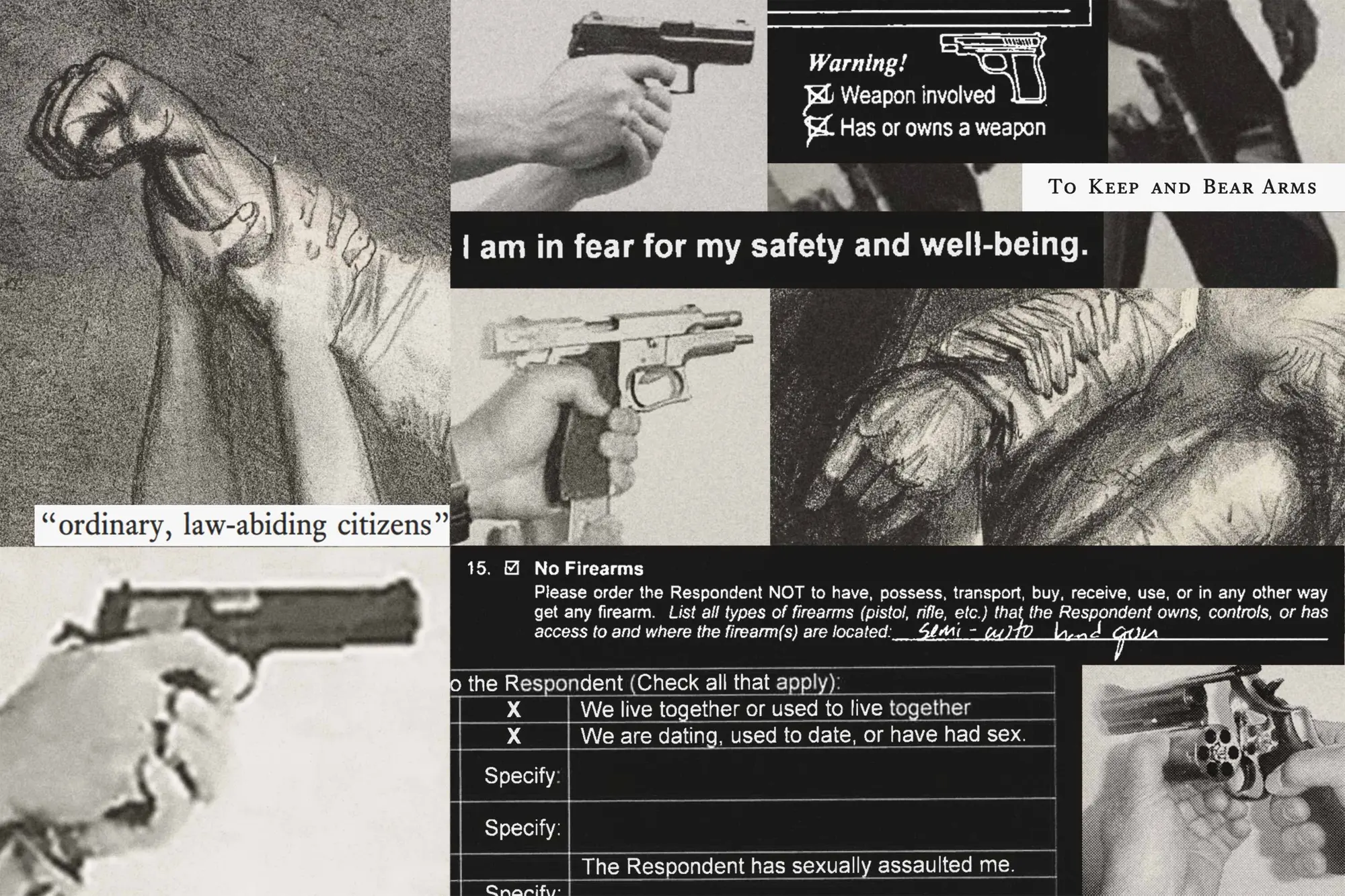 Photo illustration by Lisa Larson-Walker/ProPublica. Source images: Protective orders obtained by WPLN; lithograph by George Bellows via Wikimedia Commons; supremecourt.gov; California Department of Justice Firearms Safety Certificate Manual
.
.
Click the link below for the article:
.
__________________________________________
November 7, 2023
Mohenjo
Business, Human Interest, Political, Science, Technical
amazon, business, Business News, current-events, Future, Hotels, human-rights, medicine, mental-health, research, Science, Science News, technology, Technology News, travel, vacation
Some content on this page was disabled on April 15, 2025 as a result of a DMCA takedown notice from Guardian Media Group. You can learn more about the DMCA here:
https://wordpress.com/support/copyright-and-the-dmca/
November 7, 2023
Mohenjo
Business, Human Interest, Political, Science, Technical
amazon, business, Business News, current-events, Future, Hotels, human-rights, medicine, mental-health, research, Science, Science News, technology, Technology News, travel, vacation

Click the link below the picture
.
Nausea sucks. It’s painful and all-consuming, and there’s almost nothing to be done once it hits. Little things can help—get some fresh air, sip a ginger ale, nibble on crackers—but nausea is on its own timeline. It sticks around until it’s ready to leave.
Perhaps that’s why I’ve held on so tightly to a bit of wisdom that my mom gave me when I was a kid plagued by stomachaches. It was something I could do that maybe, maybe, would help bring an end to the pain. And it didn’t require much effort. The trick, my mom told me, was to simply lie down on my left side.
The way I imagined it as a kid was that the hole in my stomach that led to my intestines was on the left side, so lying positioned that way would help it drain faster and make it stop hurting sooner. (Turns out this is not what is happening, but it’s what I believed at the time.) I’d lie on my side and envision the painful stuff inside me swirling out of my stomach. These days, whether it be the flu, a hangover, or stop-and-go traffic, I still find myself lying on my left side, urging the nausea away. It helps—a bit!
I’ve only recently begun to wonder if the trick is more than just a piece of mom wisdom. Turns out the whole concept of resting on your left side stems from the tradition of ayurveda, a system of medicine that originated in India more than 3,000 years ago. More recently, scientists have studied how body position can affect digestion, focusing on acid reflux. The evidence suggests that lying on the left side indeed reduces heartburn. For instance, in a small study from 2000, those who lay on their left side experienced fewer and shorter reflux episodes in the four hours after eating a fatty meal than did those who lay on their right side
.
 Photo illustration by Slate. Photos by Getty Images Plus.
.
.
Click the link below for the article:
.
__________________________________________
Older Entries
Newer Entries
 James' World 2