January 11, 2025
Mohenjo
Business, Food For Thought, Human Interest, Political, Science, Technical
amazon, business, Business News, current-events, Future, Hotels, human-rights, medicine, mental-health, research, Science, Science News, technology, Technology News, travel, vacation

Click the link below the picture
.
About 170 million people use TikTok in the U.S., but that number could abruptly plummet toward zero if a law signed by President Joe Biden goes into effect on January 19. The law forces a choice for ByteDance, the China-based company that owns TikTok: it must either sell the app to a non-Chinese company or face a ban. ByteDance has repeatedly said the app is not for sale.
Instead, the company sued to keep the TikTok app available in the U.S.—and that case has now made its way before the Supreme Court. In oral arguments on Friday, Noel Francisco, attorney for ByteDance’s U.S. subsidiary TikTok, Inc., argued that the new law violates the First Amendment rights of that subsidiary, likening TikTok’s curation algorithm to editorial discretion. U.S. solicitor general Elizabeth Prelogar, arguing on behalf of the nation’s government, countered that China does not have a First Amendment right to manipulate content in the U.S. And she claimed that “the Chinese government could weaponize TikTok at any time to harm the United States.”
The Supreme Court is expected to issue a decision within the next nine days.
Why is the clock ticking for TikTok?
Congress, which passed the TikTok law with bipartisan support, says China’s influence over the platform poses a national security threat. The Department of Justice has raised concerns as well, including the potential collection of personal data from the app’s millions of American users and the potential “covert manipulation” of its content. (Although there is evidence that ByteDance shared non-U.S. user data with China, the U.S. government has not provided direct proof that the company or its subsidiary have meddled with American users.)
What might happen?
If TikTok loses its case, “as I understand it, we go dark,” Francisco told the Supreme Court on Friday. Americans would no longer be able to download or update TikTok from Google’s or Apple’s app stores. Internet service providers, too, would face severe penalties if they permitted TikTok access to U.S. users.
Americans may react in similar ways as former TikTok users elsewhere. After India banned the app in 2020, users flocked to other forms of short-form video, such as Instagram reels and YouTube Shorts. It is also possible to access blocked content via virtual private networks, or VPNs, which could disguise traffic to make it appear to originate from a country where TikTok wasn’t banned.
President-elect Donald Trump, meanwhile, has asked the Supreme Court to delay interpreting the law until he takes office. An amicus brief filed on his behalf claims his “consummate dealmaking expertise” could save the platform while addressing the national security concerns. Last September Trump promised to save the app, posting on his social media network Truth Social, “FOR ALL OF THOSE THAT WANT TO SAVE TIK TOK IN AMERICA, VOTE TRUMP!” Legal scholars have criticized Trump’s request for a delay.
.
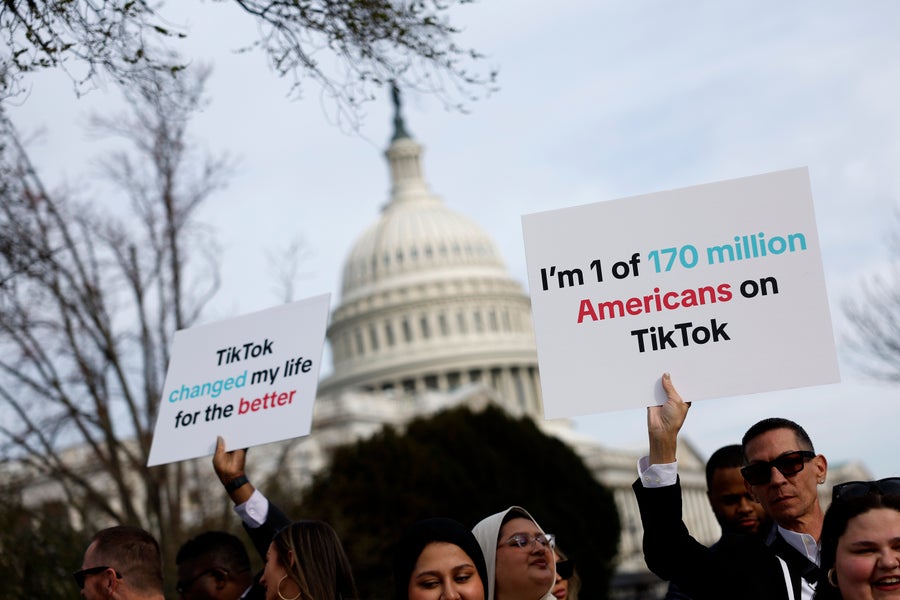
Participants hold signs in support of TikTok outside the U.S. Capitol Building on March 13, 2024, in Washington, D.C. Anna Moneymaker/Getty Images
.
.
Click the link below for the complete article:
.
__________________________________________
January 11, 2025
Mohenjo
Business, Food For Thought, Human Interest, Political, Science, Technical
amazon, business, Business News, current-events, Future, Hotels, human-rights, medicine, mental-health, research, Science, Science News, technology, Technology News, travel, vacation

Click the link below the picture
.
Last month I peeked my head into my son’s bed cave at 9:15 AM and whispered to him that I was off to a meeting, then to a friend’s house. When I squeezed his foot as I zipped him back in, his pre-teen body making the twin bed look tiny, I felt happy. I immediately thought of the word freedom.
And then I thought, as I often do, of a photo from 2021. In the picture, it’s also winter, and I’m hiding under that same son’s bed. We are in our tenth month of no childcare, no school, no daycare. My ear is pressed to my shoulder and my knee is in my armpit. I look like I’m playing 2-dimensional Twister, and losing. I remember the moment my daughter took the picture with her iPad, delighted because she’d found me in our game of hide and seek. In the photo, I look contorted and trapped. I am, of course, smiling.
During those lockdown months, my children were 2, 3, 4, 5. And I don’t know if you have been around any 3-year-olds lately, but there was a physical and emotional intensity to parenting during this time that is beyond any description; if you have ever been furious with a child, imagine being locked in a room with them and unable to leave for a year. Imagine how much you would want to be alone.
And so there is a part of me, emotionally but physically too, that is constantly bracing, as if I’m still alone in the house with my kids. And I can’t stop thinking about that photo because in some ways I’m still in it. I think, I know, it’s the reason that, in the years since, what I always wanted — what I still want, need, more than anything — is space. Time alone so I can breathe; unclench.
My husband, thankfully, works long days out of our house. He takes the kids out to breakfast on weekend mornings so I can have a few hours to myself; they have regular dad and kids dinners at restaurants while I exist alone in our house. A friend described herself as Gollum, the way she guards her time alone, and I felt seen. I guard my girls’ trips, my book club times, my silent baths. I curl around my precious snatches of time like Gollum with his ring, too, hissing at social obligations or even another hour of snuggles (please say I’m not the only one?).
But something has changed, and I’m only just starting to notice it. I don’t feel trapped in the same way. I don’t know if it’s that (for better or worse) social supports are back and running post-pandemic, or if it’s just my kids getting older. I do know any sliver of community care —playdates, shared pickups — still feels extraordinary.
And I know the feeling of freedom can go away at any time — a medical diagnosis, job loss, even relationships. There are many ways mothers can be trapped, and just because I feel some freedom now doesn’t mean I always will.
But still: yesterday I came out of hiding in my bedroom, where I’d holed up to get some writing in, only to find the house was quiet. I had come out into the living room, dreading the immediate dive into the what was for dinner debate, but my kids were off running around the neighborhood. My house was empty, but I was still hiding.
Who, exactly, am I hiding away from?
This possibility, this perspective, that motherhood doesn’t have to mean feeling trapped feels something like a secret. I wonder if I might be alone in this feeling, or if I’m just a selfish mother (another thing to discuss in therapy this week), or if many lockdown parents feel this way.
.
 romper
.
.
Click the link below for the complete article:
.
__________________________________________
January 10, 2025
Mohenjo
Business, Food For Thought, Human Interest, Political, Science, Technical
amazon, business, Business News, current-events, Future, Hotels, human-rights, medicine, mental-health, research, Science, Science News, technology, Technology News, travel, vacation
Click the link below the picture
.
CLIMATEWIRE | As historic fires rip through the Los Angeles area, President-elect Donald Trump is demanding Gov. Gavin Newsom “open up the water main” and allow “beautiful, clean, freshwater to FLOW INTO CALIFORNIA!”
At first glance, it seems to make sense. Why wouldn’t the leader of a state whose northern regions are currently enjoying above-average winter precipitation redirect water south to quench the burning metropolis as its fire hydrants run dry?
To start, there isn’t some central spigot nestled in the Sierra foothills that Newsom can just use a giant wrench to turn on. Then there’s the fact that firefighters were more hamstrung by the raging Santa Ana winds than empty hydrants due to a lack of water from Northern California.
Read on for a detailed explanation from our resident California water expert of the state’s complex water system and a brief history of Trump’s fixation with the issue.
What’s up with the ‘water restoration declaration?’
On Wednesday, Trump posted on Truth Social: “Governor Gavin Newscum refused to sign the water restoration declaration put before him that would have allowed millions of gallons of water, from excess rain and snow melt from the North, to flow daily into many parts of California, including the areas that are currently burning in a virtually apocalyptic way.”
Newsom’s communications director shot back: “There is no such document as the water restoration declaration — that is pure fiction.”
Is it? Not quite. Trump was referring to a real document, even if he used an unknown name for it that left even the most astute California water officials scratching their heads. Karoline Leavitt, the president-elect’s press secretary, explained the reference by pointing to a five-year-old legal showdown between Newsom and Trump over how to manage the state and federal systems of pumps, reservoirs, and canals that move water around California.
In short, the two disagree about how much water should be pumped out of the state’s main rivers, which combine in the Sacramento-San Joaquin River Delta, to the much drier farms of the Central Valley and cities of Southern California and how much water should be kept in the ecosystem to keep declining fish populations alive, including the Delta smelt, a frequent Trump target. Their separate plans for the pumps make only marginal differences in actual water deliveries but have taken on a political life of their own.
The conflict peaked in 2020 when Trump unveiled the “record of decision” cementing his version of the rules at a rally in the Central Valley — only to be sued by Newsom, citing harm to the environment
“That was the last significant water policy decision made during his first term in which both President Trump and Gov. Newsom took a personal interest,” said Tom Birmingham, the former general manager of Westlands Water District, the largest agricultural irrigation district in the country that sided with Trump in that battle.
.
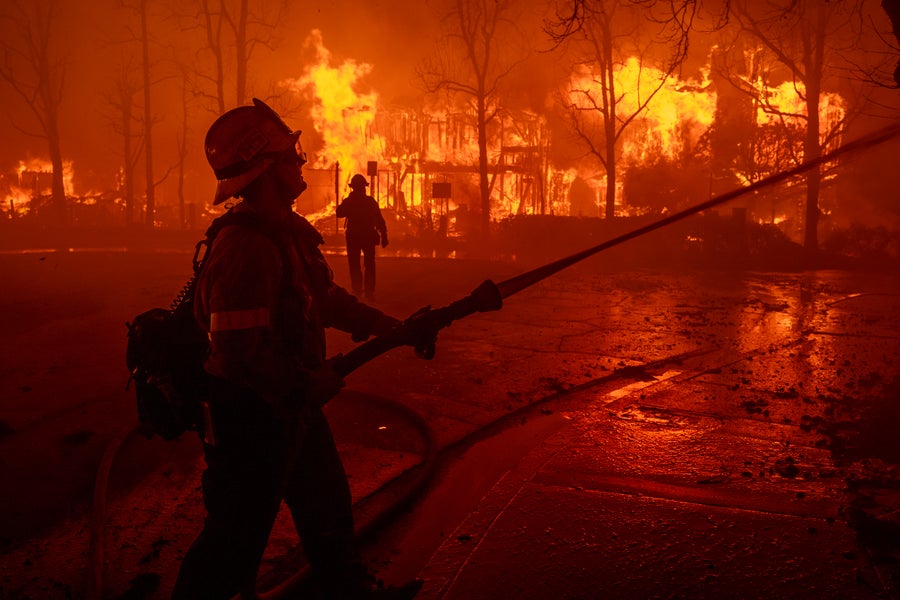
Firefighters battle the Eaton Fire in strong winds as many homes burn on January 7, 2025, in Pasadena, California. A powerful Santa Ana wind event dramatically raised the danger of wind-driven wildfires. David McNew/Getty Images
.
.
Click the link below for the complete article:
.
__________________________________________
January 10, 2025
Mohenjo
Business, Food For Thought, Human Interest, Political, Science, Technical
amazon, business, Business News, current-events, Future, Hotels, human-rights, medicine, mental-health, research, Science, Science News, technology, Technology News, travel, vacation

Click the link below the picture
.
Dressing your child appropriately for winter weather sounds simple, but according to my mom, a former preschool teacher, parents don’t always hit the mark. Between temperature changes throughout the day, your child’s activities, and what your child is actually willing to wear, there are several reasons why it’s easy to miss key details in your kid’s winter attire. As a mom to a preschooler myself, I’m certainly not immune.
I asked for my mom’s input and found 12 preschool-friendly winter clothing items to keep kids warm, dry, and comfortable during cold temperatures and fun snow days in between. From colorful merino wool socks to kids’ snow boots and a classic coat (with a removable hood!), it’s safe to say that my kiddo is ready for winter weather. Is yours? Keep scrolling to find out.
Gloves are essential in the winter, especially during recess. Since gloves can get lost easily, my mom recommends buying inexpensive pairs that come in a pack. This knit set comes in a pack of three with 12 different color combinations and multiple sizes (up to 10 years old).
One grandma bought these gloves for her 3-year-old granddaughter, who “loves the bright colors and was happy to have gloves instead of mittens.” The gloves also “held up very well when building her snowman, and after washing and drying them,” she added.
You’ll want this Miles the Label Snowsuit on hand each year because it’s so warm and cozy. One of our writers received a sample for her 5-year-old, who couldn’t stop raving about the “extra soft” fleece lining and removable faux fur edge on the hood, which “keeps my face warm.” Our writer says she saves the snowsuit pants for snow days and sends her son to school with the jacket nearly every day when it’s cold.
This kids’ coat is wind-resistant and can withstand temperatures down to -22 degrees Fahrenheit. It also features an elastic waistband and cuffs to trap heat and a Velcro cover over the zipper for extra protection. The pants have even more thoughtful features, like reinforced knees, adjustable and removable suspenders, and more.
Bonus: The parka includes a sewn-on label to write your child’s name.
.
:max_bytes(150000):strip_icc()/par-preschool-teacher-recs-for-winter-clothes-tout-34b5a0ed572f41e7a8280b787e2be294.jpg) Parents
Parents
.
.
Click the link below for the complete article:
.
__________________________________________
January 9, 2025
Mohenjo
Business, Food For Thought, Human Interest, Political, Science, Technical
amazon, business, Business News, current-events, Future, Hotels, human-rights, medicine, mental-health, research, Science, Science News, technology, Technology News, travel, vacation
Click the link below the picture
.
Another explosive wildfire in California, driven by the region’s notorious Santa Ana winds, has burned thousands of buildings and has forced thousands of people to evacuate from their homes. The Palisades Fire began at 10:30 A.M. local time on Tuesday near Los Angeles’s Pacific Palisades neighborhood. Much of the neighborhood is under evacuation orders, which extended to northern Santa Monica. As of Thursday morning, the fire had scorched more than 17,000 acres and destroyed more than 2,000 structures.
Another blaze, the Eaton Fire, erupted on Tuesday evening in Altadena, Calif., just north of Los Angeles. As of late Wednesday, it had burned more than 10,000 acres and resulted in at least five deaths. Both fires had caused numerous injuries, according to officials.
On Wednesday evening, another fire began in the heart of Los Angeles just north of Hollywood. The fire grew rapidly to cover more than 40 acres as it spread downhill in Runyon Canyon. Though winds were not as high as Tuesday night, they were still pushing the fire and carrying embers that started spot fires. Helicopters made water drops, which helped beat back the flames.
Forecasters had warned that the risk of fire was extremely high this week, reaching “particularly dangerous situation” status as the ferocious winds combined with tinder-dry vegetation after a lack of rain during the beginning of what would usually be the wet season.
Gusts around the Palisades Fire were measured in the range of 40 to 50 miles per hour as of Tuesday afternoon, climate scientist Daniel Swain said during one of his regular “virtual climate and weather office hours,” hosted on YouTube. “Right now the winds are not extremely high, but again, they’re high enough,” said Swain, who is at the University of California Agriculture and Natural Resources. Gusts were expected to reach 70 to 80 mph as the winds would peak on Tuesday night into Wednesday, with some places potentially seeing gusts as high as 100 mph. Gusts of 99 mph was measured in the San Gabriel Mountains north of Pasadena, Calif.
What Are the Santa Ana Winds?
The Santa Ana winds commonly propel fast-moving, damaging fires in this area; their characteristic dryness and speed can rapidly fan and spread flames. These winds are a result of local geography and a particular meteorological setup in which a high-pressure system sits over the Great Basin in the interior of the U.S. West and a low-pressure system hangs over California or offshore. Winds “want” to move from high to low pressure, and as they do so in this area, they travel downslope from the relatively high deserts. This descent compresses the air, warming it up and drying it out. (Such downslope winds, which happen in other locations around the world, are scientifically termed katabatic winds.)
The Santa Ana winds are additionally funneled through narrow mountain canyons, which causes them to speed up. The hot, dry, and fast nature of these winds makes them perfectly suited to spreading flames from any spark that ignites. The winds blow embers well ahead of the fire front, starting new spot fires. “Those embers are going to follow the wind and burn whatever they want,” Swain said in another video on YouTube on Tuesday.
In a couple of respects, this Santa Ana wind event isn’t a typical one: it “is especially extreme and is reaching lower elevations than usual with strong winds,” Swain said in another briefing on Wednesday morning.
Is Climate Change Playing a Role in the Los Angeles Fires?
The timing of the event is more in line with the norm: Santa Ana events typically happen from October through January. Part of what is raising fire risks from these events, though, is related to the influence of climate change on fluctuations in the region’s precipitation.
.
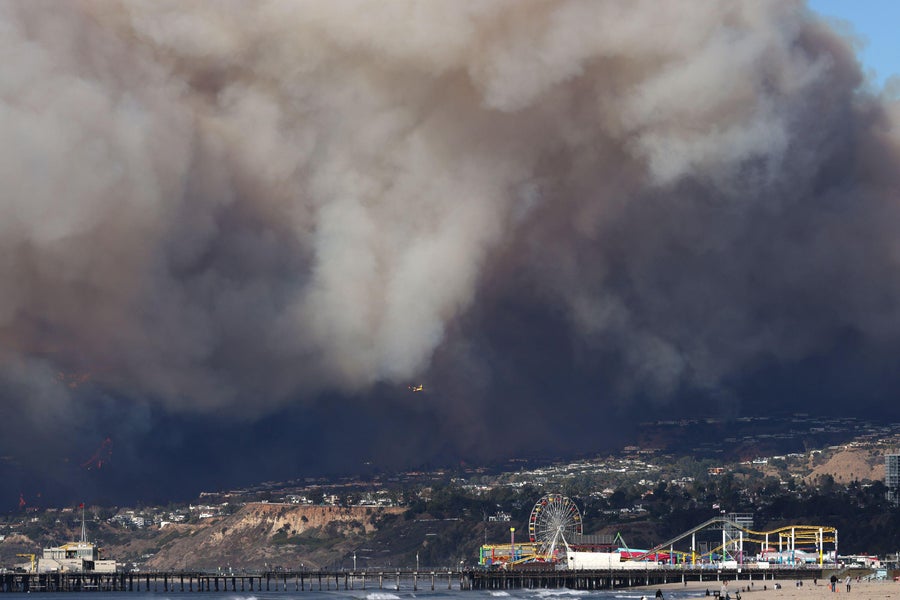
The Palisades Fire on January 7, 2025. ZUMA Press, Inc./Alamy Stock Photo
.
.
Click the link below for the complete article:
.
__________________________________________
January 9, 2025
Mohenjo
Business, Food For Thought, Human Interest, Political, Science, Technical
amazon, business, Business News, current-events, Future, Hotels, human-rights, medicine, mental-health, research, Science, Science News, technology, Technology News, travel, vacation

Click the link below the picture
.
Here’s an example of a text she sent to a friend who was one month postpartum:
Good morning love! I am yours from the hours of 12 to 3 tomorrow so please let me know how you would like to use me. Here are some options:
1. I come while you hang with the baby and I do laundry, bottles, cooking, buy and put away groceries.
2. I come and take care of the baby while you sleep in your room alone or you go do something by yourself or you guys go out to lunch the two of you without the baby.
3. I come and take you out to lunch with or without the baby.
4. And we sit on the couch and just chat or watch a funny movie with the baby.
You can decide whenever you want, just let me know!
The key here is that there are multiple options to choose from, each laid out clearly so the new parent only has to respond with a single number: 1, 2, 3, or 4. Rogers likes to include tasks that someone might be uncomfortable asking of a friend, like doing laundry or washing bottles.
“Everyone’s like, ‘Oh, let me know what you want. Let me know how I can help.’ You’re so far deep in this world of postpartum ‘whatever’ that you don’t even know how to ask someone for something,” she said in her Reel. “Also, there aren’t many people, other than my sisters, that I would ask to be like, ‘Can you just come over and clean?’”
If your friend has another kid, Rogers suggests in the video, you might also offer an option like coming over to hang with the toddler or taking the toddler out of the house while your friend is with the baby. Or you can offer to take care of the baby so your friend gets some one-on-one time with their other child.
This approach is generally going to be more useful to a parent than an open-ended offer like “Let me know how I can help!”
As postpartum educator Amy Spofford commented on Instagram: “Be specific in your offers of help and you will exponentially increase the likelihood they’ll take you up on it and that they’ll really feel the impact and benefit of it. I’ve said, ‘Hey I’m making you dinner this week, Monday or Wednesday, soup or enchiladas?’ They’ll never answer if you say, ‘Let me know if you need anything.’”
Gayane Aramyan is a Los Angeles marriage and family therapist specializing in the postpartum period. She said she “absolutely loves” Rogers’ idea.
“Oftentimes, new moms have a really hard time asking for help, even from loved ones,” Aramyan told HuffPost. “It’s great for people around to offer options and ideas so the new mom can feel more comfortable that their loved one is there to actually help.”
She also suggests having a conversation with your friend before the baby’s arrival to discuss any boundaries they might want to set.
.

Johner Images via Getty Images This is the kind of text message you probably wish you’d received as a new parent.
.
.
Click the link below for the complete article:
.
__________________________________________
January 8, 2025
Mohenjo
Business, Food For Thought, Human Interest, Political, Science, Technical
amazon, business, Business News, current-events, Future, Hotels, human-rights, medicine, mental-health, research, Science, Science News, technology, Technology News, travel, vacation
Click the link below the picture
.
A constitutional winter is upon us, partly enabled by last summer’s spike in the price of eggs. While the Federal Reserve battled egg inflation, angry voters reinstalled Donald Trump in the White House. Among his first acts: appointing two tech billionaires, Elon Musk and Vivek Ramaswamy, as efficiency czars. What their Department of Government Efficiency (DOGE)—more an advisory group, really—proposes to do, however, involves constitutional gambits that would rob James Madison, the “father of the Constitution,” of sleep.
Trump rode to victory attacking grocery costs and convincing voters that government was wasteful and that he alone could fix their grievances. His supporters included people fed up with Bidenomics and administrative snafus, everyday bureaucratic mazes that waste time, money, and patience.
Incoming presidents have often promised to address such snafus. Most famously, former president Bill Clinton, with his vice president, Al Gore, launched a “reinventing government” initiative that sought solutions from career public servants even as the initiative trumpeted basic business principles.
In stark contrast, Trump’s first-term agenda of “deconstructing the administrative state” failed in its ultimate goal of making key federal positions at-will hires to somehow deliver better government. Through DOGE, Trump will try again to overhaul the bureaucracy, this time with the help of business people whose ideas about the Constitution presage lengthy court battles.
In November, what appeared as the DOGE plan in the Wall Street Journal revealed a fundamental misunderstanding of public administration. Rather than addressing administrative snafus with a scalpel, DOGE risks creating constitutional ones with its axe.
DOGE’s lip service to eliminating “waste, fraud and abuse” thinly veils an agenda aimed at dismantling corporate watchdogs, from the EPA to the FDIC, and politicizing agencies like the DOJ and IRS to pursue presidential ends, without constitutional guardrails. This approach threatens the delicate constitutional balance that has sustained the Republic for over a century, dividing power among the three branches and the nonpartisan bureaucracy in their midst.
To nurture this balance, DOGE could consider mission-driven recommendations from the good government community of public administration scholars and nonpartisan research groups like the National Academy of Public Administration. They routinely investigate the best ways to make government more efficient and effective. Their past research findings can improve hiring, program implementation, cost management and other administrative techniques. These could have real, positive impacts on government efficiency while still allowing Trump to leave a positive legacy on the civil service. Plenty of these initiatives are already moving bureaucracy away from its technocratic, often snafu-riddled proceduralism to a more publicly engaged demonstration of outcomes.
Instead, the DOGE blueprint blatantly ignores Congress—even with GOP control—and champions the “unitary executive” theory of government by presenting normal bureaucratic rulemaking as a supposed scourge of democracy. Overstretching the summer’s Supreme Court rulings in West Virginia v. EPA and Loper Bright Enterprises v. Raimondo, the DOGE blueprint assumes that this executive, backed by a sympathetic judiciary, can “drive action” through reorganization, rule nullification, and impoundments.
.
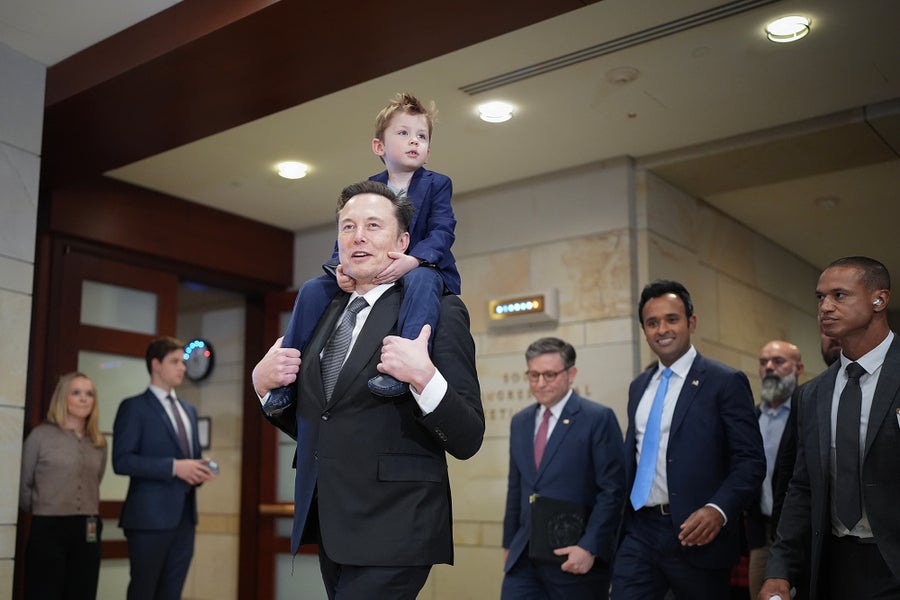
Tesla CEO Elon Musk, co-chair of the newly announced Department of Government Efficiency (DOGE), carries his son X on his shoulders at the U.S. Capitol after a media availability with businessman Vivek Ramaswamy (third from right). Andrew Harnik/Getty Images
.
.
Click the link below for the complete article:
.
__________________________________________
January 8, 2025
Mohenjo
Business, Food For Thought, Human Interest, Political, Science, Technical
amazon, business, Business News, current-events, Future, Hotels, human-rights, medicine, mental-health, research, Science, Science News, technology, Technology News, travel, vacation

Click the link below the picture
.
For the last couple of years, we’ve had a go at predicting what’s coming next in AI. A fool’s game given how fast this industry moves. But we’re on a roll, and we’re doing it again.
How did we score last time round? Our four hot trends to watch out for in 2024 included what we called customized chatbots—interactive helper apps powered by multimodal large language models (check: we didn’t know it yet, but we were talking about what everyone now calls agents, the hottest thing in AI right now); generative video (check: few technologies have improved so fast in the last 12 months, with OpenAI and Google DeepMind releasing their flagship video generation models, Sora and Veo, within a week of each other this December); and more general-purpose robots that can do a wider range of tasks (check: the payoffs from large language models continue to trickle down to other parts of the tech industry, and robotics is top of the list).
We also said that AI-generated election disinformation would be everywhere, but here—happily—we got it wrong. There were many things to wring our hands over this year, but political deepfakes were thin on the ground.
So what’s coming in 2025? We’re going to ignore the obvious here: You can bet that agents and smaller, more efficient, language models will continue to shape the industry. Instead, here are five alternative picks from our AI team.
1. Generative virtual playgrounds
If 2023 was the year of generative images and 2024 was the year of generative video—what comes next? If you guessed generative virtual worlds (a.k.a. video games), high fives all round.
We got a tiny glimpse of this technology in February, when Google DeepMind revealed a generative model called Genie that could take a still image and turn it into a side-scrolling 2D platform game that players could interact with. In December, the firm revealed Genie 2, a model that can spin a starter image into an entire virtual world.
Other companies are building similar tech. In October, the AI startups Decart and Etched revealed an unofficial Minecraft hack in which every frame of the game gets generated on the fly as you play. And World Labs, a startup co-founded by Fei-Fei Li—creator of ImageNet, the vast data set of photos that kick-started the deep-learning boom—is building what it calls large world models, or LWMs.
One obvious application is video games. There’s a playful tone to these early experiments, and generative 3D simulations could be used to explore design concepts for new games, turning a sketch into a playable environment on the fly. This could lead to entirely new types of games.
But they could also be used to train robots. World Labs wants to develop so-called spatial intelligence—the ability for machines to interpret and interact with the everyday world. But robotics researchers lack good data about real-world scenarios with which to train such technology. Spinning up countless virtual worlds and dropping virtual robots into them to learn by trial and error could help make up for that.
.
 Stephanie Arnett/MIT Technology Review | Lummi
.
.
Click the link below for the complete article:
.
__________________________________________
January 7, 2025
Mohenjo
Business, Food For Thought, Human Interest, Political, Science, Technical
amazon, business, Business News, current-events, Future, Hotels, human-rights, medicine, mental-health, research, Science, Science News, technology, Technology News, travel, vacation
Click the link below the picture
.
Ever since humans started gazing at the heavens through telescopes, we have discovered, bit by bit, that in celestial terms we’re apparently not so special. Earth was not the center of the universe, it turned out. It wasn’t even the center of the solar system! The solar system, unfortunately, wasn’t the center of the universe either. In fact, there were many star systems fundamentally like it, together making up a galaxy. And, wouldn’t you know, the galaxy wasn’t special but one of many, which all had their own solar systems, which also had planets, some of which presumably host their own ensemble of egoistic creatures with an overinflated sense of cosmic importance.
This notion of mediocrity has been baked into cosmology, in the form of the “cosmological principle.” Its gist is that the universe is basically the same everywhere we look—homogenized like milk, made of common materials evenly distributed in every direction. At the top of the cosmic hierarchy, giant groups of galaxies clump into sprawling, matter-rich filaments and sheets around gaping intergalactic voids, but past that, structure seems to peter out. If you could zoom way out and look at the universe’s big picture, says Alexia Lopez of the University of Central Lancashire in England, “it would look really smooth.”
Lopez compares the cosmos with a beach: If you plunked a handful of sand under a microscope, the sand grains would look like the special individuals they are. “You would see the different colors, shapes, and sizes,” she says. “But if you were to walk across the beach, looking out at the sand dunes, all you would see is a uniform golden beige color.”
That means Earth (or any of the other trillions of planets that must exist) and its tiny corner of the cosmos appear to hold no particularly privileged place in comparison to everything else. And this homogeneity is convenient for astronomers because it lets them look at the universe in part as a reliable way of making inferences about the whole; whether here in the Milky Way or in a nameless galaxy billions of light-years distant, prevailing conditions should be essentially the same.
This simplifying ethos applies to everything from understanding how dark matter weighs down galaxy clusters to estimating how common life-friendly conditions might be throughout the cosmos, and it allows astronomers to simplify their mathematical models of the universe’s past as well as their predictions of its future. “Everything is based on the idea that [the cosmological principle] is true,” Lopez says. “It is also a very vague assumption. So it’s really hard to validate.”
Validation is especially challenging when significant evidence exists to the contrary—and a host of recent observations suggest indeed that the universe could be stranger and have larger variations than cosmologists had so comfortably supposed.
If that’s the case, humans (and anyone else out there) actually might have a sort of special view of the light-years beyond—not privileged, per se, but also not average, in that “average” would no longer even be a useful concept at sufficiently large scales. “Different observers may see slightly different universes,” at least at large scales, says Valerio Marra, a professor at the Federal University of Espírito Santo in Brazil and a researcher at the Astronomical Observatory of Trieste in Italy.
Astronomers haven’t thrown out the cosmological principle just yet, but they are gathering clues about its potential weaknesses. One approach involves looking for structures so large they challenge cosmic smoothness even at a hugely wide zoom. Scientists have calculated that anything wider than about 1.2 billion light-years would upset the homogeneous cosmic apple cart.
.
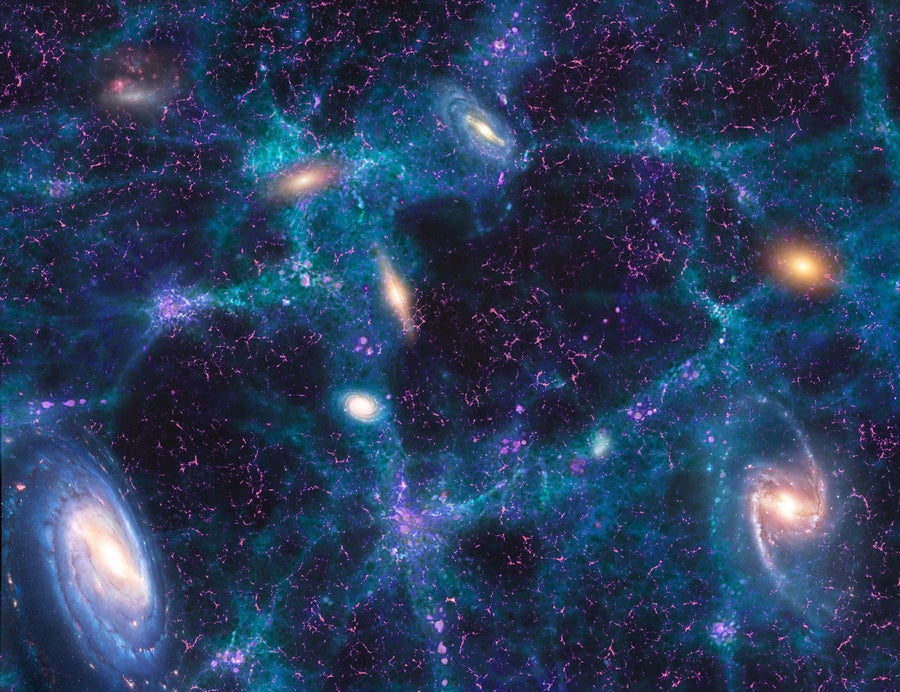
An illustration of the cosmic web, the universe’s large-scale structure of composed of galaxy-rich clumps and filaments alongside giant intergalactic voids mostly bereft of matter. At even larger scales, cosmic structure seems to smooth out into near-featureless homogeneity. Mark Garlick/Science Photo Library/Alamy Stock Photo
.
.
Click the link below for the complete article:
.
__________________________________________
January 7, 2025
Mohenjo
Business, Food For Thought, Human Interest, Political, Science, Technical
amazon, business, Business News, current-events, Future, Hotels, human-rights, medicine, mental-health, research, Science, Science News, technology, Technology News, travel, vacation
Click the link below the picture
.
We all know what it means, colloquially, to google something. You pop a few relevant words in a search box and in return get a list of blue links to the most relevant results. Maybe some quick explanations up top. Maybe some maps or sports scores or a video. But fundamentally, it’s just fetching information that’s already out there on the internet and showing it to you, in some sort of structured way.
But all that is up for grabs. We are at a new inflection point.
The biggest change to the way search engines have delivered information to us since the 1990s is happening right now. No more keyword searching. No more sorting through links to click. Instead, we’re entering an era of conversational search. Which means instead of keywords, you use real questions, expressed in natural language. And instead of links, you’ll increasingly be met with answers, written by generative AI and based on live information from all across the internet, delivered the same way.
Of course, Google—the company that has defined search for the past 25 years—is trying to be out front on this. In May of 2023, it began testing AI-generated responses to search queries, using its large language model (LLM) to deliver the kinds of answers you might expect from an expert source or trusted friend. It calls these AI Overviews. Google CEO Sundar Pichai described this to MIT Technology Review as “one of the most positive changes we’ve done to search in a long, long time.”
AI Overviews fundamentally change the kinds of queries Google can address. You can now ask it things like “I’m going to Japan for one week next month. I’ll be staying in Tokyo but would like to take some day trips. Are there any festivals happening nearby? How will the surfing be in Kamakura? Are there any good bands playing?” And you’ll get an answer—not just a link to Reddit, but a built-out answer with current results.
More to the point, you can attempt searches that were once pretty much impossible, and get the right answer. You don’t have to be able to articulate what, precisely, you are looking for. You can describe what the bird in your yard looks like, or what the issue seems to be with your refrigerator, or that weird noise your car is making, and get an almost human explanation put together from sources previously siloed across the internet. It’s amazing, and once you start searching that way, it’s addictive.
And it’s not just Google. OpenAI’s ChatGPT now has access to the web, making it far better at finding up-to-date answers to your queries. Microsoft released generative search results for Bing in September. Meta has its own version. The startup Perplexity was doing the same, but with a “move fast, break things” ethos. Literal trillions of dollars are at stake in the outcome as these players jockey to become the next go-to source for information retrieval—the next Google.
Not everyone is excited for the change. Publishers are completely freaked out. The shift has heightened fears of a “zero-click” future, where search referral traffic—a mainstay of the web since before Google existed—vanishes from the scene.
I got a vision of that future last June, when I got a push alert from the Perplexity app on my phone. Perplexity is a startup trying to reinvent web search. But in addition to delivering deep answers to queries, it will create entire articles about the news of the day, cobbled together by AI from different sources.
On that day, it pushed me a story about a new drone company from Eric Schmidt. I recognized the story. Forbes had reported it exclusively, earlier in the week, but it had been locked behind a paywall. The image on Perplexity’s story looked identical to one from Forbes. The language and structure were quite similar. It was effectively the same story, but freely available to anyone on the internet. I texted a friend who had edited the original story to ask if Forbes had a deal with the startup to republish its content. But there was no deal. He was shocked and furious and, well, perplexed. He wasn’t alone. Forbes, the New York Times, and Condé Nast have now all sent the company cease-and-desist orders. News Corp is suing for damages.
.
 George Wylesol
.
.
Click the link below for the complete article:
.
__________________________________________
Older Entries
Newer Entries

