Before Central Park was created, the landscape along what is now the Park’s perimeter from West 82nd to West 89th Street was the site of Seneca Village, a community of predominantly African-Americans, many of whom owned property. By 1855, the village consisted of approximately 225 residents, made up of roughly two-thirds African-Americans, one-third Irish immigrants, and a small number of individuals of German descent. One of few African-American enclaves at the time, Seneca Village allowed residents to live away from the more built-up sections of downtown Manhattan and escape the unhealthy conditions and racial discrimination they faced there.
The formation of Seneca Village
Seneca Village began in 1825, when landowners in the area, John and Elizabeth Whitehead, subdivided their land and sold it as 200 lots. Andrew Williams, a 25-year-old African-American shoeshiner, bought the first three lots for $125. Epiphany Davis, a store clerk, bought 12 lots for $578, and the AME Zion Church purchased another six lots. From there a community was born. From 1825 to 1832, the Whiteheads sold about half of their land parcels to other African-Americans. By the early 1830s, there were approximately 10 homes in the Village.
There is some evidence that residents had gardens and raised livestock in Seneca Village, and the nearby Hudson River was a likely source of fishing for the community. A nearby spring, known as Tanner’s Spring, provided a water source. By the mid-1850s, Seneca Village comprised 50 homes and three churches, as well as burial grounds, and a school for African-American students.
A thriving African-American community
For African-Americans, Seneca Village offered the opportunity to live in an autonomous community far from the densely populated downtown. Despite New York State’s abolition of slavery in 1827, discrimination was still prevalent throughout New York City, and severely limited the lives of African-Americans. Seneca Village’s remote location likely provided a refuge from this climate. It also would have provided an escape from the unhealthy and crowded conditions of the City, and access to more space both inside and outside the home.
Compared to other African-Americans living in New York, residents of Seneca Village seem to have been more stable and prosperous—by 1855, approximately half of them owned their own homes. With property ownership came other rights not commonly held by African-Americans in the City—namely, the right to vote. In 1821, New York State required African-American men to own at least $250 in property and hold residency for at least three years to be able to vote. Of the 100 black New Yorkers eligible to vote in 1845, 10 lived in Seneca Village.Tangie
.
Nearly 200 years ago, Central Park’s landscape near the West 85th Street entrance was home to Seneca Village, a community of predominately free African-American property owners.
I’m a psychologist, and AI is coming for my job. The signs are everywhere: a client showing me how ChatGPT helped her better understand her relationship with her parents; a friend ditching her in-person therapist to process anxiety with Claude; a startup raising $40 million to build a super-charged-AI-therapist. The other day on TikTok, I came across an influencer sharing how she doesn’t need friends; she can just vent to God and ChatGPT. The post went viral, and thousands commented, including:
“ChatGPT talked me out of self-sabotaging.”
“It knows me better than any human walking this earth.”
“No fr! After my grandma died, I told chat gpt to tell me something motivational… and it had me crying from the response.”
I’d be lying if I said that this didn’t make me terrified. I love my work—and I don’t want to be replaced. And while AI might help make therapy more readily available for all, beneath my personal fears, lies an even more unsettling thought: whether solving therapy’s accessibility crisis might inadvertently spark a crisis of human connection.
Therapy is a field ripe for disruption. Bad therapists are, unfortunately, a common phenomenon, while good therapists are hard to find. When you do manage to find a good therapist, they often don’t take insurance and almost always charge a sizable fee that, over time, can really add up. AI therapy could fill an immense gap. In the U.S. alone, more than half of adults with mental health issues do not receive the treatment they need. With the help of AI, any person could access a highly skilled therapist, tailored to their unique needs, at any time. It would be revolutionary.
But great technological innovations always come with tradeoffs, and the shift to AI therapy has deeper implications than 1 million mental health professionals potentially losing their jobs. AI therapists, when normalized, have the potential to reshape how we understand intimacy, vulnerability, and what it means to connect.
Throughout most of human history, emotional healing wasn’t something you did alone with a therapist in an office. Instead, for the average person facing loss, disappointment, or interpersonal struggles, healing was embedded in communal and spiritual frameworks. Religious figures and shamans played central roles—offering rituals, medicines, and moral guidance. In the 17th century, Quakers developed a notable practice called “clearness committees,” where community members would gather to help an individual find answers to personal questions through careful listening and honest inquiry. These communal approaches to healing came with many advantages, as they provided people with social bonds and shared meaning. But they also had a dark side: emotional struggles could be viewed as moral failings, sins, or even signs of demonic influence, sometimes leading to stigmatization and cruel treatment.
The birth of modern psychology in the West during the late 19th century marked a profound shift. When Sigmund Freud began treating patients in his Vienna office, he wasn’t merely pioneering psychoanalysis—he was transforming how people dealt with life’s everyday challenges. As sociologist Eva Illouz notes in her book, Saving the Modern Soul, Freud gave “the ordinary self a new glamour, as if it were waiting to be discovered and fashioned.” By convincing people that common struggles—from sadness to heartbreak to family conflict —required professional exploration, Freud helped move emotional healing from the communal sphere into the privacy of the therapist’s office.
Among the slew of actions that President Donald Trump has taken during his first weeks back in office has been a barrage of attacks on federal scientists and scientific funding. The administration’s science agencies have fired thousands of employees, attempted to freeze research disbursements and proposed new policies that would reduce funding into the future.
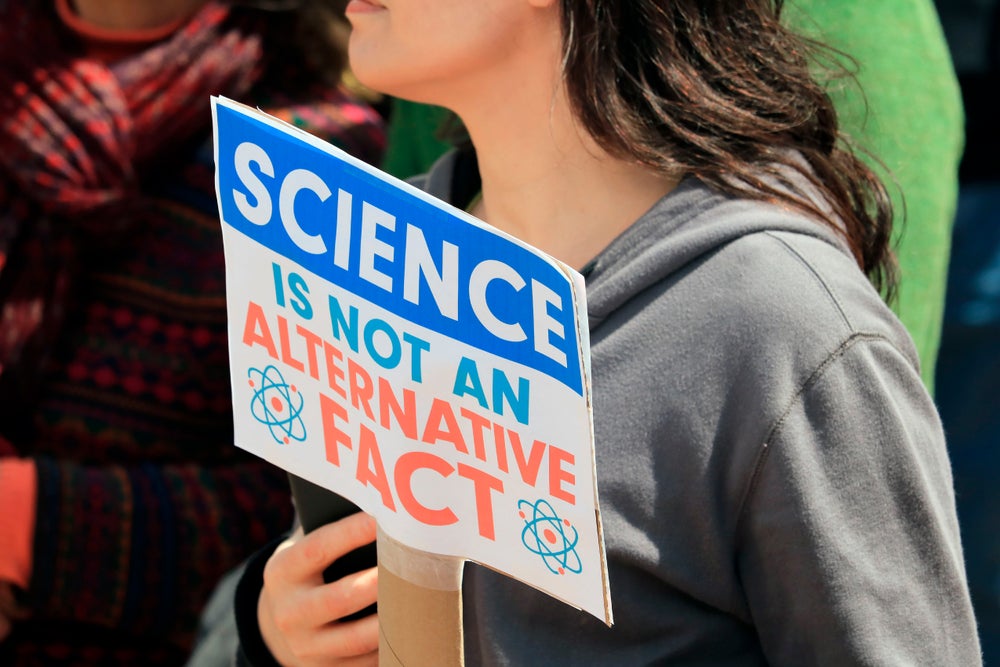
Against this backdrop, a team of early-career researchers is organizing nationwide rallies on March 7 to “Stand Up for Science”—a call for people across the U.S. to demonstrate to show their appreciation of science and its benefits to society. Rallies will take place in Washington, D.C., Chicago, Boston, Philadelphia, Seattle, Nashville, Tenn., Austin, Tex., and many other places across the country. The network of stationary rallies is set to take place eight years after the March for Science protests that met Trump’s first administration—which Stand Up for Science’s organizers hope helped prepare scientists to wade into politics.
To learn about Stand Up for Science’s plans and goals, Scientific American talked with three of its lead organizers: Colette Delawalla, a Ph.D. candidate in clinical psychology at Emory University, Emma Courtney, a Ph.D. candidate in biology at Cold Spring Harbor Laboratory, and Sam Goldstein, a Ph.D. candidate in health behavior at the University of Florida.
[An edited transcript of the interview follows.]
How did each of you come to this place of wanting to step into activism?
DELAWALLA: I was just really mad. At the end of the day, I just want to do my research. I really think that studying addiction is important, and all science is important. But it really hit home for me, personally. I was angry, and it just seemed like everybody else was angry, too, and nobody else was doing anything about it. And, you know, “be the change you want to see in the world,” as cheesy as that is.
Are you connected at all to the 2017 March for Science?
DELAWALLA: Nobody in our core leadership team overlaps with people who were in the March for Science core leadership team. But we have been in contact with a number of the organizers from that group, and they seem to be really supportive and kind and generous with their advice and time and connections. And we’re so grateful.
We really appreciate that they were so ahead of their time in understanding that what was coming down the pipe in 2017 was really serious. They laid the groundwork for people to have a working conception of what it means for scientists and people who believe in science to come together. Without that foundation, I don’t know that we would have had as much success.
GOLDSTEIN: It feels sort of like a passing of the baton—we probably wouldn’t have known where to really start.
COURTNEY: What I have found really impactful in talking with the March for Science organizers is the event, day of, is really important. But it’s also about building a sustained movement that actually drives policy change.
“We’re trying to give folks somewhere they can feel powerful and have their voices heard.”What does a successful day on March 7 look like for you?
DELAWALLA: We want thousands and thousands of people to come. All over the U.S., we want people to put down their science, put down the pipette, close their R script, cancel their run-throughs of their experiments that day and come out. That is our number one goal for March 7.
Additionally, we want this to come up on the public’s and our government representatives’ radar. We do have plans to be meeting elected officials in Washington, D.C., in the week leading up to the rally. The goal is that we start off with a bang. This is sort of the science block party to really launch the demands into public view and to start the work on seeing them met.
GOLDSTEIN: It feels like this is only the beginning of the conversation. This is really just, across America, giving folks that maybe feel a lot of despair across this first month an outlet to feel heard and understood and comforted by like-minded individuals. Despair can sometimes breed apathy. The more it hits you, the more you doomscroll, the more you just feel powerless. We’re trying to give folks somewhere they can feel powerful and have their voices heard.
.
March for Science rally in Lafayette, Ind., on April 22, 2017. Education Images/Universal Images Group via Getty Images
Reading is good for you in many ways. It fosters creativity, self-improvement and open-mindedness. Researchers even have determined it can help you live longer. Here are popular titles suggested by more than a dozen successful executives.
1. Shoe Dog by Phil Knight
“Too many business autobiographers go to great lengths to portray themselves as all-knowing and unwavering on their path to success. What I love about Phil Knight’s memoir is that the founder of Nike offers a more honest account of just how terrifying starting a business can be. Just like the rest of us, Knight had moments of self-doubt and constant flirtations with disaster as he launched and grew his company. When push came to shove, however, he had what it takes … the courage to bet everything on an idea he believed in, and the drive to out-hustle his competition at every turn.”
—Chris Mackey, CEO of MackeyRMS, a research management platform for investment professionals that has taken no outside capital/funding with clients on its platform managing over $1 trillion in assets
2. Drive by Daniel Pink
“According to the author, if you pay someone enough to take the issue of money off of the table, the things that truly motivate them are Master, Autonomy and Purpose. I add Connectedness to that list. Setting up a company and culture that allows people to do what they do best (Mastery), in the way that they think will bring about the best results (Autonomy) focused on something that is meaningful (Purpose) as part of group aligned in values (Connectedness) is what drives a great and powerful culture.”
—Art Saxby, CEO of Chief Outsiders, a strategic marketing consulting firm that has worked on the management teams of more than 600 companies across more than 60 industries
3. Founders at Work by Jessica Livingston
“[It] inspired me to see how everyone is able to go down the path of entrepreneurship. As a Ph.D. student at the time, I was no exception.”
—Zouhair Belkoura, co-founder and CEO of Keepsafe, a photo vault company used by 65 million people
4. The Subtle Art of Not Giving a F*ck by Mark Manson
“As an entrepreneur, people will always question what it is you’re doing. Why are you leaving your job? Do you really think this or that will work? It’s hard to not let that get to your head. This read helps you powerfully stand in who you are and what you care about. It inspires you to authentically and unapologetically do your thing and be your fullest self. Entrepreneurs who are vulnerable to haters and critics are more likely to throw in the towel when the going gets tough. Beat your own drum and inspire the world! To be honest, this is the kind of book I wish I read years ago.”
—David Yarus, global ambassador at Jdate, a Jewish dating site that globally has facilitated more than one million matches with more than five million messages sent each month
5. Radical Candor: Be a Kick-Ass Boss Without Losing Your Humanity by Kim Scott
“As a first-time, young female founder who quickly grew from three people on a couch to a team of ten, we love how this book clearly outlines so many tactical approaches to communication, being a good leader, and building trust on the team.”
—Rachel Renock, co-founder of Wethos, a platform that has connected over 1,500 freelancers with 300-plus nonprofits
Last week people in eastern Nebraska experienced freezing temperatures in the –30s Fahrenheit and wind chills in the –60s F. Schools were cancelled because of the extreme Arctic chill. Then, on Sunday, “I walked around the lake, and it was 57 degrees [F], and people were in shorts and T-shirts,” says Van DeWald, a lead meteorologist at the National Weather Service’s (NWS’s) office in Omaha.
For Omaha and other places in and around the High Plains, temperatures have swung by 75 to 100-plus degrees F in just under a week. Other parts of the central and eastern U.S. have also seen a substantial warm-up, though more on the order of 20 to 30 degrees F.
Last week’s big freeze came courtesy of an air mass moving southward from Canada, bringing with it extreme cold and high winds. Several places set daily temperature records: Bismarck, N.D., set a record of –39 degrees F on February 18 (besting one of –37 degrees F set in 1910). And on the same day Minot,
N.D., saw a record of –33 degrees F (breaking one of –27 degrees F set in 1903). Temperatures in the High Plains were 30 to 40 degrees F below normal, says Matthew Johnson, a meteorologist at the NWS’s Bismarck office. Outbreaks of extremely cold Arctic air aren’t unusual in the region. “That happens every one to two years, that we get that cold,” DeWald says.
Now the area is seeing temperatures in the 60s and even the 70s F, “a good 25 to 30 degrees [F] above normal,” says Brian Hurley, a senior meteorologist at the NWS’s Weather Prediction Center. He explains that the meteorological seesaw is linked to a change in air patterns higher in the atmosphere: there a region of lower pressure that brought winds from the northwest has retreated, allowing a flow of warmer air from the south and southwest.
Though the temperatures swings are sizable, they’re not entirely unexpected at this time of year: weather generally becomes more changeable during meteorological spring, which begins on March 1. “We can kind of fluctuate pretty violently during this transition season,” Johnson says.
.
Ice collects along the shore of Lake Michigan as temperatures were in the single-digits for most of the day on February 17, 2025, in Chicago, Ill. Scott Olson/Getty Images
If you are career-minded, you may think applying for a loftier position in another company is the best route. In fact, half of millennials expect to leave their current company within a year.
But it’s not always the right move. Advancing in your present company may be a smarter move. You already know the culture and the people. If you enjoy them, who is to say that you’d find something better elsewhere? Also, some companies reward loyalty. And why would you want to compete with hundreds of applicants in a chaotic job market?
If you are staying, hone your strategy. Follow these five steps to boost your likelihood of advancing.
1. ASK FOR VISIBLE ASSIGNMENTS
First, seek out high-profile assignments. You want to be seen as a go-getter.
Do this, and your boss and other leaders in the firm will regard you as a creative, productive worker with aspirational goals. I’m not talking about doing extra grunt work. I mean seizing opportunities to come up with innovative ideas and initiatives that impress others.
Commit to projects that reach beyond your department. You’ll open the door to new relationships with potential bosses in other departments. For example, you might lead a fundraising project, or help another executive with her presentation, or volunteer to speak at an International Women’s Day event in your company.
2. BUILD YOUR NETWORK AT THE COMPANY
It’s important to build your network within the firm. You’ll meet and gain the favor of leaders who recognize your talent and initiative. That can lead to important new relationships with strategically placed individuals.
Take part in activities where you can meet senior leaders. These include conferences, sports such as company golf tournaments, leadership forums, and training sessions. If there is someone in the company you admire and think you’d like to work for, find a way to get onto their calendar. You might have a mutual interest. Or, you might invite them to speak to your team as a guest expert. Be creative in setting up that meeting.
Once you’ve made that contact, broach the discussion about reporting to them. There might be an advertised position or not. Either way, if you want to work in that department, go for it, set up a meeting, and prepare to pitch yourself.
3. PREPARE A STRONG PITCH
If you’re job hunting in your present company, it might seem like overkill to prepare for each encounter. But you must do so—even for conversations with people who may not have a job to offer you at the moment. They may be able to recommend you to others.
CLIMATEWIRE | The Trump administration’s abrupt retreat from global climate action is threatening to delay a pivotal scientific report that can be used by countries to shape their responses to rising temperatures.
Delegates from more than 190 countries are meeting in Hangzhou, China, this week to make decisions related to the content and timing of the seventh assessment report by the Intergovernmental Panel on Climate Change, a U.N. body that evaluates the science behind climate change.
The conclusions of the assessments — which are released every five to seven years — help inform governments about the sources of greenhouse gas emissions, the pollution’s effects on the planet and the risks of not acting to curb it. The comprehensive reports are also integral to ascertaining whether countries are doing enough to reduce emissions — a process under the Paris climate agreement known as a stocktake.
The U.S. delegation was prevented from attending the IPCC meeting by the Trump administration, said a government official who was granted anonymity because they were not authorized to discuss the situation. The move follows
President Donald Trump’s announcement last month that he would immediately withdraw from the Paris deal.
Among the delegates who were blocked from attending the meeting is a federal scientist, Katherine Calvin, who was co-chairing one of three working groups that help assemble the next assessment. The Trump administration also halted a technical support unit that was backing that working group, according to two other government officials.
Losing that unit would ensure delays at the working group level of the assessment’s preparation, said one of those officials.
The State Department declined to comment.
Flouting the IPCC meeting is another signal that the Trump administration is pulling back from global climate engagement. U.S. officials did not attend a board meeting last week of the Green Climate Fund, the primary vehicle for helping poorer countries fund climate efforts. That’s been coupled with a complete assault on climate science at home, the shuttering of climate programs administered by the U.S. Agency for International Development and a broad freeze on foreign assistance.
There were already concerns among delegates and advocates about delays related to the IPCC’s seventh assessment following disagreements last year over some key elements of the report’s timeline. The main synthesis report is due in late 2029, but only after reports from the three working groups are completed. The idea is some of those would be published before the next stocktake in 2028.
“The Paris Agreement process must be informed by the best and latest available science,” a group of countries known as the High-Ambition Coalition urged in a statement Friday. Signatories include the United Kingdom, Germany, the European Union’s climate commissioner and several small island nations.
WASHINGTON — President Donald Trump and his vice president, JD Vance, on Friday effectively took the side of Russian dictator Vladimir Putin in his brutal invasion of Ukraine, calling visiting Ukrainian President Volodymyr Zelenskyy “disrespectful” and telling him he has “no cards” with which to negotiate.
“You’re either going to make a deal or we’re out, and if we’re out, you’ll fight it out. I don’t think it’s going to be pretty,” Trump said, berating Zelenskyy in the Oval Office in front of gathered reporters.
Vance added: “I think it’s disrespectful for you to come to the Oval Office to try to litigate this in front of the American media… You should be thanking the president for trying to bring you into this conference.”
Trump has been trying to coerce Zelenskyy into handing over Ukraine’s mineral rights in exchange for U.S. support, and the purpose of Zelenskyy’s visit was ostensibly to reach an agreement. Trump then told Zelenskyy that the Ukrainian leader was currently in no position to complain about the state of affairs, even though it was Putin, not Zelenskyy, who began the bloody three-year war.
“You don’t have the cards, but once we sign that deal, you’re in a much better position, but you’re not acting at all thankful. And that’s not a nice thing, I’ll be honest, that’s not a nice thing,” he said.
Trump and Vance’s insults of Zelenskyy came at the tail end of a nearly hour-long photo opportunity in which Trump invited questions. Trump grew visibly angry and ended media availability with: “I think we’ve seen enough.”
A planned joint news conference was canceled and Zelenskyy left the White House about an hour later. No agreement was signed.
By that point, Trump had already attacked Zelenskyy in a social media post:
“We had a very meaningful meeting in the White House today. Much was learned that could never be understood without conversation under such fire and pressure. It’s amazing what comes out through emotion, and I have determined that President Zelenskyy is not ready for Peace if America is involved, because he feels our involvement gives him a big advantage in negotiations. I don’t want advantage, I want PEACE. He disrespected the United States of America in its cherished Oval Office. He can come back when he is ready for Peace.”
Trump is trying to force Ukraine, which has been under a near-daily missile and drone barrage from Russia for three years, to turn over rare earth mineral deposits to the United States to pay for U.S. military aid the country was provided under former President Joe Biden.
The new efforts at coercion come six years after Trump’s first attempt to extort Ukraine, which had its origins in Trump’s choice to accept Russian help to win the 2016 election against Democrat Hillary Clinton.
During his discussion with Zelenskyy, Trump went off on a long tangent about the investigations into Putin helping Trump win the presidency in the first place in 2016. Although the details of Russian involvement were confirmed by both special counsel Robert Mueller’s probe and a separate inquiry by the Senate Intelligence Committee, Trump has lied that it was a “hoax.”
After sending his lawyer Rudy Giuliani to Ukraine to dig up evidence that Ukraine had tried to help Clinton in 2016, Trump attempted to extort the then-newly elected Zelenskyy into announcing an investigation into Biden, whom he most feared as an election opponent in 2020. Trump was impeached but not removed from office for that action.
Trump’s animosity toward Zelenskyy has clearly endured in the years since.
On Friday, Trump ranted about the investigations into Russia’s 2016 election interference in response to a question about how he could trust Putin to honor any peace agreement. Trump told reporters that Putin was similarly wronged by the investigations and then inexplicably dragged Biden’s son Hunter and California Democratic Sen. Adam Schiff into his answer:
“Let me tell you, Putin went through a hell of a lot with me. He went through a phony witch hunt where they used him in ‘Russia, Russia, Russia, Russia.’ You ever hear that deal that was a phony, that was a phony Hunter Biden, Joe Biden scam, Hillary Clinton, shifty, Adam Schiff, it was a Democrat scam, and he had to go through that. And he did go through it.”
Trump continued, “We didn’t end up in a war. And he went through it. He was accused of all that stuff. He had nothing to do with it. Came out of Hunter Biden’s bathroom. It came out of Hunter Biden’s bedroom. It was disgusting. And then they said, oh, oh, the laptop from hell was made by Russia, the 51 agents. The whole thing was a scam, and he had to put up with that. He was being accused of all that stuff.”
It was unclear exactly what Trump meant.
Trump claimed during his campaign to win back the presidency in 2024 that he would end the war in Ukraine prior to taking office. For years, he has claimed without evidence that Russia would never have invaded Ukraine had he remained in office in 2021 ― even though Russia was actively fighting to take Ukrainian territory in the eastern part of the country during Trump’s entire first term.
.
President Donald Trump and his vice president, JD Vance, on Friday effectively took the side of Russian dictator Vladimir Putin in his brutal invasion of Ukraine, calling visiting Ukrainian President Volodymyr Zelenskyy “disrespectful” and telling him he has “no cards” with which to negotiate.
Authorities investigating the deaths of Gene Hackman and his wife Betsy Arakawa believe Hackman likely died nine days ago, according to data recorded by his pacemaker.
Santa Fe County Sheriff Adan Mendoza told reporters at a Friday afternoon press conference that Hackman’s pacemaker last recorded an event on Feb. 17, though that doesn’t mean the pacemaker was implicated in his death.
Mendoza said an “initial interrogation” of the pacemaker showed “that his last event was recorded on Feb. 17, 2025,” which strongly suggests “that was his last day of life.”
The sheriff also confirmed earlier reports that authorities removed a handful of items from the legendary actor’s Santa Fe, New Mexico, home while executing a search warrant.
They include two green cellular devices, records from a medical diagnostics and health tracking company called MyQuest and a 2025 monthly planner. Officials also removed three types of medicine from the house: Diltiazem, typically used to treat high blood pressure; a thyroid medication; and Tylenol.
Mendoza declined to identify who was prescribed which medications, citing HIPAA laws.
The items were enumerated in a search warrant return released Friday and obtained by the Santa Fe New Mexican.
Hackman, 95, and Arakawa, 65, were found dead in the home Wednesday during a welfare check, along with one of their dogs. It’s unclear who died first, Mendoza said.
While the sheriff said there were “no apparent signs of foul play,” the circumstances were “suspicious enough in nature to require a thorough search and investigation.”
According to the affidavit, Hackman’s body was found in a mudroom near his cane, and he appeared to have fallen, while authorities found Arakawa in a bathroom with a space heater near her head.
A countertop near Arakawa had an open prescription bottle and pills scattered on its surface.
Mendoza told NBC’s Today Show earlier on Friday that the couple appears to have been deceased for “several days, possibly even up to a couple weeks,” based on the decomposition of their bodies.
.
Santa Fe County Sheriff Adan Mendoza speaks during a press conference at the Santa Fe County Sheriff’s Office on Feb. 28 in Santa Fe, New Mexico.Sam Wasson via Getty Images
CAPE CANAVERAL, Fla. — The private Athena lunar lander is on its way to the moon.
A SpaceX Falcon 9 rocket lifted off shortly after sunset this evening (Feb. 26), carrying Athena and NASA’s ride-along Lunar Trailblazer orbiter aloft against a darkening sky here at NASA’s Kennedy Space Center (KSC).
Athena — which was built by the Houston-based spaceflight company Intuitive Machines — carries 10 NASA science instruments, many of which are designed to hunt for signs of water ice. Lunar Trailblazer will do similar work from its higher perch. That’s a big priority for NASA, which aims to establish one or more human settlements on the moon via its Artemis program.
“I’m very excited to see the science that our tech demonstrations deliver as we prepare for humanity’s return to the moon and the journey to Mars,” Nicky Fox, associate administrator of NASA’s Science Mission Directorate, said during a prelaunch briefing today.
The Falcon 9 launched at 7:16 p.m. EST (0017 GMT on Feb. 27) this evening from KSC’s Launch Complex-39A. About 8.5 minutes later, the rocket’s first-stage booster came back to Earth for a landing on SpaceX’s A Shortfall of Gravitas droneship as planned. This was the ninth launch and landing of the Falcon 9 booster (B1083) supporting the IM-2 mission.
The Falcon 9’s upper stage rocketed onward. It deployed Athena into translunar injection orbit about 43.5 minutes after liftoff and Lunar Trailblazer four minutes later, as planned.
Athena’s mission is called IM-2, because it’s the second launch to the moon in as many years for Intuitive Machines. IM-2 is part of NASA’s Commercial Lunar Payload Services (CLPS) program, which seeks out commercial partnerships to deliver science and technology gear to the moon.
Athena’s ambitious mission focuses on the abundance of water ice and other resources near the moon’s south pole, and the prospect for future missions to utilize those resources for sustainable habitability in space — a process known as in-situ resource utilization (ISRU). To fulfil all IM-2’s objectives, the lander is carrying two secondary vehicles: a mini rover named MAPP (Mobile Autonomous Prospecting Platform) that was built by the Colorado company Lunar Outpost and Grace, an Intuitive Machines “hopper” robot that will explore the region around the landing site via a series of leaps.
IM-2 follows Intuitive Machines’ historic first mission, IM-1, by just over a year. The IM-1 lander, “Odysseus,” launched in February 2024, also on a CLPS flight. Odysseus managed to make it to the surface, pulling off the first-ever soft lunar landing by a private spacecraft. But the probe came in too fast and broke one of its landing legs, which caused it to tip over during the touchdown. As a result, the spacecraft’s high-gain antenna was blocked, preventing the transmission of some of the data that NASA had hoped to collect.
.
A SpaceX Falcon 9 rocket launches from NASA’s Kennedy Space Center, carrying the Intuitive Machines moon lander Athena. As part of NASA’s CLPS (Commercial Lunar Payload Services) program, Athena carries scientific experiments to search for water near the lunar south pole. Manuel Mazzanti/NurPhoto via Getty Images
Film and Writing Festival for Comedy. Showcasing best of comedy short films at the FEEDBACK Film Festival. Plus, showcasing best of comedy novels, short stories, poems, screenplays (TV, short, feature) at the festival performed by professional actors.







 [Source Photo: Freepik]





 James' World 2