
Click the link below the picture
.
Among the slew of actions that President Donald Trump has taken during his first weeks back in office has been a barrage of attacks on federal scientists and scientific funding. The administration’s science agencies have fired thousands of employees, attempted to freeze research disbursements and proposed new policies that would reduce funding into the future.
Against this backdrop, a team of early-career researchers is organizing nationwide rallies on March 7 to “Stand Up for Science”—a call for people across the U.S. to demonstrate to show their appreciation of science and its benefits to society. Rallies will take place in Washington, D.C., Chicago, Boston, Philadelphia, Seattle, Nashville, Tenn., Austin, Tex., and many other places across the country. The network of stationary rallies is set to take place eight years after the March for Science protests that met Trump’s first administration—which Stand Up for Science’s organizers hope helped prepare scientists to wade into politics.
To learn about Stand Up for Science’s plans and goals, Scientific American talked with three of its lead organizers: Colette Delawalla, a Ph.D. candidate in clinical psychology at Emory University, Emma Courtney, a Ph.D. candidate in biology at Cold Spring Harbor Laboratory, and Sam Goldstein, a Ph.D. candidate in health behavior at the University of Florida.
[An edited transcript of the interview follows.]
How did each of you come to this place of wanting to step into activism?
DELAWALLA: I was just really mad. At the end of the day, I just want to do my research. I really think that studying addiction is important, and all science is important. But it really hit home for me, personally. I was angry, and it just seemed like everybody else was angry, too, and nobody else was doing anything about it. And, you know, “be the change you want to see in the world,” as cheesy as that is.
Are you connected at all to the 2017 March for Science?
DELAWALLA: Nobody in our core leadership team overlaps with people who were in the March for Science core leadership team. But we have been in contact with a number of the organizers from that group, and they seem to be really supportive and kind and generous with their advice and time and connections. And we’re so grateful.
We really appreciate that they were so ahead of their time in understanding that what was coming down the pipe in 2017 was really serious. They laid the groundwork for people to have a working conception of what it means for scientists and people who believe in science to come together. Without that foundation, I don’t know that we would have had as much success.
GOLDSTEIN: It feels sort of like a passing of the baton—we probably wouldn’t have known where to really start.
COURTNEY: What I have found really impactful in talking with the March for Science organizers is the event, day of, is really important. But it’s also about building a sustained movement that actually drives policy change.
“We’re trying to give folks somewhere they can feel powerful and have their voices heard.”What does a successful day on March 7 look like for you?
DELAWALLA: We want thousands and thousands of people to come. All over the U.S., we want people to put down their science, put down the pipette, close their R script, cancel their run-throughs of their experiments that day and come out. That is our number one goal for March 7.
Additionally, we want this to come up on the public’s and our government representatives’ radar. We do have plans to be meeting elected officials in Washington, D.C., in the week leading up to the rally. The goal is that we start off with a bang. This is sort of the science block party to really launch the demands into public view and to start the work on seeing them met.
GOLDSTEIN: It feels like this is only the beginning of the conversation. This is really just, across America, giving folks that maybe feel a lot of despair across this first month an outlet to feel heard and understood and comforted by like-minded individuals. Despair can sometimes breed apathy. The more it hits you, the more you doomscroll, the more you just feel powerless. We’re trying to give folks somewhere they can feel powerful and have their voices heard.
.
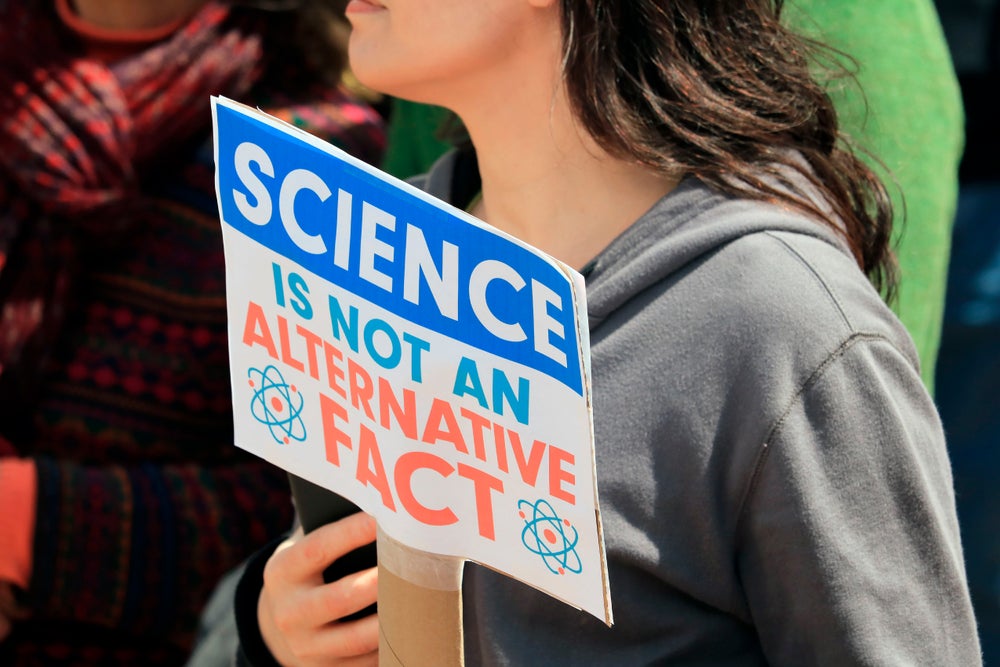
March for Science rally in Lafayette, Ind., on April 22, 2017. Education Images/Universal Images Group via Getty Images
.
.
Click the link below for the complete article:
.
__________________________________________
 James' World 2
Leave a comment