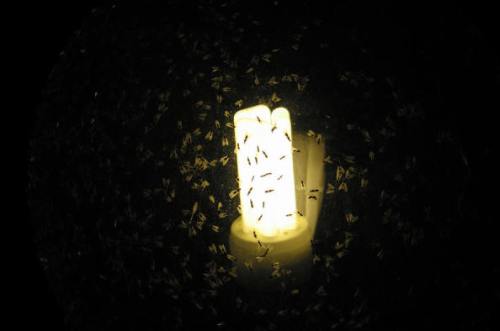
It’s the same thing every summer: you turn on your porch lights and within minutes, you’re dealing with a swarm of bugs zooming around the lights – and bouncing off of your head or crash landing into your drink. What is it about light that brings out the bugs? Science tells us that this odd phenomenon is caused by phototaxis.
How Phototaxis Affects Insects A phototactic animal or insect is one that instinctively moves to or away from light. The bugs that are swarming around your porch lights are positively phototactic, which means that they’re attracted to it. Bugs like cockroaches are negatively phototactic, which is why they scuttle away when you turn on a light.
What scientists aren’t quite sure of, though, is why insects are phototactic. Many believe that positively phototactic insects (like moths) use moonlight as a navigational tool. As they fly by moonlight, the Moon stays in a fixed position overhead. But when you turn on an artificial light, the moths see it as another Moon and become confused. As they try to guide themselves by your porch lights, they end up zooming back and forth in an effort to keep the “Moon” in sight.
Even conservative calculations show the world is in the midst of a sixth mass extinction that’s being caused by our species — and is likely to lead to humanity’s demise if unchecked, scientists reported Friday.
The scientists’ analysis, published in the open-access journal Science Advances, follows up on more than a decade’s worth of warnings about a rapid loss of global biodiversity. Many experts say the loss has risen to the scale seen during five previous global extinction events — the most recent of which occurred 65 million years ago when the dinosaurs died off.
The claims provide the theme of Elizabeth Kolbert’s Pulitzer Prize-winning book, “The Sixth Extinction.” But such claims have drawn skeptical responses as well. The skeptics say it’s difficult to judge the “background rate” of extinctions, as well as the current rate of species extinction.
.
An Imbabura tree frog (Hypsiboas picturatus) perches on a finger at the Jambatu Center for Research and Conservation of Amphibians in Quito, Ecuador. Amphibian species have been particularly hard-hit by environmental threats. Guillermo Granja / Reuters
Happy birthday, Stephen Hawking. The renowned physicist turns 73 today.
While Hawking has been known to weigh in on all sorts of serious topics, including alien life and religion as well as relativity, his whimsical way with words has also made us smile.
Scientists have created a swarm of over a thousand coin-sized robots that can assemble themselves into two-dimensional shapes by communicating with their neighbours.
At 1,024 members, this man-made flock — described in the 15 August issue of Science — is the largest yet to demonstrate collective behaviour. The self-organization techniques used by the tiny machines could aid the development of ‘transformer’ robots that reconfigure themselves, researchers say, and they might shed light on how complex swarms form in nature.
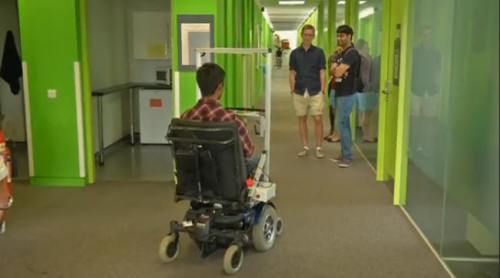
Scientists in London have developed an algorithm-based decoder system that enables wheelchair users to move around simply by looking to where they wish to travel. The researchers at Imperial College London say the system is inexpensive and easy to use and could transform the lives of people who are unable to use their limbs.
Algorithms working with inexpensive software could help quadriplegics steer wheelchairs simply by looking in their desired direction of travel. An Imperial College London team says their newly devised system can read eye movements to tell if a person is merely gazing or wants to move. Co-designer and student Kirubin Pillay says it’s simple to use.
Things are looking up for Neil deGrasse Tyson–way up. As the director of the Hayden Planetarium and the author of several popular books on space, Tyson is already one of the nation’s best-known scientists. And now his already-high profile is set for a big boost with the March 9 launch of “Cosmos: A Space-Time Odyssey,” a new documentary television series that he hosts.
Tyson calls the 13-part series a continuation of “Cosmos: A Personal Voyage,” a 1980 PBS series narrated by Carl Sagan that is acclaimed as one of the most significant science-themed programs in television history.
In anticipation of the new series’ debut, Tyson, 55, sat down with HuffPost Science for a wide-ranging and surprisingly frank interview. What follows is a condensed and edited version of the discussion, which took place in the astrophysicist’s New York City office
Scientists believe they have discovered a new reason why we need to sleep – it replenishes a type of brain cell.
Sleep ramps up the production of cells that go on to make an insulating material known as myelin which protects our brain’s circuitry.
The findings, so far in mice, could lead to insights about sleep’s role in brain repair and growth as well as the disease MS, says the Wisconsin team.
The work is in the Journal of Neuroscience.
Dr Chiara Cirelli and colleagues from the University of Wisconsin found that the production rate of the myelin making cells, immature oligodendrocytes, doubled as mice slept.
The increase was most marked during the type of sleep that is associated with dreaming – REM or rapid eye movement sleep – and was driven by genes.
In contrast, the genes involved in cell death and stress responses were turned on when the mice were forced to stay awake.
Precisely why we need to sleep has baffled scientists for centuries. It’s obvious that we need to sleep to feel rested and for our mind to function well – but the biological processes that go on as we slumber have only started to be uncovered relatively recently.
Scientists in Spain say they’ve developed the world’s first self-healing polymer that can spontaneously heal, repair and rebuild itself without any pressure, light or temperature change. Jen Markham has the story.
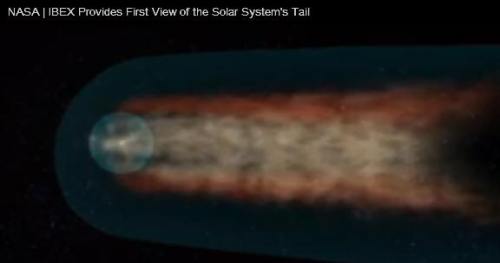
NASA can prove it now. Our solar system has a tail, just like comets.
Scientists revealed images Wednesday showing the tail emanating from the bullet-shaped region of space under the grip of the sun, including the solar system and beyond. The region is known as the heliosphere, thus the name heliotail.
The findings are based on data from by NASA’s Interstellar Boundary Explorer, or IBEX. The Earth-orbiting spacecraft was launched in 2008.
Scientists always presumed the heliosphere had a tail, but this provides the first real data on the shape.
.
.
.Click link below for story, video, and slideshow:
Film and Writing Festival for Comedy. Showcasing best of comedy short films at the FEEDBACK Film Festival. Plus, showcasing best of comedy novels, short stories, poems, screenplays (TV, short, feature) at the festival performed by professional actors.

 .
.






 James' World 2