A Trump administration proposal to exclude some types of immigrants from the 2030 census might not expand the congressional map for Republicans, and could even result in fewer House seats in red states.
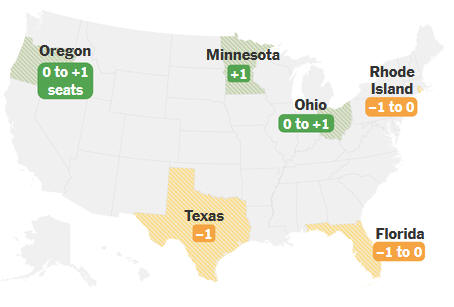
If congressional seats were redistributed based on recent census figures, excluding undocumented immigrants and other noncitizens without green cards could cause Texas to lose a congressional seat it would otherwise have gained, according to a New York Times analysis. Minnesota, a blue-leaning state, could gain a seat.
States are allotted congressional seats based on their populations during a process called reapportionment, which uses census data and occurs every 10 years. The next decennial census is slated to happen in 2030.
Though there are no official public statistics for the immigrants targeted by the proposal, two separate organizations estimated the group’s size in two recent years, 2023 and 2024. The Times used those estimates to explore the effect Mr. Trump’s proposal could have on the number of congressional seats each state would have received if reapportionment had happened in each of those years.
Both groups — FWD.us and Pew — produce detailed statistics on the types of foreign-born residents in order to estimate the undocumented population. Despite using different methods, they ended up with broadly similar results.
If reapportionment had happened in 2024 under the Trump administration proposal, it would have struck two seats from Republican strongholds in Texas and Florida, according to The Times’s analysis of the FWD.us estimates. Minnesota and Oregon would each have received one additional seat.
The map would look slightly different using Pew’s estimates, which are based on 2023 population figures. A hypothetical scenario for that year would result in a political wash. Texas would again have one fewer seat than it would have had under a full census count, and Minnesota one more, but Ohio would also gain a seat at the expense of Rhode Island.
“This isn’t exactly what I think the powers that be expected,” said Jeffrey Passel, a senior demographer at Pew who produced its breakdown of the immigrant population.
The variance between the scenarios can be attributed to differences both in the census counts for each year and in the two groups’ estimates.
For example, Florida’s growth between 2023 and 2024 would have been enough to give it another House seat. But excluding the immigrants targeted in the proposal would have canceled out that gain.
Deep in the Bolivian Yungas cloud forests, there stalks an utterly adorable beast: smaller than a house cat and spotted like a leopard, the creature has long been known to local communities as a tilcayo. Scientists, however, have only just formally discovered it—marking the first new wildcat species to be identified in more than a century.
The new species, Leopardus tilcayo, is a type of tiger cat, a group of small felines in the genus Leopardus that are native to South America. In a paper published on Thursday in Current Biology, the researchers identify five distinct species of tiger cats in South America, including the tilcayo.
The discovery came by accident, said the study’s co-lead author Paola Nogales-Ascarrunz to NBC News. A man had brought one of the kitties into the sanctuary that she volunteered at, and she noticed that it didn’t quite match any existing tiger cat species. After a series of genetic tests, she and her team discovered the cat must be a new species that had likely diverged from its closest tiger cat relative some 1.4 million years ago.
The discovery of a new mammal, especially a cat, is rare. It’s even more rare to find an entirely new species rather than a variation of a known species. The study analyzed the genomes of 38 cats, including 26 Leopardus cats, comprising “the most complete genetic study yet,” said the study’s co-lead author Jonas Lescroart, an evolutionary ecologist at the University of Antwerp in Belgium, to Gizmodo.
It’s unclear how many tilcayos are out there, and the authors have said that the study should be a catalyst for intensified conservation efforts across tiger cat species.
“Describing a new cat species after more than 100 years shows how much we still have to learn about the biodiversity around us. But it also reminds us that we need to protect the Yungas forests, which are home to so many species—including some we are only beginning to understand,” Nogales-Ascarrunz said in a statement.
.
The tilcayo is the first new species of wildcat to be identified in more than a century. Fernando Faciole/National Geographic
Actress Tisha Campbell is reminding us it’s never too late to get diagnosed. The former Martin star recently found out she’s on the autism spectrum, which she shared during a guest appearance on Way Up with Angela Yee.
After seeing specialists and undergoing intense testing, the 57-year-old received an AuDHD diagnosis, a term used for individuals with both autism and ADHD.
“I actually saw two specialists, and I took 12 tests each. They all vary from oral tests to written tests to just Q&As. And so I took all 12 twice, and I just got my diagnosis back,” she explained.
The My Wife and Kids actress also added that she’s level one on the spectrum. That means support is required for socializing and flexible thinking, but they can otherwise live life independently. Level one individuals can easily fly under the radar because they appear neurotypical.
“I have a lot of autistic tendencies, and I’m level one,” she explained to Yee. “So for me, I may not look like I need support, but I have earphones to block out sounds because I, too, have audio processing differences. Like, everything comes at me all at once.”
Some people don’t think a diagnosis later in life can be helpful because you’ve already learned to navigate the world without one. But Campbell shared that getting diagnosed has put puzzle pieces together, providing clarity for many of her life experiences. One being her hyperfixation on acting and music, which led to her undeniable success over the past few decades.
“A lot of autistic people have- they used to call them obsessions or fixations, but we call them special interests now. And my special interest was always acting and music,” she explained.
Campbell’s diagnosis couldn’t be more timely. She released her memoir The A Word: A Mother’s Journey Through Autismand Love on September 15. The book documents her experience raising her autistic son Xen, who was diagnosed at 18 months. However, the memoir doesn’t contain her personal experiences with autism since she was only recently diagnosed.
“I got the diagnosis after I wrote the book, so that part’s not even in the book. So I’m actually talking to you about this. My newer diagnosis, this just happened this year.”
If you follow Campbell, you know she’s been a staunch advocate of autism awareness over the years, shedding light on the disorder, which one in 31 children and one in 45 adults across the country have. Core messaging around autism awareness is that a diagnosis and services are there to support versus change, who autistic people are. The actress said getting diagnosed has helped her gain more self-awareness.
“I feel like I know myself so much better,” she said, adding that she’s been hiding her stimming—repetitive body movements, sounds, or object uses to help self-regulate over the years.
Campbell’s diagnosis is a full-circle moment as she’s gone from advocating for her son over the years to also advocating for herself. Other celebs like SZA and Chrisette Michele have also been diagnosed with autism as adults.
.
NEW ORLEANS, LOUISIANA – JULY 04: Tisha Campbell speaks onstage during day 2 of the 2026 ESSENCE Festival of Culture® presented by Coca-Cola® at Ernest N. Morial Convention Center on July 04, 2026, in New Orleans, Louisiana. (Photo by Paras Griffin/Getty Images for ESSENCE)
When President Trump’s envoys sat down with Vladimir V. Putin at the Kremlin this month, the Russian leader exuded confidence.
Within months, he said, Russian troops would finally capture Ukraine’s entire Donbas region. And Russia was poised to pummel Ukraine’s electricity grid, setting the stage for a miserable winter.
Then one of the envoys, Jared Kushner, tried to push back. With all due respect, you told us exactly that a year ago, Mr. Kushner said to the Russian president. What are the chances we come back here in another year and you are again saying the same thing? Maybe we don’t lose a year?
The exchange, described by a person familiar with the talks and by a U.S. official, captured the quandary of Mr. Trump’s more than 18 months of efforts to end the war in Ukraine.
Congress this week passed a landmark sanctions bill taking aim at Russia’s energy sector, a new attempt to make Russia “suffer” for its invasion and to pressure Mr. Putin to make compromises.
But even as that bill makes its way to Mr. Trump’s desk, the Trump administration is doubling down on a different approach: offering benefits for Russia that officials hope will get Mr. Putin to consider ending his war.
Among the new inducements: the White House is now considering signing business deals with Russia before it stops fighting in Ukraine, according to two people close to the talks. The U.S. official, speaking on condition of anonymity to be candid about the negotiations, said that deals with Russia before the end of the war were possible because they would show that the United States is serious about a reset relationship with Russia.
The approach represents a shift from Mr. Trump’s pledge last year that business deals with Russia would not come “until we get the war settled.” It indicates that Mr. Trump’s envoys for ending the war, Steve Witkoff and Mr. Kushner, are groping for new ways to entice Russia to stop fighting, now that it has become clear that Ukraine will not withdraw from the swath of its own territory that Mr. Putin insists he must control before the war ends.
And it contrasts with the approach advocated by both Republicans and Democrats in Congress — not to mention Kyiv’s European allies and Ukraine itself — that only heightened economic and military pressure on Mr. Putin can compel him to compromise.
“This bill will cripple Russia’s war machine and finally bring Putin to the negotiating table,” Representative Michael McCaul, Republican of Texas and one of the sanctions bill’s leading proponents, said on Wednesday after a bipartisan majority passed the legislation, 262 to 159.
Mr. Trump has indicated he will sign the bill, which was championed by Senator Lindsey Graham, Republican of South Carolina, until his death in July. It would allow the president to levy tariffs of as much as 100 percent on countries buying the most Russian oil or gas and would impose sanctions on Russian officials, businesspeople and financial institutions. Senator Darline Graham, Mr. Graham’s sister who replaced him in his seat, said it would “increase the president’s negotiating leverage.”
But insofar as the Trump administration is pursuing a carrot-and-stick approach with Mr. Putin, carrots seem the focus. The U.S. official said that the administration wanted to create more incentives for members of the Russian elite to push for peace. Executing some business deals before the end of the war could help convince anti-American hawks around Mr. Putin that Mr. Trump really does want to create a new relationship with Russia, the official added.
Balazs Jarabik, a former European Union diplomat in Kyiv who now works at R. Politik, a political analysis firm, said signs pointed to the United States “considering bigger concessions toward Russia.”
Washington “is now signaling that some deals could move forward if Moscow first demonstrates concrete restraint,” said Mr. Jarabik, who has been tracking the talks closely. “Washington had previously resisted signing such agreements before a cease-fire.”
It was not clear what deals in particular are on the table. The Kremlin’s foreign policy adviser, Yuri Ushakov, said after Mr. Putin’s meeting with Mr. Witkoff and Mr. Kushner on Sept. 5 that “economic issues and potential major mutually beneficial Russian-American projects were discussed in some detail.”
The Kremlin has been promoting business opportunities to the White House ever since Mr. Trump returned to office last year. Russian officials have floated deals for rare earths and aluminum, joint ventures in the Arctic and even getting U.S. companies involved in selling Russian natural gas to Europe.
Mr. Trump has hailed Russia’s economic potential as “tremendous,” but he has previously held out business deals as a reward for a Russia that makes peace.
“They want to do business,” Mr. Trump said ahead of his Alaska summit with Mr. Putin last year. “But they’re not doing business until we get the war settled.”
.
President Donald Trump shaking hands with President Vladimir Putin of Russia during their meeting in Alaska last year. Credit…Doug Mills/The New York Times
A nuclear fusion reaction has produced the brightest X-rays ever on Earth, rivalling those emitted by some stars. This could open the door for new extreme experiments, such as mimicking how the sun absorbs radiation and testing how materials that could improve future fusion reactions hold up to nuclear blasts.
The reaction itself was also hotter than the sun. “The truth of the matter is, when the fuel is burning, and ignition is occurring, and that [blast] wave is propagating out, we’re hotter than the sun,” says Ryan Lester at Los Alamos National Laboratory in New Mexico. “We are the hottest point in the local solar system.”
In 2021, researchers at the Lawrence Livermore National Laboratory’s National Ignition Facility in California achieved nuclear fusion ignition, a reaction that is energetic enough to be self-sustaining. This was a milestone on the path to developing nuclear fusion as a useful source of energy.
Now, Lester and his colleagues have added windows to the tiny cylinder within which ignition happens. This let out the brightest X-rays ever created in the lab and turned ignition into an unprecedentedly extreme physics experiment.
The researchers shot 192 very energetic laser beams into a gold cylinder about the size of a pencil eraser, which contained a carbon capsule filled with heavy versions of hydrogen atoms. The beams generated a bath of X-rays that compressed and heated the capsule so much that the hydrogen fuel started to undergo nuclear fusion, leading to ignition.
Once ignition happened, the windows evaporated and let the X-rays out, emitting tens of trillions of watts of power, on a par with the brightness of some red dwarf stars.
There are decades of computer simulations, prototyping and experimental tests behind every element of the apparatus that ultimately achieved ignition, says Lester. “This is a highly refined, highly optimised system to keep the radiation in, keep it warm [and] control capsule symmetry so that all the things line up in a perfect row and ignition can occur,” he says.
Laura Berzak Hopkins at the Princeton Plasma Physics Laboratory in New Jersey says that achieving ignition in the first place was a generational accomplishment, requiring details that researchers have worked on for decades. It is significant that ignition could not only be repeated, but repeated with a modified cylinder, she says.
To move from demonstrating ignition to using nuclear fusion as an efficient energy source, we have to learn something new about it every time it happens, says Berzak Hopkins. Lester and his colleagues have shown more ways to do so, she says.
Most studies of extremely energetic conditions, whether in nuclear fusion reactors or stars, rely on computer simulations, but the latest experiment could offer a more direct and exact alternative. One notable example would be studies of the sun’s opacity, or how some elements within it absorb radiation.
Lester says he hopes the experiment will also aid in designs for future ones, for example by providing a more detailed view of what happens when very low-density foams are added to the capsule. This is because it has been theorised that they could stabilise the reaction and make it more efficient. Such experiments could start as early as next year, he says.
.
An artist’s illustration of the X-rays produced during nuclear fusion
Only 13% of Gen Z say that most people can be trusted, according to a report by a political scientist at Washington University in St. Louis, while 74% think “you can’t be too careful.”
“Gen Z will be the least trusting generation in modern American history,” wrote Ryan Burge, who is also a data analyst and professor of practice at the university, in the report.
Millennials were slightly more trusting than Gen Z at 24%, while 30% of Gen X and 29% of boomers agreed that most people can be trusted. The Silent Generation—those born before 1945—is by far the most trusting at 41%, according to data between 2021 and 2024 that Burge cited from the General Social Survey, a biennial sociological study conducted out of the University of Chicago.
This phenomenon certainly colors Gen Z’s personal relationships. But in the era of automated hiring processes, ghosting, forever layoffs, and constant side hustles, it’s also reshaping the workplace as we know it.
Jaded, tired, and anxious
Burge puts this trust gap down to a number of reasons in his analysis, including religion and education. But, as he explained to Fast Company, “[Gen Z’s] parents raised them to be extra cautious about everything,” he says.
“They’re just terrified of making a mistake, and I think that leads naturally to a lack of trust in other people.”
A sheltered upbringing that overlapped with the COVID-19 pandemic, compounded by cancel culture and social media scrutiny and cynicism, has led Gen Z to embrace loss aversion, which Burge explained as “the idea that losing feels worse than winning feels good.” And they’re more distrustful because of it.
This isn’t a uniquely Gen Z issue. Over a third of the employees surveyed said they don’t have colleagues that they trust enough to share personal issues with. More than four in 10 rarely or never have conversations with coworkers about anything other than work.
But for Gen Z in particular, this trust gap is linked with having entered the workforce during COVID, and missing out on in-office soft skills as a result of remote learning and working.
“Unfortunately, I think a lot of young people just don’t ever build up that baseline of trust,” says Burge. “Being around people, what you learn more and more is that the average person is pretty trustworthy.”
Disillusionment with a broken system
Gen Z’s distrust is especially noticeable in the workplace, data suggests.
Gen Zers are 16 times as likely to say they don’t trust their coworkers as Gen X employees, according to a 2026 survey from Workday. They’re also significantly more mistrustful of their employers: Only 41% of Gen Z employees said they trust their employer, according to a 2025 Indeed survey, compared with about 65% of millennials and 71% of baby boomers. Further, a 2025 GenHQ study found that 47% of Gen Z have quit a job due to lack of trust in leadership, and 45% would take a 10% pay cut to work for a boss they completely trust.
Trust is one of the strongest predictors of whether employees stay or leave. But over the past few decades, American business has gradually upended its deal with workers. If workers aren’t fearful of their jobs being automated, they are at least skeptical of companies using AI to justify big layoffs. These fears are not unfounded. Eight in 10 leaders have used “layoffs” to get rid of an employee they wanted gone, according to a 2024 survey from Resume Builder, and 54% did it to shirk paying severance. On top of that, many Gen Z workers watched their parents push themselves to burnout, only to be ousted from long-held positions. They’re skeptical about showing the same professional loyalty, instead prioritizing work-life balance and often seeking out their own nonlinear paths instead of trusting corporate ladders. Social media, awash with “get laid off with me” vlogs and stories about toxic bosses, has only amplified this sense of mistrust in traditional workplaces. The surveillance boom is further damaging the trust between employers and employees. The benefit of being less trusting, of course, is you are less likely to be taken advantage of. But as Burge notes, “That’s the cost of doing business. That’s literally the cost of being a human.” If workers can’t fundamentally trust each other, true connection feels impossible.
Being ghosted and burning out
Scam listings and ghost jobs are everywhere. The 2026 Job Seeker Nation Report from the AI-powered hiring platform Employ found that 32% of applicants say they’ve been ghosted by a company. (On the flip side, a 2025 survey of hiring managers found that 54% had been ghosted by a Gen Z candidate after extending an offer.) This crisis of trust is bad for business.
For Gen Z workers, “I think ultimately what happens is they’re just super unproductive,” Grace McCarrick, a speaker and creator who leads corporate soft skills workshops, tells Fast Company. “They’re too busy worrying about the hidden agenda.”
Employee engagement has hit its lowest level since 2020, according to Gallup’s 2026 State of the Global Workplace report, dropping for the second year in a row and costing an estimated $10 trillion in lost productivity.
“People are really unhappy at work,” said McCarrick. “You would be too if you thought around every corner was some mustache-twirling monster trying to make your life worse and make themselves $100 million.”
Daring to trust
Trust is a two-way street. McCarrick believes young workers also have a responsibility to establish a baseline level of trust with their colleagues and employers—at least until proof of the contrary.
“You don’t have to trust that the CEO is a good person. You don’t have to trust that the company is being completely transparent about every decision,” she said. “I think you have to do the best you can to get into a job where you can go, ‘OK, I can trust enough.’”
Burge, the author of the report on trust, says he’s “a big believer that trust really builds up over a long set of interactions with other people.” Employers can help build trust with Gen Z by acknowledging their contributions, following through on their words with actions, and acting with integrity.
“When decisions affect people, I think it’s important to get as close as you can to why you made that decision and what alternatives would have been,” says McCarrick.
In the end, it’s up to Gen Z to surrender suspicion, to fall and hope someone catches them. Even if no one does?
“It’s worth getting taken advantage of sometimes to feel the connection of being a human in society,” says Burge.
Hmmmm ,,, Hail to the foresight of 3-tier government under God!
Click the link below the picture
.
Judge Patrick J. Schiltz’s warning was stark.
Immigration and Customs Enforcement had violated nearly 100 orders issued by Minnesota’s Federal District Court during the month of January, including some mandating the release of undocumented immigrants from detention.
The violations needed to stop immediately. “ICE is not a law unto itself,” Judge Schiltz wrote in his Jan. 28 order.
Judges around the country took notice, not only of the scale of the allegation but because such a harsh reproach was coming from the pen of Judge Schiltz, a George W. Bush appointee with almost 20 years of experience on the bench. He clerked for Supreme Court Justice Antonin Scalia in the 1980s and has enjoyed close ties to the conservative legal establishment for decades. This was not the profile of a judge likely to engage in a high-stakes standoff with the White House.
In a rare 90-minute interview seven months later, Judge Schiltz said his order had been prompted by concern that the Trump administration’s disregard for court orders was clogging his courthouse to a near standstill, contributing to rising tensions in the protest-filled city and, ultimately, putting the constitutional order at risk.
What happened in Minnesota’s federal court, he said, “created a grave threat to the rule of law.”
He said he thought the violations were largely the result of incompetence and staffing shortages, but also worried that the Justice Department had not taken their corrosive effect seriously enough.
“I would say aloud to myself, ‘This just never happens,’” he added, referring to the violated orders and other unusual behavior by the Justice Department. He was in his chambers, which has signed photos of Chief Justice John G. Roberts Jr. and Justice Samuel A. Alito Jr. on the wall. Earlier in his career, he helped found a law school at a Catholic university in Minneapolis, and wrote a renowned law review article about the moral perils of the legal profession.
Judge Schiltz, who served as the district’s chief judge from mid-2022 through June 2026, declined to discuss ongoing cases. But he and six other members of Minnesota’s federal bench agreed to speak to The New York Times about last winter’s tumult, to describe how an intense national spotlight, a deteriorating relationship with the Justice Department and a flood of lawsuits had combined to put their court under tremendous pressure.
In the view of the Department of Homeland Security, it operates “in line with the U.S. Constitution and all applicable federal laws,” said Chandler Rebel, a D.H.S. spokesman.
Kiersten Pels, a Justice Department spokeswoman, said the administration “will continue to fully comply with court orders.” She asserted that in most instances where there was an issue, “the underlying substance of the order was satisfied even where a secondary deadline was missed.”
Ms. Pels added that it she found it “remarkable that sitting federal judges are giving on-the-record interviews” criticizing the administration, and suggested that they consider recusing themselves if they “have made public comments on pending or related matters.”
It is indeed unusual for federal judges to give extensive interviews that reflect on periods when their rulings have made headlines.
The seven judges who spoke to The Times were appointed by both Democratic and Republican presidents. They included six of the seven judges who held active status in Minnesota last winter.
“We are allowed to speak out about judicial independence,” said Judge Nancy E. Brasel, whom Mr. Trump appointed in 2018. “And so we should, in order to keep it.”
The tensions in Minnesota eased after the administration announced an end to its surge in mid-February, following the killings of two civilians by federal agents.
Judge Schiltz said he hoped the portrait of how the bench had handled the crisis would help Americans better understand how the United States’ system of government depends on the rule of law.
“The rule of law to democracy is like oxygen to a human body,” he said. “It is something that you absolutely need to survive, and yet it’s something that people just take for granted.”
.
Judge Patrick J. Schiltz in his courtroom. A former clerk for Justice Antonin Scalia of the Supreme Court, he does not have the profile of a jurist likely to engage in a high-stakes standoff with the executive branch. Credit…Jenn Ackerman for The New York Times
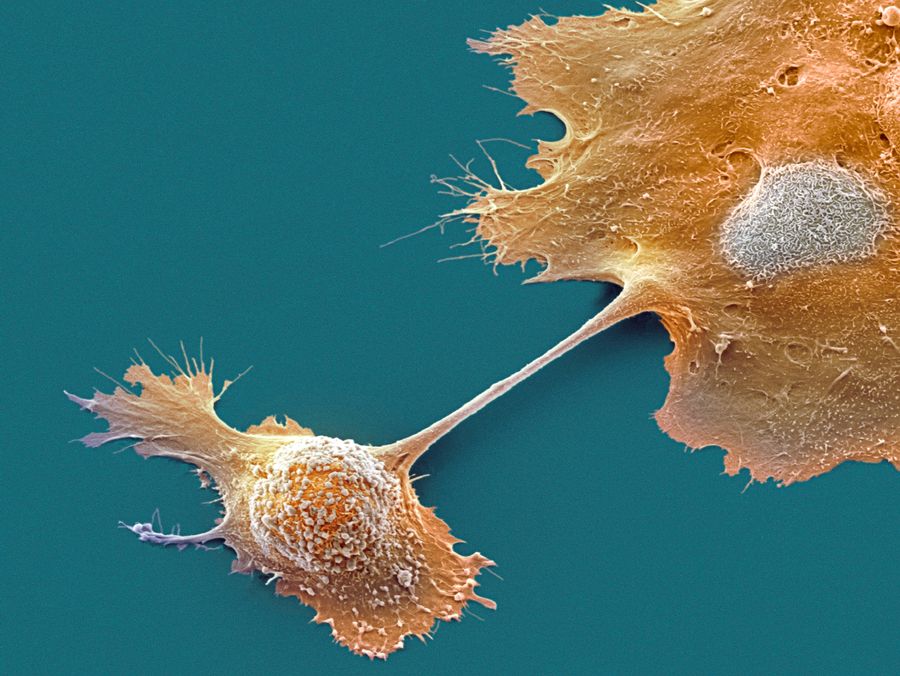
Pancreatic cancer is one of the deadliest forms of cancer—because it is so hard to detect, cases are typically caught in the late stages of the disease. A person can live with pancreatic cancer for years and not know because the early symptoms are so subtle as to be absent or negligible. There is no routine screening test, as there is for breast cancer or colon cancer, and most diagnoses happen only at advanced stages, when symptoms such as weight loss, abdominal pain, and blood sugar problems become unignorable.
As a result, the five-year survival rate of pancreatic cancer is just 13 percent. A new blood test aims to change that. In results published today in Nature Medicine, scientists show how the blood test, called PANXEON, can accurately detect pancreatic cancer in its early stages and could even identify precancerous signs, enabling doctors to quickly intervene and treat the disease.
The results come on the heels of the U.S. Food and Drug Administration’s approval of a drug for pancreatic cancer called daraxonrasib. The medication is aimed at people with late-stage pancreatic cancer who have already been through chemotherapy. In a testament to the intractability of this form of cancer, the drug, which is hailed as a breakthrough treatment by experts, improves survival by just half a year compared with chemotherapy alone (with median survival of 13.2 months versus 6.7 months, respectively).
About 1,800 people enrolled in an early-stage clinical trial to test the efficacy of PANXEON across the U.S., Europe and Asia. The test accurately detected stage 1 and 2 pancreatic cancers approximately 87 percent of the time, with a low rate of false positives. The blood test also identified advanced pancreatic dysplasia—the presence of a precancerous condition in the pancreas—more than 64 percent of the time in people with high-risk pancreatic cysts. Together, the results suggest the test could flag cancer earlier and offer opportunities for clinicians to intervene before the disease has had a chance to spread to other organs.
The blood test screens for three molecular signatures of pancreatic cancer. Researchers then use artificial intelligence to assign a risk score that measures individual risk of cancer. Doctors can use the score to determine whether more investigation or treatment is necessary, particularly in people who have inherited risk of pancreatic cancer or who have had pancreatitis, for example. More advanced clinical trials are needed before this blood test could possibly be used in the clinic, but the results are promising in a disease that is so difficult to manage.
“The earlier we find pancreatic cancer, the greater the chance that meaningful intervention is still possible,” said Ajay Goel, study senior author and chair of molecular diagnostics and experimental therapeutics at City of Hope, a cancer research and treatment organization headquartered in California, in a statement.
We’ve just begun mapping Earth’s largest single piece of infrastructure — the fungal “internet.”
This living subterranean web of filaments stretches a mind-boggling 68 quadrillion miles.
So why are we just now seeing maps of it? Because it’s not just huge, but also tiny.
Directly beneath our feet stretches a world both smaller and much, much larger than the one we know. Scientists have just begun mapping what may well be the largest piece of infrastructure on Earth: a network of fungal threads that is 68 quadrillion miles long.
It’s alive!
And we thought we’d mapped just about everything there is to map on this planet: continents, voting patterns, bird migration routes, alleged apparitions of the Virgin Mary, and Starbucks locations near you.
We’ve logged and named almost every fold of the visible world. And yet until June, the most extensive piece of infrastructure on the planet had not been extensively mapped. This network is larger than every road, cable, and shipping lane combined. And it’s alive.
To be precise: It’s fungal. This underground network is made of so-called hyphae: hair-thin filaments that knit together into vast structures known as mycelium. A large fraction of these fungi form partnerships with the roots of plants and trees. Roughly 70% of all botanical species indulge in these relationships.
Think of these relationships, also known as mycorrhizae, not so much as tender friendships, but as shrewd trade agreements: Both parties get something indispensable out of it. The plant can make sugar from sunlight, but is bad at foraging. So the fungus provides phosphorus, nitrogen, and water. The fungus is a foraging superhero, but cannot photosynthesize. So the plant repays the fungus in carbon.
How to survive on land
The arrangement is not new — it dates back several hundred million years, to when plants were first figuring out how to survive on land. What’s new is that scientists have now learned to map the actual shape and extent of that arrangement.
Writing in Science in June, a team including members of the Society for the Protection of Underground Networks (SPUN), estimated that the top 15 centimeters of the planet’s soils hold roughly 110 quadrillion kilometers of so-called arbuscular mycorrhizal fungal hyphae.
That distance in miles sounds no less deranged: 68 quadrillion. But to get some sense of the vastness of that funny-sounding number, imagine laying those filaments end to end, in which case they would stretch from the Earth to the Sun close to a billion times. No use: that’s still an absurdly large mental object to wrap your head around.
Another way of gauging the network’s size is to consider its weight instead of its length. In total, it is estimated to weigh around 300 million tons, which, the authors write, is roughly five times the biomass of all humans on Earth combined.
How could we have missed such a massive network? Well, it’s also extremely tiny — a teaspoon of soil can hold up to 10 meters of fungal hyphae, each fragment so thin as to be practically invisible.
4 billion tons of CO2
To map something this humungous and diaphanous, researchers had to develop a new mapping discipline — a cartography of dirt. They collected and analyzed 16,000 soil samples from all over the world, extrapolating this map from the data they gathered.
Easy to lose behind those quadrillion miles of living filaments is another big number. The fungal network moves around four billion tons of carbon dioxide equivalent into the soil each year. That is equivalent to 11% of humanity’s annual emissions. For a structure that few people knew about until a few months ago, the global fungal network is doing good work on a planetary scale.
That talent for burying CO2 may be why we will finally pay attention to this subterranean layer of life, beginning with this eerily glowing map of what has already been called the “fungal internet,” published by SPUN.
Although still incomplete, the map already offers some surprises. If you had to guess where Earth’s fungal network was densest, “rainforests” sounds like a reasonable answer: lushly layered flora, thick with roots. But no. The map points to grasslands as the hotbed of fungal filaments — as much as 40% of the world’s arbuscular mycorrhizal network is buried beneath the waving fields of grass of the Tibetan Plateau, and the flooded grasslands of the Everglades and South Sudan, among other places.
.
This global underground network is invisible to the naked eye, yet is more than five times the weight of all humans on Earth. (Credit: SPUN/A Hidden Infrastructure
The Trump administration has approved a $2.8 billion sale of heavy bombs to Israel, according to a U.S. official, in what would be among the largest deliveries of U.S. munitions there, even as American public support for the country declines.
The proposed sale would include 40,000 one-ton bombs whose use by Israel in Gaza and Lebanon has drawn international anger because of the civilian harm caused by their wide blast radius.
Human rights groups and some foreign governments have condemned Israel for dropping the giant munitions in densely populated areas, sometimes killing dozens of civilians in strikes targeting just one individual.
The package would include 20,000 each of America’s 2,000-pound MK-84 and BLU-117 bombs. It would also provide Israel with 20,000 bunker-busting I-2000 penetrator warheads, which explode on delay after smashing through an outer surface like soil, rock, or concrete. The plan was reported earlier by The Washington Post.
The blast from a 2,000-pound bomb can be lethal at more than 1,000 feet and leave a crater as deep as 50 feet. Israel provoked a fierce outcry after it dropped hundreds of the heavy bombs on Gaza.
The State Department recently sent the proposed deal to two congressional committees to get informal approval, the U.S. official said.
Production and delivery of the munitions usually takes months or years, but there are ways to expedite the process.
In mid-2024, the Biden administration paused a shipment of 2,000-pound bombs to Israel because of concern about their use in crowded civilian areas. President Trump allowed the shipment to proceed days after taking office last January.
Then in February, the Trump administration agreed to sell roughly $2.7 billion in munitions to Israel, a package that included 35,000 of the one-ton MK-84 and BLU-117 bombs.
While congressional leaders can tell the Trump administration that they oppose the deal, Secretary of State Marco Rubio can exercise emergency powers to proceed with the sale regardless, as he has done repeatedly, or just say he is moving forward with it. The administration would then bypass getting informal approval from Congress and formally announce the sale is happening.
In those cases, both the House and Senate would need to pass a resolution to block the deal. Such a resolution would require the support of two-thirds of each body to guarantee it can overcome a presidential veto.
The Biden administration also declared an emergency in the region to bypass congressional approval and expedite shipments of arms to Israel twice during the Israel-Gaza war. One of those packages included 13,000 rounds of tank ammunition, and the second included artillery munitions.
The State Department’s approval of such a large package of devastating munitions reflects Mr. Trump’s continued strong support for Israel despite his recent disputes with its prime minister, Benjamin Netanyahu, over the country’s military operations in Gaza, Lebanon and Iran. Mr. Netanyahu is expected to be in New York next week to address the annual gathering of world leaders at the United Nations General Assembly.
The State Department said in a statement that as a matter of policy it would not confirm or comment on a proposed arms sale that has not been formally notified to Congress.
.
Smoke rising after an Israeli bombardment of Gaza last year. Israel’s use of 2,000-pound bombs in the crowded enclave has caused widespread civilian harm. Credit…Menahem Kahana/Agence France-Presse — Getty Images
In the world, human beings are facing various problems. People who are full of greed, anger, and ignorance are seen to be fighting with each other in words and deeds. As the fighting continues, various problems such as civil wars, wars of aggression, and wars of aggression are occurring. As world peace is being destroyed, humans are facing unbearable problems. Innocent children and women are not getting the rights they deserve and deserve. I can't think of one thing every time. What is it? The United Nations. If we look at the responsibilities and duties of the United Nations, I think it is not suitable for solving the problems that are happening in the world today. In fact, the United Nations and the World Security Council, such an organization must rule the world, must be able to give orders, and must have various ways to obey orders. There must be no organization that can influence more than that organization. There should be experts from each country. They can even dominate the superpowers like the US, China, and Britain. Only then will global peace be achieved quickly. Now, if a country with power develops more militarily, economically, or socially than its own country, then powerful countries will jealously seek out enemies and wage war. Or they will attack with fighter jets. In this, innocent people are losing their lives. No one understands the value of a life. You should think about how to achieve global peace by controlling these. If the US continues to be the permanent president of the UN, world peace will never be achieved. If you think carefully, no one sees that they are working for the common good, but for their own benefit, for the benefit of their own country. The permanent president of the UN and the Security Council has rejected this, As a young Rohingya, I have come to realize that only by electing the president and secretary from among the countries in the world through a secret ballot system and governing the world fairly can we achieve global peace. The United Nations and the Security Council are organizations in which any country must govern, give orders, and make them obey their orders. For example, only when a defendant is tried in court can we hold the leaders of the countries in check and control them, can we achieve global peace smoothly. Otherwise, it will not be easy for powerful countries to use various excuses to end this war every year, every year, for the benefit of themselves and their countries. No country's leaders pay any attention to the words of the United Nations and the Security Council. If we look at it in practice, look at the Rohingya issue. Myanmar is a small country. Even that country has been under siege for 8 years. What action can be taken? Why is the UN and the Security Council Powerless? Without such Power, how can the organization bring about global peace? Everyone should think about it. Whether there is a veto or a strong one, all countries in the world can only achieve global peace if they are subject to the UN and the Security Council. Seek peace in the quiet embrace of nature. Peace is an indispensable need of the human race. It is not as if one person can kill another person, and it is as if one country can attack another country, but instead of trying to build peace, we must try to destroy the peace now, and the world is getting hotter and is on the verge of collapse. I especially appeal to all the world experts to urgently try to bring about peace in all parts of the world. Mr, Noor Muhamed Arkhan Rohingya Youth Myanmar
Film and Writing Festival for Comedy. Showcasing best of comedy short films at the FEEDBACK Film Festival. Plus, showcasing best of comedy novels, short stories, poems, screenplays (TV, short, feature) at the festival performed by professional actors.




 NEW ORLEANS, LOUISIANA – JULY 04: Tisha Campbell speaks onstage during day 2 of the 2026 ESSENCE Festival of Culture® presented by Coca-Cola® at Ernest N. Morial Convention Center on July 04, 2026, in New Orleans, Louisiana. (Photo by Paras Griffin/Getty Images for ESSENCE)




 [Photo: Adobe Stock]

 Science Photo Library–STEVE GSCHMEISSNER/Getty Images
 This global underground network is invisible to the naked eye, yet is more than five times the weight of all humans on Earth. (Credit: SPUN/A Hidden Infrastructure

