September 11, 2025
Mohenjo
Business, Food For Thought, Human Interest, Political, Science, Technical
amazon, business, Business News, current-events, Future, Hotels, human-rights, medicine, mental-health, research, Science, Science News, technology, Technology News, travel, vacation

Click the link below the picture
.
Keir Starmer has sacked Peter Mandelson as ambassador to the US over his association with Jeffrey Epstein.
The Foreign Office minister Stephen Doughty told MPs that Lord Mandelson had not disclosed the extent and depth of his friendship with Epstein, a convicted child sex offender, when he was appointed as the ambassador.
He said No 10 had not known about emails from Mandelson to Epstein suggesting his 2008 conviction for soliciting a child for prostitution was wrongful and should be challenged.
A Foreign Office spokesperson said: “In light of the additional information in emails written by Peter Mandelson, the prime minister has asked the foreign secretary to withdraw him as ambassador.
“The emails show that the depth and extent of Peter Mandelson’s relationship with Jeffrey Epstein is materially different from that known at the time of his appointment. In particular, Peter Mandelson’s suggestion that Jeffrey Epstein’s first conviction was wrongful and should be challenged is new information.
“In light of that, and mindful of the victims of Epstein’s crimes, he has been withdrawn as ambassador with immediate effect.”
Before Mandelson’s departure was announced, Wes Streeting, the health secretary, told an event that he was “completely disgusted” by messages Mandelson sent to Epstein and that his future was “a decision for the prime minister”.
Government sources said Starmer took the decision during a meeting with Yvette Cooper, the foreign secretary, on Thursday morning, after reviewing the new material on Mandelson’s defence of Epstein the previous night. It is understood Mandelson himself had not, until the leak, had access to the emails written in 2008 because they came from a long-deleted account.
Mandelson’s departure comes at a difficult time for No 10 as it prepares a state visit for the US president, Donald Trump, who is facing his own questions about his friendship with Epstein. It is understood that James Roscoe, the deputy head of mission in Washington, will be interim ambassador and supervise the state visit.
Both David Miliband, a former Labour foreign secretary, and Cathy Ashton, a former EU commissioner, were previously on the shortlist for the US ambassador job. Karen Pierce, who held the job before Mandelson, is among those who could be asked to return.
.
 Peter Mandelson’s departure will be a huge blow for No 10 as it prepares for the US president’s state visit. Photograph: Carl Court/AP
.
.
Click the link below for the complete article:
.
__________________________________________
September 11, 2025
Mohenjo
Business, Food For Thought, Human Interest, Political, Science, Technical
amazon, business, Business News, current-events, Future, Hotels, human-rights, medicine, mental-health, research, Science, Science News, technology, Technology News, travel, vacation

Click the link below the picture
.
Charlie Kirk, a 31-year-old conservative activist and media personality, was killed on Wednesday by a single gunshot to the neck while speaking at an event at Utah Valley University.
The event, in Orem, Utah, was held at an outdoor stage, where around 3,000 people had gathered to hear Mr. Kirk speak. Gov. Spencer Cox of Utah, a Republican, described the shooting as a “political assassination.” As of Thursday, the gunman was still at large.
Here is a visual timeline of how the shooting unfolded.
Wednesday, 11:52 a.m.
The gunman was seen arriving near the university campus about half an hour before the shooting occurred, officials said at a news conference on Thursday morning. Officials said they were able to later use surveillance footage to track the gunman’s movements onto the campus and then through a stairwell to the roof of the building from where the shot was fired.
Noon
Mr. Kirk’s event was free to attend and scheduled to start at noon local time. The event was the first of a 15-stop itinerary on what was called the “American Comeback” tour, which had planned appearances at U.S. college campuses.
As the event began, Mr. Kirk was addressing the crowd and answering questions while sitting under a tent, emblazoned with the tour’s name, in the outdoor courtyard of the school’s main campus.
Around 12:20 p.m.
About 20 minutes after he began speaking, Mr. Kirk was shot. Videos recorded before and after the shooting show a person on the roof of the Losee Center, about 430 feet away.
Seconds before the shooting, Mr. Kirk was asked a question about mass shootings in America.
.
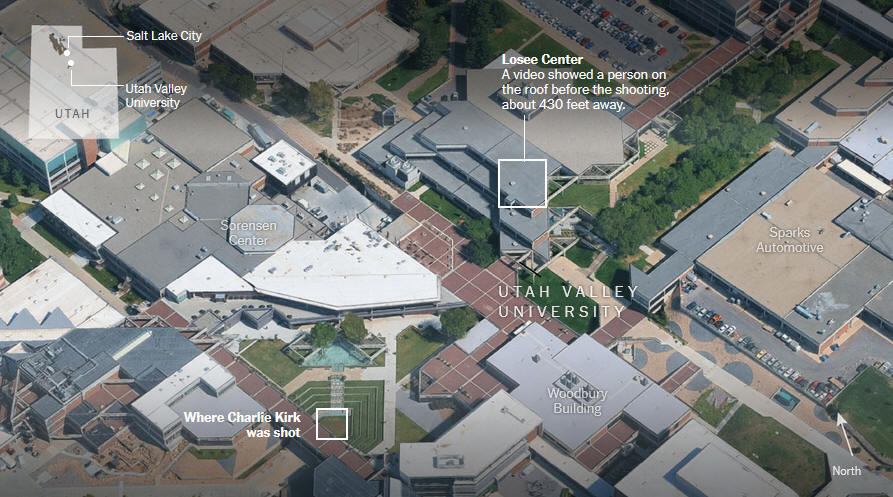
Aerial image by Google Earth by Ashley Wu, Lazaro Gamio, Daniel Wood, and Anjali Singhvi
.
.
Click the link below for the complete article and video:
.
__________________________________________
September 10, 2025
Mohenjo
Business, Food For Thought, Human Interest, Political, Science, Technical
amazon, business, Business News, current-events, Future, Hotels, human-rights, medicine, mental-health, research, Science, Science News, technology, Technology News, travel, vacation

Click the link below the picture
.
An eon ago, when only microbes dwelled on Earth, a pair of black holes some 1.3 billion light-years beyond the solar system spiraled toward each other until they crashed. The two became one big black hole that rang out in far-reaching undulations of spacetime called gravitational waves.
These ripples finally reached Earth in January 2025, where they registered in the Laser Interferometer Gravitational-Wave Observatory (LIGO) experiment as the most precise direct measurements of gravitational waves ever made. These measurements confirmed a 54-year-old theorem from the late physicist Stephen Hawking about how black holes grow when their mass increases. The waves also confirmed a bizarre property of black holes known as the “no-hair” theorem. Scientists announced the findings in a paper published today in Physical Review Letters.
The black holes involved in the smash-up contained about 33 and 32 times the mass of the sun, respectively. As they fell toward each other and coalesced, the resulting gravitational waves spread out into the universe in all directions; the fraction that trickled into LIGO’s detectors was a signal that researchers named GW250114. Studying the particular features of this signal allowed them to determine the black holes’ initial sizes, as well as the fact that the resulting larger black hole contained about 62 times the mass of the sun. The waves also revealed that the original black holes had a combined surface area of about 240,000 square kilometers (roughly the size of Oregon), whereas the final black hole had an area of some 400,000 square kilometers (roughly the size of California).
These measurements confirm a prediction Hawking made in 1971 about black hole event horizons—the boundaries beyond which nothing, not even light, can escape from their gravitational grasp.
Researchers previously tried to test these predictions with gravitational waves, but the comparatively weaker signals left a lot of uncertainty in the conclusions. The new tests offer a much greater level of confidence, says theoretical physicist Feryal Özel of the Georgia Institute of Technology, who was not involved in the research. “If we found any evidence of violation of either the area theorem or of the Kerr solution, then one or both of the assumptions would have to be changed,” she says. “In other words, either general relativity would need to be modified, or the objects are not black holes.”
This latest announcement from LIGO comes almost exactly 10 years after the project saw its first gravitational waves. The precision of the recent measurements was only possible now, after scientists have tweaked and tuned LIGO to be roughly four times as sensitive as it was when it started. It can now identify distortions in spacetime smaller than one ten-thousandth the width of a proton.
.
 An illustration imagines GW250114, a powerful collision between two black holes observed in gravitational waves by the LIGO experiment, from the perspective of one of the black holes as it spirals toward its cosmic partner. Aurore Simonnet (SSU/EdEon)/LVK/URI
.
.
Click the link below for the complete article:
.
__________________________________________
September 10, 2025
Mohenjo
Business, Food For Thought, Human Interest, Political, Science, Technical
amazon, business, Business News, current-events, Future, Hotels, human-rights, medicine, mental-health, research, Science, Science News, technology, Technology News, travel, vacation

Click the link below the picture
.
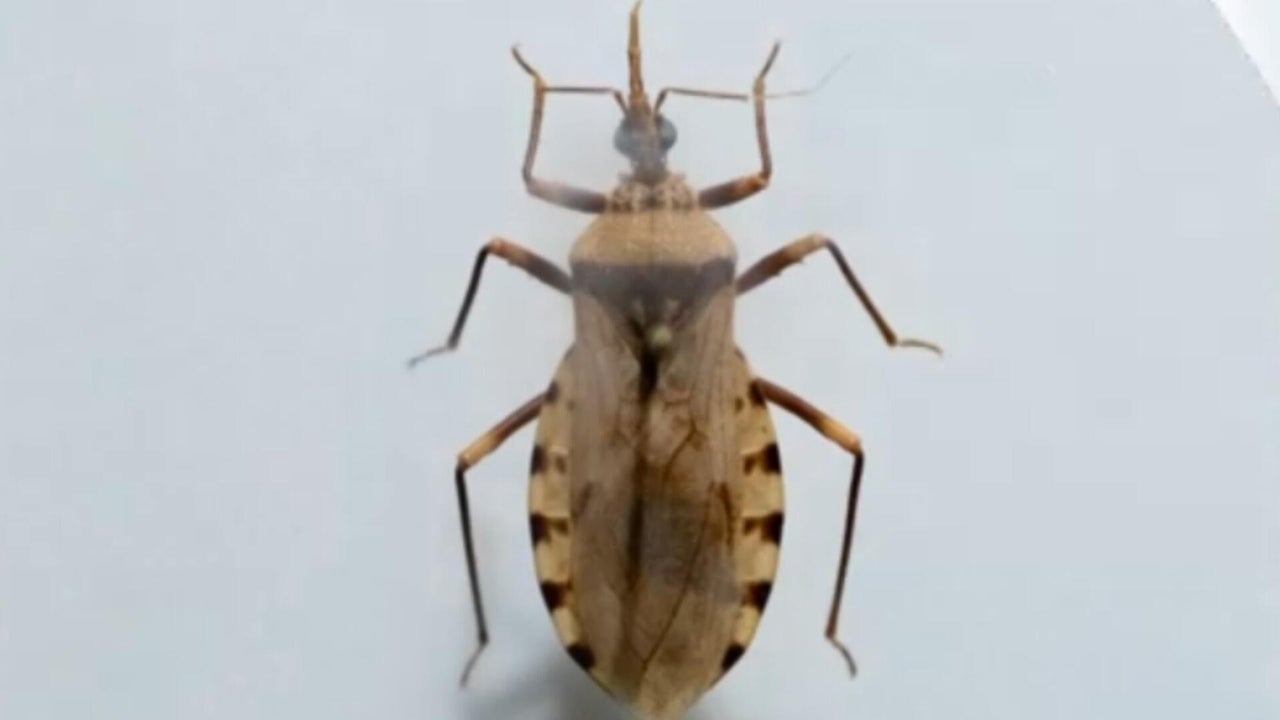
Chagas disease, a potentially deadly condition caused by an infected triatomine insect or “kissing bug,” may be becoming endemic in the United States, according to a new report published by the Centers for Disease Control and Prevention.
In the report, which was originally published last month for the September issue of the CDC journal Emerging Infectious Diseases, the authors said the disease is already endemic to 21 countries in the Americas, and growing evidence of the parasite is challenging the non-endemic label in the U.S.
“Autochthonous (or, locally acquired) human cases have been reported in 8 states, most notably in Texas. Labeling the United States as non-Chagas disease-endemic perpetuates low awareness and underreporting,” the report noted, adding the insect has been reported in 32 states.
Other states with human cases include California, Arizona, Tennessee, Louisiana, Missouri, Mississippi, and Arkansas.
The report notes that data is “inadequate” to prove that the insects are increasing in geographic distribution or abundance. But it also says that the bugs are “increasingly recognized” because of frequent encounters with humans and due to more research attention.
“Invasion into homes, human bites, subsequent allergic reactions or exposure to T. cruzi parasites, and increasing frequency of canine diagnoses have led to growing public awareness,” it says.
What causes Chagas disease?
The condition is caused by Trypanosoma cruzi parasites found in triatomine or “kissing bugs,” which can pass the disease to other animals and humans.
According to UCLA Health, the insect’s nickname comes from the bug often biting people on the face.
According to the CDC, about 8 million people globally and 280,000 in the United States have the disease, often without knowing it.
“People might scratch or rub bug feces into a bite wound, their eyes, or mouth without realizing it, which allows the parasite to enter their body,” the CDC says. The agency explains that bugs pass the parasite in their droppings after biting a person or animal. “If these droppings get into someone’s body through a cut in the skin, or near the eyes or mouth, it can lead to infection.”
The disease does not spread from person to person like a cold, nor does it spread through casual contact with those infected.
Without treatment, the condition can be life-threatening, the CDC says.
Symptoms of Chagas disease in adults
In the acute phase, which happens shortly after infection, a type of eyelid swelling known as Romaña’s sign may appear.
“This happens when the Trypanosoma cruzi parasite gets into the eyelid, usually by accidentally rubbing the bug feces into your eye or into a bug bite near your eye,” the CDC says.
Other acute signs may include:
- Fever
- Feeling tired
- Body aches
- Headache
- Rash
- Loss of appetite
- Diarrhea
- Vomiting
Others may experience symptoms for years or a lifetime, which is known as the chronic phase of infection, and can include heart and digestive issues.
“(The disease) can destroy the nerves that feed the various parts of your body — so your heart, your esophagus, your colon,” infectious disease physician Tom Moore told CBS News Philadelphia in 2019 as cases made their way north.
In both stages, some people might not feel sick while others can have serious health problems, the CDC adds.
How to avoid “kissing bugs”
There are no vaccines or drugs that can prevent Chagas disease at this time, according to the CDC, so it’s important to protect yourself.
Prevention methods include staying in well-built places if traveling, using insecticides and bug spray, wearing clothes that cover your skin, and not eating raw fruits and vegetables, as the infection can also be acquired orally or through the mouth via contaminated food.
Experts also previously told CBS News Philadelphia that homeowners can seal windows and keep trash, piles of wood, and rocks away from their homes to reduce risk.
.
.
.
Click the link below for the complete article:
.
__________________________________________
September 10, 2025
Mohenjo
Business, Food For Thought, Human Interest, Political, Science, Technical
amazon, business, Business News, current-events, Future, Hotels, human-rights, medicine, mental-health, research, Science, Science News, technology, Technology News, travel, vacation

Click the link below the picture
.
While most kids his age are still trying to master tying their own shoes, 4-year-old Zorien Royce is tackling the art of three-digit multiplication.
Zorien was just recently accepted into Mensa and Intertel, societies for the highly intelligent, after the boy scored a 156 out of 160 on his IQ test for children. Having just turned 4 last month, Zorien is already reading at a second-grade level and learning fractions.
His parents, Md Naqib Alam Ansari and Monirupa Ananya, said in a news release that they began noticing his advanced development at just 18 months old.
He’s also bilingual in English and Bengali, but is eager to learn more languages such as Spanish, French, and Hindi, his parents said.
The family, who lives in Vernon Hills, Illinois, had Zorien tested with a psychologist. His parents said the psychologist was “awestruck” at his results.
“At just three years old, he was nearly maxing out the scoring scale for his age band,” they said. “That’s when we knew we had to take the next step in finding the right resources to nurture him.”
Zorien’s parents said they reached out to Mensa because they wanted to find out how to best support their son. Their hope is that being around peers at his level will help make sure that “he has the stimulation and opportunities he needs to thrive.”
Mensa posted about Zorien’s acceptance on Wednesday in a celebration of “brilliant kids who remind us that learning is an adventure.”
“Proving that curiosity knows no age limits, this little genius is reading at 3rd-grade level and spreading joy with every language he learns,” Mensa wrote in an Instagram caption.
Zorien says he wants to be a NASA scientist one day and that the library is his “favorite place in the world.”
In addition to being a math and spelling whiz, Zorien loves to play sports and solve puzzles. His parents say he’s a fan of building Lego sets, drawing, swimming, soccer, and reading storybooks.
Zorien’s parents don’t want to push their son, but hope they are able to provide him the best environment to grow.
“For us, being gifted isn’t just about numbers or scores – it’s about balance,” they said. “We want to make sure Zorien enjoys being a child, plays, laughs, and grows emotionally alongside his intellectual journey. Our biggest goal is to keep him curious, joyful, and empathetic while supporting his immense potential.”
.

Zorien Royce. (Md Naqib Alam Ansari and Monirupa Ananya) © Md Naqib Alam Ansari and Monirupa Ananya
.
.
Click the link below for the complete article:
.
__________________________________________
September 9, 2025
Mohenjo
Business, Food For Thought, Human Interest, Political, Science, Technical
amazon, business, Business News, current-events, Future, Hotels, human-rights, medicine, mental-health, research, Science, Science News, technology, Technology News, travel, vacation
Click the link below the picture
.
Viruses have an understandably bad reputation. But deep in our digestive system, a lot of them are quietly working to keep us healthy. This “gut virome” is a key part of the overall microbiome—the vast collection of microbes that play a crucial role in our digestion, immunity, and overall health.
“The bacteria component of the microbiome is well known,” says Tao Zuo, a microbiologist at Sun Yat-sen University in China. “But the virome we don’t really know much about.”
This is partly because the virome makes up only about 0.1 percent of the microbiome’s total biomass, Zuo explains. And viruses mutate quickly, making their genetic material harder to isolate for study. To get a better understanding, Zuo and his colleagues pulled together a wealth of research data to catalog how the gut virome changes with age, diet, and environment.
Their review, published in Precision Clinical Medicine, particularly focuses on bacteriophages—viruses that infect bacteria and make up more than 95 percent of the virome. These viruses sometimes benefit us by infecting and killing harmful gut bacteria. But they can also strengthen pathogens—“for example, if a bacteriophage carries a gene that offers resistance to antibiotics,” says virologist Jelle Matthijnssens, who specializes in virome research at Belgium’s Catholic University of Leuven (KU Leuven) and was not involved in the review.
The study’s authors show how an individual’s virome is constantly developing based on genetics and environment. At birth, infants’ bacteriophages often vastly outnumber their microbiome’s bacteria, but this begins to change with exposure to the outside world and as the gut develops. During adolescence, bacterial populations develop further from hormone shifts and accrued exposure to other microbes. By adulthood, healthy individuals host a delicate and mutually beneficial equilibrium of bacteriophages and bacteria.
Certain bacteriophages that help maintain this balance are extremely reactive to environmental factors such as diet and air quality, and they also respond to their host’s inflammation levels, immune signaling, stress hormones, and more. Factors such as exposure to certain drugs and poor diet can trigger an imbalance that reduces virome diversity. This, in turn, has been associated with disorders such as inflammatory bowel disease. In elderly people, an aging immune system and increased metabolic stress can further throw this system out of whack and increase viral numbers, potentially contributing to age-related diseases.
Understanding these aging and environmental effects may someday contribute to clinical applications such as “phage therapy,” the researchers say—but much more research is needed.
“A key challenge is distinguishing causality from correlation,” says Evelien Adriaenssens, a microbiologist at the Quadram Institute in England, who was not involved in the new study. “Each individual’s virome is unique…, so we cannot make sweeping statements about the health of an individual by looking at their virome alone.”
.

Thomas Fuchs
.
.
Click the link below for the complete article:
.
__________________________________________
September 9, 2025
Mohenjo
Business, Food For Thought, Human Interest, Political, Science, Technical
amazon, business, Business News, current-events, Future, Hotels, human-rights, medicine, mental-health, research, Science, Science News, technology, Technology News, travel, vacation

Click the link below the picture
.
The Trump administration is quietly dismantling efforts by the Internal Revenue Service to shut down a slew of aggressive tax shelters used by America’s biggest multinational companies and wealthiest people.
The administration, bowing to pressure from industry groups, right-wing activists, and congressional Republicans, is quickly rolling back several I.R.S. law enforcement efforts, including one aimed at a lucrative tax shelter used by companies like Occidental Petroleum and AT&T.
The I.R.S. crackdown was projected to raise more than $100 billion over 10 years.
In April, the I.R.S. said it would rescind Biden administration rules that had required companies using such tax strategies to report them to the agency, a change making it more difficult for auditors to find the transactions. The agency also eased a pair of rules that target abusive shelters, including one that imposes penalties on wealthy Americans who used an insurance tax scheme that multiple courts have tossed out.
In late July, 20 House Republicans asked the I.R.S. to withdraw yet another line of attack on the transactions, one providing guidance to auditors on how to analyze the tax shelter deals.
That letter was “an attempt by elected officials to influence audits by the Internal Revenue Service of specific taxpayers,” said Larry Gibbs, who served as President Ronald Reagan’s I.R.S. commissioner. “From the standpoint of the integrity of the system, I am concerned about it. It’s politicizing the tax process.”
The I.R.S. is also turning on its own staff. Over the past several months, right-wing groups targeted the agency, accusing officials involved in the anti-tax-shelter efforts of being members of a “deep state” and biased against Republicans. The I.R.S. suspended several employees, including some who worked on the crackdowns. The highest-level official, Holly Paz, is a longtime, respected agency official who ran the division that oversees large business and was placed on leave in late July.
“Based on my experience with Holly Paz, over a number of years, she is experienced, she is professional, and she has been a leader at the I.R.S.,” Mr. Gibbs said. He added, “I don’t find the attack on her to be credible.”
An I.R.S. spokesman did not respond to a series of questions.
A Treasury official said the department “withdrew the Biden administration’s guidance because it would have imposed enormous and retroactive compliance burdens on many ordinary, legitimate business transactions and honest taxpayers.”
Beginning in 2022, the Treasury and I.R.S. began to express concerns about a potentially abusive transaction known as “basis shifting.”
The details are complex, but at their heart, they can work like this: Companies that buy expensive equipment often take gradual tax deductions equal to the cost, because of something called “depreciation.” Federal tax rules permit those deductions because, in theory, the equipment becomes less valuable each year.
For example, oil companies typically can take depreciation deductions for much of the expensive equipment they buy to construct and operate their wells. Those deductions, in turn, shield profits from tax. If a company spends, say, $1 billion on steel pipes to line its oil wells, it could deduct nearly $150 million annually for seven years.
But at a certain point, the deductions run out, which may mean the profits generated by the oil wells are no longer sheltered from tax.
The basis shifting transactions targeted by the I.R.S. effectively create a whole new series of deductions from thin air, permitting the companies to start sheltering the profits from tax all over again — without spending any new money.
The deals were promoted by two major accounting firms, Deloitte and EY, people familiar with their activity said.
These schemes are “very aggressive,” said Peter Barnes, a veteran lawyer at Caplin & Drysdale, a Washington, D.C., law firm specializing in taxes. “Some tax advisers are not only pushing the edge but even stepping over it.” He called Treasury’s plans to pull the regulations “very unfortunate.”
The shelters exploit the complex world of partnership tax rules, a subspecialty of the law little understood by I.R.S. examiners and even many experienced tax lawyers.
In 2021, The New York Times reported that a lack of expertise at the I.R.S. meant the agency was largely incapable of auditing large partnerships, like private equity firms, oil and gas enterprises, real estate businesses, and venture capital firms. The I.R.S. soon set up a unit to scrutinize the area.
A variety of groups lobbying to kill the crackdown on basis shifting — which relies on partnerships — also want to eliminate that new audit group. In a letter to the I.R.S., the National Association of Manufacturers accused the team of “contributing to the overreaching and unduly burdensome administrative state that the current administration is seeking to curtail.” The organization did not defend the underlying deals, but instead criticized the process that led to the crackdown.
.
 The Trump administration is rolling back several efforts by the Internal Revenue Service, including one aimed at a tax shelter used by Occidental Petroleum, the parent company of this chemical plant in La Porte, Texas. Credit…Mark Felix for The New York Times
.
.
Click the link below for the complete article:
.
__________________________________________
September 9, 2025
Mohenjo
Business, Food For Thought, Human Interest, Political, Science, Technical
amazon, business, Business News, current-events, Future, Hotels, human-rights, medicine, mental-health, research, Science, Science News, technology, Technology News, travel, vacation
Click the link below the picture
.
The Supreme Court has handed Donald Trump yet another victory by letting the administration continue to freeze billions of dollars in foreign aid while legal challenges against the government’s attempts to withhold public funding are ongoing.
On Tuesday, Chief Justice John Roberts granted the administration’s emergency appeal to temporarily block a lower court’s order, setting up a major test of what opponents have called the president’s unconstitutional attempts to control public funding approved by Congress.
Last week, a federal judge ordered the administration to spend funds that were already approved by Congress for global aid programs before that money expires at the end of the month.
U.S. Solicitor General D. John Sauer told the Supreme Court that unfreezing aid poses a “grave and urgent threat” to the presidency.
“The president can hardly speak with one voice in foreign affairs or in dealings with Congress when the district court is forcing the executive branch to advocate against its own objectives,” he wrote.
A recent study in The Lancet estimated Trump’s cuts could contribute to the deaths of 14 million people by 2030, including as many as 5 million children under the age of 5.
Several overlapping legal battles challenging Trump’s threats to the congressional power of the purse have bounced back and forth from the Supreme Court, which rejected Trump’s demand to continue blocking nearly $2 billion in foreign aid payments back in March. Last month, a panel of appellate court judges in D.C. opened the door for the administration to continue withholding billions of dollars in money for food, medicine and other aid that the president blocked on his first day in office.
But in his order last week, District Judge Amir Ali argued that the government has “given no justification to displace the bedrock expectation that Congress’s appropriations must be followed.”
The law is “explicit that it is congressional action — not the president’s transmission of a special message — that triggers rescission of the earlier appropriations,” Ali wrote last week.
The Trump administration is calling the judge’s ruling “unlawful.”
Sauer said Ali’s ruling “precipitates an unnecessary emergency and needless interbranch conflict” and urged justices to block it.
An estimated $10.5 billion of roughly $30 billion at stake is set to expire on September 30, according to Sauer.
The government intends to spend $6.5 billion of those funds before the deadline, but spending the remaining $4 billion would be a “grave and urgent threat” to the separation of powers, he argued.
Trying to “scramble” to meet that end-of-the-month deadline is “untenable,” according to Sauer.
Plaintiffs argued that the Trump administration’s “emergency” is “a circumstance of their own creation.”
The U.S. Agency for International Development, now under the State Department’s direction, has been obligated to spend those funds for more than a year, and now chooses not to, according to plaintiffs,
“The government faces no cognizable harm from having to take steps to comply with the law for the short period while this Court considers its stay application,” plaintiffs wrote.
USAID, which was among the world’s largest aid programs with hundreds of life-saving missions in dozens of countries, has already endured a virtual collapse within the first eight months of the Trump administration.
Hours after entering office, Trump issued an executive order imposing a 90-day freeze on all foreign aid distribution, then placed virtually all USAID staff on administrative leave while folding what remains of the dismantled agency into the State Department.
Elon Musk, who assumed control of the so-called Department of Government Efficiency with a mandate to slash budgets across the federal government, said he wanted the agency to be fed into a “wood chipper.”
On July 1, Secretary of State Marco Rubio said the agency would “officially cease to implement foreign assistance.”
Rubio has since handed control of what remains of the agency to White House budget director Russell Vought, who is leading efforts to claw back nearly $5 billion in congressionally approved funds.
Last month, the White House told Congress that $4.9 billion in foreign aid approved by lawmakers would not be spent through a so-called “pocket” rescission, which the government’s own watchdog has warned is an illegal attempt to undermine the congressional power of the purse and unconstitutionally erode the nation’s core system of checks and balances.
.

.
.
Click the link below for the complete article:
.
__________________________________________
September 8, 2025
Mohenjo
Business, Food For Thought, Human Interest, Political, Science, Technical
amazon, business, Business News, current-events, Future, Hotels, human-rights, medicine, mental-health, research, Science, Science News, technology, Technology News, travel, vacation
From
INSTAGRAM
Click the link below the picture for a video
 Instagram
_________________________________________________
I like a short version,
If you don’t believe in the right thing and wake up dead,
You have two things to worry about
Original or Extra Crispy
_______________________ME_________________________
.
 Willie Munoz on Instagram is by far the funniest version
.
1Click the link for the Video:
.
__________________________________________
September 8, 2025
Mohenjo
Business, Food For Thought, Human Interest, Political, Science, Technical
amazon, business, Business News, current-events, Future, Hotels, human-rights, medicine, mental-health, research, Science, Science News, technology, Technology News, travel, vacation
Click the link below the picture
.
A bacterial species found in spacecraft clean rooms can survive intensive antimicrobial cleaning by going dormant, new research finds. That’s important because other clean-room survivors had been known to live through disinfection by forming spores, which are thick-walled structures that protect bacteria from high temperatures or toxins such as ethanol. The actinobacterium Tersicoccus phoenicis can’t form these spores, but a new study published in the journal Microbiology Spectrum shows that it can go into a state similar to hibernation. In this state, it has no growth and almost no metabolism, but has the ability to “wake up” when conditions improve.
“In the cleanest places we build—spacecraft, pharma plants, food facilities—some microbes aren’t dead: they’re dormant,” says Alberto G. Fairén, an astrobiologist at Cornell University who wasn’t involved in the research.
While in this dormant state, T. phoenicis can’t be detected by the usual method of swabbing surfaces and checking which bacteria grow in culture from the swabs. That means it could theoretically sneak aboard spacecraft that are supposed to be free of Earth contaminants. If such a bug hitched a ride to another planet, it could wake up upon arrival and potentially disrupt existing extraterrestrial life. “It’s a huge planetary protection concern,” says Madhan Tirumalai, a biologist and biochemist at the University of Houston and lead author of the new study.
T. phoenicis was first discovered in a clean room at NASA’s Kennedy Space Center in Florida, where the Mars lander Phoenix was being prepared for launch. Two years later, it popped up in a European Space Agency clean room in South America. In 2013, scientists discovered that this mystery survivor was not only a new species but a new genus of bacteria.
This species is part of a larger group of bacteria, known as actinomycetota or actinobacteria, that are able to go dormant when conditions aren’t conducive to growth. (One famous member of this group is Mycobacterium tuberculosis, the bacterium that causes tuberculosis, which can go dormant and persist in the lungs over a lifetime.) To learn whether T. phoenicis was capable of dormancy, Tirumalai and his colleagues deprived cells of nutrients and extracted all water from them (a process called desiccation). The cells stopped growing, and the number of viable cells plummeted within days.
To show that these nonviable cells were dormant, not dead, the researchers added a protein called a resuscitation-promoting factor (Rpf), which is known to “wake up” other species of dormant actinobacteria. The Rpf revived the cells, “proving they were alive but silent,” Tirumalai says.
That’s a concern for human travel to a place such as Mars, which could offer a new, nutrient-rich environment to the hibernating microbes. Astronauts trying to survive on the red planet would need to grow food, and the sugars and nutrients involved could revive the bacteria, says study co-author William Widger, a University of Houston biologist. “That would be in the environmental safe quarters of astronauts, probably where you’d not want them.”
The microbe likely couldn’t survive on the Martian surface, however, Fairén says. “The high UV flux, extreme cold and desiccation, low atmospheric pressure, and cosmic radiation on Mars are overwhelmingly hostile—even to spore-formers. Dormant nonspore, nonprotected cells would almost certainly not endure long on exposed surfaces on Mars—minutes or less.”
That makes contamination from a robotic mission an unlikely concern, Fairén says, although human missions to the planet will almost certainly contaminate it. The paper does highlight the need for better detection and targeting of non-spore-forming bacteria in clean rooms, he says.
It’s not yet clear how to effectively clean up dormant microbes. Tirumalai and his colleagues are now looking to test other clean-room survivors for their dormancy potential, which would make a case for upending current cleaning procedures.
“If we can show that a significant number of these organisms that have been isolated from clean rooms can go into dormancy,” Tirumalai says, “bingo—we have a much bigger story.”
.

NASA’s Curiosity rover is prepared for launch in the clean room at the Spacecraft Assembly Facility at NASA’s Jet Propulsion Laboratory, Pasadena, CA. NASA/JPL-Caltech
.
.
Click the link below for the complete article:
.
__________________________________________
Older Entries
Newer Entries
 James' World 2