March 7, 2025
Mohenjo
Business, Food For Thought, Human Interest, Political, Science, Technical
amazon, business, Business News, current-events, Future, Hotels, human-rights, medicine, mental-health, research, Science, Science News, technology, Technology News, travel, vacation

Click the link below the picture
.
The James Webb Space Telescope is an incredible piece of engineering and has brought some incredible images of our universe. But the intention of James Webb was to peer into the furthest reaches of the known universe, how is that going? Watch to find out.
.

The Edge of the Universe
.
.
Click the link below for the video:
.
__________________________________________
March 7, 2025
Mohenjo
Business, Food For Thought, Human Interest, Political, Science, Technical
amazon, business, Business News, current-events, Future, Hotels, human-rights, medicine, mental-health, research, Science, Science News, technology, Technology News, travel, vacation

Click the link below the picture
.
Kylie Perkins faces the camera in a pink quarter-zip, hands clasped to reveal a blue manicure. “Are you doing your best, or are you lying because it’s easier?” she asks. “If you tell the truth, you are gonna be forced to make changes.”
The 27-year-old TikTok influencer has amassed most of her 2 million followers in a matter of weeks — half of them in just the past few days — by posting motivational videos from her home in North Carolina aimed at young mothers like her who may feel behind on housework, urging them to essentially get their shit together. In some, she demonstrates her morning routine of drawing the curtains, opening the windows, and making the bed. In others, she wipes down her kitchen, folds laundry, or simply addresses the camera. In many of them, she’s yelling.
“You’re capable of so much more than just scrolling on your phone and not getting anything done,” she says. Her aim, she explains, is to help women experience clearer minds through uncluttered spaces.
Women seem to be responding to the tough love. “Kylie Perkins has yelled at me enough that I finally got up and started to do something about my depression,” a 30-year-old Kansas City woman named Heather Richard said in a voice-over for a recent video. In her post, Richard described the challenge, and ultimate relief, of deep-cleaning her home while newly sober.
“pov you introduce your teenage daughter to Kylie Perkins and this is what her room looks like this morning,” reads the text over a video from another woman, who filmed herself entering a tidy bedroom with a neatly made bed and raised blinds.
The conversation around Perkins has quickly become about more than cleaning. When, in recent days, an influencer made a video alluding to Perkins and suggesting she supported Donald Trump, conservatives quickly rallied around Perkins, following her in droves and flooding her comment sections with support. “Following you because of the way the left is trying to cancel you,” one woman wrote.
Perkins’s rapid ascendence seems to mark, if not the start of a new era, a return to an old one: “bootstraps”-style self-help is back. That means no wallowing allowed. In her videos, there’s a relentless focus on the individual as the agent of change, regardless of context. If you feel shame or guilt about your mess, you probably should, she says — that’s a message from your brain to get going and fix it. (Perkins didn’t respond to requests to speak for this story.)
Part of the reason Perkins isn’t compelled by conditions that may make it hard to be productive, like depression or ADHD, she’s suggested, is that she has overcome some difficult personal circumstances of her own. In her videos, she has mentioned parents who suffered from drug addiction, a period as a teen when she experienced homelessness, and later, as a mother, a challenging time when one of her children was having seizures and Perkins struggled with suicidal ideation.
As such, she seems to have little patience for people who point to some sort of circumstantial disadvantage as an explanation for flagging motivation or functioning. If she has come through all that, she suggests in her videos, you can get off the couch and do the dishes. “I have had to be tough my whole entire life,” Perkins says. “That’s why I come on here and I’m tough with you guys.”
.
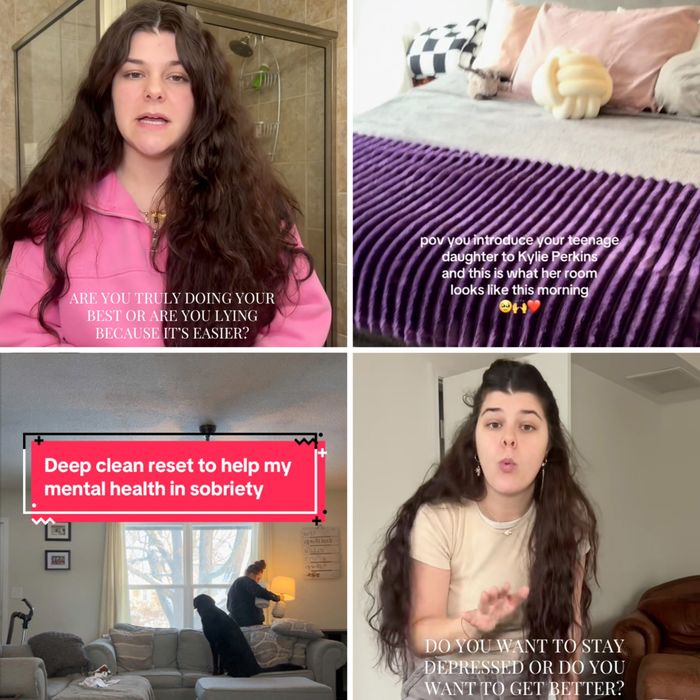 Photo-Illustration: by The Cut; Photos: @sociallykylie/TikTok, @heatheratl/TikTok, @thesoberglowwithheather/TikTok
.
.
Click the link below for the complete article:
.
__________________________________________
March 6, 2025
Mohenjo
Business, Food For Thought, Human Interest, Political, Science, Technical
amazon, business, Business News, current-events, Future, Hotels, human-rights, medicine, mental-health, research, Science, Science News, technology, Technology News, travel, vacation

Click the link below the picture
.
In the corridors of NASA buildings across the United States, Pride flags and pictures celebrating women in science are being taken down. Scientists are adding space-mission stickers to their laptops to cover ones that displayed rainbows and other symbols of LGBT+ support. Employees are stripping pronouns from their e-mail signatures and holding darkly humorous conversations in which they try to avoid saying any pronouns at all.
These and other changes are rippling through NASA, which is purging programmes involving diversity, equity and inclusion (DEI) throughout the agency. The directive to do so came from US President Donald Trump, who on 20 January issued an order to eliminate DEI initiatives across the federal government.
“I get a sinking feeling in my stomach when I have to check my [work] e-mail,” says an early-career NASA scientist, who asked to remain anonymous because of concerns about their career prospects. “Every time I reload it, it’s like, ‘oh god, will there be some new heinous missive in there?’”
Nature spoke to scientists inside and outside NASA about the impacts of its DEI changes — and heard anger, fear and confusion. Although the orders affect all federal agencies, they are keenly felt at NASA, which has a long history of working towards inclusivity. In 2020, Trump appointee Jim Bridenstine, then head of NASA, added inclusion to the agency’s list of core values, joining safety, integrity, teamwork and excellence. That fifth value has now been removed from many NASA websites.
“How do you go from something being so important that it’s a pillar [of the agency], to being so reviled that it’s off of everything?” asks Julie Rathbun, a planetary scientist at Cornell University in Ithaca, New York.
“It feels like a betrayal by NASA,” says Kas Knicely, a planetary geophysicist at the University of Alaska in Fairbanks. “It’s inefficient, it’s wasteful, and it’s also just messed up.”
In a statement, NASA said the agency “is committed to engaging the best talent to drive innovation and achieve our mission for the benefit of all. As new guidance comes in, we’re working to adhere to new requirements in a timely manner.”
A changed agency
NASA’s push towards inclusivity is one of the most visible in the US government. In the 1950s and 1960s, all of the agency’s astronauts were white men. By 1978, it had bowed to internal and external pressure and had chosen several women and people of colour to fly to space. Today, NASA’s astronauts, as well as its world-renowned scientific and engineering teams, are measurably diverse.
.

NASA’s diverse astronaut corps was an example of the agency’s support for diversity and inclusion. NASA/James Blair (CC BY-NC-ND 2.0)
.
.
Click the link below for the complete article:
.
__________________________________________
March 6, 2025
Mohenjo
Business, Food For Thought, Human Interest, Political, Science, Technical
amazon, business, Business News, current-events, Future, Hotels, human-rights, medicine, mental-health, research, Science, Science News, technology, Technology News, travel, vacation

Click the link below the picture
.
Children with a rare form of eye disorder who were born blind can now see thanks to a “remarkable” gene therapy breakthrough.
Researchers from London’s Moorfields Eye Hospital, biotech firm MeiraGTx and University College London have demonstrated that their therapy is both safe and effective in improving the vision of and slowing retinal deterioration in young patients born with “LCA-AIPL1.”
This previously untreatable genetic disorder, which affects some 2–3 of every 10 million newborns, leads to profound visual impairments and legal blindness.
In turn, this causes affected children to typically experience delayed and disrupted development in areas such as behavior, communication, and mobility.
“It’s an absolutely transformational improvement,” paper author and Moorfields ophthalmologist Michel Michaelides told Newsweek.
LCA (Leber congenital amaurosis) is the name given to a family of inherited eye disorders that affect the retina—the layer at the back of the eyeball containing light-sensitive “photoreceptor” cells.
These disorders are seen in roughly 2–3 out of every 100,000 births. There are many types of LCA and these vary depending on which of the genes involved in the development and function of the retina are affected.
At present, the only treatable form of LCA is that which involves a mutation in the gene coding for RPE65, a protein involved in the “visual cycle” that translates photons of light into electrical signals that the brain can then interpret.
Specifically, the protein helps refresh special pigments in photoreceptor cells so that they can be used over again. Without it, vision cannot be sustained.
Children with LCA-RPE65 tend to have poor night vision from birth and reduced day vision.
“They will recognize spaces and colors, and they’ll be on the vision chart,” Michaelides explains.
In 2017, the U.S. Food and Drug Administration (FDA) approved Luxturna, a gene therapy, for the treatment of RPE65-associated LCA. Gene therapies work by using a virus to install a new, healthy copy of a faulty gene into a patient’s cells to help address the underlying problem.
RPE65 mutations, however, only underlie about eight percent of LCA cases—and such are on the relatively milder end of the spectrum, in terms of not only severity but also the rate of onset and progression. Because of the latter, patients with RPE65-associated LCA can be treated from diagnosis up until their thirties or even forties.
In the new study, the researchers have focused on one of the rarest—and previously untreatable—flavors of LCA which affects the gene for AIPL1, which is essential for both the development and function of photoreceptor cells. This type of LCA is far more severe in effect, Michaelides says.
“They can’t get around in the dark. They’ve got no peripheral vision. Their central vision is virtually zero,” he explained.
“They can tell whether a light is on or off—if you shine a bright light at them, they might look towards it, for example.
“And then a smaller number of children with AIPL1 may be able to discern a large object really close up, or if it’s moving.”
Signs of AIPL1 issues in newborn children can include roving, almost shaking, eye movements; an inability to fix their eyes on anything, including their parents; and sleeping problems due to an inability to tune into the day/night cycles that normally set our bodies’ circadian rhythms.
.
 Children with a rare form of eye disorder who were born blind can now see
.
.
Click the link below for the complete article:
.
__________________________________________
March 5, 2025
Mohenjo
Business, Food For Thought, Human Interest, Political, Science, Technical
amazon, business, Business News, current-events, Future, Hotels, human-rights, medicine, mental-health, research, Science, Science News, technology, Technology News, travel, vacation
Click the link below the picture
.
“There is always a well-known solution to every human problem—neat, plausible, and wrong,” according to H. L. Mencken. Today we might ponder his words to diagnose the revival of another neat, plausible and boneheaded idea: ringing the planet with orbiting missiles to somehow make the U.S. safer.
In January, President Donald Trump called for a “next-generation missile defense shield” for the U.S. in an executive order. Named an “Iron Dome for America” after Israel’s short-range missile defense system—which it has nothing to do with—the plan would pour hundreds of billions of additional dollars into the long-underperforming rathole of U.S. missile defense efforts while weaponizing space. In the order, Trump referenced then president Ronald Reagan’s 1983 initiative, known as “Star Wars,” to build a missile defense shield with ground- and space-based weapons, saying it was “canceled before its goal could be realized.”
A similar fate awaits Trump’s plan—for the same reasons that Reagan’s missile-defense fantasia, including a late-1980s orbital version known as “Brilliant Pebbles,” never panned out: it will cost too much, won’t work and will endanger us all.
Right now the U.S. has 44 ground-based interceptor missiles stationed on the U.S. West Coast and aimed against ballistic missile attacks from the unstable nation of North Korea. They have worked 12 times out of 21 tests, a paltry success rate achieved only after $250 billion spent since their 1985 beginning. This illustrates the intrinsic, expensive difficulty of intercepting even dummy intercontinental ballistic missiles (ICBMs). It’s just hard to hit them.
What’s driving Trump’s Iron Dome? Fear of nuclear-tipped hypersonic missiles developed by Russia and China, which reach speeds of Mach 5, about one mile per second. Unlike ballistic missiles, which arc into space before returning to Earth, hypersonic ones maneuver and fly on a flat trajectory, which would be challenging for U.S. ground interceptors. “Most terrestrial-based radars cannot detect hypersonic weapons until late in the weapon’s flight due to line-of-sight limitations of radar detection,” the Congressional Research Service noted in a recent report.
In pursuit of “peace through strength,” the executive order argued, “the United States will guarantee its secure second-strike capability.” That means the ability to launch nuclear missiles as payback after a hypersonic nuclear attack on the U.S.—one that would mean World War III had started—supposedly to be assured via hypersonic-missile-detecting satellites, plus satellites to link these sensors to interceptors and the “deployment of proliferated space-based interceptors.”The idea is that space-based interceptors would presumably get a jump on blocking missiles over the current ground-based ones. (Natch, there are also space lasers planned. Although, with apologies to Dr. Evil, we’ve yet to hear if equally impractical “sharks with frickin’ laser beams attached to their heads” will also make a debut.)
.

Alexey Koza/Getty Images
.
.
Click the link below for the complete article:
.
__________________________________________
March 5, 2025
Mohenjo
Business, Food For Thought, Human Interest, Political, Science, Technical
amazon, business, Business News, current-events, Future, Hotels, human-rights, medicine, mental-health, research, Science, Science News, technology, Technology News, travel, vacation

Click the link below the picture
.
Think a hankering for pickle juice is just a weird pregnancy quirk? How about a whiff of dish liquid paired with a glass of ice?
That’s what’s on the menu for one pregnant mom who’s taken to TikTok to share her unusual craving. Lathering up a soapy sponge over a kitchen sink, @Yannigiles promises a tantalizing treat for the senses, combining the smell of soap with a mouthful of ice–and her followers are eating it up (if you’ll pardon the pun).
The TikTok, currently sitting at over 950K views, has gained a lot of attention from the curious as well as the concerned, wondering what’s the deal with pregnancy cravings.
It’s Not ‘Crazy’, It’s a Craving
“It smells so good, it’s like you can taste it almost,” Yanni explains in the TikTok as she inhales the scent of the sponge.
While a number of the 400+ commenters on Yanni’s video are a little taken aback by her newfound passion, many are backing her recommendation, sharing similar experiences of pregnancy cravings for cleaning products. And they’re not alone.
While an estimated 50%-90% of American women experience cravings for specific foods during pregnancy, non-food items are occasionally coveted too.
The tendency to compulsively desire things that aren’t edible or typically considered foods that have any significant nutritional value is known as pica.
The combination of scents and textures is just one example of non-food related cravings that some can have during pregnancy. Some specific cravings can include clay or dirt (also known as geophagia), ice and frozen substances (pagophagia), hair, chalk, and cornstarch. Some even fancy the smell of burnt matches, mothballs, or cigarette ashes.3
Craving the combination of dish soap and crushed ice commonly falls into this pica category, says Hayley Estrem, PhD, RN, a nurse scientist from the University of North Carolina Wilmington specializing in nutrition, family health and feeding disorders. She’s also the Research Consortium Project Lead for Feeding Matters.
She says pregnant people, like Yanni, are more likely to experience pica than non-pregnant people.
“Some people experience pica before and after pregnancy, but pregnancy is a marked time of increase and vulnerability,” explains Dr. Estrem. “It is believed that this could be because of the natural increase in inflammatory response that occurs with pregnancy.”
Dr. Estrem adds other lines of thought suggest pica could be activated by an increase in emotional stressors or vitamin or mineral deficiencies.
Though Pica May Be Harmless, It Could Be a Sign of Other Issues
So is there any harm in getting intimate with a little soap and ice? Well, potentially. Dr. Estrem reminds us that everything we ingest matters–including ice, which may seem harmless and most “food-like.”
“Craving ice may indicate that there is a deficiency, most often an iron deficiency, but there could be other underlying issues,” she says.
Doreen Marshall, PhD, psychologist and Chief Executive Officer of the National Eating Disorders Association (NEDA), says there’s limited understanding of what contributes to pica. However, she agrees iron-deficiency anemia and malnutrition are thought to be related.
“In pregnant individuals in particular, pica can be a sign that the body is trying to correct a significant nutrient deficiency,” says Dr. Marshall. “Treating this deficiency with medication or vitamins can address the problem, though it is important that a medical professional is involved in assessment and treatment.”
.
:max_bytes(150000):strip_icc()/Parents-MomsPregnancyCravingsWhatisPica-36e86b064b5f4ac9adfa8e91ccaa76ee.jpg) Parents/Natalia Gdovskaia via Getty Images
Parents/Natalia Gdovskaia via Getty Images
.
.
Click the link below for the complete article:
.
__________________________________________
March 4, 2025
Mohenjo
Business, Food For Thought, Human Interest, Political, Science, Technical
amazon, business, Business News, current-events, Future, Hotels, human-rights, medicine, mental-health, research, Science, Science News, technology, Technology News, travel, vacation
Click the link below the picture
.
CLIMATEWIRE | Back-to-back disasters rocked Houston last year, when a powerful derecho struck the city in May, followed by Hurricane Beryl in July. Both events brought gale-force winds to the densely built downtown, with gusts exceeding 90 miles per hour.
But after the storms, researchers noticed something strange. The derecho caused more damage than the hurricane to Houston’s tallest buildings.
Now, scientists say there’s a need for more research on the impacts of powerful downbursts in urban centers. That’s especially true for places like Houston, the Gulf Coast’s largest city, where thunderstorms and hurricanes can both wreak havoc.
In a new study, published Friday in the scientific journal Frontiers in Built Environment, researchers from Florida International University demonstrated that different kinds of storms — which produce distinct wind patterns — can pose different threats to tall buildings.
Both hurricanes and derechos can produce high-speed winds. But derechos — long-lasting wind storms often associated with bands of thunderstorms — have unique traits. They’re often characterized by sudden bursts of winds that move in straight lines, often causing damage that radiates outward in a single direction.
The researchers compared the damage caused by last year’s storms on several of Houston’s tall buildings, each at least 600 feet tall. These include the Chevron Building Auditorium, Wells Fargo Plaza, Enterprise Plaza, Wedge International Tower and the Total Energies Tower.
Each of these buildings is designed to withstand gusts up to 150 mph — yet many still sustained significant damage, particularly during the derecho. The researchers noted that an assessment of 18 buildings revealed more than 3,000 broken windows during the storm. Hurricane Beryl, on the other hand, caused significantly less glass damage than the derecho.
The researchers wanted to know why there was such a difference between the two storms. So they conducted a series of experiments in a special wind chamber housed at FIU, altering the airflow to simulate the patterns of derechos versus hurricanes. Model buildings inside the chamber helped them evaluate the impacts of the strong winds on the built environment.
They found that derecho winds can produce unique forces compared with hurricanes, including stronger suction on the walls of city buildings, allowing them to dislodge glass panels and shatter windows. The findings suggest that even buildings designed for strong winds aren’t necessarily resilient for all kinds of storms.
.

Shattered and boarded up windows are seen on the side of the Wells Fargo Plaza building in Houston, Texas, on May 17, 2024. Cecile Clocheret/AFP via Getty Images
.
.
Click the link below for the complete article:
.
__________________________________________
March 4, 2025
Mohenjo
Business, Food For Thought, Human Interest, Political, Science, Technical
amazon, business, Business News, current-events, Future, Hotels, human-rights, medicine, mental-health, research, Science, Science News, technology, Technology News, travel, vacation

Click the link below the picture
.
Before Central Park was created, the landscape along what is now the Park’s perimeter from West 82nd to West 89th Street was the site of Seneca Village, a community of predominantly African-Americans, many of whom owned property. By 1855, the village consisted of approximately 225 residents, made up of roughly two-thirds African-Americans, one-third Irish immigrants, and a small number of individuals of German descent. One of few African-American enclaves at the time, Seneca Village allowed residents to live away from the more built-up sections of downtown Manhattan and escape the unhealthy conditions and racial discrimination they faced there.
The formation of Seneca Village
Seneca Village began in 1825, when landowners in the area, John and Elizabeth Whitehead, subdivided their land and sold it as 200 lots. Andrew Williams, a 25-year-old African-American shoeshiner, bought the first three lots for $125. Epiphany Davis, a store clerk, bought 12 lots for $578, and the AME Zion Church purchased another six lots. From there a community was born. From 1825 to 1832, the Whiteheads sold about half of their land parcels to other African-Americans. By the early 1830s, there were approximately 10 homes in the Village.
There is some evidence that residents had gardens and raised livestock in Seneca Village, and the nearby Hudson River was a likely source of fishing for the community. A nearby spring, known as Tanner’s Spring, provided a water source. By the mid-1850s, Seneca Village comprised 50 homes and three churches, as well as burial grounds, and a school for African-American students.
A thriving African-American community
For African-Americans, Seneca Village offered the opportunity to live in an autonomous community far from the densely populated downtown. Despite New York State’s abolition of slavery in 1827, discrimination was still prevalent throughout New York City, and severely limited the lives of African-Americans. Seneca Village’s remote location likely provided a refuge from this climate. It also would have provided an escape from the unhealthy and crowded conditions of the City, and access to more space both inside and outside the home.
Compared to other African-Americans living in New York, residents of Seneca Village seem to have been more stable and prosperous—by 1855, approximately half of them owned their own homes. With property ownership came other rights not commonly held by African-Americans in the City—namely, the right to vote. In 1821, New York State required African-American men to own at least $250 in property and hold residency for at least three years to be able to vote. Of the 100 black New Yorkers eligible to vote in 1845, 10 lived in Seneca Village.Tangie
.

Nearly 200 years ago, Central Park’s landscape near the West 85th Street entrance was home to Seneca Village, a community of predominately free African-American property owners.
.
Click the link below for the complete article:
.
__________________________________________
March 4, 2025
Mohenjo
Business, Food For Thought, Human Interest, Political, Science, Technical
amazon, business, Business News, current-events, Future, Hotels, human-rights, medicine, mental-health, research, Science, Science News, technology, Technology News, travel, vacation

Click the link below the picture
.
I’m a psychologist, and AI is coming for my job. The signs are everywhere: a client showing me how ChatGPT helped her better understand her relationship with her parents; a friend ditching her in-person therapist to process anxiety with Claude; a startup raising $40 million to build a super-charged-AI-therapist. The other day on TikTok, I came across an influencer sharing how she doesn’t need friends; she can just vent to God and ChatGPT. The post went viral, and thousands commented, including:
“ChatGPT talked me out of self-sabotaging.”
“It knows me better than any human walking this earth.”
“No fr! After my grandma died, I told chat gpt to tell me something motivational… and it had me crying from the response.”
I’d be lying if I said that this didn’t make me terrified. I love my work—and I don’t want to be replaced. And while AI might help make therapy more readily available for all, beneath my personal fears, lies an even more unsettling thought: whether solving therapy’s accessibility crisis might inadvertently spark a crisis of human connection.
Therapy is a field ripe for disruption. Bad therapists are, unfortunately, a common phenomenon, while good therapists are hard to find. When you do manage to find a good therapist, they often don’t take insurance and almost always charge a sizable fee that, over time, can really add up. AI therapy could fill an immense gap. In the U.S. alone, more than half of adults with mental health issues do not receive the treatment they need. With the help of AI, any person could access a highly skilled therapist, tailored to their unique needs, at any time. It would be revolutionary.
But great technological innovations always come with tradeoffs, and the shift to AI therapy has deeper implications than 1 million mental health professionals potentially losing their jobs. AI therapists, when normalized, have the potential to reshape how we understand intimacy, vulnerability, and what it means to connect.
Throughout most of human history, emotional healing wasn’t something you did alone with a therapist in an office. Instead, for the average person facing loss, disappointment, or interpersonal struggles, healing was embedded in communal and spiritual frameworks. Religious figures and shamans played central roles—offering rituals, medicines, and moral guidance. In the 17th century, Quakers developed a notable practice called “clearness committees,” where community members would gather to help an individual find answers to personal questions through careful listening and honest inquiry. These communal approaches to healing came with many advantages, as they provided people with social bonds and shared meaning. But they also had a dark side: emotional struggles could be viewed as moral failings, sins, or even signs of demonic influence, sometimes leading to stigmatization and cruel treatment.
The birth of modern psychology in the West during the late 19th century marked a profound shift. When Sigmund Freud began treating patients in his Vienna office, he wasn’t merely pioneering psychoanalysis—he was transforming how people dealt with life’s everyday challenges. As sociologist Eva Illouz notes in her book, Saving the Modern Soul, Freud gave “the ordinary self a new glamour, as if it were waiting to be discovered and fashioned.” By convincing people that common struggles—from sadness to heartbreak to family conflict —required professional exploration, Freud helped move emotional healing from the communal sphere into the privacy of the therapist’s office.
.
 Sean Gladwell—Getty Images
.
.
Click the link below for the complete article:
.
__________________________________________
March 3, 2025
Mohenjo
Business, Food For Thought, Human Interest, Political, Science, Technical
amazon, business, Business News, current-events, Future, Hotels, human-rights, medicine, mental-health, research, Science, Science News, technology, Technology News, travel, vacation
Click the link below the picture
.
Among the slew of actions that President Donald Trump has taken during his first weeks back in office has been a barrage of attacks on federal scientists and scientific funding. The administration’s science agencies have fired thousands of employees, attempted to freeze research disbursements and proposed new policies that would reduce funding into the future.
Against this backdrop, a team of early-career researchers is organizing nationwide rallies on March 7 to “Stand Up for Science”—a call for people across the U.S. to demonstrate to show their appreciation of science and its benefits to society. Rallies will take place in Washington, D.C., Chicago, Boston, Philadelphia, Seattle, Nashville, Tenn., Austin, Tex., and many other places across the country. The network of stationary rallies is set to take place eight years after the March for Science protests that met Trump’s first administration—which Stand Up for Science’s organizers hope helped prepare scientists to wade into politics.
To learn about Stand Up for Science’s plans and goals, Scientific American talked with three of its lead organizers: Colette Delawalla, a Ph.D. candidate in clinical psychology at Emory University, Emma Courtney, a Ph.D. candidate in biology at Cold Spring Harbor Laboratory, and Sam Goldstein, a Ph.D. candidate in health behavior at the University of Florida.
[An edited transcript of the interview follows.]
How did each of you come to this place of wanting to step into activism?
DELAWALLA: I was just really mad. At the end of the day, I just want to do my research. I really think that studying addiction is important, and all science is important. But it really hit home for me, personally. I was angry, and it just seemed like everybody else was angry, too, and nobody else was doing anything about it. And, you know, “be the change you want to see in the world,” as cheesy as that is.
Are you connected at all to the 2017 March for Science?
DELAWALLA: Nobody in our core leadership team overlaps with people who were in the March for Science core leadership team. But we have been in contact with a number of the organizers from that group, and they seem to be really supportive and kind and generous with their advice and time and connections. And we’re so grateful.
We really appreciate that they were so ahead of their time in understanding that what was coming down the pipe in 2017 was really serious. They laid the groundwork for people to have a working conception of what it means for scientists and people who believe in science to come together. Without that foundation, I don’t know that we would have had as much success.
GOLDSTEIN: It feels sort of like a passing of the baton—we probably wouldn’t have known where to really start.
COURTNEY: What I have found really impactful in talking with the March for Science organizers is the event, day of, is really important. But it’s also about building a sustained movement that actually drives policy change.
“We’re trying to give folks somewhere they can feel powerful and have their voices heard.”What does a successful day on March 7 look like for you?
DELAWALLA: We want thousands and thousands of people to come. All over the U.S., we want people to put down their science, put down the pipette, close their R script, cancel their run-throughs of their experiments that day and come out. That is our number one goal for March 7.
Additionally, we want this to come up on the public’s and our government representatives’ radar. We do have plans to be meeting elected officials in Washington, D.C., in the week leading up to the rally. The goal is that we start off with a bang. This is sort of the science block party to really launch the demands into public view and to start the work on seeing them met.
GOLDSTEIN: It feels like this is only the beginning of the conversation. This is really just, across America, giving folks that maybe feel a lot of despair across this first month an outlet to feel heard and understood and comforted by like-minded individuals. Despair can sometimes breed apathy. The more it hits you, the more you doomscroll, the more you just feel powerless. We’re trying to give folks somewhere they can feel powerful and have their voices heard.
.
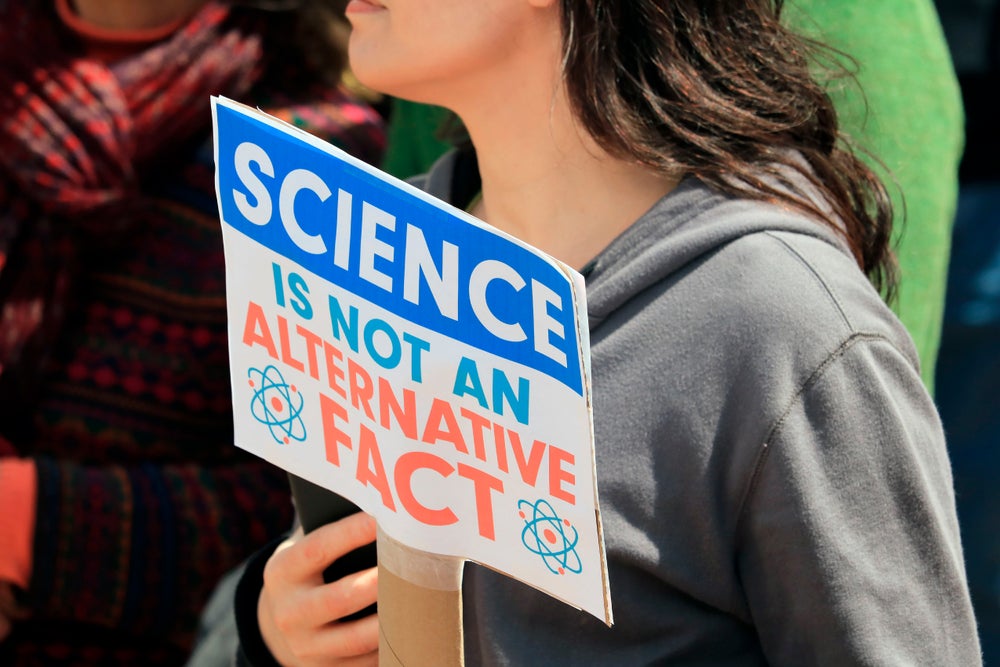
March for Science rally in Lafayette, Ind., on April 22, 2017. Education Images/Universal Images Group via Getty Images
.
.
Click the link below for the complete article:
.
__________________________________________
Older Entries
Newer Entries
 James' World 2