If you want to discover a hidden world of new life-forms, you don’t have to scour dark caves or slog through remote rainforests. Just look under your feet. When then-graduate student Anna Rosling went to northern Sweden to map the distribution of a particular root-loving fungus, she found something much more intriguing: Many of her root samples contained traces of DNA from unknown species. Weirder still, she never encountered a complete organism. When the field season ended, she had only isolated bits of raw genetic material. The fragments clearly belonged to the fungal kingdom, but they revealed little else. “I got obsessed,” recalls Rosling, now a professor of evolutionary biology at Uppsala University in Sweden.
Since then, mycologists have realized that such phantoms are everywhere. Point to a patch of dirt, a body of water, even the air you’re breathing, and odds are that it is teeming with mushrooms, molds and yeasts (or their spores) that no one has ever seen. In ocean trenches, Tibetan glaciers and all habitats between, researchers are routinely detecting DNA from obscure fungi. By sequencing the snippets, they can tell they’re dealing with new species, thousands of them, that are genetically distinct from any known to science. They just can’t match that DNA to tangible organisms growing out in the world.
These slippery beings are so widespread that scientists are calling them “dark fungi.” It’s a comparison to the equally elusive dark matter and dark energy that make up 95 percent of our universe and exert tremendous influence on, well, everything. Like those invisible entities, dark fungi are hidden movers and shakers. Scientists are convinced they perform the same vital functions as known fungi, directing the flow of energy through ecosystems as they break down organic matter and recycle nutrients. Dark fungi are prime examples of what biologist E. O. Wilson called “the little things that run the world.” But their cryptic lifestyle has made it a maddening challenge for scientists trying to show how exactly they run it.
Taxonomists have described just 150,000 of the millions of fungi predicted by global biodiversity estimates, and recent discoveries suggest a huge portion of what’s left may be off-limits to routine biological investigation. “We have not even started to scratch the surface,” says Henrik Nilsson, a mycologist at the University of Gothenburg in Sweden. “I’d be willing to bet that the clear majority will be dark.” Given the central place of fungi in the web of life that sustains us, experts argue we should get a better grasp on them.
Everything we know about dark fungi comes from environmental DNA, or eDNA. That term refers to strings of base pairs—the building blocks of DNA that are constantly sloughing off all living things. Researchers can analyze these free-floating bits of double helix to determine which species have been hanging around an area without seeing them. To identify fungi specifically, scientists look to a handy genetic marker called the internal transcribed spacer (ITS), which consists of several hundred base pairs that evolve quickly and thus help distinguish between species. Although the ITS is only a tiny fraction of the genome, researchers can single it out and amplify it with the same polymerase chain reaction technology used in COVID lab tests. If an ITS sequence is different enough from all others in genetic databases, it is thought to represent a new species, whether scientists lay eyes on its physical form or not.
In a new preprint paper—which, for context, is not peer reviewed, and is more of an editorial or set of observations than a theory or study—mathematician Kevin Buzzard is grappling with a simple idea from coding that becomes a “thornier concept” when translated into math: what does the equal sign actually mean? And what does it not mean?
Buzzard has been in the news for his efforts to turn classic math proofs into code that can be verified by a computer, including Fermat’s Last Theorem. For him, as a classically trained mathematician, the world of computer code includes some surprises.
“Six years ago, I thought I understood mathematical equality,” Buzzard wrote in his paper. “I thought that it was one well-defined term, and that there was nothing which could be said about it which was of any interest to me as a working mathematician with a knowledge of, but no real interest in, the foundations of my subject. Then I started to try and do masters level mathematics in a computer theorem prover, and I discovered that equality was a rather thornier concept than I had appreciated.”
Buzzard learned something that every Coding 101 student learns pretty quickly, whether in class or by doing it wrong in their work. In coding, there are different kinds of equal, and you have to completely work through some of the steps the human mind easily skips over when doing math in order to code properly. “The three-character string ‘2 + 2,’ typed into a computer algebra system, is not equal to the one-character string ‘4’ output by the system, for example; some sort of ‘processing’ has taken place,” Buzzard wrote.
Before any “keyboard warriors” start trying to alert the world that this is overcomplicating things or somehow undermining tradition, it’s important to remember that just because something is an edge case, that doesn’t mean it isn’t important and worth discussing. And there’s actually a lot of nuance to be addressed in this particular discussion: should the same equal sign account for terms you’ve rounded up or down? Does the equal sign cover all of the necessary bases if we imply the passage of time between one side and the other (like, for example, how two chickens eventually become three)?
Noland Arbaugh has a computer chip embedded in his skull and an electrode array in his brain. But Arbaugh, the first user of the Neuralink brain-computer interface, or BCI, says he wouldn’t know the hardware was there if he didn’t remember going through with the surgery. “If I had lost my memory, and I woke up, and you told me there was something implanted in my brain, then I probably wouldn’t believe you,” says the 30-year-old Arizona resident, who has been paralyzed below the middle of his neck since a 2016 swimming accident. “I have no sensation of it—no way of telling it’s there unless someone goes and physically pushes on it.”
The Neuralink chip may be physically unobtrusive, but Arbaugh says it’s had a big impact on his life, allowing him to “reconnect with the world.” He underwent robotic surgery in January to receive the N1 Implant, also called “the Link,” in Neuralink’s first approved human trial.
BCIs have existed for decades. But because billionaire technologist Elon Musk owns Neuralink, the company has received outsize attention. It’s brought renewed public interest to a technology that could significantly improve the life of those living with quadriplegia, such as Arbaugh, as well as people with other disabilities or neurodegenerative diseases.
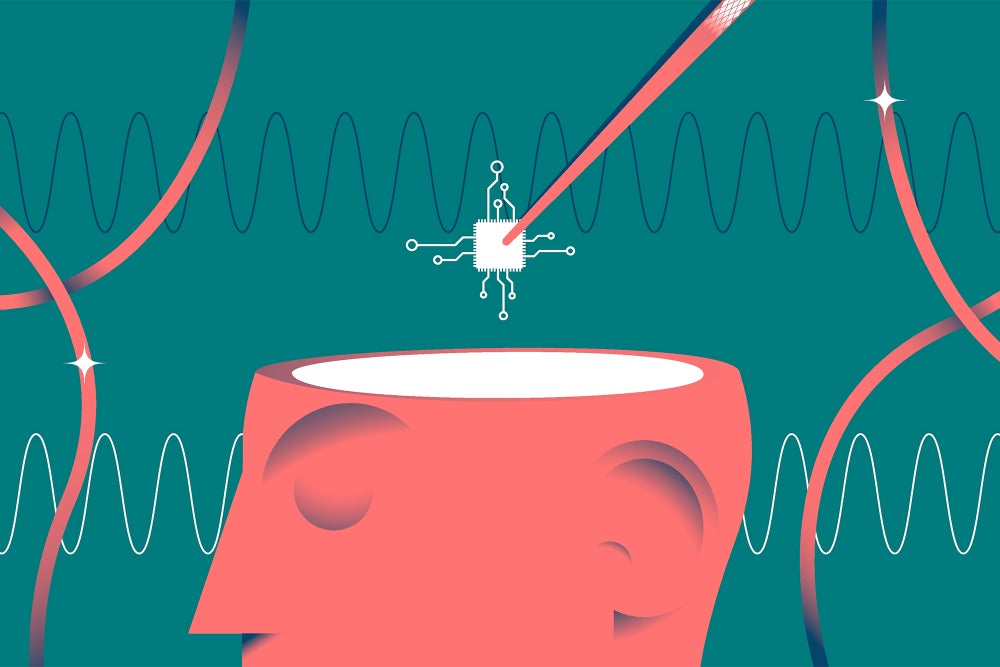
BCIs record electrical activity in the brain and translate those data into output actions, such as opening and closing a robotic hand or clicking a computer mouse. They vary in their design, level of invasiveness, and the resolution of the information they capture. Some detect neurons’ electrical activity with entirely external electroencephalogram (EEG) arrays placed over a subject’s head. Others use electrodes placed on the brain’s surface to track neural activity. Then there are intracortical devices, which use electrodes implanted directly into brain tissue, to get as close as possible to the targeted neurons. Neuralink’s implant falls into this category.
Capturing neural activity can be like trying to record chitchat between two people in a packed stadium, says Douglas Weber, a mechanical engineer and neuroscientist at Carnegie Mellon University. To hear anything more than the crowd’s roar, you need to get up close with the person speaking. “The farther away from the speaker you are, the more mixed and muddled the conversations become,” he explains. Neuralink threads electrodes into the brain’s motion-controlling motor cortex, positioning “sensors right up next to the individual neurons that are conversing.”
Passive-aggressive behavior occurs frequently in everyday interactions with our friends, romantic partners, family members, and co-workers. But because it can be insidious, you may not always recognize when it’s happening to you — or when you’re guilty of doing it yourself.
What does being “passive-aggressive” mean, exactly? It’s when you express negative emotions, such as anger or hostility, in an indirect (or passive) manner, explained Los Angeles clinical psychologist Ryan Howes — “particularly in a way that is easily deniable or not directly linked to the aggressor.”
He offered an example: Say you were frustrated with a loved one. Instead of telling them how you feel, you just “forget” to pick them up from the train station that day.
“This is easily deniable as a simple brain fart, but deep down you know you didn’t pick them up because you wanted payback for whatever they did to anger you,” Howes explained. “It’s classified as a defense mechanism because you are defending yourself from the potential pain of expressing your pain or anger directly and reaping their response, which might hurt.”
When you’re being passive-aggressive, you’re attempting to convey your feelings about something without actually saying what you want to say, Toronto-based relationship expert and sexologist Jess O’Reilly told HuffPost.
“It can be confusing, annoying, and harmful to relationships,” said O’Reilly, founder of Happier Couples Inc. “And you’re less likely to get what you want if you’re unclear in the first place.”
Though we all engage in passive-aggressive behavior now and then, this type of communication tends to be more habitual among people who are avoidant and conflict-averse, as well as those lacking self-esteem.
You might communicate this way because you find it too difficult or uncomfortable to directly express yourself, associate clinical social worker Miya Yung told HuffPost.
“Being passive-aggressive often entails a desire to avoid face-to-face conflict, not being truly honest about what [someone is] thinking, or making subtle comments that appear harmless yet have an underlying negative impact on the receiver,” said Yung, who works at The Connective, a Northern California therapy and wellness practice.
Passive-aggressive behavior can show up in many forms, from giving the silent treatment to pouting to procrastinating on a task you agreed to do. But here, we’ll focus on the verbal manifestations. We asked relationship experts to identify some of the most common passive-aggressive phrases. Here’s what to watch out for — and what to say instead.
.
Halfpoint Images via Getty Images Passive-aggressive behavior can sometimes be hard to identify. Here are some common phrases to avoid.
Researchers are investigating how an iron infusion from glacial meltwater might change Antarctica’s seas and the climate.
Rachel Feltman: Antarctica is the largest, coldest desert on the planet, with snowfall dropping less than six inches of water there each year. But for such a dry place, Antarctica has an outsize impact on the world’s oceans: the ice sheet that covers much of the continent contains most of Earth’s fresh water. You’ve probably heard that a lot of that ice is melting because of climate change and contributing to sea-level rise. But glaciers and ice shelves aren’t just made of frozen water. What else is the melt sending out to sea?
For Scientific American’s Science Quickly, I’m Rachel Feltman. You’re listening to the first episode of a four-part Fascination series on Antarctica.
For the next four Fridays, we’ll follow award-winning Brazilian journalist Sofia Moutinho as she travels on the Nathaniel B. Palmer, a U.S. icebreaker on a mission to help us understand how the climate crisis will unfold.
Today we’ll meet her on the ship as she and her fellow passengers encounter the fastest-melting glaciers and ice shelves on the continent.
Sofia Moutinho: I am on the bridge of the Nathaniel B. Palmer, a U.S. icebreaker that is slowly cruising along the coast of the coldest and most remote continent on Earth: Antarctica.
Thirty-five international researchers are onboard for a 60-day mission. Their goal is to collect thousands of gallons of water, plus lots of sea ice, to help uncover the future of our oceans and Earth’s climate.
Phoebe Lam: Ooh, what is that?
Moutinho: That’s Phoebe Lam, a chemical oceanographer at the University of California, Santa Cruz.
Lam: I think that’s land. That’s land—land ahoy [laughs]! Ooh, how exciting!
Moutinho: She is one of three scientists leading this cruise, and this is her third time in Antarctica.
Lam: Hey, it’s our first land since—a while.
Moutinho: Our journey started more than 20 days ago, when we left port in the small southern Chilean town of Punta Arenas at the end of November 2023.
.
Anaissa Ruiz Tejada/Scientific American
.
.
Click the link below for the to play clip (sound on):
The Caribbean’s sandy beaches, clear turquoise water and vibrant coral reefs filled with an amazing variety of sea creatures have long been the pride of the islands.
The big three – sun, sea and sand – have made this tropical paradise the most tourism-reliant region in the world.
But now, all of that is under threat. The explosive growth of a type of seaweed called sargassum is wreaking havoc on economies, coastal environments and human health across the islands.
I study the intersection of critical infrastructure and disasters, particularly in the Caribbean. The sargassum invasion has worsened since it exploded in the region in 2011. Forecasts and the seaweed already washing up suggest that 2024 will be another alarming year.
The Sargasso Sea
The Sargasso Sea is often referred to as a golden, floating rainforest for its vast floating sargassum blooms and the wide variety of sea life that it supports.
It is the only sea in the world with no land borders. Instead, it is bounded by four Atlantic Ocean currents: the North Atlantic current, the Gulf Stream, the North Atlantic Equatorial Current and the Canary Current.
Without human interference, and under normal conditions, sargassum is a good thing. It has existed in the Caribbean for centuries, providing habitat and food for ocean wildlife, including threatened and endangered species such as the porbeagle shark and the anguillid eel.
Conditions over the past decade around the Caribbean Sea, North Atlantic and Gulf of Mexico, however, have been anything but normal.
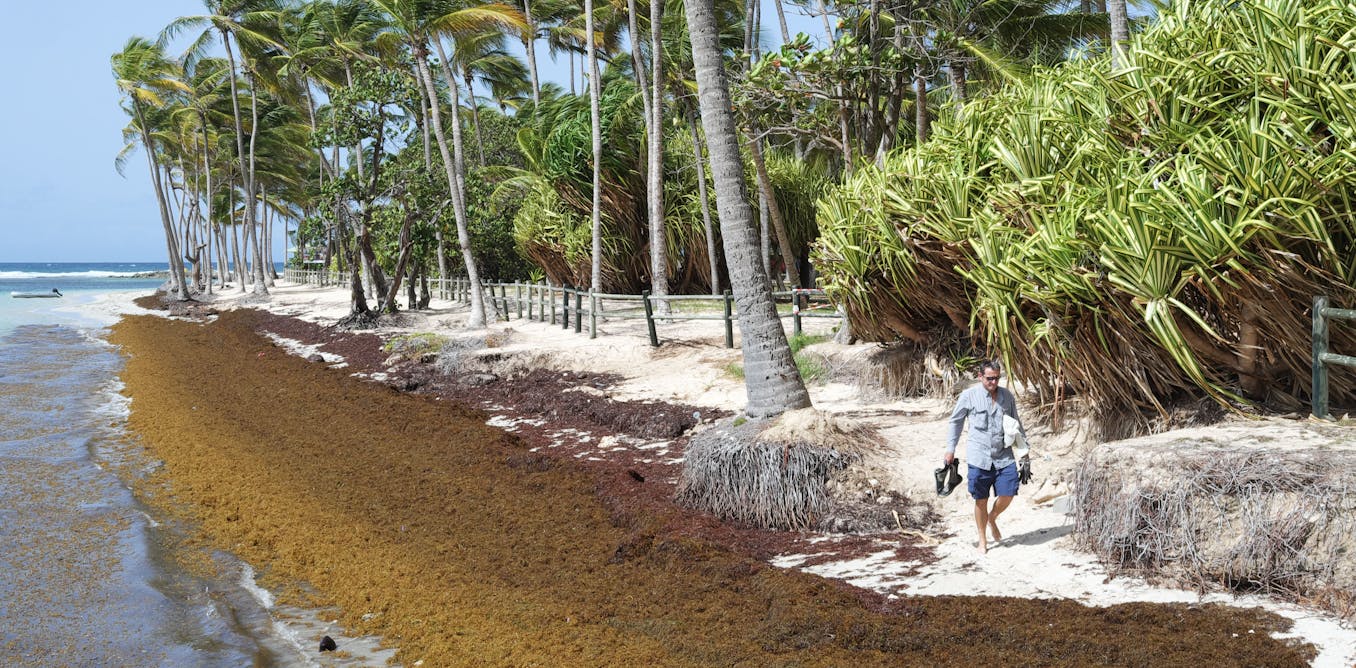
Since 2011, vast mats of sargassum seaweed have been washing up on Caribbean islands. On shore, they pile up into a dead and stinky mass.
.
Sargassum washes ashore in large, smelly mats. Clearing it away isn’t easy. Lhote/Andia/Universal Images Group via Getty Images
Kevin Hainline can time travel from his desk. Well, he can’t physically launch himself back in time. But as a user of NASA’s James Webb Space Telescope (JWST), the University of Arizona astronomer regularly observes galaxies from billions of years ago—because it takes that long for their emitted light to reach us from across the cosmos. And recently, he tracked one further back into the universe’s history than ever before.
The record-breaking galaxy, named JADES-GS-z14-0, appears to us as it existed 290 million years after the big bang, when the universe was a mere 2 percent of its present 13.8-billion-year age. This places it well within a mysterious epoch called the cosmic dawn—when the universe’s first stars began to shine and galaxies coalesced. The former record holder, a galaxy named JADES-GS-z13-0 that was reported in 2022 by Hainline and his colleagues on the JWST Advanced Deep Extragalactic Survey (JADES) research team, was observed about 325 million years following the big bang. Hainline acknowledges this age difference may seem unremarkable; cosmically speaking, not a lot usually happens in just 35 million years. But JADES-GS-z14-0 has properties that are vastly different from its slightly older counterpart, making it an anomaly that has experts second-guessing how the universe’s first galaxies evolved. “I was skeptical that it was anything special for a number of reasons,” Hainline recalls of his initial glimpse of the galaxy. “It just seemed too big and too bright…. But in January of this year, when we confirmed that it is, in fact, the new record holder, I just laughed. I had to get up from my office chair and walk down the hallway and look at the faces of the other JADES scientists.”
The group’s initial doubts were well-founded, says Brant Robertson, an astronomer and JADES member at the University of California, Santa Cruz, who is also a co-author of the preprint paper that reported the new record holder. JWST has been unveiling candidate early galaxies that seem to shatter experts’ expectations since it began operating in early 2022, but some of them were ultimately proved to be impostors—more modern galaxies much closer to us in the universe than JWST’s first glance would suggest. Unsurprisingly, Robertson says, the farthest galaxies are the hardest to accurately observe and verify; their qualities can be the most fascinating yet deserve the most skepticism.
JADES-GS-z14-0 was no exception to this rule; at first, Hainline thought it was just one half of another galaxy. With closer examination, he found that to be illusory. The other galaxy was a “foreground” object—an entirely different system billions of light-years closer to us that just happened to overlap with JADES-GS-z14-0 in our line of sight. With that relationship untangled, the candidate’s bizarre qualities became clearer: if it was an early galaxy, JADES-GS-z14-0 was abnormally large and unusually shaped. “At that point, I had been looking at thousands of little smudgy galaxies,” Hainline says. “But then this one came along, and I sent it first to my colleague Jake Helton [of the University of Arizona] and said, ‘This is seriously weird.’ And after looking into it more for some time, I knew we had to get a spectrum on it.”
.
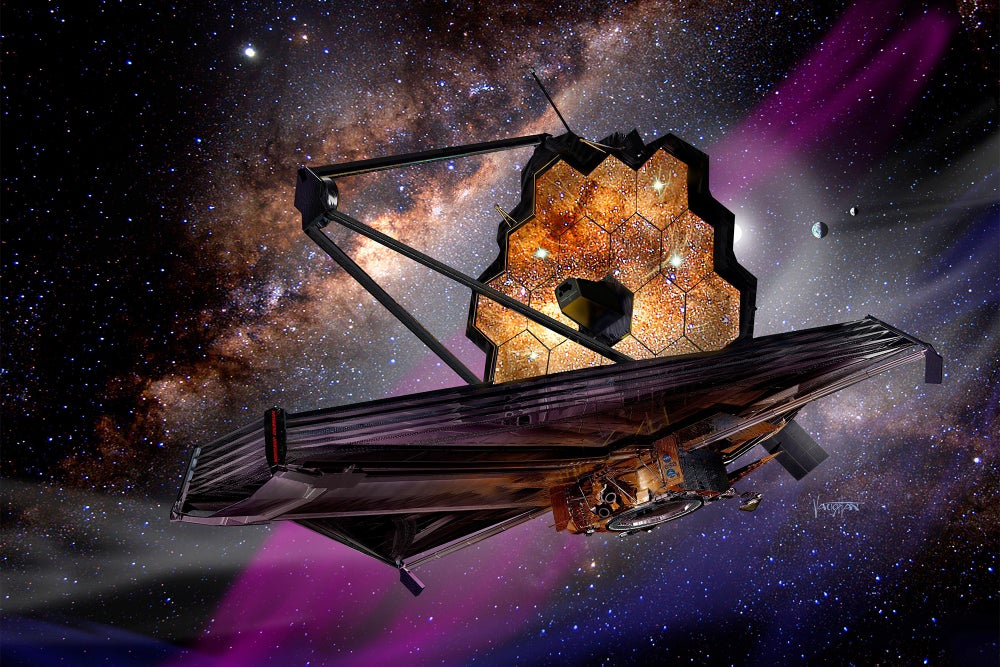
Artist’s illustration of NASA’s James Webb Space Telescope. James Vaughan/Science Photo Library/Alamy Stock Photo
Arriving early to pick up my daughter Nina at the elementary school, I pulled my car into a parking spot across the street and scanned the playground for her. Most of the boys charged across the playground in a hilarious Mad Max version of soccer. A handful of girls played four-square with a red playground ball. And the rest either dangled from the jungle gym or crouched underneath it in small clumps.
I spotted Nina sitting on one of the benches, back hunched, head down. One of the four-square players lobbed a sneering taunt in her direction. The other three players followed up with more. Nina didn’t move, so the player with the ball threw it at her. Nina lifted her face, grimaced — in pain or anger, I couldn’t tell — and shouted something back at the other girls.
The playground monitor materialized — where was she before? — and put her hands on her hips while she spoke to Nina. The other girls didn’t even try to cover their smirks. Then the bell rang, and the children lined up to go back inside. It was a miracle I didn’t wreck the car when Nina told me on the way home that the teacher had made her stand in front of the class and apologize for being disruptive at recess and for not respecting her classmates.
That day, my overwhelming desire was to take her back into my body, to hold her there where no one could reach her without first going through me. I wish I could say I swooped in and saved Nina from her tormentors, but I would have to accept failure — and acknowledge my own powerlessness — in order to do that.
The bullying began in earnest in second grade. The town was small, the school even smaller. Most of the children in Nina’s class had played at our house and ridden in our car and eaten the snacks we always brought to various events.
They were nice kids, we thought, but something changed over the summer between first and second grade. Each day our formerly lively daughter came home to us quiet, pale, and withdrawn. For a while, Nina asked me why the girls were so mean to her, but my answer, my assurance that we loved her, was useless, because the real answer was that I didn’t know — I didn’t know! Nina’s first grade teacher had been at a loss as well, when I’d asked her the same question.
.
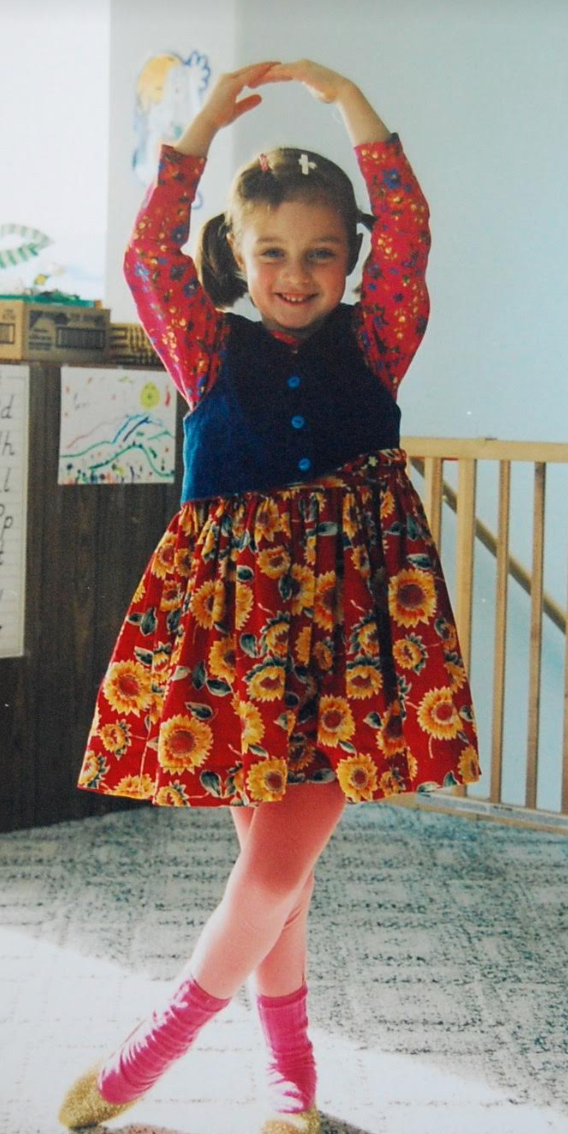
Nina at home on the morning of her first day of Kindergarten in 1997. Courtesy of Lea Page
The Moon has been a source of wonder and mystery for centuries. Even with numerous missions and extensive research, many of its secrets remain hidden beneath its surface. Recent discoveries by China’s Chang’e-4 mission have shed light on previously hidden structures on the far side of the Moon, revealing billions of years of geological history and providing new insights into its formation and evolution.
Launched in 2018, the Chang’e-4 lander by the Chinese National Space Administration (CNSA) became the first spacecraft to land on the far side of the Moon. This historic mission has been capturing stunning images of impact craters and collecting mineral samples, offering unprecedented insights into the Moon’s subsurface structures. In 2019, the Yutu-2 rover, part of the Chang’e-4 mission, began using Lunar Penetrating Radar (LPR) to map the upper 1,000 feet (300 meters) of the lunar surface in finer detail than ever before.
Findings on the Far Side of the Moon
The findings from the Chang’e-4 mission, recently published in the Journal of Geophysical Research: Planets, reveal the top 130 feet (40 meters) of the far side of the Moon’s surface consist of multiple layers of dust, soil, and broken rocks. Hidden within these layers is a crater formed by a large impact event.
Lead study author Jianqing Feng explained that the rubble surrounding this formation is likely ejecta from the impact. Beneath these surface layers, scientists discovered five distinct layers of lunar lava that spread across the landscape billions of years ago. These findings suggest a dynamic volcanic history, with the Moon’s mantle containing pockets of molten magma that erupted through surface cracks created by space debris impacts.
Film and Writing Festival for Comedy. Showcasing best of comedy short films at the FEEDBACK Film Festival. Plus, showcasing best of comedy novels, short stories, poems, screenplays (TV, short, feature) at the festival performed by professional actors.

 MattGrove/Getty Images

 Moor Studio/Getty Images


 Sargassum washes ashore in large, smelly mats. Clearing it away isn’t easy.