July 3, 2024
Mohenjo
Business, Food For Thought, Human Interest, Political, Science, Technical
amazon, business, Business News, current-events, Future, Hotels, human-rights, medicine, mental-health, research, Science, Science News, technology, Technology News, travel, vacation

Click the link below the picture
.
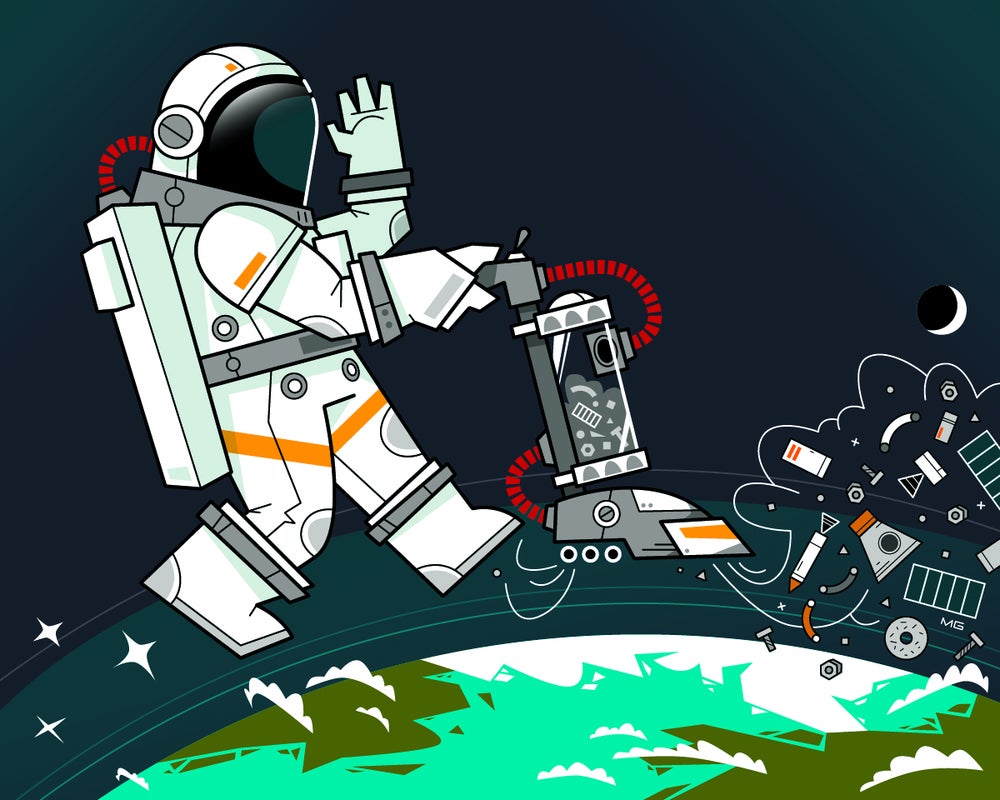
Space should not be a garbage dump. Nevertheless, we have treated the sky as a wrecker’s yard for more than half a century, and the amount of space junk orbiting Earth has skyrocketed in recent years. Now filled with the decaying hulks of defunct rockets and satellites, our polluted orbital environment is becoming more crowded by the day, threatening the growing space economy. It’s time for nations—and the billionaires commoditizing space—to clean up Earth’s near orbit.
The U.S. Air Force tracks more than 25,000 pieces of space junk larger than 10 centimeters—about the size of a bagel—weighing together some 9,000 metric tons. This dangerous trash zips around Earth at speeds of roughly 10 kilometers per second, or more than 22,000 miles per hour. Collisions between millimeter-scale objects too small to track and working satellites are now routine, as are near-miss disasters. One example is a NASA research satellite that almost hit a defunct Russian satellite in February. Orbital debris collisions cost satellite operators an estimated $86 million to $103 million in losses a year, a figure that will grow as each operator and each collision generate more debris.
The threat isn’t just in space. In March, part of a pallet from a discarded International Space Station battery fell to Earth, smashing through the roof of a Florida home. In 2020 an Ivory Coast village recovered a 12-meter-long pipe from space, courtesy of a Chinese rocket that cast off its empty core after launch. And a 2022 Nature Astronomy study puts the odds of space junk killing someone on the ground at 10 percent every decade. Needlessly.
Under the 1967 Outer Space Treaty, nations are supposed to be responsible for damages caused by space junk, even if it was originally launched by a private firm. That puts taxpayers, not space-exploring billionaires, on the hook for damages from orbital debris if its origin can be proved and the company shown negligent—a tough proposition for untraceable paint chips. No surprise, this hasn’t worked. The problem is, after decades of discussion, there is still no international treaty that limits space junk or sets standards for negligence. We need one that outlines responsibilities and imposes fines on the companies whose spacecraft debris causes harm.
As long as doing the right thing is voluntary, it may not happen, concluded a 2018 Air Force Association report. The limited action since then tells us the world is way overdue for an agreement on mandatory standards. Few countries or companies currently design rockets for their complete life cycle. They must be forced to store enough fuel and retain the capability for spacecraft to steer safely out of space when their useful life is over. Painful financial and regulatory penalties should afflict spacefaring industries and nations that fail to play by the new rules.
.
 Martin Gee
.
.
Click the link below for the article:
.
__________________________________________
July 2, 2024
Mohenjo
Business, Crime, Food For Thought, Human Interest, Medical, missed News, Political, Science, Technical
amazon, business, Business News, current-events, Future, Hotels, human-rights, medicine, mental-health, research, Science, Science News, technology, Technology News, travel, vacation

Hmmmmm… Maybe incarcerate Donald till all his cases have been litigated!
.
News You might have missed!
Use your browser or smartphone back arrow (<-) to return to this table for your next selection.
.
__________________________________________
July 2, 2024
Mohenjo
Business, Food For Thought, Human Interest, Political, Science, Technical
amazon, business, Business News, current-events, Future, Hotels, human-rights, medicine, mental-health, research, Science, Science News, technology, Technology News, travel, vacation

Click the link below the picture
.
Kate Bulkeley’s pledge to stay off social media in high school worked at first. She watched the benefits pile up: She was getting excellent grades. She read lots of books. The family had lively conversations around the dinner table and gathered for movie nights on weekends.
Then, as sophomore year got underway, the unexpected problems surfaced. She missed a student government meeting arranged on Snapchat. Her Model U.N. team communicates on social media, too, causing her scheduling problems. Even the Bible Study club at her Connecticut high school uses Instagram to communicate with members.
Gabriela Durham, a high school senior in Brooklyn, says navigating high school without social media has made her who she is today. She is a focused, organized, straight-A student with a string of college acceptances — and an accomplished dancer who recently made her Broadway debut. Not having social media has made her an “outsider,” in some ways. That used to hurt; now, she says, it feels like a badge of honor.
With the damaging consequences of social media increasingly well documented, some parents are trying to raise their children with restrictions or blanket bans. Teenagers themselves are aware that too much social media is bad for them, and some are initiating social media “cleanses” because of the toll it takes on mental health and grades.
But it is hard to be a teenager today without social media. For those trying to stay off social platforms while most of their peers are immersed, the path can be challenging, isolating, and at times liberating. It can also be life-changing.
This is a tale of two families, social media, and the ever-present challenge of navigating high school. It’s about what kids do when they can’t extend their Snapstreaks or shut their bedroom doors and scroll through TikTok past midnight. It’s about what families discuss when they’re not having screen-time battles. It’s also about persistent social ramifications.
.
 No Social Media
.
.
Click the link below for the article:
.
__________________________________________
July 2, 2024
Mohenjo
Business, Food For Thought, Human Interest, Political, Science, Technical
amazon, business, Business News, current-events, Future, Hotels, human-rights, medicine, mental-health, research, Science, Science News, technology, Technology News, travel, vacation

Click the link below the picture
.
Global spending on renewables, nuclear, energy efficiency, and low-emissions fuels like hydrogen is set to eclipse $2 trillion in 2024, double the $1 trillion spent on fossil fuels, according to the International Energy Agency’s annual review of global energy spending.
The transformation is particularly strong in the power sector, where worldwide investment in solar ($500 billion) is set to exceed spending on all other forms of power generation combined.
The IEA’s annual World Energy Investment report is closely tracked by industry analysts as a leading indicator for trends in the energy industry. This year’s report predicts that spending on clean energy will grow by almost 6 percent, up from nearly $1.9 trillion in 2023.
.

Workers install solar panels at a factory in Nairobi, Kenya, last year. Luis Tato/AFP via Getty Images
.
.
Click the link below for the article:
.
__________________________________________
July 1, 2024
Mohenjo
Business, Food For Thought, Human Interest, Political, Science, Technical
amazon, business, Business News, current-events, Future, Hotels, human-rights, medicine, mental-health, research, Science, Science News, technology, Technology News, travel, vacation

Hmmmmm… Did the Supreme Court just give President Biden the power to eliminate Donald Trump Legally?
Click the link below the picture
.
What to know about the Supreme Court’s ruling on Trump’s immunity appeal
- The Supreme Court ruled that former President Donald Trump has some immunity from prosecution in his federal election interference case. The 6-3 decision, which is complex, further delays special counsel Jack Smith’s prosecution.
- Chief Justice John Roberts, writing for the majority, rejected Trump’s broad immunity claims and said Trump has immunity only for his “official” acts as president. The high court did not determine what constitutes an official act in this case, leaving that to the lower court.
- The court’s liberal justices issued blistering dissents. In her dissent, Justice Ketanji Brown Jackson said the ruling “breaks new and dangerous ground.”
- President Joe Biden gave brief remarks from the White House this evening on the court’s ruling, calling it a “dangerous precedent.”
Biden says immunity ruling means there are ‘virtually no limits’ on presidential power
Biden said tonight that the Supreme Court’s ruling means there are “virtually no limits” on presidential power.
He said voters deserved to have an answer through the courts before Election Day about what took place on Jan. 6, 2021.
“Now, because of today’s decision, that is highly, highly unlikely. It’s a terrible disservice to the people of this nation,” he said.
Biden added that the high court’s ruling means voters in November will be charged with deciding whether they want to elect Trump “now knowing he’ll be more emboldened to do whatever he pleases, whenever he wants to do it.”
.

.
.
Click the link below for the article:
.
__________________________________________
July 1, 2024
Mohenjo
Business, Food For Thought, Human Interest, Political, Science, Technical
amazon, business, Business News, current-events, Future, Hotels, human-rights, medicine, mental-health, research, Science, Science News, technology, Technology News, travel, vacation
Click the link below the picture
.
When the electric air taxi revolution arrives, you probably won’t, it hear coming. A remarkable feature of an electric vertical takeoff and landing (eVTOL) aircraft is how quietly it flies, scarcely noticeable amid typical city traffic sounds. Unlike a helicopter, there’s no pounding, 90-decibel “thwop, thwop, thwop.” In contrast, eVTOL aircraft use multiple small propellers that spin half as fast as a chopper’s rotor—avoiding the annoying, low-frequency sound pulses created by the big whirling blades.
Electric motors, which are quieter than helicopters’ turbine engines, also help keep any racket to a minimum. “The latest air taxi designs, such as those from leading builders like Joby and Archer, deliver a 20- to 25-decibel reduction in noise levels compared to helicopters,” says Mark Moore, the trailblazing engineer who led the development of NASA’s X-57 Maxwell electric airplane. That means that eVTOLs could be four or five times less noisy to nearby listeners. Beyond offering quieter flights, these new machines should also be significantly safer, greener, and cheaper to fly than helicopters. Moore maintains that electric air taxis are uniquely suited for what the aviation industry calls urban air mobility (UAM) services, enabling normally gridlocked travelers to “take advantage of the third dimension to escape the ant trails on the ground.”
More than two dozen major eVTOL builders have been founded in the past decade, and a few are nearing commercial certification from the U.S. Federal Aviation Administration or its European counterpart, the European Union Aviation Safety Agency (EASA). Each company is working on its own homegrown aircraft design, but all have the same goal: to provide on-demand air trips no longer than 18 to 25 miles—the “sweet spot” range for first-generation, battery-electric eVTOL taxis. These short, high-speed hops could carry commuters between city centers and airports or transport cargo and packages. Militaries may want eVTOLs for casualty evacuations or logistical supply. Other potential uses include air ambulances, donor organ delivery, and police transport, as well as scheduled shuttles and ecotourism trips—and, of course, personal flying cars.
Distributed Electric Propulsion
In 2016 Moore, who co-founded Uber Elevate, an air taxi offshoot of the ride-sharing company, and his colleagues outlined the emerging industry’s basic business model in a seminal white paper entitled “Fast-Forwarding to a Future of On-Demand Urban Air Transportation.” It galvanized the nascent UAM industry by declaring that the necessary technology had finally arrived. “What had previously been science fiction” was suddenly becoming a going enterprise, Moore recalls. Uber Elevate soon assembled potential players including budding airframe builders, airline companies, auto makers, and transport service providers, as well as potential financiers and operators of new vertiports—airports for vertical-lift aircraft.
.
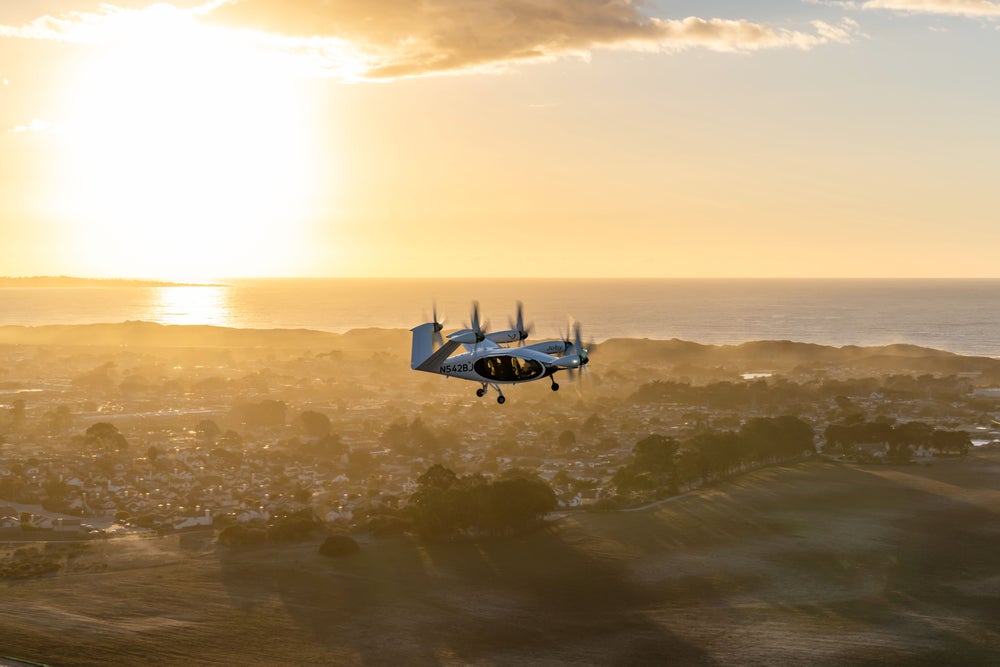
A flying electric air taxi developed by California-based Joby Aviation. Joby Aviation/© Joby Aero, Inc.
.
.
Click the link below for the article:
.
__________________________________________
July 1, 2024
Mohenjo
Business, Food For Thought, Human Interest, Political, Science, Technical
amazon, business, Business News, current-events, Future, Hotels, human-rights, medicine, mental-health, research, Science, Science News, technology, Technology News, travel, vacation

Hope you never have to use this information!
Click the link below the picture
.
Several months ago 2 cousins, just 19 years old, drowned when their car plunged into a pond.
The driver was traveling from her workplace at Amazon to a nursing home where the other cousin worked.
Medical examiners say both women died of accidental drowning and that no foul play is suspected. This emergency was tragic news and a devastating incident for the community – and it doesn’t happen to just adults.
Children and babies are frequently victims in water related accidents.
I was even more surprised to find out that over 10,000 auto accidents like this happen each year.
Some survive, others don’t.
And it made me think, “would I know what to do in a situation like this?”
“How would I save children or other passengers in a drowning car?”
We all like to think that we’d be able to escape a car crash in water.
But being in the moment, inside a car sinking in water is far more disorienting than you may think.
It happens fast.
And you may even find yourself upside down and in the dark – a panic inducing moment even without passengers.
With a short window of opportunity.
.
 Sinking Car
.
.
Click the link below for the article:
.
__________________________________________
June 30, 2024
Mohenjo
Business, Food For Thought, Human Interest, Science, Technical
amazon, business, Business News, current-events, Future, Hotels, human-rights, medicine, mental-health, research, Science, Science News, technology, Technology News, travel, vacation
Click the link below the picture
.
When historian and ecologist Laura J. Martin decided to write a history of ecological restoration, she didn’t think she would have to go back further than the 1980s to uncover its beginnings. Deep in the archives, she found evidence of a network of early female botanists from the turn of the 20th century. Martin’s book Wild by Design: The Rise of Ecological Restoration brings their work back into the record. The nonfiction account tells the stories of Eloise Butler, Edith Roberts and the wild and wonderful gardens they planted and studied.
LISTEN TO THE 26:52 PODCAST – (sound on after clicking link for article in red below narrative and picture)
Lost Women of Science is produced for the ear. Where possible, we recommend listening to the audio for the most accurate representation of what was said.
EPISODE TRANSCRIPT
Laura Martin: I found all of these, you know, gems of untold stories of women scientists in the early twentieth century, who really were laying the scientific foundation for restoration.
Sophie McNulty: I’m Sophie McNulty, and I’m a producer for Lost Women of Science.
I worked on the first two seasons of the show before I moved to the UK and ended up working on a gardening podcast for the Royal Horticultural Society. I recently returned to Lost Women of Science and, apropos of horticulture, I’m particularly excited to be hosting today’s episode on ecological restoration.
This is quite the hot topic in the world of horticulture and environmental management at large. To give you a sense of just how hot it is, today billions are spent on ecological restoration projects each year, and the UN General Assembly declared 2021 to 2030 to be the UN decade on ecosystem restoration. But, the history of this field has been largely overlooked, and when it is told, women are often written out of the narrative.
And so today, we’re going to try to remedy that by zeroing in on important early restorationists who were themselves women. We’ll be focusing on botanists Eloise Butler and Edith Roberts. And to do this, I’m so pleased to welcome Laura Martin, a professor at Williams College and author of Wild By Design, The Rise of Ecological Restoration.
Hi, Laura. Thanks for coming on the show.
Laura Martin: Thank you. I’m very excited to speak with you today, Sophie.
Sophie McNulty: So to start, before we go back in time to the stories of these early restorationists, I want to quickly define terms. So what exactly is ecological restoration and how is it different from, say, conservation or preservation?
.
 Keren Mevorach (art design); Harvard University Press (book)
.
.
Click the link below for the article:
.
__________________________________________
June 30, 2024
Mohenjo
Business, Food For Thought, Human Interest, Political, Science, Technical
amazon, business, Business News, current-events, Future, Hotels, human-rights, medicine, mental-health, research, Science, Science News, technology, Technology News, travel, vacation

Click the link below the picture
.
There’s a running joke about going on vacation with your kids — you know the one. That it’s not really a vacation. It’s just a trip, it’s just parenting in a different place, it’s just the same work you do every day except now with more sand. But here’s the hack everyone seems to be missing: go on vacation with your friends and their kids.
That’s where the breathing room is.
There’s a reason why we look for mom groups, for parents to hang next to at the park, for the dads at preschool drop-off. We want to be with the people who get it. Who don’t judge when they see our kid throw themselves mouth-first into the woodchips because we dared to suggest sunscreen. These are the kind of friends who don’t try to fix the situation, offer advice, or give a backhanded compliment like, “Wow, he’s really spirited, huh?” They just give you a knowing look and try to hide their amusement from your toddler. So why not vacation with that same kind of energy?
Going on a vacation with friends — real friends — means extra sets of adult hands around bodies of water and people to unwind with at night. It means your kids have built-in playmates for the week, are excited to run upstairs and put on a movie at bedtime while the grown-ups play Trivial Pursuit downstairs. It means you hardly see your kids while you’re at the beach, and you may be able to actually read a book because there they’ve been, for the past hour, building an epic sand castle with their besties.
There are not just extra adults but two more parents in the house — and the distinction is key. Parents who will offer to take your big kids with their kids to get ice cream because your baby’s sleeping and parents who will start breakfast for everyone because they know the value in a surplus of pancakes. They’re your friends, so you can trust them, and your kids do, too. You don’t have to worry about your kids waking up in the middle of the night and being scared because even if they walk in the wrong room, they’ll find people who love them and care about them.
Of course, the prep work for a vacation with friends is still work. Someone has to figure out a meal plan, someone has to have a list of things to do, someone has to figure out sleeping arrangements — that’s why you have to vacation with friends. With people who have seen your house messy, the kinds of friends that come over for a barbecue and take out the trash when they see it’s overflowing. The kinds of friends that always bring a dish to share and have been known to rock your babies to sleep or wipe crusty chocolate ice cream off squirming faces.
.

Fly View Productions/E+/Getty Images
.
.
Click the link below for the article:
.
__________________________________________
June 29, 2024
Mohenjo
Business, Food For Thought, Human Interest, Political, Science, Technical
amazon, business, Business News, current-events, Future, Hotels, human-rights, medicine, mental-health, research, Science, Science News, technology, Technology News, travel, vacation

Click the link below the picture
.
Earlier this year, Atlantic staff writer McKay Coppins suggested that voters, in the interest of civic hygiene and personal illumination, attend a Trump rally. This would be the way to understand the candidate, his thoughts, and his supporters, Coppins argued. He himself has attended more than 100 such gatherings since 2016, and he noted, correctly, that “nothing quite captures the Trump ethos like his campaign rallies.”
I have attended only a few of these rallies (though among them was Trump’s January 6, 2021, rally on the Ellipse, which should count double). But what one derives from the experience is, in the words of our colleague Tom Nichols, the visceral sense that Trump is deeply unwell.
Attendance at Trump rallies can be metaphysically taxing—and some seem to go longer than a Taylor Swift concert. So watching them from beginning to end online is occasionally a welcome substitute.
A couple of weeks ago, on C-SPAN, I watched my first Trump rally in quite some time, a gathering under a heat dome in Las Vegas. I watched not because I expected to learn something new about the candidate, but because I had been alerted by concerned friends and colleagues that Trump had attacked me by name. This hadn’t happened in quite some time, and self-interest dictated watching.
.
 Donald
.
.
Click the link below for the article:
.
__________________________________________
Older Entries
Newer Entries

