Welcome to The Twilight Zone. Not some science fiction fantasy, but a real place where up to 90 percent of us spend the majority of our waking lives.
We have built a world that hides us from daylight in dimly-lit offices, and then illuminates the night. We talk of burning the candle at both ends. The midnight oil. There not being enough hours in the day. We depend on night shift workers to mend our roads and staff our hospitals.
Small wonder, then, that a third of us are struggling to sleep. Finally, though, the degree to which we’ve been playing a dangerous game with our biology is being understood.
Until recently, sleep science was often synonymous with circadian science, but the latter is now emerging out of the shadows. The 2017 Nobel Prize in Physiology or Medicine was awarded to three scientists in the field of circadian rhythm. As a result of theirs and others’ breakthroughs, we’re waking up to the power of the body’s internal biological clock.
Like plants and animals, we too are preprogrammed to do certain activities at specific times of the day. Our circadian rhythms are controlled by circadian clocks, present in every organ and every cell, and these clocks tell our brain when to sleep, tell our gut when to digest our food optimally, tell our heart to pump more blood, and when to slow down.
The health risks associated with a disrupted circadian rhythm
Ignore them at your peril. In the short term, you may feel lethargic, suffer insomnia, and weight gain. One report showed that 57 percent of junior doctors have had a crash, or near miss, on the way back from a night shift.
And the long-term effects? Chronic disease, such as type 2 diabetes, Alzheimer’s, and cancer, have been linked to disruption of our circadian rhythm. The impact of disrupting our circadian sleep rhythm is such that night-shift workers have a higher mortality rate. The 24-hour society comes with a high price tag.
For Dr Satchin Panda, one of the scientists at the forefront of the circadian science revolution, the challenge for humanity is to rethink the world which we have built over the past 100 years.
“It’s an asbestos moment,” he says. “We figured out asbestos was harmful in the Seventies, and we’re still removing it now. We’re going through that moment with circadian disruption, but it will take a generation to implement change.”
China has landed on the moon’s mysterious far side — again.
The robotic Chang’e 6 mission touched down inside Apollo Crater, within the giant South Pole-Aitken basin, at 6:23 a.m. Beijing Time on Sunday (June 2) , according to Chinese space officials. It was 6:23 p.m. EDT (2223 GMT) on June 1 at the time of the landing. The probe “successfully landed in the pre-selected area,” China’s space agency said.
The China National Space Administration (CNSA) now has two far-side landings under its belt — this one and Chang’e 4, which dropped a lander-rover combo onto the gray dirt in January 2019. No other country has done it once.
And Chang’e 6 will make further history for China, if all goes according to plan: The mission aims to scoop up samples and send them back to Earth, giving researchers their first-ever up-close looks at material from this part of the moon.
“The Chang’e-6 mission is the first human sampling and return mission from the far side of the moon,” CNSA officials said in a translated statement. (To be clear: Chang’e 6 is a robotic, not crewed, mission.) “It involves many engineering innovations, high risks, and great difficulty.”
Sampling a new environment
Chang’e 6 launched on May 3 with a bold and unprecedented task: haul home samples from the moon’s far side, which always faces away from us. (The moon is tidally locked to Earth, completing one rotation on its axis in roughly the same amount of time it takes to orbit our planet. So observers here on Earth always see the same side of our natural satellite.)
Every lunar surface mission before Chang’e 4 targeted the near side, largely because that area is easier to explore. It’s harder to communicate with robots operating on the far side, for example; doing so generally requires special relay orbiters, which China launched ahead of both Chang’e 4 and Chang’e 6. China’s newest moon relay satellite, called Queqiao-2, aided the Chang’e 6 landing, CNSA officials said.
.
A Long March 5 rocket, carrying the Chang’e-6 mission lunar probe, lifts off as it rains at the Wenchang Space Launch Centre in southern China’s Hainan Province on May 3, 2024. Hector Retamal/AFP via Getty Images
I can’t think of anything permeating mainstream camera culture as aggressively as the DJI Osmo Pocket 3. The Fujifilm X100VI has stolen some of its thunder among film simulation enthusiasts, but DJI’s still having somewhat of a cultural moment on YouTube, Instagram, and the troubled TikTok by spurring all sorts of creator glee.
Of course, the camera buffs are all over it, but serious and casual creators from other genres have paused their usual programming to rave about how it transcends amateur vlogging pursuits, whether you’re filming a wedding or self-shooting a scene for a Sundance-hopeful short film.
Some of us at The Verge are excited, too: Vjeran liked it enough to call it his favorite gadget of 2023, and Sean just bought one after using it to elevate his Today I’m Toying With videos.
I felt tingles about the $519 Osmo Pocket 3 when DJI first announced it, but it wasn’t until I purchased a Creator Combo that I fully understood the hype. The video quality often comes close to my full-frame Sony mirrorless (although I can’t get all the same shots) and is very noticeably better than my phone.
The original Osmo Pocket and Pocket 2 couldn’t make those boasts, but the Pocket 3 is a cut above. Its larger one-inch-equivalent sensor is now bigger than those in most phones, with better low-light performance and more reliable autofocusing than predecessors. It has a much bigger display, longer battery life, faster charge time, more microphones — the list goes on like that for nearly everything that makes it tick.
.
Despite its name, the Pocket 3 isn’t exactly comfortable to stuff in tighter pockets. Photo by Quentyn Kennemer / The Verge
Kris Hansen had worked as a chemist at the 3M Corporation for about a year when her boss, an affable senior scientist named Jim Johnson, gave her a strange assignment. 3M had invented Scotch Tape and Post-it notes; it sold everything from sandpaper to kitchen sponges. But on this day, in 1997, Johnson wanted Hansen to test human blood for chemical contamination.
Several of 3M’s most successful products contained man-made compounds called fluorochemicals. In a spray called Scotchgard, fluorochemicals protected leather and fabric from stains. In a coating known as Scotchban, they prevented food packaging from getting soggy. In a soapy foam used by firefighters, they helped extinguish jet-fuel fires. Johnson explained to Hansen that one of the company’s fluorochemicals, PFOS—short for perfluorooctanesulfonic acid—often found its way into the bodies of 3M factory workers. Although he said that they were unharmed, he had recently hired an outside lab to measure the levels in their blood. The lab had just reported something odd, however. For the sake of comparison, it had tested blood samples from the American Red Cross, which came from the general population and should have been free of fluorochemicals. Instead, it kept finding a contaminant in the blood.
Johnson asked Hansen to figure out whether the lab had made a mistake. Detecting trace levels of chemicals was her specialty: she had recently written a doctoral dissertation about tiny particles in the atmosphere. Hansen’s team of lab technicians and junior scientists fetched a blood sample from a lab-supply company and prepped it for analysis. Then Hansen switched on an oven-size box known as a mass spectrometer, which weighs molecules so that scientists can identify them.
As the lab equipment hummed around her, Hansen loaded a sample into the machine. A graph appeared on the mass spectrometer’s display; it suggested that there was a compound in the blood that could be PFOS. That’s weird, Hansen thought. Why would a chemical produced by 3M show up in people who had never worked for the company?
Hansen didn’t want to share her results until she was certain that they were correct, so she and her team spent several weeks analyzing more blood, often in time-consuming overnight tests. All the samples appeared to be contaminated. When Hansen used a more precise method, liquid chromatography, the results left little doubt that the chemical in the Red Cross blood was PFOS.
Hansen now felt obligated to update her boss. Johnson was a towering, bearded man, and she liked him: he seemed to trust her expertise, and he found something to laugh about in most conversations. But, when she shared her findings, his response was cryptic. “This changes everything,” he said. Before she could ask him what he meant, he went into his office and closed the door.
This was not the first time that Hansen had found a chemical where it didn’t belong. A wiry woman who grew up skiing competitively, Hansen had always liked to spend time outdoors; for her chemistry thesis at Williams College, she had kayaked around the former site of an electric company on the Hoosic River, collecting crayfish and testing them for industrial pollutants called polychlorinated biphenyls (PCBs). Her research, which showed that a drainage ditch at the site was leaking the chemicals, prompted a news story and contributed to a cleanup effort overseen by the Massachusetts Department of Environmental Protection. At 3M, Hansen assumed that her bosses would respond to her findings with the same kind of diligence and care.
Hansen stayed near Johnson’s office for the rest of the day, anxiously waiting for him to react to her research. He never did. In the days that followed, Hansen sensed that Johnson had notified some of his superiors. She remembers his boss, Dale Bacon, a paunchy fellow with gray hair, stopping by her desk and suggesting that she had made a mistake. “I don’t think so,” she told him. In subsequent weeks, Hansen and her team ordered fresh blood samples from every supplier that 3M worked with. Each of the samples tested positive for PFOS.
.
In April, the Environmental Protection Agency finalized two historic regulations of forever chemicals, which are found in countless everyday products. Photo illustration by Philotheus Nisch for The New Yorker
Bird flu has been behaving very strangely lately. A strain of the highly pathogenic avian influenza virus (H5N1) has been spreading in dairy cows in at least nine U.S. states. Infected cows have very high levels of virus in their milk, and early reports indicate that it is being spread by contaminated milking equipment, although other methods of transmission are also possible. Several cats that drank raw milk from infected cows developed neurological symptoms and died. Pasteurizing milk appears to effectively neutralize the H5N1 virus.
In recent weeks, three human infections with the virus have been confirmed—all in dairy workers who had contact with sick cows. All three developed symptoms of eye infections known as conjunctivitis. The latest case, reported in Michigan this week, also involved respiratory symptoms more typical of a flu infection. The workers were most likely exposed to the virus in contaminated milk—by getting it on their hands and then touching their eyes, for example, or via milk droplets (or even microscopic particles called aerosols) from a cow’s udder or milking equipment.
“It is really surprising how widespread this thing got over a few months’ time and how this virus seems to be spreading through the milking machines from udder to udder,” says Ron Fouchier, deputy head of the viroscience department at Erasmus University Medical Center Rotterdam in the Netherlands. “This is a completely new situation for all of us, and it’s surprising and a little bit worrying because of the enormous amounts of virus that can be in raw milk.”
But why is H5N1 causing eye infections in humans? And is there a risk the virus could spread more widely and potentially cause a pandemic?
In fact, cases of avian flu causing conjunctivitis are not that rare. There was a large outbreak of H7N7 avian flu in poultry in the Netherlands in 2003, which led to 89 confirmed human cases. Of these, 78 people had conjunctivitis; five had both conjunctivitis and flulike illness and two had only flulike illness. One person developed pneumonia and respiratory distress and died, according to a 2004 study by Fouchier and his colleagues.
“We’ve seen this [conjunctivitis] also before with … H7N7 viruses quite a lot and a little bit less with H5 bird flu viruses,” Fouchier says. (The latter is the type now spreading in cows.) “But we know that these bird flu viruses can cause conjunctivitis rather easily.”
.
Matthew Ludak/The Washington Post via Getty Images
When Google announced it was rolling out its artificial-intelligence-powered search feature earlier this month, the company promised that “Google will do the googling for you.” The new feature, called AI Overviews, provides brief, AI-generated summaries highlighting key information and links on top of search results.
Unfortunately, AI systems are inherently unreliable. Within days of AI Overviews’ release in the US, users were sharing examples of responses that were strange at best. It suggested that users add glue to pizza or eat at least one small rock a day, and that former US president Andrew Johnson earned university degrees between 1947 and 2012, despite dying in 1875.
On Thursday, Liz Reid, head of Google Search, announced that the company has been making technical improvements to the system to make it less likely to generate incorrect answers, including better detection mechanisms for nonsensical queries. It is also limiting the inclusion of satirical, humorous, and user-generated content in responses, since such material could result in misleading advice.
But why is AI Overviews returning unreliable, potentially dangerous information? And what, if anything, can be done to fix it?
How does AI Overviews work?
In order to understand why AI-powered search engines get things wrong, we need to look at how they’ve been optimized to work. We know that AI Overviews uses a new generative AI model in Gemini, Google’s family of large language models (LLMs), that’s been customized for Google Search. That model has been integrated with Google’s core web ranking systems and designed to pull out relevant results from its index of websites.
Most LLMs simply predict the next word (or token) in a sequence, which makes them appear fluent but also leaves them prone to making things up. They have no ground truth to rely on, but instead choose each word purely on the basis of a statistical calculation. That leads to hallucinations. It’s likely that the Gemini model in AI Overviews gets around this by using an AI technique called retrieval-augmented generation (RAG), which allows an LLM to check specific sources outside of the data it’s been trained on, such as certain web pages, says Chirag Shah, a professor at the University of Washington who specializes in online search.
Once a user enters a query, it’s checked against the documents that make up the system’s information sources, and a response is generated. Because the system is able to match the original query to specific parts of web pages, it’s able to cite where it drew its answer from—something normal LLMs cannot do.
One major upside of RAG is that the responses it generates to a user’s queries should be more up-to-date, more factually accurate, and more relevant than those from a typical model that just generates an answer based on its training data. The technique is often used to try to prevent LLMs from hallucinating. (A Google spokesperson would not confirm whether AI Overviews uses RAG.)
Polaris, the North Star, is one of the most famous stars in the sky, but it’s also quite an enigma. A recent reappraisal of its basics—such as its mass and distance from Earth—suggests that the star is paradoxically youthful, appearing to be only a small fraction of its true multi-billion-year age, like a middle-aged human who somehow passes for a toddler. This is deeply strange; you’d probably assume astronomers have simply miscalculated this star’s age. But in fact, the truth may be even stranger: it turns out that stars can sometimes turn back the cosmic clock to rejuvenate themselves. And understanding how this may have happened for Polaris could prove crucial for nothing less than our conception of the universe itself.
To explain this enigma, the first thing to know is that Polaris is actually a multistar system in which several stars orbit one another. Even a quick glance through a small backyard telescope will reveal Polaris to be two stars: a bright one called Polaris A and a fainter one quite close to it called Polaris B. More sophisticated observations further reveal that the brighter star is itself actually a very tight binary consisting of two stars (called Aa and Ab), which orbit each other so closely that they appear as one in most images.
Polaris Aa is a giant star and by far the brightest of the three—when astronomers talk about Polaris, they usually mean this star specifically. It’s also a very special kind of star called a Cepheid variable, one that grows brighter and then dimmer periodically. Polaris Aa changes in brightness by about 4 percent over the course of about four days. Cepheid variables are critical in astronomy: the length of time it takes them to go through a complete cycle of dimming and brightening is related to how much energy they emit. That means that if you can measure their variability, you can get their absolute brightness. Comparing that intrinsic brightness with how bright a star appears in Earth’s sky is a way of determining cosmic distances (because more distant objects look fainter). We can spot such stars in nearby galaxies, which means we can measure the distance to that galaxy, which is otherwise difficult to do! That’s a very big deal indeed.
Polaris is the closest Cepheid to Earth, which means that getting its distance is critical. With that value in hand, we can then use it to calibrate the distances to other, more distant Cepheids. The problem is, getting the distance to Polaris is hard! It’s a decently bright star and rapidly saturates the detectors of most modern telescopes. This, in large part, is why distance estimates for Polaris have varied pretty widely, from roughly 300 to 450 light-years, which is an unacceptably large uncertainty, given how important this star system is to our fundamental cosmic reckoning.
In 2018 a team of astronomers did something clever: the researchers assumed that the third star, Polaris B, is physically associated with Polaris A (a pretty solid bet) and observed it with the Hubble Space Telescope to measure its distance using a technique called parallax. The result, 521 light-years, is actually even more distant than the top end of the previous estimates for Polaris, so it was a surprise. But is it right?
.
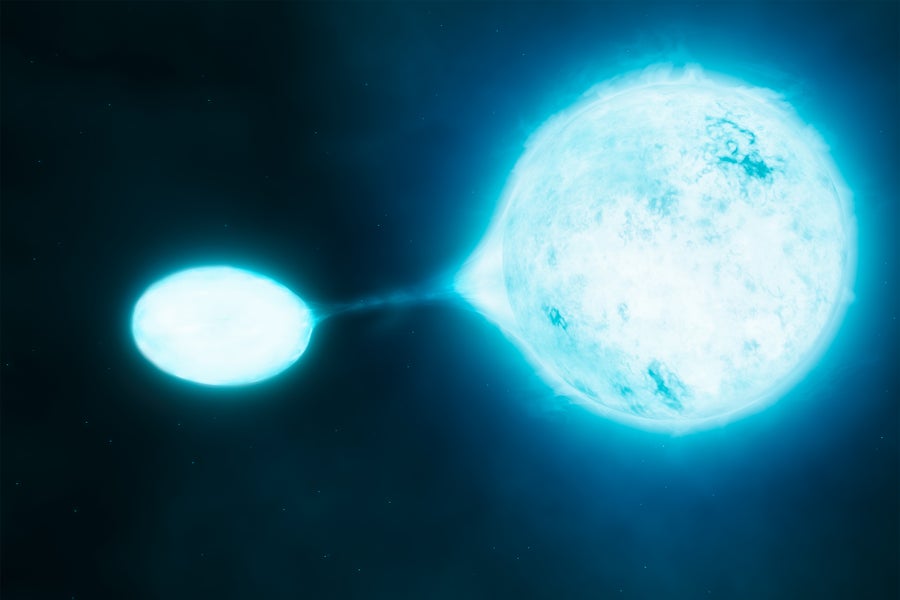
An artist’s impression of a massive star (right) feeding on a smaller companion star (left). ESO/M. Kornmesser/S.E. de Mink
According to OpenAI cofounder Sam Altman, ChatGPT has 100 million weekly users. Many of these are founders using the friendly (and now all-knowing) chatbot to supercharge their personal brand, adopt a winner’s mindset, and outperform their competitors. But how do you know you’re using the tool as effectively as possible? You’re probably not. These unconventional pointers will ensure you’re not missing out on that top tier of results.
Researchers at Mohamed bin Zayed University of AI came up with a comprehensive list of principles for best practice in prompting, in a paper called Principled Instructions Are All You Need for Questioning LLaMA-1/2, GPT-3.5/4. Entrepreneurs and business leaders can use them to take their ChatGPT usage to the next level. If you’re using the tool, you might as well do it right.
You don’t need to be polite when prompting ChatGPT. It’s a robot, not a person. Forget please and thank you, it doesn’t make a difference. Save the characters for more useful instructions such as examples, more detail, or clarification on any ambiguous terms. For best results, use the phrases “Your task is” and “You must.” Write clear prompts, give clear instructions, and save the fluff for humans.
Include the audience
Reference the intended audience in the prompt, so ChatGPT knows who the output is for. It will keep them in mind when generating your articles, social media posts or web copy, for results that resonate better with your customers.
Use sequences
If you break down a complex task into logical steps, ChatGPT should better understand what’s required. Instead of a big block of text, give instructions one prompt at a time. After each one, check understanding and signal that more are on their way. If adding the sequence within one prompt, use line breaks to avoid confusion and ensure you get the answers you’re after.
.
20 novel ways to improve your ChatGPT prompts (according to science) Photothek via Getty Images
Film and Writing Festival for Comedy. Showcasing best of comedy short films at the FEEDBACK Film Festival. Plus, showcasing best of comedy novels, short stories, poems, screenplays (TV, short, feature) at the festival performed by professional actors.

 Nebasin/Getty Images


:format(webp)/cdn.vox-cdn.com/uploads/chorus_asset/file/25441475/DJI_Osmo_Pocket_3_Kennemer_6.jpg)


 Matthew Ludak/The Washington Post via Getty Images



 James' World 2