
Click the link below the picture
.
China has landed on the moon’s mysterious far side — again.
The robotic Chang’e 6 mission touched down inside Apollo Crater, within the giant South Pole-Aitken basin, at 6:23 a.m. Beijing Time on Sunday (June 2) , according to Chinese space officials. It was 6:23 p.m. EDT (2223 GMT) on June 1 at the time of the landing. The probe “successfully landed in the pre-selected area,” China’s space agency said.
The China National Space Administration (CNSA) now has two far-side landings under its belt — this one and Chang’e 4, which dropped a lander-rover combo onto the gray dirt in January 2019. No other country has done it once.
And Chang’e 6 will make further history for China, if all goes according to plan: The mission aims to scoop up samples and send them back to Earth, giving researchers their first-ever up-close looks at material from this part of the moon.
“The Chang’e-6 mission is the first human sampling and return mission from the far side of the moon,” CNSA officials said in a translated statement. (To be clear: Chang’e 6 is a robotic, not crewed, mission.) “It involves many engineering innovations, high risks, and great difficulty.”
Sampling a new environment
Chang’e 6 launched on May 3 with a bold and unprecedented task: haul home samples from the moon’s far side, which always faces away from us. (The moon is tidally locked to Earth, completing one rotation on its axis in roughly the same amount of time it takes to orbit our planet. So observers here on Earth always see the same side of our natural satellite.)
Every lunar surface mission before Chang’e 4 targeted the near side, largely because that area is easier to explore. It’s harder to communicate with robots operating on the far side, for example; doing so generally requires special relay orbiters, which China launched ahead of both Chang’e 4 and Chang’e 6. China’s newest moon relay satellite, called Queqiao-2, aided the Chang’e 6 landing, CNSA officials said.
.
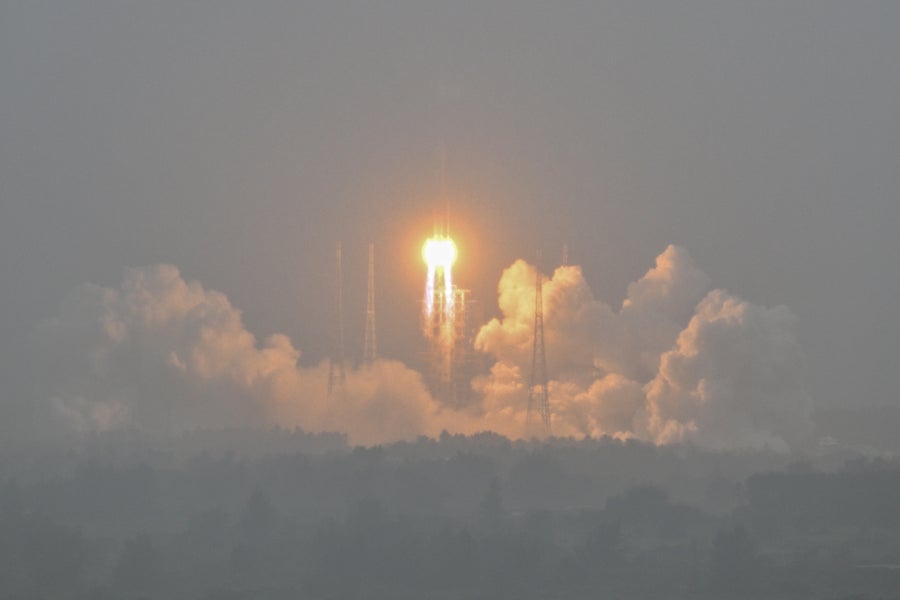
A Long March 5 rocket, carrying the Chang’e-6 mission lunar probe, lifts off as it rains at the Wenchang Space Launch Centre in southern China’s Hainan Province on May 3, 2024. Hector Retamal/AFP via Getty Images
.
.
Click the link below for the article:
.
__________________________________________


Leave a Reply