September 22, 2013
Mohenjo
Technical
amazon, aviation, business, Business News, cars, DeepFlight, Deepflight Super Falcon, Engineering, Environment, Graham Hawkes, hot air balloons, Hotels, huffington post, huffingtonpost, Influencers And Innovation, it just flies underwater, little crab, ocean engineer, ocean engineer Graham Hawkes, ocean exploration, Ocean Science, oceans, research, Science, Science News, Slideshow, Submarine, Super Falcon, technology, Technology News, transportation, travel, vacation, Video
Click link below picture
.
It all started with a little crab.
While conducting tests with a conventional submersible that crawled on the bottom of the sea, ocean engineer Graham Hawkes came nose to nose with a little crustacean that was poised to fight the underwater machine.
“I remember stopping and laughing,” Hawkes told The Huffington Post. “But I thought, ‘That crab has got it all wrong. These fish are moving in three dimensions. This guy is scurrying along the bottom. So am I. We’ve both got it wrong.'”
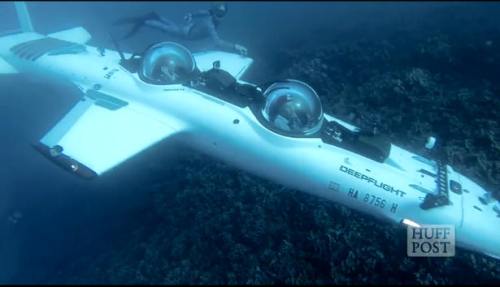
Inspired by the movement of fish, Hawkes designed and built the DeepFlight Super Falcon, a submarine that flies through the water like an airplane, instead of taking on water to sink itself. Similar to how hot-air balloons release weights to fly up, traditional submarines have compartments that fill with water to sink down.
Hawkes started a company out of his garage to create the DeepFlight Super Falcon in 1995. Today, Hawkes’ dream has become a reality. “What we’re doing is really, really obvious,” Hawkes said. “There’s nothing that clever about it. We actually build a thing that has wings, we build up speed, and it just flies underwater.”
.
.
.
Click link below for story, video and slideshow:
.
______________________________________________________________________________
June 16, 2013
Mohenjo
Technical
aids epidemic, amazon, broadcast documentaries, business, challenger deep, coastal living magazine, David Gallo, David Gallo's 'Underwater Astonishments', Environment, herman melville, Hotels, huffingtonpost, Jim Cameron, mapped 100 percent of the Moon and Mars, mapped less than 10 percent of the ocean, mapping ocean, Ocean Science, Pacific's Challenger Deep, prairie dog burrows, research, rovers to Mars, Science, Science News, technology, Technology News, travel, vacation, Video
FROM

Click link below picture
.
We’ve mapped less than 10 percent of the ocean with the resolution we’ve mapped 100 percent of the Moon and Mars, and yet when we send rovers to Mars what’s the first sign of life they probe for? Water. David Gallo’s ‘Underwater Astonishments’ reminds us of how little we know about our own blue marble planet and the 97 percent of its livable habitat that is saltwater. Remember that we air-breathing terrestrials only inhabit about 300 feet of space from prairie dog burrows to the tops of the trees where birds nest. Above that is only heaven and space. Hundreds of people have now gone into space, calling it “the last frontier,” but last year Jim Cameron became only the third human being ever to reach the lowest point on our planet, seven miles down in the Pacific’s Challenger Deep.
.

David Helvarg is Executive Director of Blue Frontier Campaign (www.bluefront.org) and the author of five books: Blue Frontier, The War Against the Greens, 50 Ways to Save the Ocean, Rescue Warriors and Saved by the Sea. He is editor of the Ocean and Coastal Conservation Guide, organizer of several ‘Blue Vision’ Summits for ocean activists, and winner of Coastal Living Magazine’s 2005 Leadership Award and the 2007 Herman Melville Literary Award. Helvarg worked as a war correspondent in Northern Ireland and Central America, covered a range of issues from military science to the AIDS epidemic, and reported from every continent including Antarctica. An award-winning journalist, he produced more than 40 broadcast documentaries for PBS, The Discovery Channel, and others. His print work has appeared in publications including The New York Times, LA Times, Smithsonian, Popular Science, Sierra, and The Nation. He’s done radio work for Marketplace, AP radio, and Pacifica. He has led workshops for journalists in Poland, Turkey, Tunisia, Slovakia and Washington DC. He is a licensed Private Investigator, body-surfer and scuba diver.
.
.Click link below for article and video:
http://www.huffingtonpost.com/david-helvarg/ocean-conservation_b_3361936.html?ir=TED+Weekends&ref=topbar
.
___________________________________________________
May 26, 2013
Mohenjo
Science
amazon, ambystoma mexicanum, aquatic salamander, biology, business, climate, Daily Discovery, Environment, Hotels, huffingtonpost, human-rights, Immune Cells, immune system, Limb Regeneration, monash university, Ocean Science, research, Salamander Regeneration, Salamanders, Salamanders Regrow, Science, Science News, Slideshow, technology, Technology News, travel, vacation, Video, Weird Science
FROM

Click link below picture
.
Salamanders can regrow entire limbs and regenerate parts of major organs, an ability that relies on their immune systems, research now shows.
A study of the axolotl (Ambystoma mexicanum), an aquatic salamander, reveals that immune cells called macrophages are critical in the early stages of regenerating lost limbs. Wiping out these cells permanently prevented regeneration and led to tissue scarring. The findings hint at possible strategies for tissue repair in humans.
“We can look to salamanders as a template of what perfect regeneration looks like,” lead study author James Godwin said in a statement. “We need to know exactly what salamanders do and how they do it well, so we can reverse-engineer that into human therapies,” added Goodwin, of the Australian Regenerative Medicine Institute (ARMI) at Monash University in Melbourne. [Ready for Med School? Test Your Body Smarts]
.

The axolotl, an aquatic salamander, can regenerate lost limbs.
.
.Click link below for story, slideshow, and video:
http://www.huffingtonpost.com/2013/05/21/limb-regeneration-salamanders-immune-cells-axolotl_n_3311704.html?ref=topbar
.
____________________________________________________

 James' World 2