Five Sherpas surrounded the frozen corpse. They swung axes at the body’s edges, trying to pry it from its icy tomb. They knocked chunks of snow from the body, and the shattered pieces skittered down the mountain. When they finally freed a leg and lifted it, the entire stiff and contorted body shifted, down to its fingertips.
The sun was shining, but the air was dangerously cold and thin at 27,300 feet above sea level. A plume of snow clouded the ridge toward the summit of Mount Everest, so close above. When the Sherpas arrived — masks on their faces, oxygen tanks on their backs — the only movement on the steep face came from the dead man’s frayed jacket pockets. They were inside out and flapping in the whipping wind.
More than a year of exposure to the world’s wickedest elements had blackened and shriveled the man’s bare face and hands. His hydrant-yellow summit suit had dulled to the hue of a fallen leaf. The bottom of his boots pointed uphill. His frozen arms were bent at the elbows and splayed downhill over his head. It was as if the man sat down for a rest, fell backward and froze that way.
.
Subhas Paul, left, and his guide, Lakpa Sherpa, at the summit.Subhas Paul
An 81-year-old veteran hobbled into the emergency room at the rural Veterans Affairs hospital here in December, malnourished and dehydrated, his skin flecked with ulcers and his ribs broken from a fall at home.
A doctor examining the veteran — a 20-year Air Force mechanic named Walter Savage who had been living alone — decided he was in no shape to care for himself and should be admitted to the hospital. A second doctor running the inpatient ward agreed.
But the hospital administration said no.
Though there were plenty of empty beds, records show that a nurse in charge of enforcing administration restrictions said Mr. Savage was not sick enough to qualify for admission to the hospital. He waited nine hours in the emergency room until, finally, he was sent home.
.
Walter Savage, 81, an Air Force veteran, at a medical center in Roseburg, Ore. Mr. Savage was turned away from the veterans hospital there even though two doctors said he should have been admitted.CreditRuth Fremson/The New York Times
A scientist recruited by the renowned Cleveland Clinic is stuck in India because his visa is delayed. An entrepreneur courted by Silicon Valley companies had his application denied. Many green card applicants have new interviews to pass.
The Trump administration has pursued its immigration agenda loudly and noticeably, ramping up arrests of undocumented immigrants, barring most travel from several majority-Muslim countries and pressing the case for a border wall.
But it has also quietly, and with much less resistance, slowed many forms of legal immigration without the need for Congress to rescind a single visa program enshrined in the law.
.
The Cleveland Clinic has faced challenges securing visas for foreign-born specialists, one of many employers affected by President Trump’s tougher approach toward immigration.CreditT.J. Kirkpatrick for The New York Times
It was a spring Friday night when one of Japan’s best-known television journalists invited Shiori Ito out for a drink. Her internship at a news service in Tokyo was ending, and she had inquired about another internship with his network.
They met at a bar in central Tokyo for grilled chicken and beer, then went to dinner. The last thing she remembers, she later told the police, was feeling dizzy and excusing herself to go to the restroom, where she passed out.
By the end of the night, she alleged, he had taken her back to his hotel room and raped her while she was unconscious.
The journalist, Noriyuki Yamaguchi, the Washington bureau chief of the Tokyo Broadcasting System at the time and a biographer of Prime Minister Shinzo Abe, denied the charge and, after a two-month investigation, prosecutors dropped the case.
.
Shiori Ito told the police she had been raped by Noriyuki Yamaguchi, then the Washington bureau chief for the Tokyo Broadcasting System and a biographer of Prime Minister Shinzo Abe.CreditJeremie Souteyrat for The New York Times
There was no pressure. It was just another day in the recording studio.
That was the key to writing Ed Sheeran’s “Shape of You,” which has been on the Hot 100 since it was released on Jan. 6, and topped Billboard’s year-end singles chart. It’s a tale of romance sketched in mundane details — “now my bedsheets smell of you” — with four chords delivered in plinking, dancehall-tinged syncopation. The song has drawn more than 2.8 billion views on YouTube and is also the most-played track ever on Spotify, with more than 1.5 billion streams.
Mr. Sheeran thought he already had enough songs for the album he released this year, and he was pondering the final selections. As a diversion, he set up a recording session for his sideline: supplying songs to other performers. “I didn’t make this song to be mine to sing,” Mr. Sheeran said.
Over the past three decades, this increasingly prosperous nation has become the fattest country in Asia, with nearly half the adult population now overweight or obese. Several years ago, Dr. Tee E Siong, Malaysia’s leading nutrition expert, decided to act, organizing a far-reaching study of local diets and lifestyle habits.
The research, conducted by scientists from the Nutrition Society of Malaysia, which Tee heads, has produced several articles for peer-reviewed academic journals. But scientists weren’t the only ones vetting the material. One of the reviewers was Nestlé, the world’s largest food company, which financed the research.
Among the published articles was one that concluded that children who drank malted breakfast beverages — a category dominated in Malaysia by Milo, a sugary powder drink made by Nestlé — were more likely to be physically active and spend less time in front of a computer or television.
.
RAHMAN ROSLAN/NYT
A worker stocks milk and juices at a supermarket in Kota Bharu, Malaysia, Nov. 6, 2017. Food companies are forging deep financial partnerships with nutrition scientists, policymakers and academic societies in developing countries like Malaysia, where sales of processed foods are exploding and nearly half of all adults are now overweight or obese. (Rahman Roslan/The New York Times)
Kellyanne Conway, counselor to President Trump, said on NBC’s “Meet the Press” on Sunday that the White House had put forth “alternative facts” to ones reported by the news media about the size of Mr. Trump’s inauguration crowd.
She made this assertion — which quickly went viral on social media — a day after Mr. Trump and Sean Spicer, the White House press secretary, had accused the news media of reporting falsehoods about the inauguration and Mr. Trump’s relationship with the intelligence agencies.
In leveling this attack, the president and Mr. Spicer made a series of false statements.
.
Kellyanne Conway, counselor to President Trump, before speaking live on TV outside the White House on Sunday.Credit Andrew Harnik/Associated Press
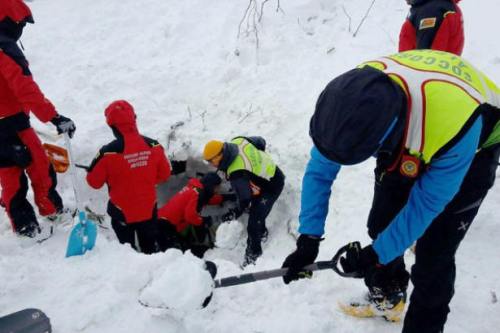
As night fell in Italy’s Apennine Mountains on Thursday, prospects dimmed of finding survivors of an avalanche that had swept over a small resort hotel the previous night. At least 30 people were missing, according to the authorities.
The avalanche occurred after four earthquakes struck central Italy, which has been hit hard in recent months.
Giampiero Parete, a cook at the Rigopiano hotel and one of the two known survivors, had gone out to get something from his car when the avalanche struck. His wife and two young children remained inside and are among the missing.
Quintino Marcella, a restaurateur, told the Italian newspaper Corriere della Sera that he had received a frantic call for help from Mr. Parete on Wednesday night.
Mr. Parete told him that the hotel had been wiped out: “The hotel isn’t here anymore, it’s not here,” Mr. Marcella told the newspaper. He said that the guests had been waiting for a snow plow to clear the roads. “All the guests had their bags packed and were waiting to leave,” he said.
.
As many as 30 people were reported missing at the hotel.
Alpine and Speleological Rescue Team, via Agence France-Presse — Getty Images
E. R. Braithwaite, a Guyanese author, diplomat and former Royal Air Force pilot whose book “To Sir, With Love,” a memoir of teaching in London’s deprived East End, was adapted into a hit 1967 film starring Sidney Poitier, died on Monday in Rockville, Md. He was 104.
Mr. Braithwaite’s companion, Genevieve Ast, confirmed his death to The Associated Press. He had taught English at Howard University, in Washington, and lived in the area for many years.
Mr. Braithwaite, who became a diplomat and represented Guyana at the United Nations and in Venezuela, wrote several books, many about racism in countries like South Africa and the United States, where he lived much of his life. But he is best known for “To Sir, With Love”
.
The Guyanese writer E.R. Braithwaite, circa 1960. He wrote “To Sir, With Love,” drawing on his experiences as a teacher in the East End of London.Credit FPG/Archive Photos, via Getty Images
Film and Writing Festival for Comedy. Showcasing best of comedy short films at the FEEDBACK Film Festival. Plus, showcasing best of comedy novels, short stories, poems, screenplays (TV, short, feature) at the festival performed by professional actors.






 Ed Sheeran Reveals How He Made ‘Shape Of You’


 James' World 2