September 1, 2013
Mohenjo
Science
amazon, Ancient Nanotechnology, Ancient Romans, Ancient Romans Lycurgus Cup, Ancient Romans Nanotechnology, ancient technology, anthropology, Archaeology, biology, business, Business News, chemistry, color changes, Daily Discovery, Hotels, huffingtonpost, illinois assistant, Lycurgus Cup Nanotechnology, Nanotechnology, Nanotechnology History, Physics, research, Science, Science News, silver and gold, Slideshow, smithsonian magazine, technology, Technology News, tiny particles, travel, vacation, Video
FROM

Click link below picture
.54294
The ancient Romans were pretty advanced for their time — so advanced that they may even have been pioneers of what we now call nanotechnology.
In fact, an ornately decorated Roman artifact, known as the Lycurgus cup, is inspiring researchers to explore practical applications of the ancient technology.
Created sometime in the Fourth Century, the goblet exhibits a color-changing property that makes its glass take on different hues, depending on the light source — just watch the cup in the video above.
Scientists were long at a loss to explain the cup’s color changes. Then in the 1990s they discovered tiny particles of silver and gold in the cup’s glass. According to Smithsonian Magazine, “When hit with light, electrons belonging to the metal flecks vibrate in ways that alter the color depending on the observer’s position.”
Now, a research team is attempting to build upon the unique technology and apply it in the medical field.
Gang Logan Liu, an University of Illinois assistant professor who has studied the Lycurgus cup for several years, described it as an “icon for inspiration.”
.
.
.
Click link below for story, video and slideshow:
.
______________________________________________________________________________
August 30, 2013
Mohenjo
Technical
amazon, Breaking Defense, business, Business News, chemical contamination, Christopher Field, firefighting robot, Hotels, Nanotechnology, nanowire, Naval Research Laboratory, navy lab, precious air, radiation leaks, research, rotten food, Science, Science News, sensors, SiN-VAPOR, technology, Technology News, tiny sensors, travel, vacation
Click link below picture
.
Imagine: tiny sensors built into military combat gear to detect chemical or biological weapons; unseen sensors peppered throughout a submarine to detect radiation leaks or chemical contamination of the crew’s precious air; a cellphone — think Star Trek tricorder, flip it open, open the app and bingo! — able to detect the gas of explosives down to parts per trillion that helps to speed passengers through crowded airports. Or you could embed sensors in your refrigerator and it could tell you exactly what was spoiling and whether it was still safe to eat.All those technologies may be possible thanks to a breakthrough at the Navy’s premier research lab who may be on the verge of unleashing the long-sought promise of nanotechnology. Researchers at the Naval Research Laboratory (NRL) – Christopher Field, Junghoon Yeom, Daniel Ratchford, Hyun Jin In and Pehr E Pehrsson – have figured out how to manufacture nanowires reliably using existing technology.
.
.
.
Click link below for article:
.
______________________________________________________________________________
August 10, 2013
Mohenjo
Science
amazon, Art And Science, Art And Technology, Art Science, arts, Atomic-Force-Microscope, aviation, business, Business News, climate, gaming, Hotels, huffingtonpost, illustration, Mini Lisa, Mini Mona Lisa, mona lisa, Nanotechnology, research, Science, Science News, Slideshow, Smallest Mona Lisa, Tcnl, technology, Technology News, Thermochemical Nanolithography, transportation, travel, vacation, Weird Science
FROM
Click link below picture
.
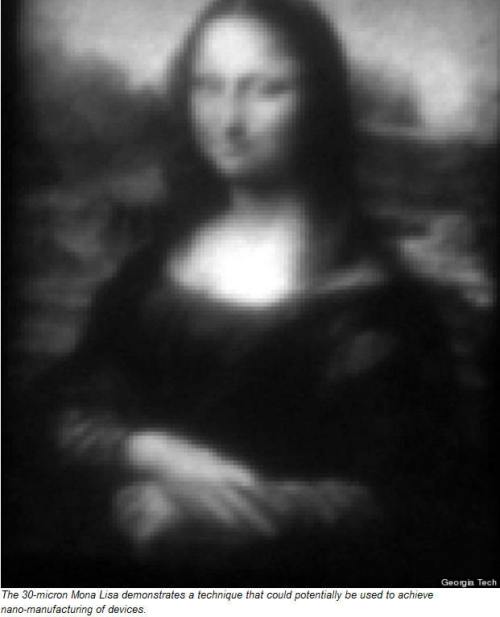
The enigmatic image is perhaps the most reproduced in art history, but it’s never before been painted on such a small canvas.
Using a novel nanotechnique, researchers have made a miniature Mona Lisa that stretches 30 microns across, just a third of the width of a human hair.
A team from Georgia Tech created the molecular masterpiece using an atomic force microscope and a process dubbed ThermoChemical NanoLithography, or TCNL for short.
Each 125-nanometer pixel of the “Mini Lisa” represents a confined set of chemical reactions. The technique allowed the researchers to control the amount of heat applied over each pixel to vary the number of new molecules created in each spot. More heat resulted in more molecules and lighter shades of gray. In this way, the team made the tiny copy of Leonardo da Vinci’s most famous work, pixel by pixel.
.
.
.Click link below for story and video:
http://www.huffingtonpost.com/2013/08/06/mini-mona-lisa-worlds-smallest-nano-technology_n_3713694.html?ref=topbar
.
________________________________________________________________________________


 James' World 2