Home

A New World Order Is Coming. We Aren’t Ready.

Leave a comment

Click the link below the picture

.

When a storm is coming, there will always be signs. The wind might suddenly drop. The tide goes out farther than usual. Streamers of clouds sail across the sky.

It’s possible to misread or even ignore these signs — to insist that the drops of rain are just a passing shower — until it’s too late. That’s when the real trouble arrives.

What is true of weather is also true of human affairs. Regimes look strong until they don’t. Revolutions at home and upheavals in the international order — the two so often go together — are easy to see in retrospect, but are not always anticipated. Yet if we look closer, we’ll often find the signs were there.

Those of us who live in relatively stable and well-ordered societies would like to believe, like Voltaire’s absurd Dr. Pangloss, who stumbles from one disaster to another, that “all is for the best.” We might grumble about the economy or the prospect of another far-off war, or listen approvingly to radical voices from either end of the political spectrum, but we don’t expect our world to be turned upside down.

We would do better to heed the warning of another French writer. In Albert Camus’s postwar novel “The Plague,” when dead rats appear on the streets of the Algerian city of Oran, and people fall ill with a mysterious disease, the local government and most of the citizens ignore the signs until it is too late. “There have been as many plagues as wars in history,” Camus’s narrator says, “yet always plagues and wars take people equally by surprise.”

Today, there are dead rats all around. New temperature records have been set and reset this summer; the earth has baked in droughts, and wildfires have raged. Debt across advanced economies is approaching historic highs. Cuts in medical and food aid, most significantly by the United States, have caused unnecessary deaths and helped the spread of diseases, one of which, sooner or later, could become another pandemic. Artificial intelligence continues its rapid, unregulated rise, threatening jobs, security and, in darker projections, human existence.

Revisionist powers flout rules and norms with impunity. Electorates are angry and volatile. Slow, deliberate, necessarily discreet diplomacy, which builds trust and understanding, has given way to a performative, brash style more suited for TikTok-addled attention spans or the playground.

The Uppsala Conflict Data Program recorded 65 state-based conflicts last year — the highest number since 1946. Great powers find themselves bogged down in asymmetric wars with countries that are making the most of new technologies. President Vladimir Putin of Russia’s war in Ukraine, meant to be won in a matter of days, is creaking through its fifth year. Iran, using inexpensive, mass-produced drones to attack American forces and allies, has gained control, perhaps permanently, over a crucial corridor of world trade, drastically reduced U.S. missile stocks and mired President Trump in a war of his own choice.

A world war is not inevitable, but the threat of a catastrophic conflict between big and well-armed powers is closer than it has been for decades.

Like the people of Camus’s Oran, we are understandably reluctant to recognize just how much the world has changed. The problems are thorny, complex, and tedious, and it’s easier to look away. So we holiday on beaches while wildfires rage; we ask A.I. how to train a new puppy, how to write that letter — to do our thinking for us. We hope that the wars will end, that the guardrails, institutions and alliances will be rebuilt, and that the world as we understand it will recover and endure.

But a new reality has arrived with startling speed. The world order that held together for most of our lives started to erode when those within it got too comfortable and complacent, and when there was too much acceptance — even approval — of bad behavior.

We have arrived in a new age of disorder. We must prepare ourselves, which begins with being honest about the seriousness of the moment we’re in, and accepting that our fragile system is faltering. That countries are already adjusting, for better and worse. And that any future of cooperation will have to look different.

What happens to those who refuse to adapt, and insist that a crumbling system can carry on? Consider three revolutions that were, and one that wasn’t.

On the eve of the French Revolution, France, Europe’s greatest land power, was probably bankrupt, in large part because of the enormous amounts it had borrowed to help defeat the British in the American Revolution. Extravagant and corrupt ruling elites had lost their way, and a growing middle class, excluded from political power, was demanding change. At the bottom of society, workers and peasants faced starvation and were increasingly desperate.

Powerful new Enlightenment ideas were circulating — some of which were imported from the American Revolution — about human rights and new forms of government that would give power to at least some of the people.

The French kings and their courtiers misunderstood the depth of the discontent and assumed that nothing could shake them from their privileged position. They were wrong: The monarchy was overthrown, and a chaotic, violent republic was born. Within a decade, Napoleon would be emperor.

There is no single pattern for revolutionary change, but those at the summit of a regime often fail to recognize how brittle it is. The Russian Revolution of 1917 was the consequence of defeat abroad, rather than a costly victory. But Czar Nicholas II also insisted, against all evidence, that no reforms were needed because Russians still adored him. In 1930s Germany, Hitler was invited into power by elites who thought, wrongly, that they would be able to use him, and that the existing system was strong enough to box him in.

Each of these revolutions had profound international ramifications. Napoleon led France to dominance over the continent, smashing old institutions and ideas like the divine right of kings to rule. The Bolsheviks, who seized power in Russia, preached and fostered revolutionary internationalism, waging war worldwide on capitalism and democratic nations. Hitler rearmed Germany, conquered most of Europe and murdered millions of Jews and many others in the name of Aryan dominance.

.

https://static01.nyt.com/images/2026/09/03/opinion/01macmillan-final/01macmillan-draft-superJumbo-v2.jpg?quality=75&auto=webpPhoto Illustration by Alma Haser for The New York Times

.

.

Click the link below for the complete article:

https://www.nytimes.com/2026/09/01/opinion/world-order-international-relations.html

.

__________________________________________

Einstein thought time dilation was both real and not – he was right

Leave a comment

Click the link below the picture

.

The passage of time often seems like the most malleable thing in the world. A minute may feel much longer when you’re asked to hold a plank position in a workout class, and an hour may fly by when you’re chatting with a friend. In these cases, your perception of time is altered. But real, physical time dilation also happens. According to Albert Einstein’s special theory of relativity, clocks that are closer to Earth’s centre of gravity, say at sea level, tick more slowly than those at the top of a mountain. A similar slowing happens when a clock is physically travelling extremely fast.

Undeniably, this sounds bizarre, but decades’ worth of experiments haven’t managed to disprove it. Yet in what exact sense time dilation is real – and what it means for a physical effect to be real at all – has inspired philosophical debates ever since Einstein first formulated his theory in 1905.

In fact, in June, at the Foundations of Physics conference in Irvine, California, I heard Marco Giovanelli discuss how time dilation is both real and apparent at once. It sounds paradoxical, but when I called Giovanelli, who is a historian of philosophy and science at the University of Turin in Italy, to talk through it, I started to understand that it reflects the facets of our physical world that Einstein’s work first uncovered.

For Einstein, it was all about rods and clocks, explains Giovanelli. Suppose that you and a friend each had an identical clock and a metre-long rod. You stand still, while your friend gets into an incredibly fast spaceship and sets off on a journey. Compared with yours, their clock will tick less quickly, and their rod will contract in size. If you want to know by how much, Einstein’s got your back: he worked out those calculations more than a century ago. If you happen to have a second friend who has a slightly slower spaceship and their own clock-and-rod set, the same trick will work again, except that their clock will slow and their rod contract a little less than your speedier friend. Finally, if you also acquire a spaceship and catch up with either of your friends, your clocks will start to tick at the same rate again, and your metre-long rods will again look the same length.

To discuss these effects, physicists use the language of “inertial frames”, similar to comparing a room at rest, or a rest frame, with a spaceship travelling at a constant speed, or a moving frame. In your individual frames, you and your friends can each establish a coordinate system, the familiar grid of width, depth and height. Your coordinate systems will match when you are all at rest or when your spaceships move side by side at the same speed.

When one of you moves more quickly, though, special relativity shows that their grid will deform, contracting in the direction of motion. It is this detail that bothered Einstein’s contemporaries. It seemed that the change in the rod length was uncomfortably intertwined with changes in the coordinate system used to situate it. But an effect that is a function of a coordinate system cannot possibly be real, critics argued. Ultimately, coordinate systems themselves are of dubious reality. They seem to simply be tools that we humans made up to help us organise our theories and observations of the physical world.

In 1911, physicist Vladimir Varićak argued that the rod’s length contraction “is only a psychological and not a physical fact, i.e., the body has not really undergone any change”. Giovanelli recounts another anecdote where, in the 1970s, physicist John Stewart Bell surveyed his colleagues at the CERN particle physics laboratory about whether length contraction could break a thread suspended between two spaceships accelerating at exactly the same rate. Most physicists said the thread wouldn’t break, endorsing the idea that nothing physically changes about the atoms in the thread. Could they have possibly been wrong? This made my head spin.

I will admit to having always been a rather terrible student of relativity, only learning it just well enough to pass my preliminary exams in graduate school. However, I’m certain I was previously taught that relativistic time dilation and length contraction are unquestionably real. We know they are, from experience in everyday life. The precise clocks on GPS satellites tick at different rates than those on Earth. This is partly because they move quickly and partly because of the gravitational effects explained by Einstein in his general theory of relativity. For GPS to be accurate, the difference in ticks must be corrected for. Failing to do so would have very real consequences, like ending up in someone’s backyard when I try to use my phone to visit a new café or bookstore. But here’s the crucial thing: the clocks on GPS satellites derive their precision from leveraging quantum control over atoms rather than some macroscopic clock gears, so it feels especially egregious to suggest that time dilation does, well, nothing to an atom.

Einstein himself was thinking about this, too, Giovanelli tells me. In fact, an atomic effect was at the centre of a 1906 debate he had with Johannes Stark, a physicist who was awarded the Nobel prize for discovering how electromagnetic fields can affect the energy states of atoms. Stark was studying fast-moving charged atoms, and Einstein recognised that these experiments may display the transverse Doppler effect – in the same way that a siren changes pitch as it approaches you due to a shift in the frequency of its sound waves, a similar effect can happen due to time dilation. It is a distinct prediction of special relativity, an effect that doesn’t exist in other theories, says Giovanelli.

For the standard Doppler effect, you know that you could cancel it out by driving after the police car and that what is happening isn’t due to something changing inside the car’s speaker. The same question reared its head for the transverse Doppler effect. “Stark really thought, kind of naively but naturally, that something is going on in the atom,” says Giovanelli – in our analogy, the speaker in the car would be physically changing. Einstein rejected this. He posited that all the atoms remain the same and that their inner workings are unaffected by motion. Time dilation was the only explanation. Seemingly apparent, here it was confronted with a real, empirical test.

Ironically, when the transverse Doppler effect was experimentally verified in 1938, one of the two physicists involved was Herbert Ives, who never accepted special relativity. Ives thought that he had found signatures of the “luminiferous aether”, a hypothetical substance that some researchers thought permeated the universe and provided one preferred, true reference frame. A preponderance of other experimental evidence, much of it obtained even prior to Ives’s work, completely ruled out this option, and special relativity became the only game in town. For all the clamouring about the oddity of an effect related to an observer’s perspective, one that many physicists wanted to dismiss, time dilation withstood the test of time. Over the ensuing decades, ever-increasingly precise atomic clocks hav

e never uncovered any evidence that something more “real” could be happening.As far as Giovanelli is concerned, what happened was not so much a dispute over physics, but rather a run-in between physics and philosophy. Underneath the sticky question of whether time dilation is real hides another, even stickier philosophical one: what does it mean to be real?

“At a certain point, you cannot avoid it,” says Giovanelli. “And so, Einstein was forced to address the question philosophically. OK, really, let’s define: ‘apparent’ means disappears for the co-moving observer, ‘real’ means empirically testable.” In some sense, the situation ought to never have become that complicated, he says. Scientific theories provide testable hypotheses – it is what they are designed for – and special relativity has passed every test we’ve put it to. What more could you ask from a theory?

Well, it’s hard to understand from an intuitive point of view, says Giovanelli. Einstein even had his own questions, primarily about how certain he could really be that two clocks, or two atoms being used as clocks, could be reliably identical. The advent of quantum physics offered some assurances, but Einstein had his qualms with quantum theory and spent time worrying about it way beyond how it applies to rods and clocks. But he never questioned the empirical reality of time dilation and length contraction, says Giovanelli.

As we talked, I wondered whether for me, like Einstein’s critics, it was my notable lack of relativistic intuition that made time dilation so hard to grasp. It may have been easier to accept that when atoms within a clock or a rod move at a certain speed, some as-yet-unknown mechanism physically changes them, leading to time dilation and length contraction. Instead, I have to grapple with there really being no such thing as absolute time.

.

https://www.newscientist.com/wp-content/uploads/2026/08/SEI_309685329.jpg?w=840

Is time dilation real? That depends on what “real” means. Tetra Images/Getty Images

.

.

Click the link below for the complete article:

https://www.newscientist.com/article/2586888-einstein-thought-time-dilation-was-both-real-and-not-he-was-right/

.

__________________________________________

Restaurant workers would never order these menu items—here’s why

Leave a comment

Click the link below the picture

.

When I’m tired of cooking, there’s truly nothing like going out to a restaurant and letting the professionals take the reins. There’s something about the atmosphere of dining out that makes the day feel special. And let’s face it: I’m almost always getting a tastier meal than I could make myself (unless, of course, I’m following a Delish recipe). The problem is that not every dish is worth your hard-earned cash.

Sometimes a restaurant is overcharging for a menu item. Sometimes the dish lacks flavor. And sometimes, the ingredients may even raise food safety concerns. We tapped chefs across the country to find out what they would never order at a restaurant, so you never have to overpay, leave unsatisfied, or worse, deal with food poisoning. You’re welcome.

This steak-loving gal was shocked to find one of her favorite cuts on the list. But Antimo DiMeo, co-owner and Executive Chef at Bardea Restaurant Group, says he would pass on filet mignon, especially when he isn’t dining at a steakhouse.

“There’s nothing wrong with filet when it’s sourced beautifully and executed with precision, but in a lot of restaurants, it becomes the ‘safe’ luxury order,” he says. “It’s tender, yes, but it’s also one of the least flavorful cuts on the animal because it doesn’t have the same fat, marbling, or character as a ribeye, strip, hanger, bavette, or even a great short rib.”

In other words, filet may sound like the fancy choice, but it’s not always the most exciting one.

“A lot of times, people order filet because it feels like the premium choice, but premium doesn’t always mean most delicious,” he notes. “Unless the restaurant has a serious steak program, I’d rather order a cut with more personality.”

.

https://img-s-msn-com.akamaized.net/tenant/amp/entityid/AA26OjXv.img?w=768&h=1024&m=6gettyimages-1086378976 © LauriPatterson – Getty Images

.

.

Click the link below for the complete article (with other meal choices shown):

https://www.msn.com/en-ca/money/general/restaurant-workers-would-never-order-these-menu-items-here-s-why/ar-AA26OAe2?ocid=hpmsn&cvid=6a95c7448ca34f96827520240c4db809&ei=41

.

__________________________________________

Summit With Russia, India and Iran Shows Leverage Wars Have Given Xi of China

Leave a comment

Click the link below the picture

.

As the leaders of China, Russia, India, Iran and other nations converged on Central Asia for a two-day summit beginning on Monday, one thing was clear from the outset. Even as President Trump tries to bend the world to revolve around Washington, President Xi Jinping of China has his own powerful orbit.

The Chinese leader’s arrival in Bishkek, the capital of Kyrgyzstan, for a meeting of the 10-nation political and security grouping known as the Shanghai Cooperation Organization underscored Mr. Xi’s broad ability to sustain Washington’s foes, both in peacetime and in war.

The talks come against the backdrop of two wars that have pushed the globe into a period of intense geopolitical instability, suppressing economic growth and driving up inflation. Those challenges were at the heart of discussions taking place simultaneously on the other side of the globe in Asheville, N.C., at a gathering of finance ministers from the Group of 20 countries.

The meeting in Bishkek, in contrast, was a showcase for the incredible leverage that the wars have given Mr. Xi.

No nation has been more critical to Russia and Iran in sustaining their economies and war efforts than China. Mr. Xi has undermined efforts by the United States and its allies to pressure Russia and Iran economically, employing Beijing’s vast geopolitical and economic clout as the world’s largest importer of crude oil and exporter of consumer goods.

Mr. Xi’s biggest rival, the United States, has been distracted by the war in Iran and has pulled some of its military forces from Asia and Europe. Last month, the Chinese leader was able to brush off threats by President Trump that the United States would inflict an “economic D-Day” on countries that provided Tehran with a lifeline. Mr. Trump once made similar threats about purchasers of Russian oil, but did not follow through with any actions against Beijing.

“After the past year, Trump has a fundamental credibility problem with Xi,” said Julian Gewirtz, who served as the senior director for China and Taiwan Affairs at the National Security Council during the Biden administration. “Both his threats and his assurances appear to Beijing, as another world leader put it, to be written in pencil.”

In Bishkek, Mr. Xi’s priority is to burnish his image as the leader of non-Western nations and to push back against what he calls U.S. hegemony. Despite that, he will most likely be cautious about how much support he publicly offers Iran.

The Chinese leader cannot afford to provoke Mr. Trump less than a month before he is scheduled to travel to Washington to attempt to extend a fragile economic truce between the United States and China. Before heading to the United States, Mr. Xi will travel to Egypt and India for state visits.

The series of trips leading up to his summit with Mr. Trump is aimed at casting Mr. Xi as a powerful statesman at a time when Mr. Trump has frayed U.S. relations globally, analysts said.

“Xi appears to see an opportunity to show that China has friends and options around the world at precisely the moment Washington is alienating many of its allies,” Mr. Gewirtz said.

This week’s summit in Bishkek is a reminder of the limits of U.S.-led economic warfare. President Vladimir V. Putin of Russia and President Masoud Pezeshkian of Iran, both critically reliant on China, arrived in the Kyrgyz capital on Monday as they work to defy Western efforts to isolate them and persevere with their own wartime goals.

Beijing has largely obliged, extending economic lifelines to both Moscow and Tehran and leveraging its economic clout to the frustration of Washington.

While Mr. Xi’s power is on the rise, there are limits to it. Though the Shanghai Cooperation Organization is partly a security grouping, Beijing has been unwilling to deploy its military to defend members such as Iran, which joined the organization in 2023, or Russia, instead formally calling for dialogue and an end to the conflicts.

Mr. Xi does not want to be entangled in foreign wars, analysts have said, viewing them as one of the primary reasons the United States has seen its power wane over the decades. But Beijing is willing to increase trade and provide technologies that can be used on the battlefield.

The Chinese leader met with Mr. Putin for bilateral talks in Bishkek on Monday, praising what he called ever-brighter prospects for relations between China and Russia.

Mr. Putin, in turn, highlighted the success of visa-free travel between the two nations and said he was ready to make the arrangement permanent. The Russian leader noted that the first scheduled voyage of a Chinese container ship passed through what is known as the Northern Sea Route in mid-August, presaging broader cooperation in the Arctic.

Whether Mr. Xi meets with the Iranian leader separately from the summit will indicate how much the Chinese leader is willing to push the line ahead of the scheduled visit to the United States.

.

https://static01.nyt.com/images/2026/08/31/multimedia/31int-xi-1-kjfb/31int-xi-1-kjfb-jumbo.jpg?quality=75&auto=webpChinese President Xi Jinping, center, and Kyrgyz President Sadyr Japarov, left, during a welcoming ceremony in Bishkek, Kyrgyzstan, on Monday. Credit…Pavel Mikheyev/Reuters

.

.

Click the link below for the complete article:

https://www.nytimes.com/2026/08/31/world/asia/putin-xi-modi-sco.html

.

__________________________________________

How the brain learns to read is an evolutionary mystery—a new study offers clues

Leave a comment

Click the link below the picture

.

For an experienced reader, recognising the words on this page feels effortless. Yet, evolutionarily speaking, your brain shouldn’t be able to read. Reading has existed for too short a time to have shaped a dedicated centre in the brain.

Therefore, the brain has to learn to read using systems that evolved for other purposes. But it has long been unclear exactly which systems it recruits to do so and how.

This is important, as differences in these pre-existing systems could shed light on why some of us find reading easier than others. It could also explain how people who are deaf, blind or have dyslexia learn to read in remarkably different ways. In my new paper, published in Cerebral Cortex, I have come up with some answers.

In my study, I investigated the relationship between individuals’ reading skills and their fine-grained brain structure. I also compared twins with different degrees of genetic overlap to see whether shared genetic factors contribute to the links between brain structure and reading skill.

These patterns offer clues about which parts of the distributed “reading network” might provide the initial conditions for reading, and which might respond more to experience.

Basic, neural hardware

I used high-resolution brain scans from the Human Connectome Project, a large study of healthy young adults. The participants did not read while their brains were being scanned. Instead, they completed a range of language tests separately. The most important of these tests for my study was an adaptive reading test in which participants pronounced written words aloud. I used their scores on this test as a measure of reading ability.

I discovered that several brain areas contribute to the skills needed for reading, and that some show heritable links with it. To be clear, heritability does not mean that we are born a certain way and cannot change. The brain is, in fact, constantly changing. Rather, we begin with a partly inherited lump of clay that we continuously shape and refine throughout our lives.

Let’s begin with auditory abilities. When we learn how to read in school, we typically begin with identifying sounds and putting them together in our minds. In fact, problems with perceiving the sound structure of language are commonly cited as an underlying factor in developmental dyslexia.

To read, children learn to map each letter to a sound and join strings of letters into words: the letter s to the “sss” sound, i to the short “i”, and t to the “t” sound, so that s-i-t is pronounced “sit”. Breaking spoken words into individual speech sounds starts at the syllable level, dividing sitting into sit|ting. This requires the skill to identify slowly developing changes in loudness. Most syllables start quiet with a consonant like s-, then grow louder at the vowel (-i-), with its singing character, before going down in intensity again (-t).

Before we’ve learnt how to read properly, the brain can use auditory cues like these to detect syllables and their internal structure in spoken language and begin its road to literacy.

Particularly suited for this task is a region next to the primary auditory cortex at the top of the left temporal lobe, which sits underneath the temple and upper ear. It is called the medial belt area and is tuned to slow, coarse changes in sound. Strikingly, I found that a well-organized structure of its nerve cells is linked with reading ability.

The relationship had a genetic component, suggesting that the organization of this perceptual system might affect how easy we find it to learn to read. Such differences could contribute to variation in literacy that does not simply separate people with and without dyslexia, but span the whole population.

We also need to understand what we read, however. A skilled reader can usually see words and directly connect them to meaning, in parallel with the activation of their sound. Recognizing the visual aspect of a word is thought to build on our capacity to distinguish faces through their defining features. We identify letters and words by their smaller parts—bows, dots and lines—just like we recognise faces by the eyes, noses and chins.

Face identification seems to depend on a brain area in the right anterior temporal lobe called the dorsal temporal pole. Interestingly, I found that the size of this area is linked with reading ability—and this combination is also passed down. A possible explanation is that it helps us identify written words in a way similar way to how we recognise a face.

Finally, another region in the left anterior temporal lobe (the anterior middle temporal gyrus) is thought to connect word form and meaning. The bigger it is, the better we are at deciphering meaning. And it makes sense that having an advantage in accessing the meaning of words might make it easier to learn to read. Indeed, its size was also genetically related to reading ability.

The role of nurture

Now that we have identified some possible initial conditions for the brain’s reading ability—the lump of clay—we can turn to how the clay might be shaped.

After detecting syllables, the speech-sound distinctions need to be refined. This requires the primary auditory cortex to perform fine-grained sound analysis. Here, a thicker cortex (the outermost layer of the brain) is associated with better reading skills.

But, as I discovered, this combination of reading skill and a thick cortex was not genetically driven. In fact, it might be that experience—including exposure to speech sounds, other forms of auditory analysis (such as picking up different individual sounds from a soundscape) and reading practice—contributes to greater cortical thickness.

The structure of the nerve fibre bundles connecting sound to meaning and visual form also correlates with reading ability. But these relationships do not appear to be heritable either. These bundles might develop when sound, meaning and visual word form are connected during literacy training and general language exposure. So the more we read, the better the brain gets at doing it.

What can we learn from all this? Some brains might have an easier time learning to sound out letters, identify written words or access the meaning of words. In the end, though, our reading and language activities substantially mould the brain’s reading network. In other words, devoted parents, teachers and speech therapists can actually help children develop their inner worlds.

Alternative ways of learning to read

But there is not only one way to learn to read or even only one way to read. I once talked to a physics professor with dyslexia. He was incapable of sounding out words readily and didn’t hear them in his head while reading. He did, however, understand text, describing it as if written words silently built up systems of meaning in his head. He even felt that his reading style was advantageous in his line of work. While listening, I couldn’t keep from wondering what his anterior temporal lobes (involved in identifying familiar forms and accessing meaning) might look like.

.

https://static.scientificamerican.com/dam/m/158aa2b7248cc665/original/further_reading_plastic.jpg?m=1763492843.566&w=900Deagreez/Getty Images

.

.

Click the link below for the complete article:

https://www.scientificamerican.com/article/how-the-brain-learns-to-read-is-an-evolutionary-mystery-a-new-study-offers-clues/

.

__________________________________________

KPMG’s Investment in Interns Reveals an AI Problem Companies Can’t Ignore

Leave a comment

Click the link below the picture

.

AI has been expected to remove some of the bottom rungs on the corporate ladder. As software absorbs routine analysis, research, drafting, and administrative work, companies have had fewer reasons to hire large classes of junior employees. Recent evidence suggests that assumption may be changing. Some major employers are hiring again, and companies using AI extensively are reporting greater demand for entry-level workers.

KPMG (Klynveld Peat Marwick Goerdeler) offers an especially interesting example. The professional services company recently brought nearly 1,000 interns to its Lakehouse training center in Orlando for intensive development in critical thinking, judgment, communication, and interpersonal skills. KPMG’s own research found that interns ranked critical thinking and problem solving as the most important capabilities they wanted to demonstrate while working alongside AI.

KPMG may be responding to a problem that extends far beyond accounting and consulting. Entry-level jobs have always produced more than inexpensive labor. They provide the experiences through which organizations create their next generation of experts, managers, and decision makers.

AI can remove the work that teaches people how to work

Consider what traditionally happens during the first few years of a career. Junior employees research unfamiliar problems, prepare first drafts, make mistakes, receive corrections, observe customers, and explain their reasoning to people with greater expertise. Much of that work can look inefficient because learning itself is inefficient.

Generative AI changes the calculation. A senior employee who once delegated research or preliminary analysis to a junior colleague can now ask an AI system to produce it in seconds. The immediate productivity gain is obvious. The developmental cost is much harder to see.

A recent study of software engineers identified precisely this risk. Researchers interviewed junior and senior software engineers and found evidence that generative AI was absorbing some of the work through which novices traditionally developed expertise. They described the loss of “productive struggle,” the difficult process of working through problems that helps beginners construct the knowledge they later need to solve more complicated ones.

The study is small, involving 14 interviews in South Korea, so its findings should not be treated as proof of what is happening across every profession. It raises an important organizational question, however. If AI continually transfers entry-level work from beginners to experienced employees working with machines, where will future experienced employees come from?

Productivity today can create a capability problem tomorrow

Organizations naturally measure AI by what it saves. A task takes 20 minutes instead of two hours. One employee produces what previously required three. Projects move faster and staffing requirements decline.

Those measures capture current output. They rarely capture the expertise the organization would have developed while producing that output. A junior analyst struggling through an assignment may be slower than AI, but that assignment is simultaneously producing an analysis and a more capable analyst.

KPMG appears to recognize that distinction. Its Lakehouse is explicitly designed as a learning and development environment, and the company says it is expanding immersive, in-person experiences as AI increases the importance of human judgment and other skills. KPMG has also emphasized mentorship, hands-on work, feedback, and real-world application as part of preparing employees to work alongside AI.

Redesign entry-level work around learning

Companies do not need to preserve routine work simply because generations of employees learned from doing it. They do need to identify what developmental function that work performed before automating it away.

That means designing early-career roles around experiences AI cannot easily provide by itself. Junior employees can frame problems before prompting an AI system, verify its work, explain why they accepted or rejected its recommendations, interact directly with customers, observe experienced colleagues making consequential decisions, and assume progressively greater responsibility for outcomes.

This also changes what leaders should measure. The fastest junior employee may be the person who delegates the most thinking to AI. A more useful question is whether that employee is becoming capable of handling increasingly difficult work with less supervision.

AI can make an organization more productive while simultaneously weakening its ability to reproduce expertise. Those outcomes will not appear on the same dashboard or on the same timetable. KPMG’s investment in interns offers a useful reminder that organizations still need beginners, because somewhere inside today’s entry-level workforce are the seasoned experts they will depend on tomorrow.

.

Photo: Getty Images

.

.

Click the link below for the complete article (sound on to listen to the article):

https://www.inc.com/scott-hutcheson/kpmgs-investment-in-interns-reveals-an-ai-problem-companies-cant-ignore/91395960

.

__________________________________________

Nepal Turns to Mass Burials, as Thousands Remain Missing from Floods

Leave a comment

Click the link below the picture

.

Only a fraction of the over 2,500 missing are turning up among the dead, underscoring a bleak reality: The death toll is likely to keep rising for days to come.

Five days after an angry deluge tore through the mountain passes of Nepal, family members arriving after long journeys looked for something — anything — that could identify their loved ones amid the hundreds of mangled bodies.

In one hall in the downstream city of Bharatpur, men and women stared at a small television screen, watching a slide show of recovered remains in complete silence.

Next door, another government hall turned makeshift morgue housed the 270 sets of remains whose photos had been flashing on that screen. Nearly all remained unidentified.

Bharatpur, over 100 miles from where the floods first hit, had no capacity to preserve the corpses that washed up to its riverbanks, and could not keep them any longer. They were being transported to a forest for a mass burial before darkness took over the city.

At the burial spot, security forces in protective gear offloaded the bodies one by one onto stretchers, as cameras documented each step. Nearby, rows of metal numbered signs stuck into concrete-filled pots — the markers for each grave — awaited.

Only a fraction of the missing are turning up among the dead, underscoring a bleak reality: The death toll is likely to keep rising.

As of Sunday night local time, nearly 800 bodies had been found. More than 2,500 people were still missing, with hopes dimming they would be found alive. The initial 72 hours after a disaster are usually seen as critical to a rescue operation.

The devastating flood swept through northern Nepal and Tibet on Wednesday after part of a glacier sheared off a mountain face, and its fall created such seismic force that officials initially believed it was an earthquake. The massive wall of water and mud it created swept up villagers, hydropower workers and hundreds of tourists and travelers from nearly three dozen countries on religious pilgrimages. Tens of thousands of people remain in need of relief, with entire towns wiped out, and roads, bridges and communication lines destroyed.

The bulk of the ongoing rescue effort has focused on the tunnels of several major hydropower projects in Rasuwa, which saw some of the earliest and fiercest damage in Nepal, and in Nuwakot, just downstream.

Through a night of rain, the army had tried to drill its way to tunnels buried under debris and mud. By Sunday afternoon, with support from Indian rescue teams, they had managed to find an opening to one tunnel, which they found brimming with water, according to Brig. Gen. Raja Ram Basnet, the army spokesman. A second tunnel has proved more difficult to locate an opening to, he said.

“The Nepali Army has been using thermal drones to search for signs of life,” he said. “But there have been no indications of survivors so far.”

The force of the deluge was such that nearly a dozen bodies were swept hundreds of miles away and found in India.

When the remains started washing up on the riverbanks of the Chitwan district, dozens of miles downstream from where the floods first hit, the officials were immediately overwhelmed.

Nepal is a deeply poor country, with limited infrastructure. The morgues in Chitwan have the capacity for storing just over three dozen bodies, Police Chief Rameshwor Poudel said.

With no good alternatives, district officials turned to the government hall in Bharatpur. Since it only had one air-conditioner, they tried to procure dry ice. They set up a help desk and a visitor hall. And they photographed the remains, so the loved ones who were beginning to trickle in could identify their missing.

But the bodies had been in water for so long. The monsoon heat did not help. And the freezers the foreign minister had appealed for from his international counterparts were not materializing immediately.

Only about a dozen bodies were identified and handed over to their families for burial. More remains kept coming.

“We’re still finding 15 to 20 new bodies every day,” said Anil Thapa, a senior traffic cop helping at the makeshift morgue. “This will keep going on for months.”

On Saturday, the district authorities announced that they would begin burying the remains after a thorough process of documentation that includes taking photographs, recording distinguishing marks or clothing articles found on the corpses, and collecting DNA samples.

In a lush forest glade, a 10-minute drive away, they buried 93 bodies late Saturday, and another 100 the next day.

During the closing hours of the mass burial on Sunday evening, Biresh Kumar Sah, 17, reached the town’s makeshift morgue after an eight-hour bus ride.

He was studying in the Nepali capital when he first heard that the flood had hit his hometown, Siraha. His father, a math teacher, and his younger brother, who studied at the same school, were missing.

“The first day I tried to ignore it. I hid the information from everyone,” he said. “I wanted to still have hope.”

On the second day, he posted online that his father was missing.

.

A blurry yellow tape crosses a dense forest scene with people in white hazmat suits and masks.Officers at a mass burial of unidentified victims in the Devghat forest area of Bharatpur, Nepal, on Sunday.

.

.

Click the link below for the complete article:

https://www.nytimes.com/2026/08/30/world/asia/nepal-floods-mass-burials-missing.html

.

__________________________________________

From back pain to cancer, how the interstitium could transform medicine

Leave a comment

Click the link below the picture

.

In the 17th century, physician Samuel Collins observed a mesh around each organ, which he called a “common Vest” made of “curious well-spun Threads… wonderfully interwoven with each other”. The “remanent spaces”, he noted, were filled with a “concreted Animal Liquor”.

Over the following centuries, the purpose of these structures was thought to be purely architectural. The vest, known today as fascia, offers a kind of girding that holds our organs in place; the gaps filled with that “animal liquor” – called interstitial fluid – provide a kind of shock absorber that allows our organs to slide freely as we move, without bruising.

We now know that those pockets of fluid are far more important than this. Emerging research suggests they form an interconnected network called the interstitium that provides an important channel of communication between and inside our tissues. And that is set to cause a quiet revolution in medicine, changing how we think about everything from muscle pain and the microbiome to the spread of cancerous tumours across the body.

According to some scientists, it may even offer a modern explanation for concepts in traditional Chinese medicine, including the fundamental life force “qi”.

The discovery of body-wide channels

The interstitium’s basic anatomy certainly suggests some structural role. The extracellular matrix within it provides structural support for pockets of fluid, with threads made of collagen, which create a strong scaffold, and elastin, which act like tiny bungee cords and offer flexibility. The interstitial fluid coursing through gaps in this matrix comprises around 12 per cent of our body weight and contains hyaluronic acid, a large molecule that forms a gel in water, perfect for cushioning delicate tissue.

The mainstream view was that each organ and muscle is sealed off in its own compartment, with its own, isolated interstitium. While a few researchers, such as molecular engineer Melody Swartz at the University of Chicago, have long been interested in how the fluid flows within the different compartments, there was little evidence that they were interconnected.

That was partly due to a serious practical limitation: when you take tissue samples to study under a microscope, the interstitial fluid drains away and the collagen fibres that give the cavities their structure collapse in on themselves. This made it very hard to characterise the space.

That changed with a groundbreaking study in 2018, using a new procedure that combines a laser with an endoscope to build microscopic images of tissue in a living body. This enabled Neil Theise, professor of pathology at the New York University Grossman School of Medicine, and his colleagues to follow the movement of a fluorescent dye injected during pancreatic surgery. This revealed a series of channels and cavities where they had expected to find dense connective tissue, suggesting that the interstitium was larger and more intricate than previously recognised. Widening their search to other organs, their detailed images provided the strongest evidence yet that it comprised a network spanning the whole body.

“If this organ is present in every tissue and other organ the way the cardiovascular and lymphatic systems are, then we have an incomplete understanding of the entire body,” Theise said at the time. “I don’t think there’s anything that doesn’t get changed by this.”

Building on these results, Theise and his colleagues later examined biopsies of people with tattooed skin. They found that some of the ink had crept from the skin into the interstitial spaces around other organs, proving that the interstitial compartments are interconnected.

Such discoveries paint the interstitium as a tidal marsh, streaming in nutrients and washing out waste. The main drift comes from high-pressure arteries, which supply much of the interstitial fluid, to low-pressure lymphatic vessels where the trash is deposited. But the motion of the fluid is also strongly affected by body movement, with every muscle in the body contributing a squeeze. Even in repose, there is flow from the peristaltic motion of the digestive tract, overlaid with the tremolo of arterial pulsing throughout the body.

This may have immediate implications for fast-moving infections like necrotising fasciitis, which destroys the tissue beneath the skin, including fascia and muscles, and cellulitis, a deep infection that leaves the skin red and swollen. “Appreciating the interstitial location of these infections may give us important information about their spread,” says Rebecca Wells, professor of gastroenterology at the University of Pennsylvania and part of the team behind the 2018 study. “On the flip side, the patterns of spread in fasciitis and cellulitis may tell us about interstitial structure and flow.”

Rewriting biology

More profoundly, a closer study of the interstitium could offer new insights into basic biological systems.

We know, for instance, that immune cells called T-cells pursue pathogens throughout the extracellular matrix. Peter Friedl, director of the Microscopic Imaging Centre at Radboud University in the Netherlands, who has studied cellular transport through the interstitium since 2007, compares them to “little monkeys” swinging through the “jungle” of collagen. Investigations into the interstitium might therefore reveal overlooked but essential elements of the immune response. 

Presiding over the interstitial tissues are multi-tentacled cells called telocytes, first named in 2010 by Laurentiu Popescu at the Carol Davila University of Medicine and Pharmacy in Romania and Maria-Simonetta Faussone-Pellegrini at the University of Florence in Italy. Using electron microscopy, they found that the arms of these cells have an impressive reach, which they use to create junctions with distant cells. The junctions are similar to neural synapses, except they connect with all types of body cells, including blood vessels, nerve fibres, muscle cells, glands, stem cells and other telocytes.

Like neurons, telocytes have electric properties that allow them to stimulate those neighbouring cells. In this way, the interstitium complements the nervous system as a body-wide sensory tissue, responding to stretching, tension, pressure, vibration and movement. The resulting input provides us with proprioception – the sense of where our body is – and much of what we feel as muscle pain and stiffness may originate in the interstitium.

Telocytes also play a crucial role in healing. Popescu and Faussone-Pellegrini observed them controlling the release of heart stem cells in the myocardial interstitium, for instance.

Stemming the spread of cancer

The interstitial fluid is also awash with extracellular vesicles, tiny packets filled with bits of RNA, proteins and lipids. These interstitial messengers bud off from sender cells and drift to a recipient. Extracellular vesicles include potent regulatory microRNAs that can make epigenetic changes to the receiving cell, altering its behaviour or even changing its identity.

This may have particularly important implications for the treatment of cancer. In 2015, David Lyden at Weill Cornell Medical College in New York and his colleagues discovered that tumour cells continuously launch extracellular vesicles into the interstitium, complete with a chemical “address” directing them to specific target tissues.

Because they are tiny, they can easily sail through the interstitium, leaving a trail of chemical breadcrumbs behind them. When they hit their target, they promote the growth of new blood vessels, preparing the ground for the metastatic cells to follow.

To make that journey, the cancer cell reaches out a sticky appendage and attaches to a fibre in the matrix of collagen. It isn’t an easy trek; it must pull its cell body along until its chunky nucleus gets jammed in the webbing. At that point, the cell releases chemicals that break down the collagen around the nucleus, freeing the cell to continue hacking its way through the interstitial undergrowth.

In this way, rogue cancer cells create tunnels throughout the interstitium, making it easier for subsequent metastatic cells to slide through.

With time, researchers may find ways to interfere with interstitial metastasis before the tumours embed. Because the tumour extracellular vesicles are addressed to specific organs, Lyden’s goal is to create personalised treatments that direct therapeutic payloads to specific tissues, avoiding damage to healthy organs.

Swartz, meanwhile, has been developing a vaccine that induces the growth of lymphatic vessels in the interstitium around melanomas. The idea is that these would attract cancer-killing T-cells. The research is still in its early stages, but her tests on mice suggest it can limit the spread of the disease.

Beyond cancer, the interstitium and its contents may shed light on endometriosis, in which tissue similar to the lining of the womb starts to grow outside the uterus, leading to pain, fatigue and fertility problems. Some experts have therefore proposed that malfunctioning telocytes may support the growth of new blood vessels that help the endometrial tissue to implant and survive.

A back door to the brain

The all-encompassing continuity of the interstitium, including organs, blood, lymph cells and nerves, is astonishing. But there is an exception: the brain, which has its own private interstitium.

This is largely to avoid friendly fire from our immune system, which could take out memories, cognitive function and motor control. The brain is therefore separated from the rest of the body by the blood-brain barrier. It keeps out most microbes most of the time, but if they do manage to sneak in, they alert the brain’s more delicate immune cells, the microglia, that must avoid too much collateral damage.

In the brain, the interstitial liquid is called cerebrospinal fluid (CSF). It provides the fuel for brain tissue and picks up the waste afterwards. The flow of CSF runs through the glymphatic system, first discovered by Maiken Nedergaard, a neuroscientist at the University of Rochester Medical Center in New York state. Arteries and veins normally run alongside lymphatic vessels, but in the brain, they run inside the glymphatic vessels. The pulsing of arteries drives the surrounding CSF into the brain interstitium, pushing its fluid towards returning veins, helping to flush out detritus.

.

https://www.newscientist.com/wp-content/uploads/2026/08/SEI_308205819.jpg?w=840

An interconnected network called the interstitium is causing a quiet revolution in medicine, Grace Russell

.

.

Click the link below for the complete article:

https://www.newscientist.com/article/2583939-from-back-pain-to-cancer-how-the-interstitium-could-transform-medicine/

.

__________________________________________

Trump Cannot Deport Students For Criticizing Israel, Judge Rules

Leave a comment

Click the link below the picture

.

“Freedom of speech is illusory if we are only ‘free’ to express complementary views about the government and its leaders,” the judge wrote.

The decision largely piggybacks on findings from nearly a year ago by a U.S. district judge in Boston, who ruled that the Trump administration violated the Constitution when it targeted people who are not citizens for deportation solely for supporting Palestinians and criticizing Israel.

Wise wrote that the freedoms of speech and the press are “foundational to America’s enduring democracy.” The judge cited free-speech and vagueness flaws that violate the First Amendment and Fifth Amendment as she struck down portions of the provisions that the federal government follows regarding deportations.

Wise cited retaliation in March 2025 by U.S. immigration authorities against people who engaged in speech supporting the Palestinians and against Israel’s actions — which a growing number of experts, including those commissioned by a U.N. body, have said amount to genocide. The judge also cited retaliation against people who were critical of Charlie Kirk after the Turning Point USA co-founder was assassinated last September.

“Tomorrow, or perhaps even today, targets may include anyone in the United States who exercises their freedom of speech to simply express opinions the government does not like,” the judge in San Jose said.

“This downward spiral is antithetical to our Constitution that recognizes our right to speak freely,” she added. “Here you can simultaneously hate the content of a person’s speech and love the country that cherishes the freedom to allow it. Zealous protection of our Constitutional right to free speech is a provocative demonstration of our country’s powerful lack of fear.”

George Porteous, the editor-in-chief of The Stanford Daily, responded to the ruling by saying on X: “The reporters in our newsroom shouldn’t have to fear that writing a story will result in their deportation. Today’s victory means they won’t have to.”

Conor Fitzpatrick, an attorney with the Foundation for Individual Rights and Expression, which brought the lawsuit, praised the ruling.

“In America, free speech doesn’t just belong to the people who say things the government agrees with,” Fitzpatrick said in a release.

In her decision, Wise said it was clear that the government’s tactics has had an effect on college campuses.

“The government has offered a chilling message regarding protected speech — speak out against Israel or in support of Palestinians, and we will revoke your visa and deport you. Behave. Noncitizen students heard the warning and heeded. And, as the idiom goes, the silence is deafening,” the judge wrote.

.

https://img.huffingtonpost.com/asset/6a93257a1900002bda6bbafe.jpeg?cache=PPc2KYt3SX&ops=scalefit_720_noupscale&format=webp

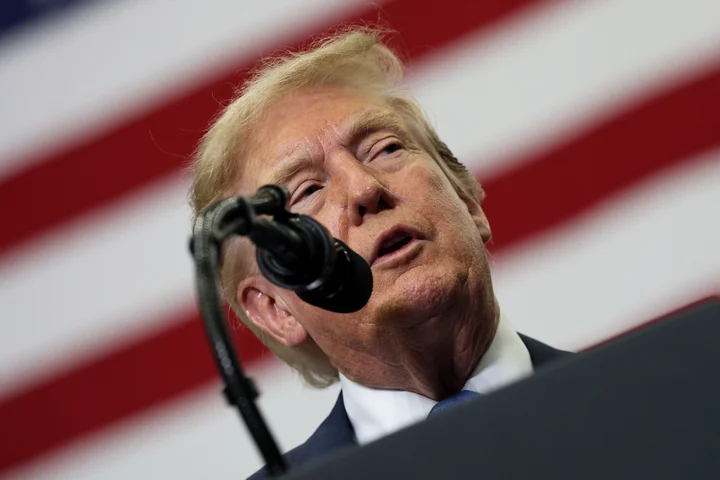
U.S. President Donald Trump delivers remarks during a ceremony honoring Artemis II crew members at NASA’s Johnson Space Center on August 28, 2026, in Houston, Texas. (Photo by Win McNamee/Getty Images) Win McNamee via Getty Images

.

.

Click the link below for the complete article:

https://www.huffpost.com/entry/trump-cannot-deport-students-for-criticizing-israel-judge-rules_n_6a9323fae4b0e9dbd39ba701?origin=home-latest-news-unit

.

__________________________________________

Trump’s Venezuelan Oil Deal Relies on a Powerful and Divisive Partner

Leave a comment

Click the link below the picture

.

The Trump administration’s highly unusual deal to develop Venezuela’s vast oil resources would have the U.S. government collaborate with an influential and polarizing Venezuelan businessman.

Under the deal that President Trump announced late Friday, the United States would work with Alejandro Betancourt López, whose family controls Venezuela’s second largest private oil producer, North American Blue Energy Partners, according to four people familiar with the arrangement.

The federal government is expected to back the development of a significant portion of Venezuela’s proven oil reserves through the Pentagon’s Office of Strategic Capital, while Mr. Betancourt’s company would lead operations, three of the people said. The deal covers 17 oil fields spread across Venezuela.

Venezuela’s president, Delcy Rodríguez, backed the deal, saying in a statement late Friday that it would have a “significant impact on our nation’s revival,” and generate more than $200 billion in tax revenue for the government.

Mr. Trump described the deal as giving the United States “majority control” over a large portion of the country’s reserves, though many of the details of the highly unorthodox arrangement remained unclear on Saturday afternoon and were expected to change as the project gets going.

The deal represents Mr. Trump’s most direct foray into Venezuela’s oil industry since he sent U.S. Special Forces in January to seize the country’s leader, Nicolás Maduro, and began working closely with his vice president, Ms. Rodríguez, who now runs the government.

For Mr. Trump, the deal advances his quest to reshape the global energy market and enhance America’s energy security, according to a person familiar with his thinking. Mr. Trump believes, the person said, that additional oil from Venezuela would reduce the market power that Middle Eastern countries have and would help stabilize energy prices, which have risen sharply since the United States and Israel started attacking Iran in February.

Any meaningful new production from Venezuela will take years to materialize. As a result, the effort will have little immediate impact on global commodity prices, which in turn determine what U.S. consumers pay at the pump.

Chevron, the second-largest U.S. oil company, is also in advanced talks to expand its production in Venezuela, which would further expand the U.S. sphere of influence, The New York Times has reported.

Venezuela’s proven oil reserves are among the largest in the world, but its energy industry has been decimated by mismanagement, corruption and U.S. sanctions. It produces a little more than one million barrels of oil a day, or about 1 percent of global production, roughly the same share as under Mr. Maduro.

In broad terms, the United States is expected to gain preferential access to cheap Venezuelan oil, a key objective of the Trump administration as it seeks greater influence over oil production in the Americas.

North American Blue Energy Partners, or NABEP, would benefit from the direct backing of the U.S. government, which would make it easier for the company to obtain financing and supplies amid continuing U.S. sanctions against the Venezuelan economy. Working with the Trump administration should also shield the company from the volatility of Venezuelan politics.

The State Department said through a U.S. official that the deal would effectively give the United States 55 percent of the joint venture’s output. Neither the White House nor the State Department answered specific questions on Mr. Betancourt’s role, his company or the structure of the deal.

In a statement to The Times, NABEP said it looked forward to working with the U.S. government to rebuild Venezuela’s energy industry but added that “it would be premature to comment on exactly what role our company will play.” Mr. Betancourt declined to be interviewed for this article.

Under the deal, the U.S. government would have the right to acquire shares in NABEP or a related entity through a financial instrument known as a warrant, according to two people familiar with the matter. A warrant allows its owner to buy shares in a company at a predetermined price. Warrants can be traded and can rise and fall in value based on the price of the shares of the company that issued them.

NABEP, which is based in Barbados, according to its website, produces around 200,000 barrels per day. The company plans to take up to $5 billion in debt to raise output to one million barrels in the next five years, according to a person close to the company.

Mr. Betancourt, 46, rose to prominence in the 2010s, when the Venezuelan government awarded him and his partners contracts to build numerous power plants across the country even though they had no experience doing that work. The deals earned the investors the moniker “bolichicos,” meaning the “Bolivarian boys,” a reference to the new cohort of businessmen who profited from the government so-called Bolivarian Revolution.

Mr. Betancourt later bought a stake in an oil company called Petrozamora that operated mature oil fields in Lake Maracaibo in western Venezuela. Those fields became the core of NABEP, which has since acquired new fields and raised it production significantly since 2024.

Mr. Betancourt’s personal bank accounts have been under investigation for more than a decade by prosecutors in Zurich, but he has not been formally charged in Switzerland.

“Mr. Betancourt has never been charged with a crime in any jurisdiction,” Sara Chouraqui, NABEP’s general counsel, said in a statement.

Since ousting Mr. Maduro in January, the Trump administration has been relying on Mr. Betancourt to help put together commercial ventures and partnerships in Venezuela, a person familiar with the U.S. government’s efforts said.

The Trump administration began looking into Mr. Betancourt last year, as it sought out partners who would help it advance U.S. interests after the removal of Mr. Maduro. Washington officials, including Secretary of State Marco Rubio, took a positive view of Mr. Betancourt’s record of raising oil production, a rare success story amid the malaise of the industry dominated by state-run oil fields. The operational track record made the Trump administration look past the allegations of corruption that have swirled around Mr. Betancourt for years, according to a person close to the administration.

This year, State Department officials tried to pressure the Swiss government to ease up on investigations into Mr. Betancourt and asked the British government to lift travel restrictions on him, said the person familiar with the U.S. government’s efforts. The department also gave Mr. Betancourt a multiple-entry visa to the United States so he could meet with Trump administration officials.

The Washington Post reported earlier on some details of the administration’s efforts to help Mr. Betancourt.

The Pentagon did not answer specific questions about how its Office of Strategic Capital would work with Mr. Betancourt’s company. The office “conducts extensive due diligence and comprehensive legal review of potential transactions to fulfill all applicable legal and regulatory requirements,” Kingsley Wilson, the Pentagon’s press secretary, said.

.

https://static01.nyt.com/images/2026/08/29/multimedia/29biz-venezuela-betancourt-topart-zgcw/29biz-venezuela-betancourt-topart-zgcw-jumbo.jpg?quality=75&auto=webpVenezuela is believed to have one of the world’s largest reserves of oil, but it produces very little oil because of mismanagement, corruption and U.S. sanctions. Credit…Adriana Loureiro Fernandez for The New York Times

.

.

Click the link below for the complete article:

https://www.nytimes.com/2026/08/29/business/energy-environment/venezuela-alejandro-betancourt-oil-trump.html

.

__________________________________________

Older Entries Newer Entries

PeopleTalky

Where Trends Meet Truth

MRS. T’S CORNER

https://www.tangietwoods

Srikanth’s poetry

Freelance poetry writing

MediaNegy

Zalai Betti

INOVATION BLOG AND NEWS

INOVATION BLOG PEOPLE AND NEWS

szigetingy | budapest

Németh György

PT. LPPL Lombok

Konsultan Lingkungan Hidup di Lombok - NTB

Idézetek – LeaArt21

Lea Krasznai (LeaArt21) – Idezetek (Idézetek) WordPress (Budapest, Hungary)

danielecolleoni

Appunti, spunti e passioni in liberta'

تعلم وعلم، ادخر،سافر واستجمم .

تعنى بتقديم نصائح للمعلمين المبتدئين، والطلبة الممتحنين، ومشاركة الاخرين تجربة الادخار في المال، بترشيد الاستهلاك المنزلي، وترتيب البيت، والحفاظ على البيئة، وتشجيع السيارات صديقةالبيئة، والسياحة والاسفار، ونماء رؤوس الاموال، والطب البديل وتشجيع التعليم الرقمي والذكاء الاصطناعي، والعناية بالنحل وتربية الاسماك، والاسثمار في رؤوس الاموال، الزراعة العضوية، والعناية باسنان الرضع، و صحة الحوامل، وتفسير القران

scientifique

apprendre pour évoluer

In Between the Lines

Thoughts on books, language, meaning, and the culture around it.

Great Lakes Mindet

Outdoor Recreation & Adventure in the Great Lakes Region

Nelsapy

News, Info, Bio, Articles, Reviews, Lyrics, Technology, Science, Inspiration, Motivation, Philosphy and many more...

Becoming HIS Tapestry

Christian Lifestyle Blogger

Joe Mullins Commissioner

CEO and president of The Mullins Companies

The Luttie Board

Two Cultures. One Life. Endless Stories

Charles Maxwell DeCook

Real Estate Development Specialist

Amor Entre Estrellas

¡Bienvenido de vuelta viajero!

Heart of Loia `'.,°~

so looking to the sky ¡ sing and from my heart to YOU ¡ bring...

Michael Ciullo

CEO and Founder of Nsight Health

Nelson MCBS

Catholic News, Prayers, HD Images, Rosary, Music, Videos, Holy Mass, Homily, Saints, Lyrics, Novenas, Retreats, Talks, Devotionals and Many More

global geopolitics

Decoding Power. Defying Narratives.

Talk Photo

A creative collaboration introducing the art of nature and nature's art.

Movie Burner Entertainment

The Home Of Entertainment News, Reviews and Reactions

C r i s t i a n a' s Fine Arts ⛄️

•Whenever you are confronted with an opponent, conquer him with love.(Gandhi)

TradingClubsMan

Algotrader at TRADING-CLUBS.COM

Comedy FESTIVAL

Film and Writing Festival for Comedy. Showcasing best of comedy short films at the FEEDBACK Film Festival. Plus, showcasing best of comedy novels, short stories, poems, screenplays (TV, short, feature) at the festival performed by professional actors.

Bonnywood Manor

Peace. Tranquility. Insanity.

Warum ich Rad fahre

Take a ride on the wild side

Madame-Radio

Découvre des musiques prometteuses (principalement) dans la sphère musicale française.

Ir de Compras Online

No tiene que Ser una Pesadilla.

Kana's Chronicles

Life in Kana-text (er... CONtext)

Jam Writes

Where feelings meet metaphors and make questionable choices.

emotionalpeace

Finding hope and peace through writing, art, photography, and faith in Jesus.

Essu Center

Eyasu The Wonderful

Wearing2Gowns.Blog

A former medical student's journey through healthcare challenges and personal growth

...

love each other like you're the lyric to their music

Luca nel laboratorio di Dexter

Comprendere il mondo per cambiarlo.