
.
News You might have missed!
Use your browser or smartphone back arrow (<-) to return to this table for your next selection.
.
__________________________________________
Assorted human interest posts.
April 23, 2024
Food For Thought, Human Interest, missed News, Political, Science, Technical amazon, business, Business News, current-events, Future, Hotels, human-rights, medicine, mental-health, research, Science, Science News, technology, Technology News, travel, vacation Leave a comment
.
.
__________________________________________
April 22, 2024
Business, Food For Thought, Human Interest, Political, Science, Technical amazon, business, Business News, current-events, Future, Hotels, human-rights, medicine, mental-health, research, Science, Science News, technology, Technology News, travel, vacation Leave a comment

Click the link below the picture
.
Mucus is not widely considered a topic for polite conversation. It’s something to be discreetly blown into a tissue, folded up, and thrown away.
But the simple truth is that without mucus, you wouldn’t be alive.
“Mucus is essential for the protection of your body,” says Jeffrey Spiegel, an ear, nose, and throat surgeon at Boston University. “It’s a protective barrier, and it allows you to breathe comfortably. If you had no mucus, you’d be quite sorry you didn’t.”
Given how important mucus is — and how often colds and allergies cause mucus-related symptoms — it’s worth learning a bit more about it.
1) You produce about 1.5 quarts of mucus a day — and swallow the vast majority
Most of us think of mucus as something that leaks from our nose, but the truth is that it also gets secreted in your trachea and other tubes that carry air through your lungs, where it’s technically called phlegm. Wherever it’s produced, mucus is a mix of water and proteins, and most of it gets pushed to the back of your throat by microscopic hairs called cilia.
Whether you’re aware of it or not, you’re constantly swallowing all this mucus, and it harmlessly ends up in your stomach. “You’re swallowing, on average, twice a minute — even when you’re sleeping at night,” says Michael Ellis, an ear, nose, and throat doctor at Tulane University.
Ellis says that, on average, a person produces about 1.5 quarts of mucus per day, and contrary to what you might think, it doesn’t vary by all that much. But that mucus gets diluted by a separate, watery secretion (called serous fluid), which can vary widely based on your health.
2) Mucus is basically the body’s flypaper
Mucus has two main functions: it keeps the nasal cavity and the other airways inside your body moist, preventing them from drying out due to all the air that flows over them. (Relatedly, the serous fluid that mucus is mixed with also moistens the air itself before it enters the lungs.)
Mucus’ other function, though, might surprise you. “Mucus is kind of like flypaper,” Ellis says. “Debris that comes into the nose or throat sticks to it, and then you swallow it, so it doesn’t get into your lungs.”
Mucus, in other words, is nature’s filter for your delicate lungs. The bacteria, dust, and other tiny particles that you breathe in get stuck in mucus and pulled down into your stomach, where they’re destroyed by enzymes.
.
:format(webp)/cdn.vox-cdn.com/uploads/chorus_image/image/45663604/shutterstock_231805510.0.0.jpg)
.
.
Click the link below for the article:
.
__________________________________________
April 22, 2024
Food For Thought, Human Interest, missed News, Political, Science, Technical amazon, business, Business News, current-events, Future, Hotels, human-rights, medicine, mental-health, research, Science, Science News, technology, Technology News, travel, vacation Leave a comment
.
.
__________________________________________
April 22, 2024
Business, Human Interest, Political, Science, Technical amazon, business, Business News, current-events, Future, Hotels, human-rights, medicine, mental-health, research, Science, Science News, technology, Technology News, travel, vacation Leave a comment

Click the link below the picture
.
A rare photo of comedian Redd Foxx with his older brother Fred G. Sanford Jr.
Redd Foxx made sure that the executives for the show Sanford and Son allowed him to name his character so that he could honor the memory of his brother, Fred, who’d died before the show premiered.
.
 Redd Foxx with his older brother Fred G. Sanford Jr.
.
.Click the link below for the post:
.
__________________________________________
April 22, 2024
Business, Food For Thought, Human Interest, Political, Science, Technical amazon, business, Business News, current-events, Future, Hotels, human-rights, medicine, mental-health, research, Science, Science News, technology, Technology News, travel, vacation Leave a comment

Click the link below the picture
.
I know for sure that many different types of species are operating hyper-advanced aerodynamic platforms, and they’re visiting Earth, coming and going like taxis. As to who these operators are, I don’t know. Are they interdimensional, inter-realm, interplanetary?
I’ve had four vivid sightings of craft that were not jets, helicopters, or planes.
I was on my motorcycle about eight o’clock at night, and I saw a red beacon flying over the high-tension power lines. There was no sound. It stops right above my motorcycle and shines a light on me. I look up, totally delighted. And the light winks off, and this thing drifts off over the field again.
My dad was an absolute absurdist. He would go to a grocery store, grab a roll of paper towels, and whip them over to the next aisle to hear the reaction. “Oh, whoa, whoa!” He was wonderful.
I was very mouthy in class all the way through high school because I knew I could get laughs. I was not a good student, but I was an entertaining one.
My parents enrolled me in the St. Pius X minor preparatory seminary for boys, which was a priest school in Ottawa. So I went there from grade 9, 10, 11, and I was asked to leave, dismissed in a letter saying, “We believe your son is not a suitable candidate for the priesthood.”
A little under half the year, I’m at the farm in Ontario. It’s where the family settled in 1826.
We had a family medium, and frequent séances took place in the old farmhouse in the 1930s and ’40s, usually on a Sunday morning. The big black Chryslers, Packards, Cadillacs, and Lincolns would come in with the big bosomy matrons and their tiny, skinny little husbands. They’d sit around the table and my great-grandfather Samuel would host.
I was studying criminology at Carleton University and expecting that I would go into the corrections service, having worked a summer as a Clerk 5 in the Penitentiary Service of Canada doing inmate catalogs.
I wrote a manual for deploying weapons in riots for the commissioner. And I thought, “Well, it’s an interesting profession.”
But I met a woman named Valri Bromfield in high school, and she said, “You’re not going to be a prison guard. You’re coming with me to Toronto.” And she dragged me off with our audition tape that we’d made on cable TV in Ottawa. It got the attention of Lorne Michaels.
.
 Kevin Nixon
.
.
Click the link below for the article:
.
__________________________________________
April 22, 2024
Business, Food For Thought, Human Interest, Political, Science, Technical amazon, business, Business News, current-events, Future, Hotels, human-rights, medicine, mental-health, research, Science, Science News, technology, Technology News, travel, vacation 2 Comments

Click the link below the picture
.
When HMS Challenger set sail in 1872, some scientists still believed in the azoic theory: that life cannot exist below 300 fathoms, or 550 meters. Others thought that creatures lived in the abyss, but that the cold and dark prevented them from evolving. With no more than their dredges, the Challenger scientists soon disproved both ideas.
The exploration of life at and below the surface of the dark seafloor began with a 1936 article by Claude ZoBell and Quentin Anderson of the Scripps Institute of Oceanography, who found abundant bacteria in the surface layers of sediment cores 40 to 75 centimeters long taken off the coast of Southern California.
The deep sea and its creatures became a subject of great interest in the 1930s, prompted by the invention of the deep-sea submersible, a sort of mini submarine built to withstand the great pressures of the abyss. The most notable of these early vessels was the two-person “Bathysphere” used by famed scientist and author William Beebe (1877–1962), whose books with their photos of bizarre deep-sea creatures fascinated and inspired youngsters of an earlier time. Engineer Otis Barton designed the vessel, and he and Beebe used it to make a number of deep dives off the coast of Bermuda. In 1934, the two reached a record depth of 923 meters.
The successor to Beebe’s Bathysphere was the Alvin, named for its inventor, the eponymous Al Vine, and launched in 1964 by the Woods Hole Oceanographic Institution. It was designed to carry two scientists and a pilot 4,500 meters down and allow them to stay at that depth for nine hours. Alvin made over 5,000 dives and fostered an estimated 2,000 research publications. But it had a rocky start, to say the least. Alvin’s first dive was in 1965 to 1,800 meters. In March 1966, Alvin was used in an unsuccessful attempt to recover a hydrogen bomb that had been lost in a midair accident and fallen to the seafloor at 910 meters depth off the coast of Spain. Then in October 1966, as Alvin was being lowered over the side of its support vessel, with crew members aboard and the hatch open, the two steel cables holding it broke. The crew was able to escape, but the vessel fell to the seafloor in 1,500 meters of water. The fortunate crew members had left their lunches behind, and when Alvin was hauled up, there the food was, intact and with no sign of attack by snacking microbes. This reinforced the view that the deep sea was inimical to significant bacterial life.
.
 Microbial life may be pervasive everywhere beneath Earth’s surface under conditions long thought to be inhospitable, if not fatal. Photo: Husnee Mubaarik, via Unsplash
.
.
Click the link below for the article:
.
__________________________________________
April 21, 2024
Food For Thought, Human Interest, missed News, Political, Science, Technical amazon, business, Business News, current-events, Future, Hotels, human-rights, medicine, mental-health, research, Science, Science News, technology, Technology News, travel, vacation Leave a comment
.
.
__________________________________________
April 21, 2024
Business, Food For Thought, Human Interest, Political, Science, Technical amazon, business, Business News, current-events, Future, Hotels, human-rights, medicine, mental-health, research, Science, Science News, technology, Technology News, travel, vacation Leave a comment

Click the link below the picture
.
It was once a small and seemingly cozy late Bronze Age village. A settlement of five circular dwellings was built on stilts about 6.5 feet above a rambling river in eastern England. The homes were full of domestic knick knacks that paint a picture of daily life about 3,000 years ago. By all available evidence, Must Farm was a peaceful settlement constructed by skilled builders. That is, until a catastrophic fire engulfed “Britain’s Pompeii” and its buildings and materials plunged into a muddy river below.
Now, the first of two reports published March 19 by the University of Cambridge Archaeological Unit (CAU) delves into the details of the Must Farm settlement. This prehistoric stilted village dates back to about 850 BCE and was built in a swampy wetland locals call The Fens or Fenlands. The settlement was excavated in 2015 and 2016 after it was discovered on the edge of the town of Whittlesey, northwest of Cambridge.
According to the team, the site provides them with a unique blueprint for the circular architecture, home interiors, and overall domesticity of the prehistoric “fenlanders” who lived in England’s east.
“These people were confident and accomplished home-builders. They had a design that worked beautifully for an increasingly drowned landscape,” report co-author, CAU archaeologist Mark Knight, said in a statement. “While excavating the site, there was a sense that its Bronze Age residents had only just left. You could almost see and smell their world, from the glint of metal tools hanging on wattled walls to the sharp milkiness of brewed porridge.”
An archeological mirror
The Must Farm dig site currently contains five total structures with walkways that connect them, surrounded by a fence about 6.5 feet high made from sharpened posts. However, the original settlement was likely twice as big. During the 20th Century, half the remains were removed when the area was quarried. The team believes that the site may have been home to at least 60 people living in family units.
The river that previously ran underneath this community on stilts likely would have been shallow and ran slowly, with thick vegetation. The boggy ground below cushioned the burned remains of the buildings when they fell from the fire. This created an archaeological “mirror” of what had stood above, so the team could map the layout of the structures.
One of the main roundhouses had almost 538 square feet of space–about the size of many New York City apartments–that may have had distinct areas for specific activities the way modern homes do.
“Conducting research on Must Farm is a bit like getting an estate agent’s tour of a Bronze Age stilt house,” report co-author and CAU archeologist David Gibson said in a statement.
.
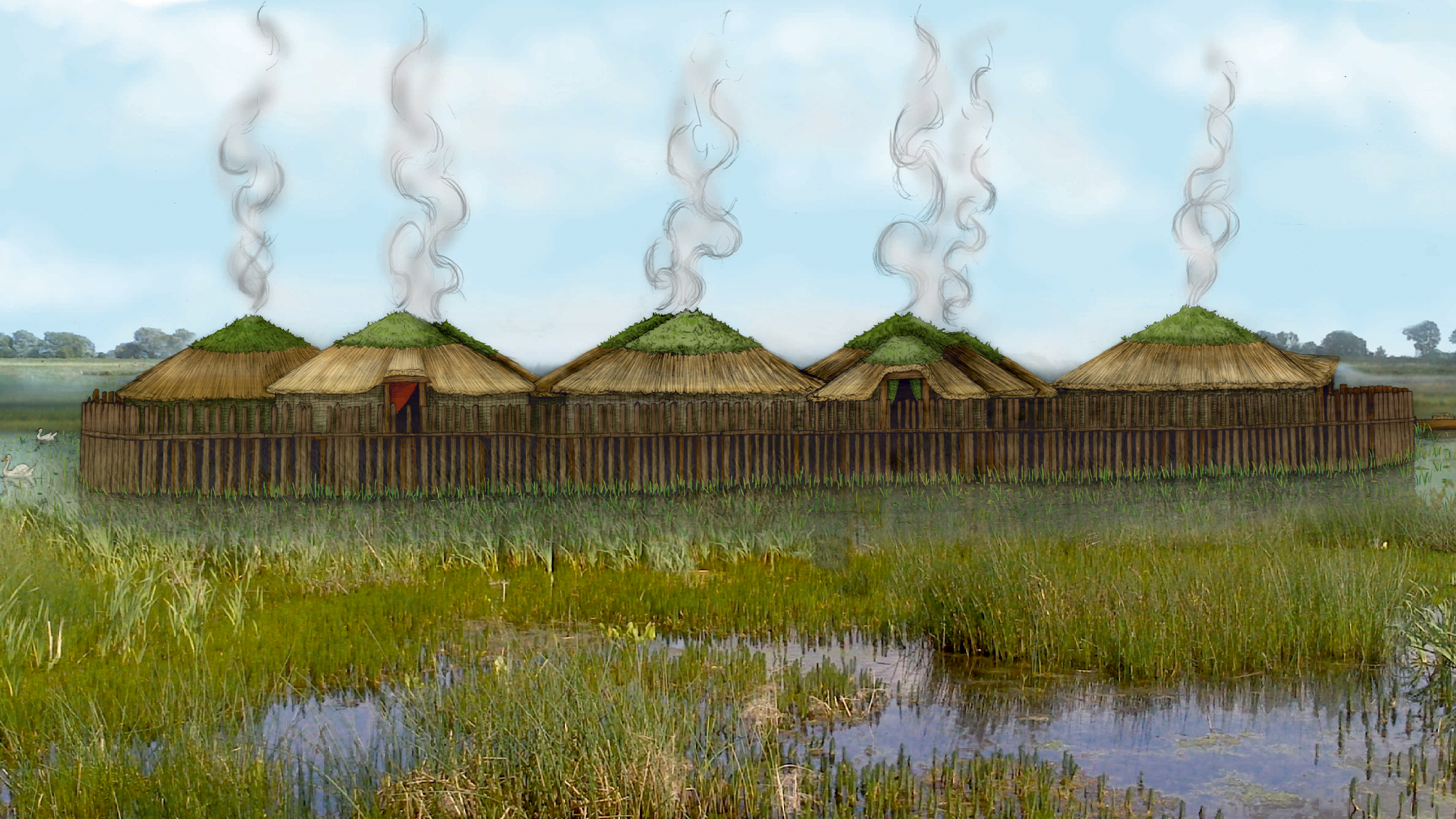 An illustration of the Bronze Age stilt settlement uncovered at Must Farm in eastern England. Cambridge Archaeological Unit
.
.
Click the link below for the article:
.
__________________________________________
April 21, 2024
Business, Food For Thought, Human Interest, Political, Science, Technical amazon, business, Business News, current-events, Future, Hotels, human-rights, medicine, mental-health, research, Science, Science News, technology, Technology News, travel, vacation Leave a comment

Click the link below the picture
.
Hitler is so fully imagined a subject—so obsessively present on our televisions and in our bookstores—that to reimagine him seems pointless. As with the Hollywood fascination with Charles Manson, speculative curiosity gives retrospective glamour to evil. Hitler created a world in which women were transported with their children for days in closed train cars and then had to watch those children die alongside them, naked, gasping for breath in a gas chamber. To ask whether the man responsible for this was motivated by reading Oswald Spengler or merely by meeting him seems to attribute too much complexity of purpose to him, not to mention posthumous dignity. Yet allowing the specifics of his ascent to be clouded by disdain is not much better than allowing his memory to be ennobled by mystery.
So the historian Timothy W. Ryback’s choice to make his new book, “Takeover: Hitler’s Final Rise to Power” (Knopf), an aggressively specific chronicle of a single year, 1932, seems a wise, even an inspired one. Ryback details, week by week, day by day, and sometimes hour by hour, how a country with a functional, if flawed, democratic machinery handed absolute power over to someone who could never claim a majority in an actual election and whom the entire conservative political class regarded as a chaotic clown with a violent following. Ryback shows how major players thought they could find some ulterior advantage in managing him. Each was sure that, after the passing of a brief storm cloud, so obviously overloaded that it had to expend itself, they would emerge in possession of power. The corporate bosses thought that, if you looked past the strutting and the performative antisemitism, you had someone who would protect your money. Communist ideologues thought that, if you peered deeply enough into the strutting and the performative antisemitism, you could spy the pattern of a popular revolution. The decent right thought that he was too obviously deranged to remain in power long, and the decent left, tempered by earlier fights against different enemies, thought that, if they forcibly stuck to the rule of law, then the law would somehow by itself entrap a lawless leader. In a now familiar paradox, the rational forces stuck to magical thinking, while the irrational ones were more logical, parsing the brute equations of power. And so the storm never passed. In a way, it still has not.
Ryback’s story begins soon after Hitler’s very incomplete victory in the Weimar Republic’s parliamentary elections of July, 1932. Hitler’s party, the National Socialist German Workers’ Party (its German initials were N.S.D.A.P.), emerged with thirty-seven percent of the vote, and two hundred and thirty out of six hundred and eight seats in the Reichstag, the German parliament—substantially ahead of any of its rivals. In the normal course of events, this would have led the aging warrior Paul von Hindenburg, Germany’s President, to appoint Hitler Chancellor. The equivalent of Prime Minister in other parliamentary systems, the Chancellor was meant to answer to his party, to the Reichstag, and to the President, who appointed him and who could remove him. Yet both Hindenburg and the sitting Chancellor, Franz von Papen, had been firm never-Hitler men, and naïvely entreated Hitler to recognize his own unsuitability for the role.
.

.
.
Click the link below for the article:
.
__________________________________________
April 20, 2024
Business, Food For Thought, Human Interest, Political, Science, Technical amazon, business, Business News, current-events, Future, Hotels, human-rights, medicine, mental-health, research, Science, Science News, technology, Technology News, travel, vacation Leave a comment

Click the link below the picture
.
Physicists have deduced subtle hints that the mysterious “dark” energy that drives the universe to expand faster and faster may be slightly weakening with time. It’s a finding that has the potential to shake the foundations of physics.
“If true, it would be the first real clue we have gotten about the nature of dark energy in 25 years,” said Adam Riess, an astrophysicist at Johns Hopkins University who won the Nobel Prize for co-discovering dark energy in 1998.
The new observations come from the Dark Energy Spectroscopic Instrument (DESI) team, which today unveiled a map of the cosmos of unprecedented scope, along with a bonanza of measurements derived from the map. To many researchers, the highlight is a plot showing that three different combinations of observations all insinuate that the influence of dark energy may have eroded over the eons.
“It’s possible we’re seeing hints of dark energy evolving,” said Dillon Brout of Boston University, a member of the DESI team.
Researchers inside and outside of the collaboration all stress that the evidence is not strong enough to claim a discovery. The observations favor the erosion of dark energy with the sort of middling statistical significance that could easily vanish with additional data. But researchers also note that three distinct sets of observations all point in the same intriguing direction, one that’s at odds with the standard picture of dark energy as the intrinsic energy of the vacuum of space — the quantity that Albert Einstein dubbed the “cosmological constant” due to its unvarying nature.
“It’s exciting,” said Sesh Nadathur, a cosmologist at the University of Portsmouth who worked on the DESI analysis. “If dark energy is not a cosmological constant, that’s going to be a huge discovery.”
Rise of the Cosmological Constant
In 1998, Riess’s group, along with another team of astronomers led by Saul Perlmutter, used the light of dozens of distant, dying stars called supernovas to illuminate the structure of the cosmos. They discovered that the expansion of the universe is growing faster as it ages.
According to Einstein’s general theory of relativity, any matter or energy can drive cosmic expansion. But as space expands, all the familiar kinds of matter and energy become less dense as they spread out in a roomier universe. As their densities fall, the expansion of the universe should slow down, not speed up.
.

The Dark Energy Spectroscopic Instrument (DESI) at Kitt Peak National Observatory in Arizona has produced the largest 3D map of our universe to date. Marilyn Sargent/The Regents of the University of California, Lawrence Berkeley National Laboratory
.
.
Click the link below for the article:
.
__________________________________________
Publicație umoristică dedicată glumeților de pretutindeni
Faith saved us from the savages that we were, losing faith makes us savages again
Where Trends Meet Truth
https://www.tangietwoods
Freelance poetry writing
Zalai Betti
INOVATION BLOG PEOPLE AND NEWS
Németh György
Konsultan Lingkungan Hidup di Lombok - NTB
Lea Krasznai (LeaArt21) – Idezetek (Idézetek) WordPress (Budapest, Hungary)
Appunti, spunti e passioni in liberta'
Gyorgy Nemeth
تعنى بتقديم نصائح للمعلمين المبتدئين، والطلبة الممتحنين، ومشاركة الاخرين تجربة الادخار في المال، بترشيد الاستهلاك المنزلي، وترتيب البيت، والحفاظ على البيئة، وتشجيع السيارات صديقةالبيئة، والسياحة والاسفار، ونماء رؤوس الاموال، والطب البديل وتشجيع التعليم الرقمي والذكاء الاصطناعي، والعناية بالنحل وتربية الاسماك، والاسثمار في رؤوس الاموال، الزراعة العضوية، والعناية باسنان الرضع، و صحة الحوامل، وتفسير القران
apprendre pour évoluer
Thoughts on books, language, meaning, and the culture around it.
Outdoor Recreation & Adventure in the Great Lakes Region
News, Info, Bio, Articles, Reviews, Lyrics, Technology, Science, Inspiration, Motivation, Philosphy and many more...
Christian Lifestyle Blogger
CEO and president of The Mullins Companies
Two Cultures. One Life. Endless Stories
Real Estate Development Specialist
¡Bienvenido de vuelta viajero!
so looking to the sky ¡ sing and from my heart to YOU ¡ bring...
CEO and Founder of Nsight Health
Catholic News, Prayers, HD Images, Rosary, Music, Videos, Holy Mass, Homily, Saints, Lyrics, Novenas, Retreats, Talks, Devotionals and Many More
Decoding Power. Defying Narratives.
A creative collaboration introducing the art of nature and nature's art.
The Home Of Entertainment News, Reviews and Reactions
•Whenever you are confronted with an opponent, conquer him with love.(Gandhi)
Algotrader at TRADING-CLUBS.COM
Film and Writing Festival for Comedy. Showcasing best of comedy short films at the FEEDBACK Film Festival. Plus, showcasing best of comedy novels, short stories, poems, screenplays (TV, short, feature) at the festival performed by professional actors.
Peace. Tranquility. Insanity.
Take a ride on the wild side
Découvre des musiques prometteuses (principalement) dans la sphère musicale française.
No tiene que Ser una Pesadilla.
Life in Kana-text (er... CONtext)
Where feelings meet metaphors and make questionable choices.
Finding hope and peace through writing, art, photography, and faith in Jesus.
Eyasu
Eyasu The Wonderful
A former medical student's journey through healthcare challenges and personal growth

