About eight years ago, I was hosting an open house at my Montessori school. Classrooms were buzzing with parents and kids, yet one mother stood out. She was speaking to her 4-year-old son in a performative manner, loudly narrating feelings he may be having as he moved through the room.
“I know you want to have that, but it is in the hands of another child. That makes you sad and frustrated, but I am here to help you,” she said to her child. When she spoke to me, she slipped back into a more natural tone and manner of speaking, her voice coming down a full octave.
In our brief conversation, her words flowed freely, as though they were casual representations of her own internal thought process. When she turned back to her son, however, it was as though she were channeling an adult who hosted a PBS show for children. I found this mother to be both engaging and competent in our interactions, yet slightly off-putting and disingenuous as she interacted with her son. I wondered sincerely why she didn’t allow her son access to her authentic self.
I now realize this mother was an early adopter of parenting scripts, something I had never heard of at the time, though they have now become ubiquitous.
Words matter when talking to kids
The spoken message behind parenting scripts is that parents can optimize how they speak to children, supporting their children’s development and validating their feelings. The unspoken message behind parenting scripts is that much of parents’ reflexive language toward their children is pernicious.
Seemingly innocuous but now verboten phrases include “you’re OK,” “be careful,” “stop it,” “you’re so smart,” and “good job.” These phrases gaslight, dominate, or put children into a fixed mindset, right? While there could be some truth to this — words do matter after all — it may be time to ask what impact this is having on parents. And is it really working for children?
When parents are repeatedly given the message that, left to their own devices, the way they communicate with their children is probably harmful, it invites shame, doubt, and a pervasive feeling that every word out of a parent’s mouth carries with it alarmingly high stakes.
I worry about parents wanting to optimize everything
As parenting scripts gain in popularity, I worry that some parents are buying into the idea that they can optimize the parent-child relationship by becoming less of their authentic selves and more of an “ideal” parent that’s prescriptively laid out to them by an expert whose interaction style may differ wildly from the parents’.
.
The author says parenting scripts can harm parent-child relationships. FG Trade Latin/Getty Images
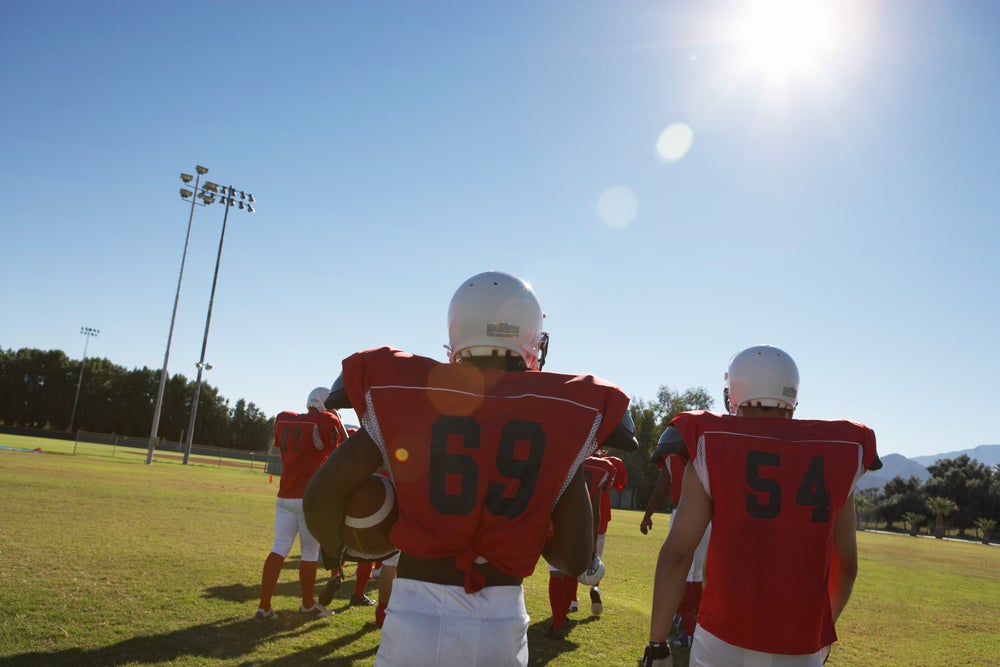
High school sports teams start practices soon in what has been an extremely hot summer in much of the country. Now, before they hit the field, is the time for athletes to start slowly and safely building up strength and stamina.
Studies have found that the greatest risk of heat illness occurs in the first two weeks of team practices, while players’ bodies are still getting used to the physical exertion and the heat. Being physically ready to start increasingly intense team practices can help reduce the risk.
I am an athletic trainer who specializes in catastrophic injuries and heat illnesses. Here’s what everyone needs to know to help keep athletes safe in the heat.
Why should athletes restart workouts slowly?
One of the biggest risk factors for developing dangerous exertional heat illnesses is your physical fitness level. That’s because how fit you are affects your heart rate and breathing, and also your ability to regulate your body temperature.
If an athlete waits until the first day of practice to start exercising, their heart won’t be able to pump blood and oxygen through the body as effectively, and the body won’t be as adept at dissipating heat. As a person works out more, their body undergoes changes that improve their thermoregulation.
That’s why it’s important for athletes to gradually and safely ramp up their activity, ideally starting at least three weeks before team practices begin.
There is no hard and fast rule for how much activity is right for preparing – it varies by the person and the sport.
It’s important to remember not to push yourself too hard. Acclimatizing to working out in the heat takes time, so start slow and pay close attention to how your body responds.
How hot is too hot for working out outside?
Anything that is hotter than normal conditions can be risky, but it varies around the country. A hot day in Maine might be a cool day in Alabama.
If it’s significantly hotter outside than you’re used to, you’re more likely to get a heat illness.
To stay safe, avoid exercising outside in the hottest periods. Work out in the shade, or in the early mornings or evenings when the sun’s rays aren’t as hot. Wear loose clothing and light colors to dissipate and reflect as much heat as you can.
Hydration is also important, both drinking water and replenishing electrolytes lost through sweating. If your urine is light-colored, you are likely hydrated. Darker urine is a sign of dehydration.
.
The first two weeks of practice are the hardest as the body acclimatizes. IPGGutenbergUKLtd/Getty Images
Communication with teens can be challenging. And receiving any sign of affection can also sometimes feel impossible, particularly after you say “I love you” to them, and you are met with just an aloof “K.”
There’s a new way teens are communicating with their parents and loved ones that appears to be breaking the emotional barrier. (Maybe not fully breaking, but it is creating tiny little cracks in the facade.)
It’s called “pebbling,” which is often used to describe a romantic relationship but has been crossed over into other types of relationships, including between parent and child. The term originated from the actions of gentoo penguins in Antarctica, who were observed presenting rocks to each other as a form of courtship. The rocks symbolized a desire to build a nest together.
Pebbling, in its current trending form, refers to little signs of love or affection that are gifted to a friend or a loved one that you think they would enjoy. It now often comes in the form of memes, GIFs, or social media videos that you would send to someone to help brighten their day.
“Recently I learned that the act of sending your friends & family little videos and tweets and memes you find online it’s called pebbling, like how penguins bring pebbles back to their little penguin loved ones,” an X user recently wrote in a viral post.
There can be many pros to this, and experts say parents can also benefit from engaging in some pebbling with their kids.
Why ‘Pebbling’ Can Be Positive
If you’re wondering why kids are sending endless memes and videos via social media, you’re not alone. But in today’s world, experts say pebbling on social media has become a way for them to connect, strengthen interactions, and show affection.
Not only does pebbling feel good for the person on the receiving end, but it can also trigger a positive chemical chain reaction in the sender’s brain as well, according to Cameron Caswell, PhD, an adolescent psychologist and mom of a teen.
“When you perform a kind act, your brain releases dopamine, a neurotransmitter associated with pleasure, motivation, and reinforcement,” she explains. “Feeling recognized and valued gives the receiver a surge of dopamine, too.”
Of course, there are also benefits when the affection is shown through a tangible object. “When you see the joy on the recipient’s face after receiving your thoughtful gesture, your brain releases oxytocin,” says Dr. Caswell. “This hormone fosters feelings of trust, empathy, and bonding.”
The more “good feelings” each party experiences, she says, the more likely they will repeat the act, “triggering the release of more happy hormones, creating a cycle of kindness.” Dr. Caswell recommends encouraging your teen to pebble others when they’re feeling down because it could be a powerful mood-lifter.
Parents can also do it. Something as simple as a little meme or a song could go a long way, making the bond with your teen more solid.
My sister Francesca consistently participates in pebbling with her two teenagers. She said it is common to feel disconnected from her kids, who often see her as “uncool” or “cringe.” But she says instead of taking it personally, she has embraced the dynamic by sending self-deprecating memes and reels that poke fun at the parent-teen relationship.
My kids might roll their eyes at first, but they always end up laughing and sending back funny responses,” she says. “It’s become a fun way for us to bond and keep the lines of communication open.”
Dr. Caswell agrees. “Affection, in any form, is a vital building block for strong bonds with teens,” she says. “It shows you see them and care about them. A well-chosen meme or GIF can be a playful way to show you’re thinking of them.”
The Summer Olympics will soon begin in Paris, against the backdrop of heat waves and drought throughout much of Southern Europe.
The organizers of the games say that in light of climate change, they’ve made sustainability a centerpiece of their enterprise. Channeling their inner Greta Thunberg, they promise that the event will be “historic for the climate” and “revolutionary Games like we’ve never seen before.”
Yet in the city where global leaders signed a landmark agreement in 2015 to limit postindustrial global warming to 1.5 degrees Celsius, we’re getting a recycled version of green capitalism that is oblivious in its incrementalism, vague with its methodology and loose with its accountability. It’s too late for Paris, but if the Olympic organizers truly want to be sustainable, the Games need to reduce their size, limit the number of tourists who travel from afar, thoroughly greenify their capacious supply chains and open up their eco-books for bona fide accountability. Until then, the Olympics are a greenwash, a pale bit of lip service delivered at a time when climatological facts demand a systematic transformation in splendid Technicolor.
Greenwashing is nothing new for the sports world, where a massive chasm exists between sustainable word and deed. Sports mega-events such as the Olympic Games and FIFA World Cup have long voiced concern for the environment and claimed to proffer solutions while doing the bare minimum—if anything—to make genuine ecological improvements.
Nevertheless, Olympic organizers swear they are scything a fresh path. “We want the legacy to be different,” Tony Estanguet, president of the Paris 2024 Olympics, told Time magazine. “We’ve promised to cut the carbon footprint in half from the London Olympics in 2012.” Those Olympics in London emitted around 3.3 million metric tons of CO2. Paris 2024 is aiming for 1.5 million metric tons.*
To be sure, this summer’s Paris Olympics have made significant sustainability strides. But their earnest efforts have raised a broader question: Can the Olympics truly be an environmentally sustainable event? “There is no version of a sustainable Games as of yet,” said Madeleine Orr, author of Warming Up: How Climate Change Is Changing Sport, in an interview with the Real News Network. This sentiment is echoed by many, including Christine O’Bonsawin, an Indigenous sport scholar and member of the Abenaki Nation at Odanak in Quebec, who dubbed such measures an “Olympic sustainability smokescreen.” The modern-day supersized Olympics, with its fossil-fuel-guzzling ways, is simply not compatible with an authentic sustainability agenda.
So how has Paris fared?
To limit their carbon footprint, organizers have kept venue construction to a minimum by building only two new sports facilities—an aquatic center and a climbing venue—and two additional sites: the Media Village for journalists and the Olympic Village, where athletes will reside during the Games. Organizers have made an effort to deploy bio-sourced materials—especially wood—and to reuse and recycle supplies, such as the seats in the aquatic center, which are constructed exclusively with local plastic waste. Construction of the Olympic Villageaspires to limit carbon intensity—the amount of carbon dioxide released to create a kilowatt-hour of electricity—by expending less than 650 kilograms of carbon dioxide equivalent per meter squared (kgCO2e/m2), half of France’s average for the construction of office structures (1,400 kgCO2e/m2) and multifamily housing (1,300 kgCO2e/m2).
.
Giant Olympic rings are affixed to the Eiffel Tower in Paris as part of the 2024 Summer Olympic Games. Daniel Dorko/Hans Lucas/AFP via Getty Images
A government investigation has revealed more detail on the impact and causes of a recent AT&T outage that happened immediately after a botched network update. The nationwide outage on February 22, 2024, blocked over 92 million phone calls, including over 25,000 attempts to reach 911.
As described in more detail later in this article, the FCC criticized AT&T for not following best practices, which dictate “that network changes must be thoroughly tested, reviewed, and approved” before implementation. It took over 12 hours for AT&T to fully restore service.
“All voice and 5G data services for AT&T wireless customers were unavailable, affecting more than 125 million devices, blocking more than 92 million voice calls, and preventing more than 25,000 calls to 911 call centers,” the Federal Communications Commission said yesterday. The outage affected all 50 states as well as Washington, DC, Puerto Rico, and the US Virgin Islands.
The outage also cut off service to public safety users on the First Responder Network Authority (FirstNet), the FCC report said. “Voice and 5G data services were also unavailable to users from mobile virtual network operators (MVNOs) and other wireless customers who were roaming on AT&T Mobility’s network,” the FCC said.
An incorrect process
AT&T previously acknowledged that the mobile outage was caused by a botched update related to a network expansion. The “outage was caused by the application and execution of an incorrect process used as we were expanding our network, not a cyber attack,” AT&T said.
The FCC report said the nationwide outage began three minutes after “AT&T Mobility implemented a network change with an equipment configuration error.” This configuration error caused the AT&T network “to enter ‘protect mode’ to prevent impact to other services, disconnecting all devices from the network, and prompting a loss of voice and 5G data service for all wireless users.”
While the network change was rolled back within two hours, full service restoration “took at least 12 hours because AT&T Mobility’s device registration systems were overwhelmed with the high volume of requests for re-registration onto the network,” the FCC found.
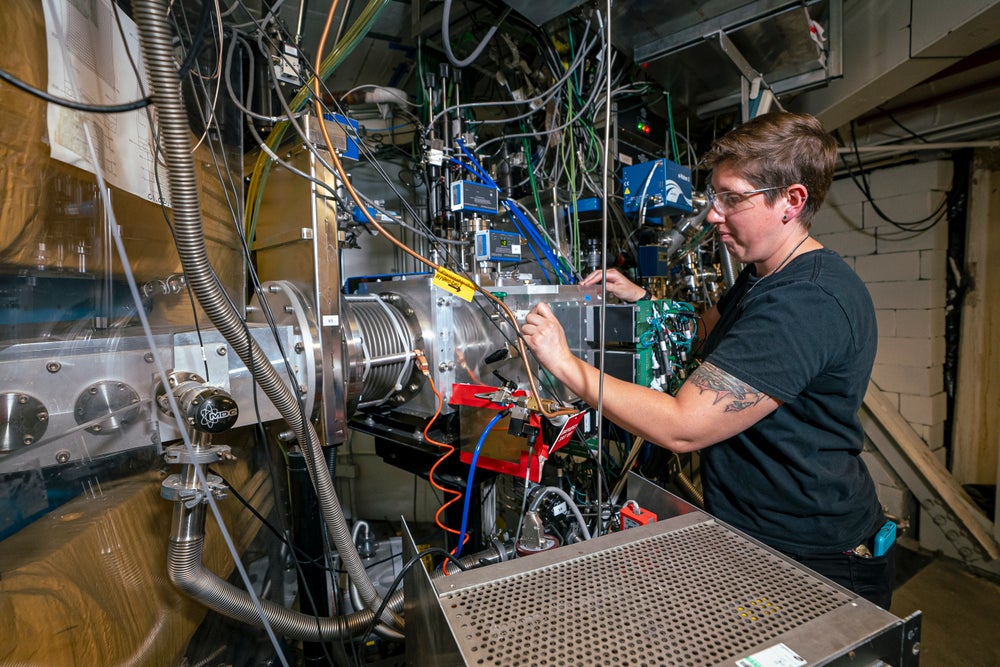
For new, human-made heavy elements on the periodic table, being “too ‘big’ for your own good” often means instability and a fleeting existence. The more protons and neutrons scientists squeeze together to construct a “superheavy” atomic nucleus—one with a total number of protons greater than 103—the more fragile the resulting element tends to be. So far, all the superheavy elements humans have managed to make decay almost instantaneously. Researchers who synthesized such hefty atoms via a particle accelerator at the Lawrence Berkeley National Laboratory, however, have now made a significant stride toward the elusive “island of stability”—a hypothesized region of the periodic table where new superheavy elements might finally endure long enough to buck the trend.
The team successfully forged element 116, livermorium, using a novel method involving titanium 50, a rare isotope that makes up about 5 percent of all the titanium on Earth. By heating this titanium to 3,000 degrees Fahrenheit and channeling it into a high-energy beam, the researchers were able to blast this particle stream at other atoms to create superheavy elements. Although livermorium has been made before using other techniques, this innovative approach paves the way for the synthesis of new, even heavier elements, potentially expanding the periodic table.
“This achievement is truly groundbreaking,” says Hiromitsu Haba, a researcher at the RIKEN Nishina Center for Accelerator-Based Science in Japan, who was not a part of the study. Haba adds that this feat is “necessary to further discover new elements.” The work was presented at July’s Nuclear Structure conference and is currently under review at the journal Physical Review Letters.
The “Simple” Math of Superheavy Fusion
Berkeley Lab is home to the 88-Inch Cyclotron—a device that generates an electromagnetic field to nudge atomic nuclei into shedding some of their surrounding electrons and hurtle at a high speed toward other, stationary atoms. Using these machines, the synthesis of superheavy elements then boils down to simple math: to form an element with 116 protons, you need to fuse two atomic nuclei with that sum total of protons between them. As is often the case with nuclear physics, however, the process is not exactly so simple.
Traditionally, calcium 48 has been the gold-standard isotope for superheavy fusion reactions because of its “doubly magic” nature. Atomic nuclei are surrounded by orbital shells of whirling electrons; nuclei possessing “magic numbers” of protons or neutrons that completely fill in a shell are very stable, and ones with “doubly magic” numbers of both particle types are exceptionally so. But calcium 48’s low proton count limits its utility for creating heavier elements. The heaviest stable element that can be combined with calcium 48 (20 protons) is curium (96 protons), resulting in livermorium (116 protons). While calcium 48 and the heavier berkelium (97 protons) have been used to synthesize element 117, berkelium “is extremely difficult to produce,” says Witold Nazarewicz, chief scientist at the Facility for Rare Isotope Beams at Michigan State University, who wasn’t involved in the new study. “If we want to make most heavier elements, we need a beam with more protons [than calcium 48].”
To make such a beam, the research team turned to titanium 50, attempting to fuse it with plutonium to make livermorium. “Until we ran this experiment, nobody knew how easy or difficult it would be to make things with titanium,” emphasizes Jacklyn Gates, leader of the Heavy Element Group at Berkeley Lab and lead author of the study.
Unlike the doubly magic and highly stable calcium 48, titanium 50 is distinctly nonmagic and lacks extreme stability. It also has a melting point nearly twice that of calcium, making it harder to work with. And the lower stability of titanium 50 atoms decreases the probability of successful fusions, even when collisions occur. “It’s the difference between seeing a synthesized atom every day versus every 10 days or worse,” Gates explains. Despite these challenges, titanium 50 emerged as the next best candidate because it offered hope of creating superheavy elements beyond calcium’s reach.
When my partner Adam asked what I thought of his girlfriend Leah coming out to visit for his birthday, I pragmatically decided to view it as the next step on my path. I’d read in “The Smart Girl’s Guide to Polyamory” that one of the best ways to combat jealousy was to meet your metamour. Since she would be coming to visit for a week in August (a whole week straight!), I decided to reach out. And thus began the most texting-intensive relationship of my life.
Indeed, it was actually a huge relief to text with Leah. Our exchanges were overtly kind; we were both going out of our way to signal politeness. It reminded me of how some femmes will reflexively compliment something about your outfit when they meet you at a party, as if to say, “I come in peace.” Or is it a keep your friends close, enemies closer kind of thing?
Leah was deferential to my “primacy” in a way that made me feel like she had no interest in stealing my place. She did this by sometimes saying so directly, but also demonstrated it by rarely referencing her relationship with Adam at all. The same unspoken code didn’t apply to me, with her making generous references to admiring our “primary relationship.” But I tried not to talk about Adam in any way that might come off as bragging.
On the rare occasion she did mention Adam with romantic undertones, I’d feel a twinge of jealousy, a feeling that it was somehow a passive-aggressive power play. And then I’d consciously try to shut the thought down, because it was unfair.
I became close to my partner’s girlfriend, Leah
When it came to everything but the man we “shared,” we were almost compulsively forthcoming. We dished about sex (except sex with Adam) in the kind of detail I’d seen on “Sex and the City.” Was it because we shared the same man? Were we backhand bragging? Bonding? All of the above, I’d suspect. Soon, we could even commiserate over Adam’s newer romantic prospects like more senior sister wives; admitting how attractive they were, the precarious feeling of constant competition.
I soon became very protective of Leah’s well-being, a sort of on-call counselor. I found she was sometimes even more anxious, insecure, and neurotic than I was, which was really rather impressive/a little disturbing. Is this Adam’s type? No matter. Now that she was a real person instead of an abstract threat, what was important was Leah was no longer she-who-must-not-be-named in my mind.
I was even able to talk with Adam about her like a mutual friend. Sometimes, I knew things that were going on with her before he did. That felt good, too, like I was less excluded and more in control. Leah and I congratulated ourselves often on our friendship. It was a choice we were making, and not an easy one, not to cast the other as the enemy. It felt not just evolved, but laced with real sisterhood.
.
Rachel Krantz is the author of the memoir “Open: One Woman’s Journey Through Love and Polyamory.” Photo Credit: Malika Danae Photography
President Biden told the American public in an Oval Office address on Wednesday that he had abandoned his re-election campaign because there is “a time and a place for new voices, fresh voices — yes, younger voices.”
His words, lasting 11 minutes in all, were the first extensive ones from Mr. Biden since his decision to step aside, and expanded on his initial announcement, delivered in a post on social media on Sunday, that he was dropping out of the race. His tone was wistful and his speech was an early farewell.
“It’s been the privilege of my life to serve this nation for over 50 years,” he said.
Sitting behind the Resolute Desk and surrounded by photos of his family, Mr. Biden ticked through the accomplishments of his term, ranging from the choice of the first Black woman to be a Supreme Court justice to pulling the country out of a paralyzing pandemic. He expressed gratitude to the American people for allowing a “kid with a stutter” from modest beginnings in Scranton, Pa., to reach the pinnacle of American politics.
Just beyond the camera, dozens of aides and several members of his family, including Jill Biden, the first lady, watched as Mr. Biden said he would walk away from the office they had worked to help him reach for decades.
“I revere this office,” he said, “but I love my country more.”
Ultimately, Mr. Biden said, he concluded that “the best way forward is to pass the torch to a new generation.” The president praised Vice President Kamala Harris — “she’s experienced, she’s tough, she’s capable” — but warned, as he has for years, that Americans faced a choice between preserving democracy and allowing it to backslide.
“History is in your hands,” Mr. Biden said. “The power is in your hands. The idea of America lies in your hands. We just have to keep faith, keep the faith, and remember who we are.”
.
Speaking from the Resolute Desk in the Oval Office, President Biden defended his record and celebrated the vice president, Kamala Harris, saying it’s time for new, younger voices to lead the country.CreditCredit… Pete Marovich for The New York Times
James Lange remembers the day he and a team of botanists and conservationists gathered at a rock formation encircled by a thicket of mangroves in Key Largo, Florida. They’d come to the nation’s last wild stand of a rare cacti to confront the inevitable. With sea level rise bringing the Atlantic Ocean ever closer to the withering plants, the group had made the difficult decision to remove the cacti’s remaining green material, preserve it in nurseries, and hope that it might one day be reintroduced in the wild.
Three years later, research published last week reveals what Lange and the others long suspected: The demise of the Key Largo tree cactus is the first recorded case of sea level rise driving a local species to extinction in the United States. Its collapse was a blow to Lange, a research botanist at Fairchild Tropical Botanic Garden in Coral Gables who coauthored the study. “It was one of the things that made the Keys so special,” he said. “Just a big, bold, beautiful plant.”
Tree cactus is a suitable name for Pilosocereus millspaughii, known to reach towering heights, yield white flowers that entice nectar-hungry bats, and produce reddish-purple fruits for birds and mammals to feast upon. Although the cactus still grows on a few scattered islands in the Caribbean, it was restricted to a single population in North America, a thriving stand of 150 plants discovered in the Florida Keys in 1992. By 2021, just six ailing stems remained.
It is a monumental loss, scientists say, in no small measure because of what it signifies. Anthropogenic planetary warming is no longer solely endangering human communities. It is eradicating the very species that make up the fabric of our natural world.
“This existential threat that everyone’s aware of, seeing the actual evidence of it happening, giving an expectation of what we can expect moving forward, is important,” said Lange. He remembers how “everything was just looking horrible,” as the sea rapidly encroached on the cluster of plants. “We just knew there was no long-term hope for this population in this area,” he said. “There’s no shortage of plants in the Keys that are threatened with this same fate.”
From the critically imperiled Big Pine partridge pea to the jumping prickly apple, any number of coastal species in the Florida Keys could be wiped out next in one of the places most vulnerable to sea level rise. And unlike the Key Largo cacti, which survives, if only barely, elsewhere, several of them are the last of their kind.
“It’s very alarming,” said Marcelo Ardón, who studies coastal ecology at North Carolina State University. “Climate change is compounding all of these different drivers that makes these populations even more vulnerable.”
A major herbivory event, in which a substantial amount of the plants were eaten by animals, stressed the Key Largo cactus species in 2015. (Researchers suspect it might have occurred as a result of tidal flooding causing a shortage of freshwater, driving a gaggle of thirsty racoons or other wildlife to gnaw on the stems.) The threat was magnified by an ensuing series of recurring king tides, in addition to storm surge and damage wrought by Hurricane Irma. Jennifer Possley, lead author of the new study, considers it a possible “bellwether for how other low-lying coastal species will respond to climate change.”
.
The Key Largo tree cactus was initially found growing in the United States in 1992 at a single site. That population has since been lost to a combination of rising sea levels and increasingly intense storms. Courtesy of Susan Kolterman
When most of us think about how to get the perfect night’s sleep, we consider things like how firm our mattress is, how cool or dark our room is, and what time we go to bed. One factor we sometimes fail to consider? Our pillow setup.
“I think pillows are often incredibly overlooked,” says Dr. W. Christopher Winter, a neurologist, sleep specialist, and author of The Sleep Solution.
Winter says he always asks patients what kind of pillow they have and where they bought it. “It’s really surprising how few people can actually answer the question,” he says. “It’s like they just always had the pillow or it just showed up in their bed at some point, and they never really questioned it.”
Finding the perfect pillow is an opportunity for people to improve their sleep without buying a new mattress, which can be time-consuming and costly, says Winter, who also hosts the “Sleep Unplugged” podcast.
The following advice can help ensure your pillow setup will get you the best sleep possible.
Not too low, not too high
The most comfortable sleeping position is highly personal. Some people will feel most comfortable sleeping on their stomach, while others will get the best sleep on their side or back. (Generally speaking, side and back sleeping are best for the alignment of the spine.)
Pillow height is highly personal, too; there’s no scientific consensus yet on the ideal pillow height. But a good rule of thumb is to use a pillow that fills the gap between your shoulder and ear, as this helps align your neck and spine, says Craig Hensley, associate professor of physical therapy and human movement sciences at Northwestern University Feinberg School of Medicine.
Read More: Why You Sweat So Much at Night—And What to Do About It
“If the pillow is too thick, it will bend and put stress on your neck,” he says. “If it’s not thick enough, it’ll bend your neck the other way, which could compress some of your joints.”
Find the right firmness and material
Most people sleep better with a firmer pillow, Hensley says. Firm pillows support the head and neck better than soft ones. Just beware of a pillow that’s too firm, as this can cause stiffness from hyperextension of the neck, says Dr. Rachel Salas, a sleep neurologist at the Johns Hopkins Center for Sleep and Wellness.
Film and Writing Festival for Comedy. Showcasing best of comedy short films at the FEEDBACK Film Festival. Plus, showcasing best of comedy novels, short stories, poems, screenplays (TV, short, feature) at the festival performed by professional actors.



:max_bytes(150000):strip_icc():format(webp)/Parents-Border-GettyImages-1411137274-32a5665cc9fc47598b2872eb6cf1462c.jpeg)