The smart home revolution is only beginning. It’s largely believed that one day all products in the house will be connected to the Internet and work together — your fridge will send a message to your TV telling you you’re out of milk; the lights will flicker if you’ve left the front door open.
But before we get to the point where products are figuratively talking to one another, manufacturers are launching web-connected items alongside their traditional offerings. This includes everything from smart thermostats and garage doors to toothbrushes, tennis racquets and even your bed. They collect data about how you use them, learn your habits, typically connect to an app and give you feedback to improve your lifestyle.
These products are a part of a larger concept called the “Internet of Things,” which refers to items and things that are web-connected. But it’s not just small products — big ticket items like refrigerators are getting smarter too; there are even models that connect (and play) Internet radio, serve up recipes from popular webpages and even send your tweets.
BMW is developing a remote-control valet parking system for cars that can be operated by a smartwatch.
The sensor-filled BMW i3 car, which will be on display at the 2015 International CES in Las Vegas in January, integrates with smartwatch and can essentially self-park. According to the company, a driver could activate the “Remote Valet Parking Assistant” via an app, which then guides the vehicle to a parking spot all by itself.
The car works with the help of laser sensors that scan the surrounding environment so it can move without running into anything. It will work in tandem with a digital site plan, so the car has a map of the environment, too.
It took Microsoft three tries, but it finally scored a hit with the Surface Pro 3, which the company touts as the “tablet that can replace your laptop.”
Now, three former Google engineers are running with that idea in the Android arena.
The Remix tablet, unveiled on Wednesday at CES 2015 by Chinese company Jide, looks a lot like one of Microsoft’s Surface devices. It’s about the same size with an 11.6-inch screen, and the edge has a similar trapezoid shape that makes it suited to sitting at an angle. The Remix also has both a kickstand and a magnetically attached keyboard — two Surface hallmarks. Even the volume control feels the same.
In the space between somewhat practical vehicles like the Segway and completely fad-driven curios like the Tamagotchi, there exists a middle ground of outlandish gadget that almost seems to make sense, but is weird enough that you might be too embarrassed to use it in public.
It’s still early days, but that appears to be the case with Acton’s RocketSkates, which look like a joint creation by the art departments of Judge Dredd and Willy Wonka & the Chocolate Factory. Offering to motorize your feet, they are a recent Kickstarter success story. And depending on your temperament, the RocketSkates either look like a glimpse at the future, or an expensive prank.
Do they work as described? A demonstration video indicates that, yes, you can use the RocketSkates to traverse the city at fairly rapid speeds. But there are limitations.
Ian Burkhart had barely finished his freshman year of college when he broke his neck.
Standing on top of a cliff in North Carolina’s Outer Banks, which overlooked an orange sandbar jutting into the Atlantic Ocean, he dove hands-first toward the deceptively shallow water below.
“It happened so fast. There was this loud snap,” he says.
The impact with the sandbar broke his vertebrae at what’s called the C5 level, paralyzing his body from the elbows down. He spent the next four months recovering. Doctors told him he’d never be able to use his arms again.
.
Image: The Ohio State University
Ian Burkhart shares a smile with Chad Bouton, research leader from Battelle. Bouton and his team at Battelle pioneered the Neurobridge technology, working closely with doctors from The Ohio State University Wexner Medical Center, which allowed Burkhart to become the first patient ever to move his paralyzed hand with his own thoughts.
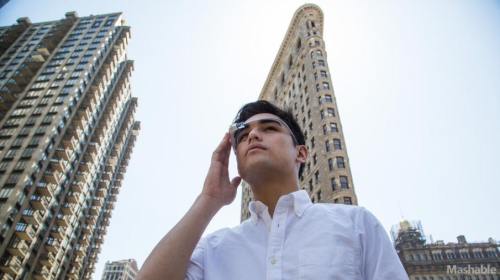
Wearable technology is perhaps the most prolific trend in the tech industry today.
From activity-tracking fitness bands to Google Glass and Oculus Rift, big names are getting involved in the once-niche technology — and they’re getting involved in big ways.
You probably wouldn’t have guessed that the tech behind wearable computing devices finds much of its history in attempting to cheat casinos. Inventors built some of the first wearables in the 1960s and ’70s to count cards and improve a gambler’s odds at the roulette table.
A new portable charging system aims to put on-the-go power in your pocket, boasting a set-up that reportedly doesn’t compromise on power or portability. Modulo, developed by Barcelona-based tech company Idapt, is a credit card-sized gadget that claims to power any USB device, wherever you go.
“All our lifestyle now goes to electronics — it’s portable, really portable,” Idapt CEO Jacques Giribet told Mashable. “We have designed a battery that is as small as possible, taking into account that we want it to give you the same power as the original battery.”
Welcome to Hiroshima, Japan a business fair was held back in January and some really amazing gadgets were introduced to the public. Among many gadgets that we witnessed, there was a peculiar new gadget that reminded us right away of Joaquin Phoenix in film ‘Her’.
The creation comes from Kazuhiro Taniguchi who is a staffer at Hiroshima City University. This device, prototype so far, employs infrared waves in order to ascertain when the user closes or opens his/her mouth. These detected movements and the respective commands are sent back to the device. So what we are looking at are applications that will allow the users to get information pertaining to traffic or even be able to get directions by turning their heads or biting down. The device is being called an Ear Switch which comes equipped with earpiece along with a compass, speaker, barometer, gyro sensors, microphone, battery and GPS capabilities.
This week’s Consumer Electronics Show (CES) in Las Vegas may be the place where the likes of Samsung and Panasonic announce their latest TVs and cameras, but it’s also full of extremely weird — yet sometimes surprisingly useful — devices from big companies and small.
Full-body gaming suit As for virtual reality, this guy is experiencing the next best thing. The PrioVR “gaming exoskeleton” puts trackers on your head, body, arms, and legs — but you still play games on the TV, at least for now. All this might be obsoleted by 3-D tracking systems like the Kinect, but there’s something special about getting wired up with all that gear. The zombies don’t stand a chance.
Mobile typists usually have to settle for touch keyboards or small plastic add-ons, but the folks behind TrewGrip are looking to change that. The TrewGrip literally flips the lid on traditional keyboard design by placing all of the letter keys on the rear, allowing users to type on a mobile device, PC, or smart device while maintaining a comfortable grip. We spent a few minutes re-learning how to type on this wireless Bluetooth device, and saw some serious potential.
The TrewGrip has a distinct U-shaped design with soft-grips on either end and a micro-suction panel in the middle that help keep your smartphone or tablet in place. The back of the device hosts its full QWERTY keyboard, which is split among the left and right side based on which keys are typically accessed with either hand.
Film and Writing Festival for Comedy. Showcasing best of comedy short films at the FEEDBACK Film Festival. Plus, showcasing best of comedy novels, short stories, poems, screenplays (TV, short, feature) at the festival performed by professional actors.

 .
.





 Image: The Ohio State University







 James' World 2