September 19, 2022
Mohenjo
Business, Food For Thought, Human Interest, Science, Technical
amazon, business, Business News, current-events, Future, Hotels, human-rights, medicine, mental-health, research, Science, Science News, technology, Technology News, travel, vacation

Click the link below the picture
.
One of the most frustrating hobbies I ever took up was archery, but not because it’s hard to hit a target on the wall (it is, but I got pretty good at that). My problem was that one of the popular ways to go out and have fun with archery was to do “3D shoots,” where you would have to shoot at a series of statues of animals, each positioned at an unknown distance.
Estimating distance turned out to be my downfall. If you don’t have a good sense of how far away the fake deer is, you’ll end up shooting way over its back or burying your arrow under the ground beneath its feet. At the time, I assumed that estimating distance was less a learnable skill and more a gut feeling. Hence my surprise when I recently came across a quick eyeball-and-mental-math trick that allows anyone to estimate distance pretty accurately.
.
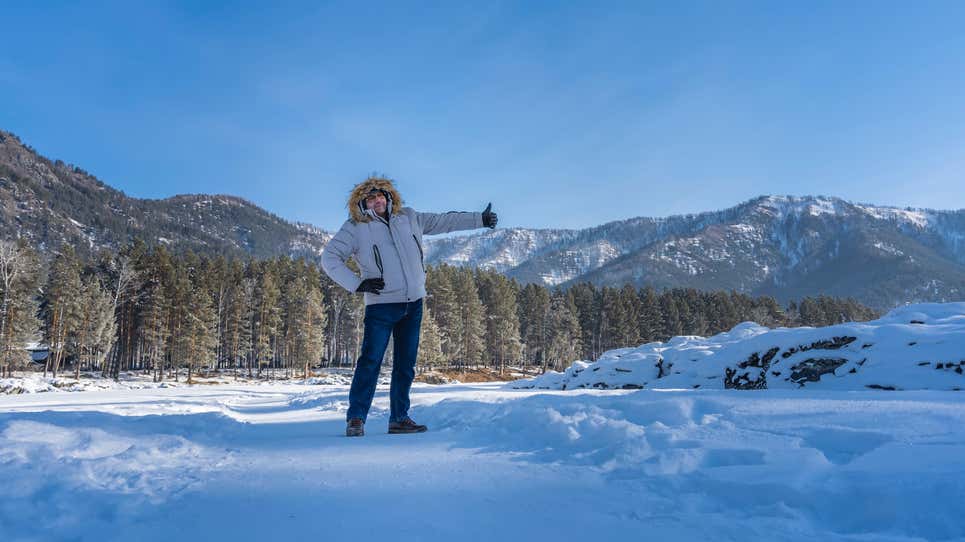 Photo: Veranika848 (Shutterstock)
.
.
Click the link below for the article:
.
__________________________________________
September 19, 2022
Mohenjo
Crime, Food For Thought, Human Interest, Medical, missed News, Political, Science, Technical
amazon, business, Business News, current-events, Future, Hotels, human-rights, medicine, mental-health, research, Science, Science News, technology, Technology News, travel, vacation

.
News You might have missed!
Use your browser or smartphone back arrow (<-) to return to this table for your next selection.
.
__________________________________________
September 18, 2022
Mohenjo
Business, Food For Thought, Human Interest, Political, Science, Technical
amazon, business, Business News, current-events, Future, Hotels, human-rights, medicine, mental-health, research, Science, Science News, technology, Technology News, travel, vacation

Click the link below the picture
.
The James Webb Space Telescope captured mysterious concentric rings around a distant star that astronomers are still working to explain.
The image, taken in July, was released on Twitter by citizen scientist Judy Schmidt, prompting a torrent of comments and head-scratching. It shows a star known as WR140 surrounded by regular ripple-like circles that gradually fade away. The circles, however, are not perfectly round, but have a somewhat square-like feel to them, prompting speculations about possible alien origins.
“I think it’s just nature doing something that is simple, but when we look at it from only one viewpoint it seems impossible, at first, to understand that it is a natural phenomenon,” Schmidt told Space.com in an email. “Why is it shaped the way it is? Why is it so regular?”
Mark McCaughrean, an interdisciplinary scientist in the James Webb Space Telescope Science Working Group and a science advisor to the European Space Agency, called the feature “bonkers” in a Twitter thread.
“The six-pointed blue structure is an artifact due to optical diffraction from the bright star WR140 in this #JWST MIRI image,” he wrote. “But red curvy-yet-boxy stuff is real, a series of shells around WR140. Actually in space. Around a star.”
He noted that WR140 is what astronomers call a Wolf-Rayet star, which have spat much of their hydrogen into space. These objects are also surrounded by dust, he added, which a companion star is sculpting into the strange shells.
Astronomers will know more soon thanks to a scientific paper currently under review about this mysterious phenomenon.
.
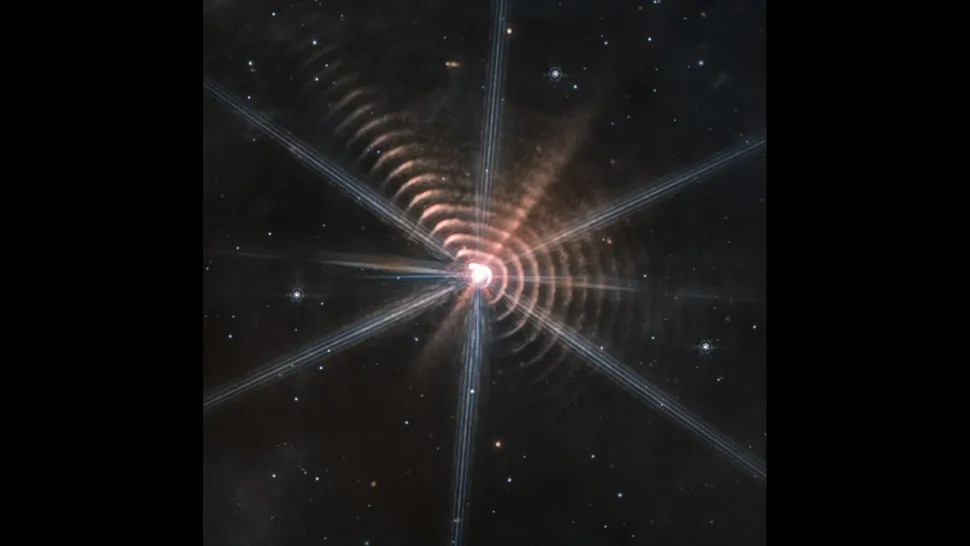 The James Webb Space Telescope captured the star WR 140 surrounded by strange concentric shells. (Image credit: NASA/ESA /CSA /Ryan Lau /JWST ERS Team /Judy Schmidt)
.
.
Click the link below for the article:
.
__________________________________________
September 18, 2022
Mohenjo
Business, Food For Thought, Human Interest, Political, Science, Technical
amazon, business, Business News, current-events, Future, Hotels, human-rights, medicine, mental-health, research, Science, Science News, technology, Technology News, travel, vacation
Click the link below the picture
.
For many of us, making friends as an adult is intimidating, and sometimes embarrassing or a bit baffling. But we all know those people who appear to be naturals: They balance bustling social calendars, glide easily into conversations with strangers, and seem to get invited to everybody’s wedding. Research shows that these super friends, as I like to call them, really exist: Not only are they better at initiating new friendships, but they also view their friendships as closer and more enduring.
Superfriends tend to have one quality in common—one that allows them to flourish outside of their relationships too. Studies find that people with this trait have better mental health; they’re more satisfied at work, more open to new ideas, and less prejudicial. Research suggests that they feel less regret; that during typically stressful events, like math tests or public-speaking engagements, they keep calm; and that they are less likely to have physical ailments such as heart attacks, headaches, ulcers, and inflammation.
So what is the distinguishing quality of super friends? It’s a secure attachment.
Attachment is the “gut feeling” we project onto ambiguity in our interactions. It’s driven not by a cool assessment of events but by the collapsing of time, the superimposition of the past onto the present. Understanding our attachment style is invaluable, not so we can mentally flog ourselves for biased interpretations but so we can gain more control over our social worlds. When we recognize how we contribute to our own relationship problems, we can try to change course—toward greater security and stronger friendships.
.
 Ben Hickey
.
.
Click the link below for the article:
.
__________________________________________
September 17, 2022
Mohenjo
Business, Enthralling, Human Interest, Photographs
amazon, business, Business News, current-events, Future, Hotels, human-rights, medicine, mental-health, research, Science, Science News, technology, Technology News, travel, vacation

Click the link below the picture
.
Charles-François Daubigny; 15 February 1817 – 19 February 1878) was one of the painters of the Barbizon school, and is considered an important precursor of impressionism.
He was also a prolific printmaker, mostly in etching but also as one of the main artists to use the cliché verre technique.
Daubigny was born in Paris, into a family of painters; taught the art by his father, Edmé-François Daubigny [fr], and his uncle, miniaturist Pierre Daubigny (1793-1858).
Initially, Daubigny painted in a traditional style, but this changed after 1843 when he settled in Barbizon to work outside in nature. Even more important was his meeting with Camille Corot in 1852 in Optevoz (Isère). On his famous boat Botin, which he had turned into a studio, he painted along the Seine and Oise, often in the region around Auvers. From 1852 onward he came under the influence of Gustave Courbet.
In 1866 Daubigny visited England, eventually returning because of the Franco-Prussian war in 1870. In London, he met Claude Monet, and together they left for the Netherlands. Back in Auvers, he met Paul Cézanne, another important Impressionist. It is assumed that these younger painters were influenced by Daubigny.
His most ambitious canvases are Springtime (1857), in the Louvre; Borde de la Cure, Morvan (1864); Villerville sur Mer (1864); Moonlight (1865); Auvers-sur-Oise (1868); and Return of the Flock (1878). He was named by the French government as an Officer of the Legion of Honor.
Daubigny died in Paris. His remains are interred at cimetière du Père-Lachaise (division 24). His followers and pupils included his son Karl [fr] (whose works are occasionally mistaken for those of his father), Achille Oudinot [fr], Hippolyte Camille Delpy, Albert Charpin, and Pierre Emmanuel Damoye.
The life of Daubigny was adapted into a graphic novel by Belgian comics writer Bruno de Roover and artist Luc Cromheecke. It appeared under the title De Tuin van Daubigny (The Garden of Daubigny, 2016). Wikipedia
.
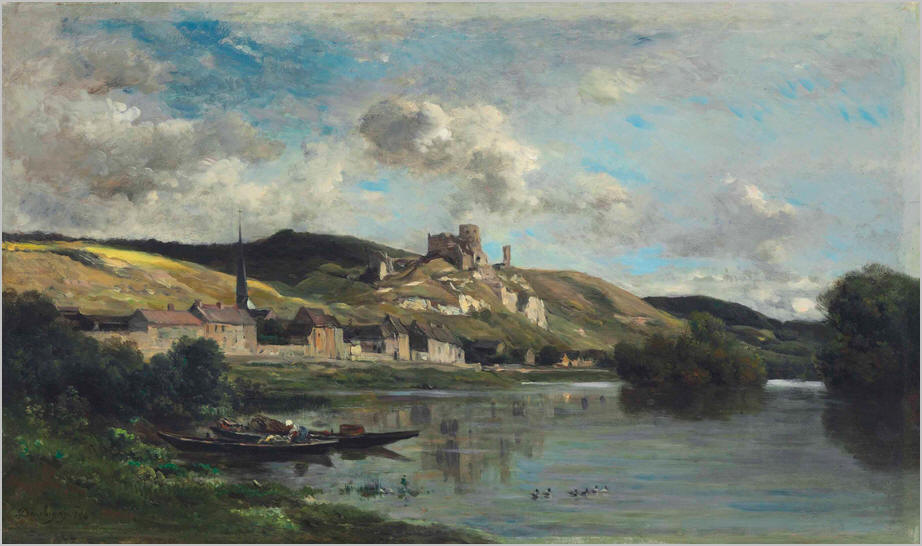 An image of a painting by Charles-Francois Daubigny
.
.
Click the link below for images:
.
__________________________________________
September 17, 2022
Mohenjo
Business, Food For Thought, Human Interest, Political, Science, Technical
amazon, business, Business News, current-events, Future, Hotels, human-rights, medicine, mental-health, research, Science, Science News, technology, Technology News, travel, vacation
Click the link below the picture
.
Last year, the particle physicist Lance Dixon was preparing a lecture when he noticed a striking similarity between two formulas that he planned to include in his slides.
The formulas, called scattering amplitudes, give the probabilities of possible outcomes of particle collisions. One of the scattering amplitudes represented the probability of two gluon particles colliding and producing four gluons; the other gave the probability of two gluons colliding to produce a gluon and a Higgs particle.
“I was getting a little confused because they looked kind of similar,” said Dixon, who is a professor at Stanford University, “and then I realized that the numbers were basically the same — it’s just that the [order] had gotten reversed.”
.
 The new “antipodal duality” inverts the terms used to calculate one particle scattering process to get the terms for another, in a way that’s similar to inverting the coordinates of points on a sphere. Kristina Armitage for Quanta Magazine
.
.
Click the link below for the article:
.
__________________________________________
September 17, 2022
Mohenjo
Business, Food For Thought, Human Interest, Medical, Political, Science, Technical
amazon, business, Business News, current-events, Future, Hotels, human-rights, medicine, mental-health, research, Science, Science News, technology, Technology News, travel, vacation

Click the link below the picture
.
“There cannot be a crisis next week. My schedule is already full.” — Henry Kissinger.
Since the Covid-19 pandemic hit our shores, we’ve been forced to adapt in many ways, and consequently, social unrest exploded onto the world stage. Living life during these trying times is challenging without dropping a personal crisis into the mix.
So how does someone adapt to their problems when the world is navigating through a transformation?
Here’s my experience.
About a year ago, I resigned from my day job to address mental health issues and their increasing impact on my life. For as long as I can recall, I’ve struggled with self-worth, image, and the desire to be liked by all others. Later in life, I would be diagnosed with Major Depressive Disorder, Post Traumatic Stress Disorder, and Cluster B Personality Disorder.
As an outcome of my disabilities, I created a character of who I wanted to be, convincing myself the persona would conceal my insecurities and encourage my confidence. Instead, it spiraled out of control as reality and fiction blurred, convening in a complete mental breakdown a week before news outlets began to report on me.
.
 .
.
.
Click the link below for the article:
.
__________________________________________
September 17, 2022
Mohenjo
Crime, Food For Thought, Human Interest, Medical, missed News, Political, Science, Technical
amazon, business, Business News, current-events, Future, Hotels, human-rights, medicine, mental-health, research, Science, Science News, technology, Technology News, travel, vacation
.
News You might have missed!
Use your browser or smartphone back arrow (<-) to return to this table for your next selection.
.
__________________________________________
September 16, 2022
Mohenjo
Business, Enthralling, Human Interest, Photographs
amazon, business, Business News, current-events, Future, Hotels, human-rights, medicine, mental-health, research, Science, Science News, technology, Technology News, travel, vacation
Click the link below the picture
.
Düsseldorf; often Dusseldorf is the capital city of North Rhine-Westphalia, the most populous state of Germany. It is the second-largest city in the state and the seventh-largest city in Germany, with a population of 617,280.
Düsseldorf is located at the confluence of two rivers: the Rhine and the Düssel, a small tributary. The -dorf suffix means “village” in German (English cognate: thorp); its use is unusual for a settlement as large as Düsseldorf. Most of the city lies on the right bank of the Rhine. Düsseldorf lies in the center of both the Rhine-Ruhr and the Rhineland Metropolitan Region. It neighbors the Cologne Bonn Region to the south and the Ruhr to the north. It is the largest city in the German Low Franconian dialect area (closely related to Dutch).
Mercer’s 2012 Quality of Living survey ranked Düsseldorf the sixth most livable city in the world. Düsseldorf Airport is Germany’s fourth-busiest airport, serving as the most important international airport for the inhabitants of the densely populated Ruhr, Germany’s largest urban area. Düsseldorf is an international business and financial center, renowned for its fashion and trade fairs, and is headquarters to one Fortune Global 500 and two DAX companies. Messe Düsseldorf organizes nearly one-fifth of premier trade shows. As second largest city of the Rhineland, Düsseldorf holds Rhenish Carnival celebrations every year in February/March, the Düsseldorf carnival celebrations being the third most popular in Germany after those held in Cologne and Mainz.
There are 22 institutions of higher education in the city including the Heinrich-Heine-Universität Düsseldorf, the university of applied sciences (Hochschule Düsseldorf), the academy of arts (Kunstakademie Düsseldorf, whose members include Joseph Beuys, Emanuel Leutze, August Macke, Gerhard Richter, Sigmar Polke, and Andreas Gursky), and the university of music (Robert-Schumann-Musikhochschule Düsseldorf). The city is also known for its influence on electronic/experimental music (Kraftwerk) and its Japanese community. Düsseldorf is classified as a GaWC Beta+ world city.
The first written mention of Düsseldorf (then called Dusseldorp in the local Low Rhenish dialect) dates back to 1135. Under Emperor Friedrich Barbarossa the small town of Kaiserswerth to the north of Düsseldorf became a well-fortified outpost, where soldiers kept a watchful eye on every movement on the Rhine. Kaiserswerth eventually became a suburb of Düsseldorf in 1929. In 1186, Düsseldorf came under the rule of the Counts of Berg. 14 August 1288 is one of the most important dates in the history of Düsseldorf. On this day the sovereign Count Adolf VIII of Berg granted the village on the banks of the Düssel town privileges. Before this, a bloody struggle for power had taken place between the Archbishop of Cologne and the count of Berg, culminating in the Battle of Worringen.
The Archbishop of Cologne’s forces were wiped out by the forces of the count of Berg who were supported by citizens and farmers of Cologne and Düsseldorf, paving the way for Düsseldorf’s elevation to city status, which is commemorated today by a monument on the Burgplatz. The custom of turning cartwheels is credited to the children of Düsseldorf. There are variations of the origin of the cartwheeling children. Today the symbol (Der Radschläger) represents the story and every year the Düsseldorfers celebrate by having a cartwheeling contest. After this battle the relationship between the four cities deteriorated because they were commercial rivals; it is often said that there is a kind of hostility between the citizens of Cologne and Düsseldorf. Today, it finds its expression mainly in a humorous form (especially during the Rhineland Karneval) and in sports.
A market square sprang up on the banks of the Rhine and the square was protected by city walls on all four sides. In 1380, the dukes of Berg moved their seat to the town, and Düsseldorf was made regional capital of the Duchy of Berg. During the following centuries, several famous landmarks were built, including the Collegiate Church of St Lambertus [de]. In 1609, the ducal line of the United Duchies of Jülich-Cleves-Berg died out, and after a virulent struggle over succession, Jülich and Berg fell to the Wittelsbach Counts of Palatinate-Neuburg, who made Düsseldorf their main domicile, even after they inherited the Electorate of the Palatinate, in 1685, becoming now Prince-electors as Electors Palatine. Wikipedia
.
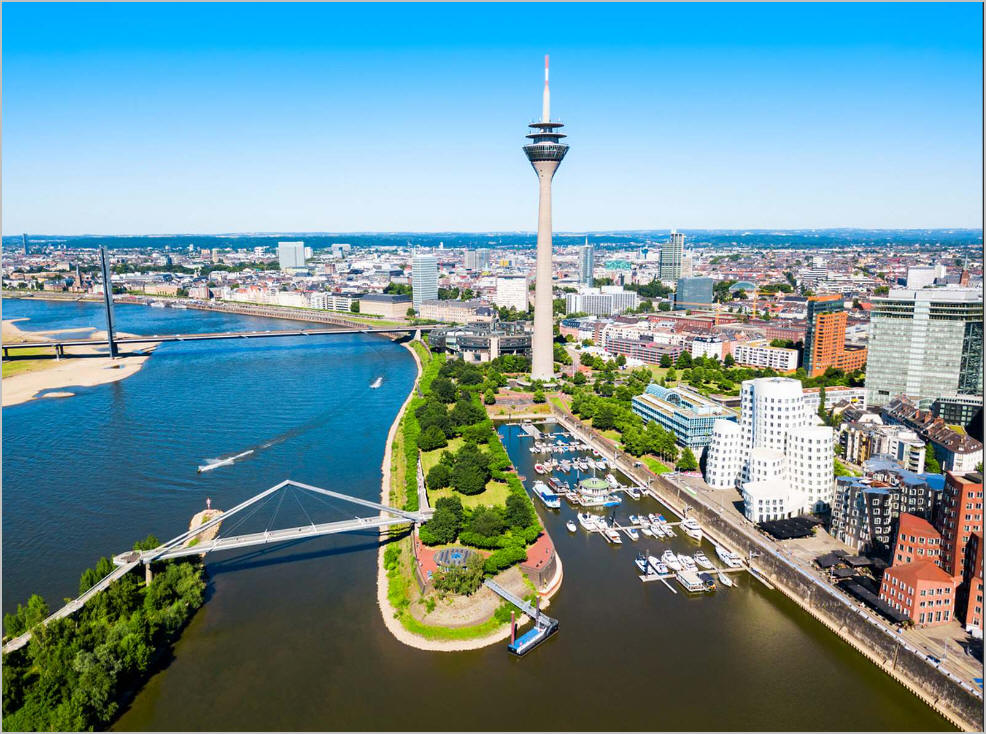 An image from Düsseldorf, Germany
.
.
Click the link below for images:
.
__________________________________________
September 16, 2022
Mohenjo
Business, Food For Thought, Human Interest, Medical, Political, Science, Technical
amazon, business, Business News, current-events, Future, Hotels, human-rights, medicine, mental-health, research, Science, Science News, technology, Technology News, travel, vacation

Click the link below the picture
.
A recent revolutionary assertion has gone viral, claiming that the Big Bang never happened and that the latest data from the James Webb Space Telescope (JWST) has proven it. The notion of the Big Bang has never sat well with many — all the way from its earliest incarnations in the 1920s (via Georges Lemaître) and the 1940s (from George Gamow; apparently you had to be named “George” to realize this) — and has been continuously challenged since its inception. However, the evidence has remained overwhelmingly in its favor ever since the 1960s, and no other serious competitors have ever been able to reproduce its successes. Which leads one to wonder: what are the merits, if any, of this latest claim? Could it be true, and if so, how and why?
That claim has provoked identical questions from many, including James Laing-Smith, Marc Van Lysebetten, David Siegel (no relation), Jeff Humphrey, and Patreon supporter Pedro Teixeira. They all inquire something akin to:
“I read an article by LPPFusion, saying the new [JWST] pictures cast doubt on the Big Bang. It has something to do with redshift and the size and smoothness of galaxies, and it’s all due to plasma and proves their fusion theories.”
Indeed, this is roughly the claim that’s been made. Let’s walk through what the Big Bang actually states, what the new JWST images show, what the author is claiming when they say “The Big Bang never happened,” and what we can scientifically conclude based upon the full suite of evidence.
.
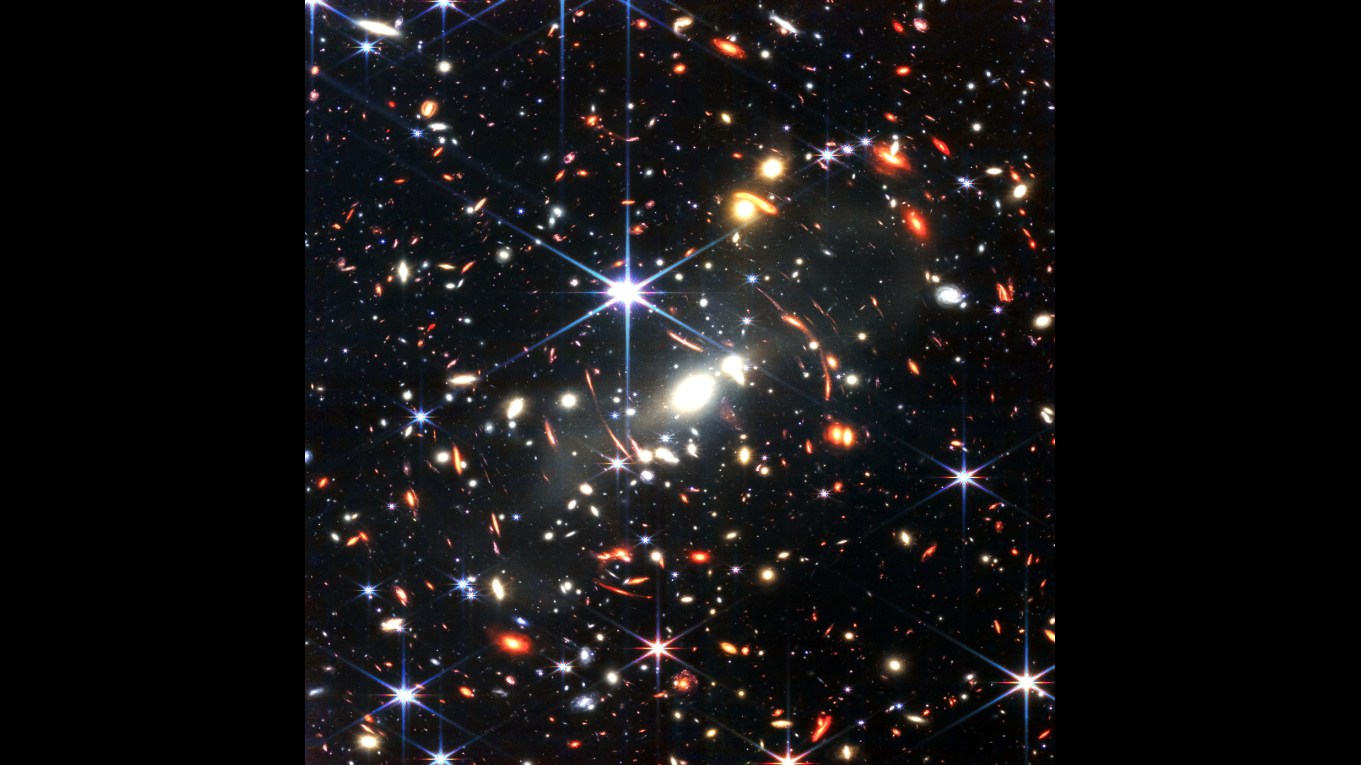 (Credit: NASA, ESA, CSA, and STScI; Processing by E. Siegel) This enhanced view of JWST’s first deep-field image of the cosmos overexposes the brightest galaxies and the cluster’s center in order to better bring out the details present in the fainter, redder, more distant galaxies. This first deep-field view took only half a day to acquire with JWST. With 20+ years of data to come, we can only imagine what will ultimately be revealed
.
.
Click the link below for the article:
.
__________________________________________
Older Entries
Newer Entries
 James' World 2