Lindsey Konchar has known her best friend, Caroline since Caroline was born. Their mothers have been best friends since the seventh grade, so even though Konchar is two years older than Caroline, and the two attended different schools in their hometown of Eden Prairie, Minnesota, there was no escaping each other. “We were quite literally forced to be friends,” Konchar told me. But even after they moved out of their mothers’ homes, the friendship continued.
Konchar stayed in Minnesota for college, while Caroline attended school in Boston and then moved to New York City, where she started dating someone. (Caroline is being identified by a pseudonym to protect her privacy.) At first, the new relationship seemed marvelous, “all butterflies and roses,” Konchar recalled. But over time, Caroline’s updates on the relationship grew less cheerful and more vague. To Konchar, a social worker, something seemed off, and a visit to NYC only solidified her concerns that Caroline’s partner wasn’t treating her well. “She wasn’t her happy-go-lucky self,” Konchar recalled. On the final day of her visit, Konchar decided to express her concerns about the relationship. She chose her words carefully, making sure to cite specific examples, use “I” statements, and clarify that she was speaking up only because she was worried about her friend’s safety. But Konchar could tell that Caroline wasn’t having it. “Her walls went up,” Konchar told me. “We didn’t talk for a long time.”
The dilemma that Konchar faced—whether to say something or bite her tongue—gets at a long-running debate about what it means to be a good friend. Is it appropriate to tell a friend when you think they’re making a bad decision? Or is a friend’s role to offer steadfast and unconditional support, and leave the unsolicited advice to parents, spouses, or siblings? Those parties may feel more entitled or obligated to speak up because their relationships are better defined and more formalized. But it’s difficult to speak about authority or obligation in friendship, which is to some extent defined by what it’s not: Friends are those who choose to be in one another’s lives although they don’t fulfill a specific role. Even between close friends, it can be tricky to pin down exactly what, if anything, two people owe each other.
The world’s tiniest rabbit is roughly the size of a softball—a very, very soft softball. An adult weighs less than a pound.
These little bunnies abound in the scrublands of the American West, but one population, known as the Columbia Basin pygmy rabbit, long ago colonized what is now central Washington, happily munching away at a smallish patch of fragrant sagebrush steppe for thousands of years.
Every last inch of a pygmy rabbit is built for sagebrush. The enzymes in its gut evolved to neutralize the plant’s toxins and maximize digestion, and it tunnels elaborately beneath the sagebrush’s roots. It even forfeited its archetypal cotton tail, and thus blends in with the gray-green bushes.
But in the last century or so, about 80 percent of the wild “sagebrush sea” of the Columbia Basin was converted into farms and ranchland. By the early 2000s, the genetically distinct Columbia Basin pygmy rabbit population had dwindled to just a few animals. Scientists crossbred survivors with pygmy rabbits from Idaho; reared in protected paddocks, the offspring retained at least three-quarters of their unique Columbia Basin pygmy rabbit DNA. Today only a few hundred of the rabbits remain, living in semi-captivity and in the wild.
.
The Columbia Basin pygmy rabbit relies on sagebrush for food and shelter, but the shrub has nearly disappeared. It’s also slow to regrow: it takes about two decades or ten pygmy rabbit lifetimes. Morgan Heim
When I was younger, I would wander around the pre-teen jewelry store Claire’s imagining myself decked out in its wares. I often came across dual necklaces, each with a broken half of a heart with the inscription “best friends.”
I never bought these necklaces out of fear that whomever I considered my best friend at the time would not reciprocate this label, and just the thought of that rejection crushed me into inaction.
Even in adulthood, I hear stories of uneven friendship “levels” and the negative spiral it induces. If your best friend has ever implied that you’re not theirs, it can indeed be crushing. Why might this be, and what should you do about it? Communication and friend experts tell Mashable that everyone has their own individual measures — and that labels aren’t the most important part of friendship, anyway.
.
Realizing your best friend doesn’t think of you the same way can feel like a rejection.Credit: Bob Al-Greene / Mashable
I admit it: Like many liberals, I’m feeling a fair bit of MAGAfreude — taking some pleasure in the self-destruction of the American right.
There has, after all, never been a spectacle like the chaos we’ve seen in the House of Representatives this week. It had been a century since a speaker wasn’t chosen on the first ballot — and the last time that happened, there was an actual substantive dispute: Republican progressives (yes, they existed back then) demanded and eventually received, procedural reforms that they hoped would favor their agenda.
This time, there has been no significant dispute about policy — Kevin McCarthy and his opponents agree on key policy issues like investigating Hunter Biden’s laptop and depriving the Internal Revenue Service of the resources it needs to go after wealthy tax cheats. Long after he tried to appease his opponents by surrendering his dignity, the voting went on.
But while the spectacle has been amazing and, yes, entertaining, neither I nor, I believe, many other liberals are experiencing the kind of glee Republicans would be feeling if the parties’ roles were reversed. For one thing, liberals want the U.S. government to function, which among other things means that we need a duly constituted House of Representatives, even if it’s run by people we don’t like. For another, I don’t think there are many on the U.S. left (such as it is) who define themselves the way so many on the right do: by their resentments.
When you win drop me a million, it will be greatly appreciated!
Another Mega Millions drawing, another night without a big winner.
No one hit all six numbers and won the estimated $940 million jackpot, pushing the lottery prize to an estimated $1.1 billion ahead of the next drawing Tuesday night.
The prize is now the third-largest in U.S. history.
The numbers drawn late Friday were: 3, 20, 46, 59, 63 and gold Mega Ball 13.
There have been 24 drawings without a jackpot winner, stretching back for more than two months. The winless streak is largely due to the game’s long odds of 1 in 302.6 million.
he new estimated prize of $1.1 billion is for a winner who chooses an annuity paid annually over 29 years. Grand prize winners usually take the cash option, which for Tuesday night’s drawing will be an estimated $568.7 million.
“Mega Millions has just reached the $1 billion mark again. It’s especially nice to see the jackpot grow throughout the holidays and into the new year,” Pat McDonald, the Ohio lottery director and lead director of the Mega Millions Consortium, said in a statement early Saturday. “As the jackpot grows, we encourage our players to keep within their entertainment budget and enjoy this jackpot run right along with us.”
The only Mega Millions jackpots larger than the estimated $1.1 billion opportunity on Tuesday have been the $1.53 billion won in South Carolina in 2018 and $1.33 billion winning ticket in Illinois in July, Mega Millions said in the statement.
.
Mega Millions jackpot rises to $1.1 billion after no winner
If you are driving home from work along a road you’ve traveled numerous times before, your mind is likely to wander. You might become absorbed by a great conversation on the radio, or start rehearsing for an important meeting the next day. You steer your car down your usual route in a largely automatic way, without having to pay deliberate attention to the steering wheel, the subtle movements of your feet on the pedals, or the ever-changing traffic conditions around you. Yet if you encounter a sudden cognitive challenge, such as an unexpected road closure, you are quickly able to shift gears, identifying a new route home via a side street that you rarely use.
This kind of shift toward more deliberate thinking happens in a variety of different situations: for instance, when you have to carefully search for the solution to an especially tricky crossword clue, or think of a new way to frame an argument to change a stubborn friend’s mind. How the brain balances between the cognitive modes involved in these scenarios – relatively automatic processing and more deliberate processing – remains poorly understood, which suggests we need new ways of thinking about it.
It’s instructive to start by considering the kinds of features in our brains that might help us handle challenging multitasking situations. Firstly, we need to be able to learn all the ins and outs of a particular challenge – otherwise, how might we anticipate the next step in a complex sequence, like driving along a road occupied by other cars and pedestrians? We also need to be able to process all the information related to the task at hand, without it seeping over into another process we’d like to run in parallel – otherwise, we might allow a crescendo on the stereo to affect whether we swerve our car’s steering wheel into oncoming traffic. In addition, we’d like to be alerted when any process we’re allowing to run on its own goes awry. Deprived of this control, we’d plow right through a red light or fail to notice a pesky detour sign.
.
A 3D CT scan of the gut. Photo by Callista Images/Getty
Film and Writing Festival for Comedy. Showcasing best of comedy short films at the FEEDBACK Film Festival. Plus, showcasing best of comedy novels, short stories, poems, screenplays (TV, short, feature) at the festival performed by professional actors.



/https://tf-cmsv2-smithsonianmag-media.s3.amazonaws.com/filer_public/32/2c/322c5bcc-3128-4006-a954-2e0c66f66fc8/janfeb2023_d01_endangeredpygmyrabbit_copy.jpg)





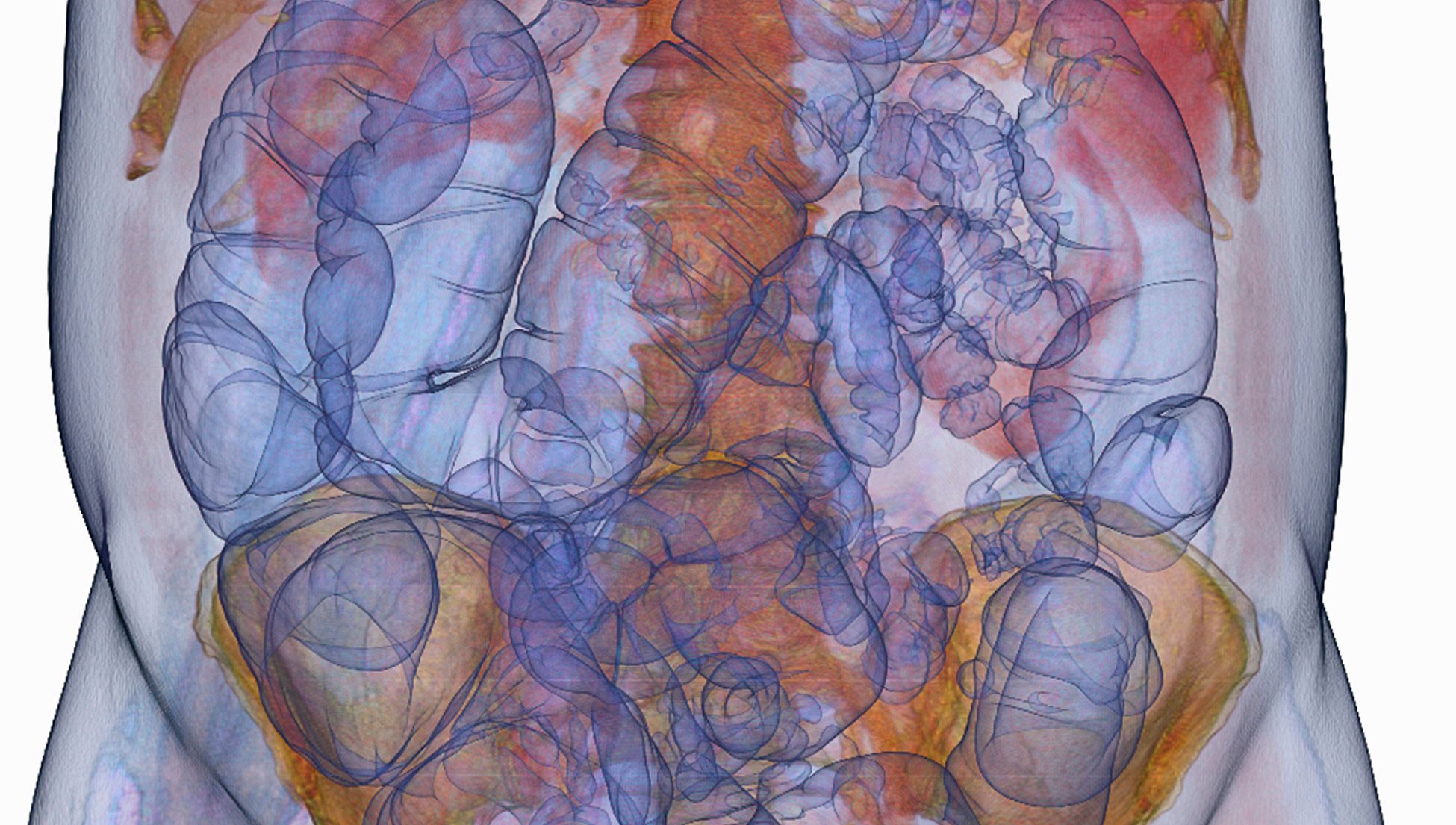 A 3D CT scan of the gut. Photo by Callista Images/Getty
 James' World 2