Say you accidentally cut the tip of your finger off. Especially if this happened to you as a child, there’s a good chance it would regrow—skin, nail, and all. The same is true for other mammals such as monkeys and mice. Unfortunately, however, our regenerative abilities stop there. While some other creatures, most notably salamanders and starfish, can regenerate entire limbs, mammals don’t have this evolutionary superpower.
“The big question is: Why are mammals limited?” says Jessica Whited, an associate professor of stem cell and regenerative biology at Harvard University.
Part of the reason why our cells only have a limited ability to regenerate may have to do with our genes. But according to new research, two key environmental mechanisms may be at play, too.
How rich a tissue is in hyaluronic acid and how well it can sense oxygen may affect its ability to regrow and heal, a pair of new studies published in Science on Thursday suggest. The results could lead to better wound treatments and possibly the ability to one day regrow larger pieces of human tissue—even limbs.
In one study, researchers investigated what might makes the mammalian fingertip special: Why can only the tip of the finger regrow, whereas the rest of it can’t? “Same finger, two entirely different outcomes,” says Byron Mui, lead author of the study and a postdoctoral fellow at the Stanford University School of Medicine.
The researchers found that mice with a partial finger amputation could regrow part of their finger more easily and with less scarring when there were higher levels of hyaluronic acid in the animals’ “extracellular matrix”—the material between cells. Hyaluronic acid may be familiar to some readers: it is a common ingredient in face creams and moisturizers that claim to reduce wrinkles.
The study “elegantly challenges” the idea that scarring is a given in mammals that have lost a limb or digit, according to a related commentary in Science that was co-authored by Whited, who was not involved with either study.
In the other study, researchers compared two species: African clawed frog tadpoles and embryonic mice. Tadpoles can regenerate their limbs; embryonic mice can’t.
The researchers subjected amputated tissues from tadpoles and embryonic mice to various laboratory tests, explains molecular biologist Georgios Tsissios, the study’s lead author. In a low-oxygen environment—similar to that of tadpoles’ usual aquatic habitat—mice tissue healed better than when it was exposed to more oxygen.
“These experiments showed that lowering oxygen in embryonic mouse limbs can make them mimic frog tadpole limbs, enabling them to activate the very early regenerative responses,” Tsissios says.
Tsissios and his colleagues found, however, that tadpole cells appear to be worse at sensing oxygen than embryonic mice cells do—suggesting that tissue regeneration may be influenced by both levels of oxygen and the animals’ ability to sense it.
The results are preliminary: in neither study did the researchers regrow entire mammalian limbs. And any kind of tissue regeneration therapy for humans based on these findings is a long way off, Whited says. But the studies do offer hope for human research because they offer clues to what factors—both in the animals’ biology and their environment—may determine their tissue’s regenerative powers.
“As a field, the way that we piece all of these puzzle pieces together will eventually lead to human limb regeneration,” Whited predicts.
.
Cross section of a regenerating tadpole limb. Georgios Tsissios
Welcome back to the Fluctus Channel, as we explore China’s massive Goupitan shiplift, one of the world’s tallest ship elevators, and the advanced elevator operations onboard US Aircraft Carriers.Fluctus is a website and YouTube channel dedicated to sea geeks. Whenever you are curious or an incorrigible lover of this mysterious world, our videos are made for you ! We publish 3 videos a week on our YouTube channel and many more articles on our website. Feel free to subscribe to not miss any of our updates and visit our website to discover additional content. Don’t forget to follow us on twitter: Please keep the comments section respectful. Any spam, insults, or troll will be deleted. To contact us, make sure to use our email in the about section of this channel.
.
.
.
Click the link belowfor the complete article (17 minutes + video):
Here’s what happened in the war in the Middle East on Thursday.
The aftermath of an airstrike in the Tallet el-Khayat area of Beirut, Lebanon, on Thursday. Credit…Diego Ibarra Sanchez for The New York Times
Hospital staff and soldiers transferring a patient from a parking garage used as a shelter, back to Ichilov Hospital in Tel Aviv on Thursday. Credit…Avishag Shaar-Yashuv for The New York Times
Prime Minister Benjamin Netanyahu of Israel said Thursday that his country would continue striking Hezbollah, the Iran-backed militia in Lebanon, even as he agreed to start talks with the Lebanese government about disarming the paramilitary group. The Lebanese government has no direct control over Hezbollah — just one hurdle of any negotiations.
April 9, 2026, 8:04 p.m. ETApril 9, 2026
Pranav Baskar
International reporter
In a statement on Thursday, the State Department said that a group of U.S. diplomats had been ambushed in Baghdad on Wednesday by Iran-aligned militia groups in Iraq. No casualties were reported. The ambush, the department said, followed “hundreds” of attacks in recent weeks against U.S. citizens and diplomatic facilities — including the weeklong abduction of the American journalist Shelly Kittleson.
The department called on the Iraqi government to take immediate steps to dismantle Iran-aligned militia groups in Iraq, and criticized its “failure” so far to constrain them.
April 9, 2026, 7:49 p.m. ETApril 9, 2026
Farnaz Fassihi
International reporter
Iran’s state media announced that the former foreign minister Kamal Kharazi, who was targeted by Israel in airstrikes on April 1, was dead after more than a week of being in a coma. Mr. Kharazi headed Iran’s Foreign Policy Council, a body that sets foreign policies. He had been supervising discussions with Pakistan for potential talks between Tehran and Washington, according to three Iranian officials.
Credit…Majid Asgaripour/Wana News Agency, via Reuters
April 9, 2026, 4:50 p.m. ETApril 9, 2026
Pranav Baskar
International reporter
The Israeli military said it had detected rockets fired toward northern Israel from Lebanon, according to a military spokesman and Israel’s emergency rescue service. Hezbollah, the Iran-backed Lebanese armed group, said it had fired a rocket salvo toward northern Israel, in a statements published through its media arm. The Israeli military spokesman said one rocket was intercepted and another fell in open space, and declined to say whether other rockets were fired.
April 9, 2026, 4:22 p.m. ETApril 9, 2026
Emmett Lindner
Markets cautiously rebounded on Thursday after some progress in negotiations between Israel and Lebanon in the afternoon, but oil prices rose in late trading as reports of fresh strikes came out of the Middle East. Brent crude, the international benchmark, settled at $95.92 a barrel, less than its high of the day but still up more than 1 percent on Thursday.
April 9, 2026, 4:19 p.m. ETApril 9, 2026
Michael Crowley
State Department reporter
The State Department will host a meeting next week with representatives of Israel and Lebanon to discuss cease-fire negotiations. Prime Minister Benjamin Netanyahu of Israel said Thursday that his country would begin diplomacy with Lebanon to discuss the disarmament of Iran-backed Hezbollah fighters in Lebanon following pressure from President Trump to resolve a matter that has threatened his cease-fire deal with Iran.
April 9, 2026, 4:10 p.m. ETApril 9, 2026
Dayana Iwaza
A senior Hezbollah official dismissed the possibility of talks between Israel and the Lebanese government, hours after Prime Minister Benjamin Netanyahu of Israel said his government would hold them to discuss disarming the group. Hezbollah is not concerned with any decisions the government may take regarding negotiations, said the official, who spoke on condition of anonymity to discuss internal matters. The official said Hezbollah could not take a position on the talks before knowing the government’s stance, but added that the atmosphere between the Iran-backed militant group and the government was negative.
The official also said that Hezbollah would continue to fight to defend Lebanon, and echoed statements by Iran that Lebanon was supposed to be included in the cease-fire.
April 9, 2026, 3:57 p.m. ETApril 9, 2026
Pranav Baskar
International reporter
For the first time since the cease-fire was struck, two non-Iranian oil tankers were tracked to cross to Strait of Hormuz by Kpler, a global ship-tracking firm. Those ships carried Palau and Gabon flags, according to public vessel data. A total of eight bulk carriers, which carry dry cargo, have also crossed the vital waterway since the two-week truce was made, but overall, marine traffic in the strait remained at a trickle.
Adding to the confusion about the waterway’s status, Kpler later said it found that the two non-Iranian tankers that passed through the Strait of Hormuz today have been linked to sanctioned entities tied to Iran.
April 9, 2026, 3:25 p.m. ETApril 9, 2026
Pranav Baskar
International reporter
The Israeli military said it was launching fresh strikes against Hezbollah sites in Lebanon.
April 9, 2026, 3:17 p.m. ETApril 9, 2026
Pranav Baskar
International reporter
In a statement on social media, Kuwait’s army said it was fending off hostile attacks from drones which penetrated the country’s airspace, targeting a number of vital facilities. The army did not specify the source of the drones. It came after a day of relative calm among the Gulf States, where Iran fired hundreds of missiles in the peak of the conflict.
April 9, 2026, 3:15 p.m. ETApril 9, 2026
Vivian Nereim
Reporting from Riyadh, Saudi Arabia
A recent attack on a pumping station that is part of Saudi Arabia’s east-west oil pipeline caused damage that will reduce the throughput capacity of the pipeline by 700,000 barrels per day, Saudi Arabia’s state news agency reported, citing an “official source” at the energy ministry. The pipeline has become a key export route for the kingdom, the world’s largest oil exporter, after traffic through the Strait of Hormuz was nearly choked off. The news agency did not say where the attack had originated or when it had occurred.
Recent attacks in Saudi Arabia have also damaged oil production facilities in Manifa and Khurais, reducing the kingdom’s oil production capacity by 600,000 barrels per day, the agency added. One Saudi national has been killed and seven other people injured in the recent attacks, it said.
The war in Iran has dealt a new blow to the world economy, which the head of the International Monetary Fund said on Thursday will mean slower growth this year because of the destruction of energy infrastructure and supply chain disruptions.
The fragile two-week truce that the United States and Iran agreed to this week could temper the economic damage from the war. But Kristalina Georgieva, the I.M.F.’s managing director, warned that even in the most optimistic scenario there would be significant fallout for the global economy.
April 9, 2026, 12:29 p.m. ETApril 9, 2026
Aaron Boxerman
Reporting from Jerusalem
The talks between Israel and Lebanon that the Israeli prime minister just announced will face enormous roadblocks. Israeli officials have so far given no indication that negotiations would lead them to stop their attacks in Lebanon, where they have signaled plans for a longer occupation of the country’s south. It is far from clear how much buy-in the talks have from Hezbollah, which has long overshadowed the official Lebanese government. And while Lebanese leaders have voiced interest in disarming Hezbollah, Israel has expressed intense skepticism that they would be able to do so.
April 9, 2026, 11:52 a.m. ETApril 9, 2026
Aaron Boxerman
Reporting from Jerusalem
Benjamin Netanyahu, the Israeli prime minister, said he had ordered the Israeli government to start direct negotiations with Lebanon to disarm Hezbollah, the Iranian-backed Lebanese armed group. In a statement, Netanyahu’s office said the talks — which would take place “as soon as possible” — would also focus on “arranging peaceful ties between Israel and Lebanon.”
Joseph Aoun, Lebanon’s president, has repeatedly called for direct talks with Israel to end the ongoing Israeli invasion in Lebanon against Hezbollah, which escalated amid the monthlong war with Iran. Until now, Aoun’s entreaties had largely been dismissed by Israeli officials. Israel and Lebanon do not have formal relations and official meetings between the sides have been rare in recent decades.
April 9, 2026, 11:48 a.m. ETApril 9, 2026
Anton Troianovski
Foreign policy reporter
Rutte said that NATO countries are “looking for what they can do to contribute” to keeping the Strait of Hormuz open, with assets like warships, minesweepers and radar technology. Rutte is arguing that Europe needs some time to pull together, especially because “there was not a lot of prior consultation” when Trump started the war on Iran on Feb. 28. But major European countries have remained steadfast in describing a mission to secure the Strait of Hormuz as only being possible when the shooting in the region stops, and there is no sign they are changing that position.
Rutte also argued that the U.S. military presence in Europe helpd protect the United States and enabled its global influence. Indeed, despite European unhappiness with the war, American bases in Britain, Germany and elsewhere have been key to the U.S. war effort against Iran.
April 9, 2026, 11:39 a.m. ETApril 9, 2026
Megan Mineiro
Congressional reporter
House Democrats just tried to force passage of legislation that would compel President Trump to ask Congress to authorize the war in Iran to continue the conflict, but the Republican majority blocked the attempt. A handful of Democratic members who came to the Capitol amid the congressional recess to try to force the vote on the war powers resolution yelled “shame” and “end the war” before the brief session ended. The House defeated a similar resolution to end the war last month.
April 9, 2026, 11:38 a.m. ETApril 9, 2026
Anton Troianovski
Foreign policy reporter
The NATO secretary general, Mark Rutte, said he sensed Trump’s “disappointment” in the alliance in his meeting with the president at the White House on Wednesday. Rutte, speaking at an event in Washington, said he told Trump that “we have coalitions in Europe” and “the political home front to take care of.” He added: “But then we pull together, and almost all of Europe did, for the U.S. to project power on the world stage.”
April 9, 2026, 11:13 a.m. ETApril 9, 2026
Isabel Kershner
Reporting from Jerusalem
The war with Iran is unfinished business for Israel’s prime minister.
Image
At an underground bomb shelter being used as a hospital in Haifa, Israel, on Thursday, a television showed Prime Minister Benjamin Netanyahu addressing the nation. Credit…Marco Longari/Agence France-Presse — Getty Images
When Prime Minister Benjamin Netanyahu finally spoke to the Israeli public on Wednesday night, some 18 hours after a two-week cease-fire with Iran had come into force, his televised address was less about victory than unfinished business.
The “double existential threat” of Iran’s ballistic missiles and its nuclear program has been “distanced,” he said, but not eliminated.
Khatibzadeh also told the broadcaster that “we hope that we can meet soon in Pakistan” for scheduled talks with an American delegation. But he insisted that Lebanon was part of the cease-fire deal and criticized Israeli strikes there, saying that Iran hoped the United States could “control its ally” and “honor their words.”
April 9, 2026, 7:14 a.m. ETApril 9, 2026
Josh Holder
Though the cease-fire was announced late on Tuesday Eastern time, Wednesday saw the lowest ship traffic through the Strait of Hormuz since late March, according to data from Kpler, a global ship-tracking firm. Just five bulk carriers transited the strait, with no oil or gas tankers making the crossing, the firm said. Before the war, more than 130 ships typically crossed the strait each day.
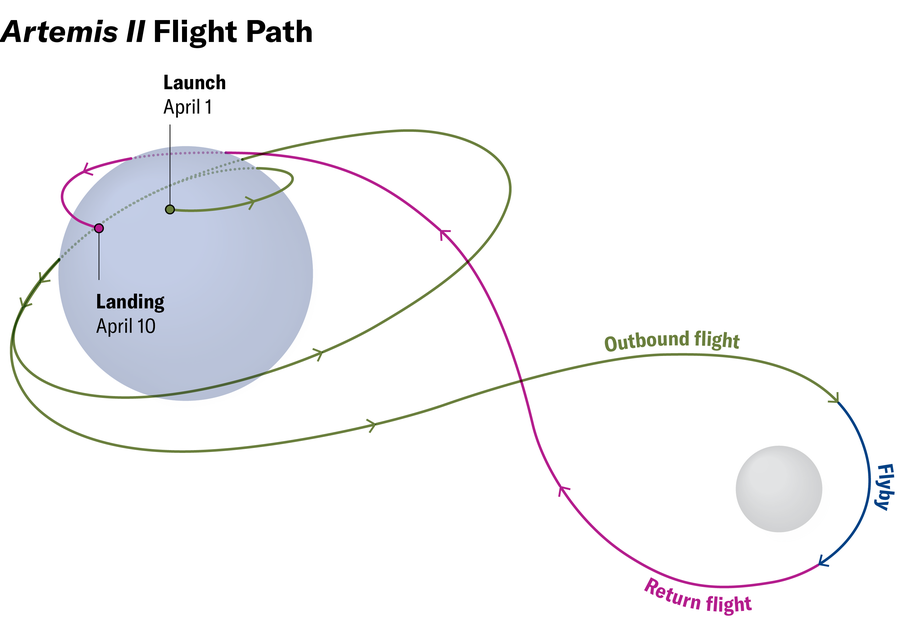
NASA’s Artemis II moon mission began the return leg of its historic voyage on Monday night, completing the first half of an elegant figure eight “free return” trajectory from the Earth to the moon and back again.
“We will continue our journey even further into space before Mother Earth succeeds in pulling us back,” said astronaut Jeremy Hansen, one of Artemis II’s missions specialists, as the team broke a distance record from Earth for space travel on Monday. “We most importantly choose this moment to challenge this generation and the next to make sure this record is not long-lived.” In marking the record, the Artemis II astronauts proposed that one crater be named Integrity, after their Orion spacecraft, and that another be named Carroll, for mission commander Reid Wiseman’s late wife, Carroll Taylor Wiseman, who died in 2020.
The spacecraft has performed as expected, despite some minor computer glitches and toilet trouble, according to NASA.
Launched on April 1, Artemis II is now in the seventh day of its mission to demonstrate a successful crewed trip around the moon—the first in more than a half-century. Around 7:02 P.M. EDT on Monday, the Orion capsule and its crew of four astronauts set a distance record for human spaceflight, reaching 252,756 miles from Earth as it arced around the moon before falling back home.
That’s right: falling. Artemis II’s homecoming is already baked into the voyage, courtesy of the moon’s gravity bending the Orion spacecraft’s trajectory to wing the capsule home without much, if any, help from Orion’s rocket engines. That’s the “free” part of the free return trajectory, says Samantha Kenyon, an assistant professor of aerospace engineering at Virginia Tech.
The choice, Kenyon says, was to either fire Orion’s engines as the spacecraft swooped over the far side of the moon and out of radio contact with Earth—or to fire them much earlier in the mission and closer to Earth. Choosing the latter course “means less risk for the astronauts in the capsule” if something were wrong with the rockets, she says. The free return trajectory also set up the spaceflight distance record that the crew set yesterday.
Last Thursday, the Orion capsule—officially named Integrity—fired its rockets for nearly six minutes in a “translunar injection burn” that consumed roughly 1,000 pounds of fuel, just enough to loosen Earth’s gravitational grip and set a course for looping around the lunar far side and free return. The maneuver went so well that the space agency skipped two out of three smaller corrective burns built into the mission’s schedule.
Aerospace engineers can plot such trajectories by thinking of the respective pulls of Earth and the moon as gravity “wells,” Kenyon says. Imagine these gravity wells as topographic maps of sorts, where Earth and the moon are two gravitational holes rotating around each other, surrounded by curving hills. The free return trajectory is essentially a marble trick of sending Integrity scooting along the curves mapped around the moon’s moving gravity well on a path that gets captured again by Earth’s gravity well. “Once you get to a certain height on that hill’s topographic map and get on that path, you stay on for free,” she says. “All the spacecraft is doing is just following the path that’s associated with the energy that it’s been given.”
Amanda Montañez; Source: NASA (reference)
Pioneered in 1959 by the Soviet Union’s robotic Luna 3 mission, the first to photograph the far side of the moon, the distinctive figure eight shape of the free return trajectory has been well established early as an option for lunar missions. But the most famous use of the trajectory was for NASA’s Apollo 13 mission in 1970, which, after a near-fatal mishap on its journey to the moon for a planned lunar landing, aborted to a free return to ensure its three astronauts could get back to Earth.
Technically, the trajectory is referred to as a solution of the “three body” problem in orbital mechanics, where the bodies are Earth, the moon, and a spacecraft, says Jay Warren McMahon, an associate professor of aerospace engineering at the University of Colorado, Boulder. (The sun’s gravity also perturbs the trajectory slightly, so it must be accounted for in calculations as well.) Solving the problem typically requires plotting the motion of a spacecraft from Earth’s gravitational “sphere of influence,” where our planet’s pull predominates, to the moon’s domain. For Artemis II, this handover happened at 12:41 A.M. EDT on Monday. “We kind of fly in front of the moon, and it catches up with us and then pulls us back and swings us around,” McMahon says. “So effectively we return faster and on an honestly different path than we would have if the moon hadn’t been there.”
Similar calculations power so-called gravitational slingshot maneuvers used by interplanetary probes such as NASA’s Voyager II to optimize transit times throughout the solar system. They all rely on the transfer of momentum via a gravitational tug from the larger body, whether moon or planet, upon a tiny spacecraft to alter the vehicle’s trajectory in a desired direction. In what is essentially a gravitational tug-of-war in space, a spacecraft passing in front of a moon or planet loses some of its angular momentum to the bigger object, changing its trajectory much like the moon-bound Artemis II. The opposite happens when the spacecraft passes behind the bigger object to gain some angular momentum. Either way alters the spacecraft’s path.
For Artemis II, that bit of physics will send its crew home, setting Integrity on a course to return to Earth on April 10 in an elegant demonstration of orbital mechanics.
.
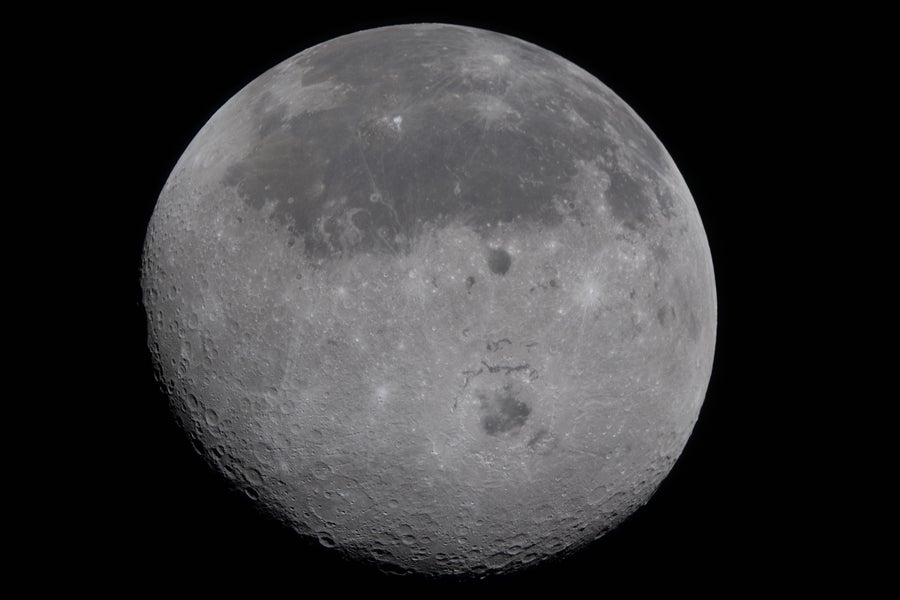
The far side of the moon emerging into the view of Artemis II on April 6, 2026. NASA
Click the link at the bottom of the page for 118 photos!
Every year, the Met Gala is where celebrities ascend to style icon status.
On the first Monday in May, celebrities don’t just walk the red carpet: They climb the steps of the Metropolitan Museum in custom gowns and statement couture, presenting their interpretation of the exhibition’s theme to the entire world. Unlike an awards show or a premiere, the goal isn’t to shine for a moment—it’s to create a look that resonates for decades. Despite the wealth of designer gowns and bespoke suits, few accomplish that feat, but those who do earn themselves a place in fashion history.
The greatest hits—Rihanna’s papal chic, Kate Moss’s golden turban, Sarah Jessica Parker’s tartan Alexander McQueen, Erykah Badu’s glittering top hat, Madonna in a hippie caftan—rank among the best outfits ever to be worn. And their charms wouldn’t have been as compelling on another night. After all, the gala encourages the kind of innovation rarely seen elsewhere.
The Costume Institute’s trove of landmark runway creations serves as an inspiration for guests, allowing them to take on fashion at its most avant-garde. Where else will you see Cardi B. and a small army of assistants move a mountainous red Thom Browne train across a pink carpet? Or watch awestruck as Lady Gaga and Brandon Maxwell take their magenta nesting doll ballgown to the streets, much to the delight of New Yorkers. A standout Met look can be performative (Amber Valletta going full baroque in 2004), subversive (Daphne Guinness in a plume of McQueen feathers in 2011), witty (Karolina Kurkova’s playful Viktor and Rolf in 2015, or referential (the Olsen twins and their yearly vintage surprise)—it just can’t be boring.
With this year’s exhibition theme, Costume Art, and a “Fashion is art” red-carpet dress code, what looks can we expect to see? Those fashions will be kept under wraps until the first Monday in May, but considering the co-chairs are Beyoncé, Nicole Kidman, and Venus Williams, you can rest assured they’ll be worth the wait.
In honor of the 2026 Met Gala, see 118 of the most memorable, daring, and over-the-top Met outfits of all time below.
Even as the status of the Strait of Hormuz remained unclear and U.S. and Iranian officials issued dueling threats to resume attacks if the cease-fire fell apart, both countries had reason to hope it held together.
Here’s the latest.
The day-old cease-fire between the United States and Iran was being tested on Wednesday by uncertainty over the status of the economically vital Strait of Hormuz and disagreement over whether the truce applied to Lebanon, where Israel continued to carry out punishing attacks.
Iran, which said Lebanon was included in the cease-fire, accused the United States of not upholding its end of the deal. And Iran’s foreign minister, Abbas Araghchi, said Washington had to choose between a cease-fire or continued war via Israel, and “cannot have both.” Pakistan, which mediated the truce, said the deal covered Lebanon, a claim disputed by the White House press secretary, Karoline Leavitt.
Disagreement over Lebanon’s inclusion in the cease-fire threatens to unravel it.
Less than twenty-four hours after Iran and the United States agreed to a cease-fire, a disagreement surfaced over whether or not the terms applied to Lebanon, where Israel is bombarding Hezbollah.
Iran said the deal included Lebanon. The U.S. said it did not.
Attacks reported after cease-fire took effect
Attacks continued in the Middle East on Wednesday after a U.S.-Israeli cease-fire with Iran. Israel said that Lebanon was excluded from the truce.
.
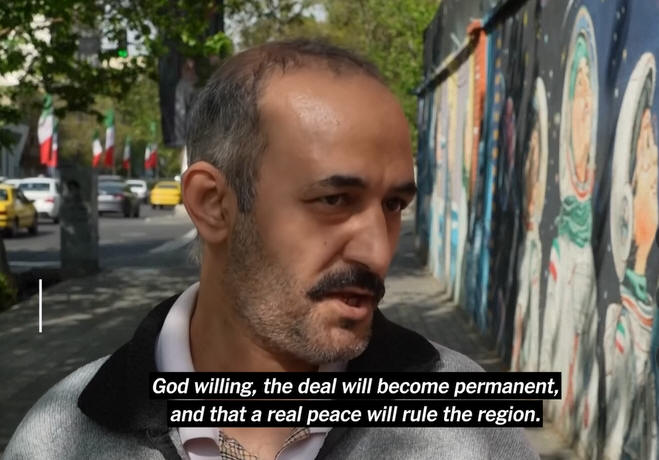
As the cease-fire deal among the U.S., Israel and Iran took hold, residents of Tehran expressed mixed reactions. CreditCredit…Arash Khamooshi for The New York Times
Right now, all eyes are on Artemis II, NASA’s historic mission that just sent astronauts around the moon for the first time in more than a half-century. But, as detailed by NASA administrator Jared Isaacman at the space agency’s recent “Ignition” event in Washington, D.C., Artemis II is only the beginning of a larger U.S. effort to populate the moon with astronauts and resource-prospecting robots. If this quest advances at the breakneck pace Isaacman desires, then Earth’s celestial sidekick will also become a place of profound scientific revelations.
Despite the moon being so nearby, we know surprisingly little about it with much certainty. The Apollo astronauts hauled back a bevy of moon rocks and left behind a few short-lived geological experiments, but most of our lunar knowledge today comes from moon-orbiting satellites, telescopic observations from Earth, and the handful of sample-return missions undertaken recently by China.
Starved of more in situ data, researchers can’t yet scratch a bigger scientific itch; they wish to study the moon as a Rosetta Stone for the origin and evolution of our world and the solar system at large. Now, thanks to the proposed high cadence of lunar missions—crewed and robotic, by space agencies and private industry alike—it looks like their wish will be granted. Earth’s tectonics, volcanism, oceans, atmosphere, and life have all erased the geological records of the planet’s earliest eras. But the moon, lacking such tumult, has preserved them. That makes Earth’s silvery orb “a perfect geological laboratory,” says Sara Russell, a planetary scientist at London’s Natural History Museum.
With that in mind, here are the biggest mysteries moon-focused scientists are now hoping to solve.
How is the moon still alive, geologically speaking?
The churning heat deep within planets and moons is what gives them geological “life,” from volcanic eruptions and earthquakes to uplifting mountains and excavating ocean basins. But when the heat wanes, a world dies, geologically speaking.
Scientists know of three main ways to keep the metaphorical fires burning: the “primordial” heat left over from impactors slamming together during the world’s collisional formation, the heat from decaying radioactive elements and the frictional heat from tidal forces that can knead a world’s innards like dough.
The moon is much smaller than Earth, so its primordial heat should have leaked into space long ago. Lunar samples and theoretical models suggest it lacks a hidden abundance of radioactive elements. And careful calculations show that Earth’s gravitational pull shouldn’t be causing significant lunar tidal heating. Yet shallow “moonquakes” still shake the moon, while age estimates based on crater counts of its pockmarked surface hint that some volcanism may be 100 million years old—which, on geological timescales, is yesterday.
Scientists, naturally, have questions. “Is the moon still volcanically active?” asks Thomas Watters, a senior scientist in the Center for Earth and Planetary Studies of the Smithsonian Institution’s National Air and Space Museum in Washington, D.C. To find out just how much geological “life” still lingers there—and why—“we need to get a better look at the moon’s internal structure,” Watters says.
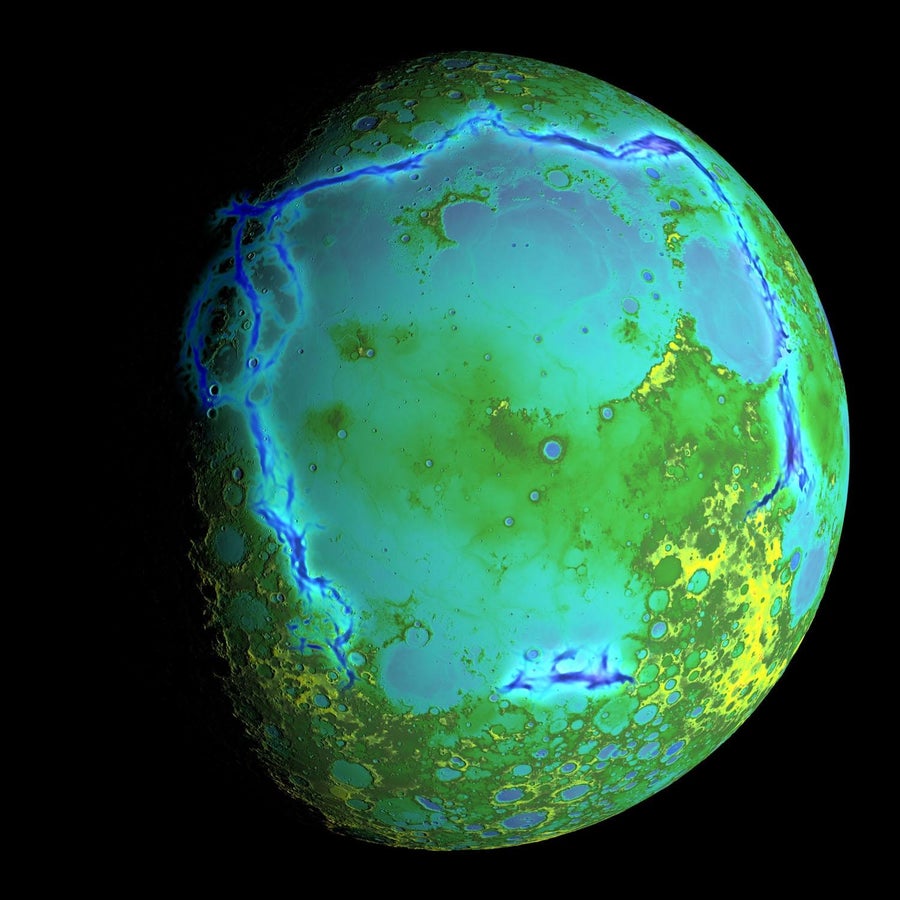
This eerie false-color topographic lunar view is centered on Oceanus Procellarum, the largest expanse of frozen lava on the moon. Based on data from NASA’s Lunar Reconnaissance Orbiter as well as the space agency’s Gravity Recovery and Interior Laboratory (GRAIL) mission, the blue border structures are thought to be ancient, lava-flooded rift zones buried beneath Oceanus Procellarum’s volcanic plains. NASA/Colorado School of Mines/MIT/GSFC/Scientific Visualization Studio
To delve to the (geological) heart of the matter, scientists want to know the moon’s deepest secret—what’s happening at its most abyssal depths. “Does the moon have a solid core or a liquid core?” says Yuqi Qian, a lunar geologist at the University of Hong Kong. “We still don’t know.”
Seismometers offer silver bullets, allowing scientists to use moonquakes (whether homegrown or imported via lunar impacts of errant meteoroids) to effectively perform a CT scan of the deep subsurface. But coverage is currently nonexistent; what we know about the lunar underworld was provided by Apollo-era seismometers that operated until 1977. And these were all placed in just one patch of the moon’s nearside. “We don’t have any seismometers deployed on the farside,” Qian says.
That’s about to change. If current projections are to be believed, the next time anyone lands astronauts on the moon will be the Artemis IV mission, set for 2028. When those crew members reach their landing site near the moon’s south pole, they’ll tote along a cutting-edge seismometer package called the Lunar Environment Monitoring Station, or LEMS. Eventually, as part of NASA’s Commercial Lunar Payload Services, or CLPS, initiative, a network of sensors known as the Farside Seismic Suite will be robotically deployed in the eponymous region. Recent news suggests China may make its first crewed landing somewhere on the moon’s nearside, and those astronauts will likely bring seismometers as well.
In other words, the “Artemis astronauts will be laying down some of the first nodes of a global seismic network,” says Nicholas Schmerr, a seismologist and planetary scientist at the University of Maryland.
Samples, too, will be vital. Rocks nabbed by China’s robotic lunar sample return missions, Chang’e 5 and 6, indicate active volcanism there up until at least two billion years ago. Widening our view to the moon’s more recent epochs requires nabbing more youthful material from the surface. For now, Qian says, “we don’t have samples younger than that.”
Scientists also hope future landings will locate and sample expunged sections of the moon’s mantle—the primeval, less altered underbelly of the lunar crust. If mantle rocks prove to be riddled with byproducts of radioactive decay, this would probably mean the moon’s interior is richer in heat-generating radioisotopes than scientists had thought—thus explaining why it’s still convulsing long past its presumed geological expiry date.
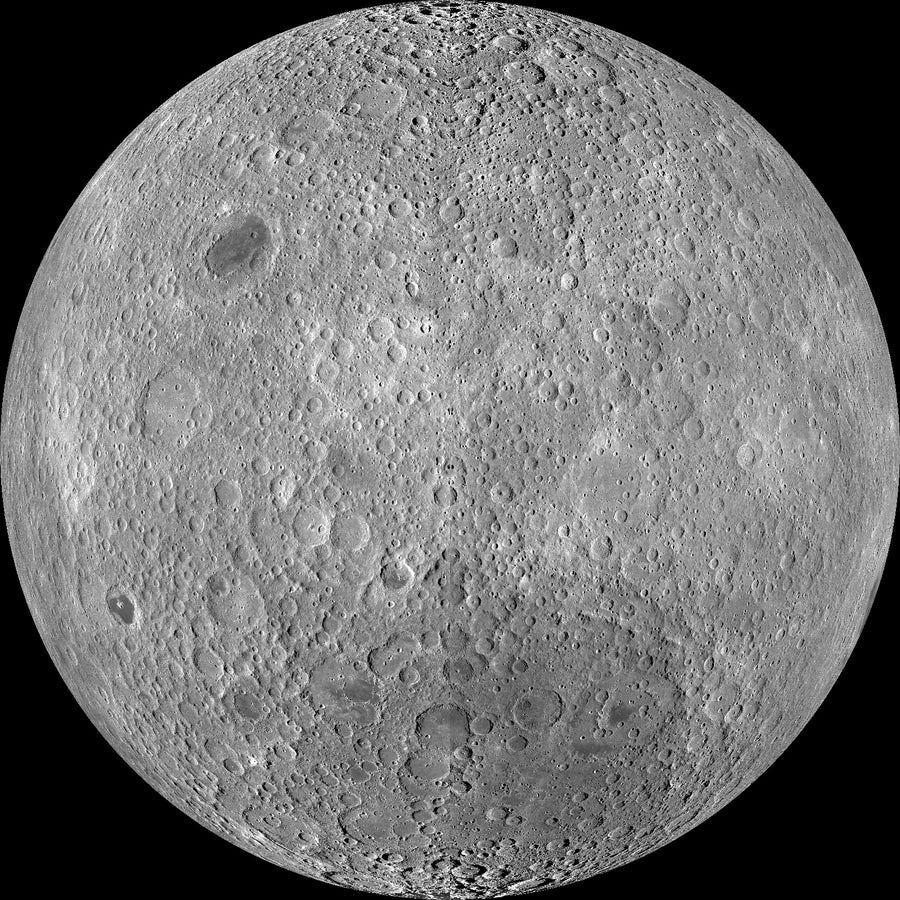
A view of the moon’s crater-pocked far side, based on observations from NASA’s Lunar Reconnaissance Orbiter. NASA/Goddard/Arizona State University
How did the moon form?
The most popular origin story involves Theia—a Mars-sized protoplanet—smashing into the primordial proto-Earth, with the debris from both bodies quickly coalescing into the moon. This isn’t just a fable: it’s backed up by robust computer simulations grounded with plenty of geochemical evidence. Samples of the moon’s mantle, though, could further test this theory—while geophysical observations could address the moon’s weirdest feature.
The nearside is covered in vast, dark splotches of cooled volcanic rock named mare (Latin for “sea”). The farside has a dearth of these and instead looks more like Mercury: a crater-filled land of jagged mountain ridges. Why is the moon so two-faced?
One possible explanation comes from an idea dubbed “Earthshine.” Eons ago, when the moon formed, it orbited Earth 15 times closer. At some stage, the moon became tidally locked, meaning one hemisphere (the nearside) always faced Earth. And because our planet back then was a seething ball of magma, the lunar nearside should have been baked like crème brûlée, with the nearside turning molten and bubbly. Streams of vaporized rock whooshed around the moon, cooling and raining out on the farside to create its thick, lumpy crust.
Here, too, seismology offers another silver bullet. A network of seismometers, especially on the farside, could reveal crucial otherwise-hidden clues. “What is the structure of the moon?” Russell asks. “This is important to find out, as it will help us understand how the moon first formed from the debris of a giant impact and how it then evolved.”
Where did the moon’s water come from?
NASA really wants to plonk its astronauts down near the lunar south pole (and even build a moon base there) because that’s where permanently shadowed craters harbor some vague amount of water ice—a potential resource for hydrating humans, growing crops and making rocket fuel.
Data from NASA’s Lunar Reconnaissance Orbiter reveals the possible presence of water-ice deposits (blue) at the dark floors of craters around the moon’s south pole. NASA/GSFC
It’s no coincidence, then, that lunar prospecting was a hot topic at NASA’s Ignition event. Astronauts could, in principle, descend into the treacherously dark and cold craters to look for themselves, but most of this water divining will be conducting by robots.
NASA’s Volatiles Investigating Polar Exploration Rover, or VIPER, will use its instruments to sniff out subsurface water, then use a drill to confirm its suspicions. And NASA’s next-generation moon buggy—or Lunar Terrain Vehicle—will do something similar, whether it’s being piloted by astronauts or (as will likely be the case for most of its lunar tenure) autonomously navigating the surface. And brought along for the ride on an upcoming crewed surface mission will be the Lunar Dielectric Analyzer, an instrument that can detect electrical currents in the ground below, which can reveal the presence of ice. “This will really help us understand where water is on the moon and in what form,” Russell says.
This endeavor isn’t just about being pragmatic. Scientists still don’t really know where Earth’s water came from. Ice-rich comets or drier asteroids are the two prime suspects. Geochemical studies of various meteorites and Earth’s oceans hint at asteroids as the more likely culprit, but the case is far from closed. Consulting the moon’s relatively pristine terrain —much of which has been frozen in time for billions of years—could help finally solve this mystery. “If there’s any water ice on the moon, its signal might be more primitive,” Qian says. And because Earth and the moon have a very similar ancient history, then “the origin of water on the moon is likely the same as the origin of water on the Earth,” Russell says. All scientists need to do now, then, is find it.
.
A visualization of the moon’s Orientale basin, a region closely studied by the Artemis II crew during their lunar flyby. Gravitational data from NASA’s Gravity Recovery and Interior Laboratory (GRAIL) mission are depicted in false colors on this image’s right side, and chart the basin’s subsurface structure. NASA’s Scientific Visualization Studio
The Stanislaus County Sheriff’s Office in California is assisting with a shooting involving agents from U.S. Immigration and Customs Enforcement. The incident occurred near Sperry Avenue and Interstate 5, between San Jose and Modesto.
Authorities said no local law enforcement officers were involved in the incident. The “suspect” was taken to a local hospital for further medical attention, the sheriff’s office said.
There will be road closures and a large law enforcement presence for an undetermined period, causing significant traffic delays, the sheriff’s office said.
Person shot by ICE in critical condition, county officials say, adding FBI will lead investigation
A sheriff’s sergeant said the person shot by ICE officers has been taken to a local hospital and is in critical condition.
Sgt. Veronica Esquivez, speaking with reporters in Spanish, said the shooting victim was the only one who was hurt in the incident.
Asked for a message to the broader community, Esquivez said that it was a unique event and that the community should not be scared.
ICE spokesperson Todd Lyons had identified the man as Carlos Ivan Mendoza Hernandez, an alleged gang member from El Salvador, and has said the shooting took place after a “targeted vehicle stop.”
Esquivez said that the Stanislaus Sheriff’s Department does not work with ICE but that it responded to the shooting after it initially got a call about shots fired and helped secure the scene.
The FBI has assumed primary responsibility for the investigation and asked the public to share information or videos of what happened online.
ICE has been under the microscope after months of tensions
For the last year, the Immigration and Customs Enforcement agency has been under intense public scrutiny as the Trump administration has ramped up immigration enforcement.
There were at least 14 shootings involving ICE between September and March, which included shootings of suspected criminals, immigrants who lack permanent legal status, and U.S. citizens. It is not clear how many of the shootings federal authorities have fully investigate,d as there have been no public reports of any findings.
In addition to the use of force, some have criticized the administration for going after undocumented immigrants without criminal histories and those in the process of obtaining citizenship through the legal system. Critics have also taken issue with the detention of young children.
President Donald Trump has repeatedly defended his immigration policies, which was a cornerstone of his re-election campaign.
Tensions came to a head in January, when federal officers flooded into Minneapolis and its surrounding area as part of an immigration crackdown. They were met with widespread protest.
Two U.S. citizens were fatally shot — Renee Good and Alex Pretti.
Their deaths ignited a national outrage. The Trump administration withdrew most of its immigration enforcement from Minnesota. Former Homeland Secretary Kristi Noem was fired weeks later and replaced by Sen. Markwayne Mullin, R-Okla.
Democrats are insisting on reforms on how ICE and Customs and Border Patrol operate in return for funding the Department of Homeland Security, which has been in a shutdown since Feb. 14. Republicans have yet to come to an agreement with their counterparts on the matter.
Video from bystander shows ICE shooting at vehicle
+2
Caroline Radnofsky, Marin Scott, and Video from a bystander shows the moment ICE officers opened fire on a vehicle in Patterson, California.
The video shows a hatchback vehicle on the side of the road with at least three law enforcement officers surrounding it. The hatchback is between two larger vehicles in an area that matches where the Stanislaus County Sheriff’s Office said the shooting occurred.
NBC News has reached out to the Department of Homeland Security for comment on the video.
At least one of the officers is in front of the driver-side window and seems to lean forward before the hatchback reverses into a truck behind it. The passenger-side door is open and seems to be heavily damaged in the crash.
Seconds later, the video shows the hatchback moving forward and turning toward the road as officers appear to pull weapons and point them at the vehicle. There is no audio in the clip seen by NBC News.
The hatchback accelerates across the road’s median, hitting the road hard enough that two hubcaps come off the wheel, before the clip ends.
FBI confirms it is investigating ICE shooting
Insiya Gandhi
The FBI’s field office in Sacramento is responding to the shooting in Patterson, California, it confirmed in a statement that noted the investigation is “in its early stages.”
“We are conducting a thorough investigation in partnership with the Stanislaus County Sheriff’s Office and are grateful for the Patterson community’s continued patience and support,” the FBI said.
ICE officers were seeking a gang member before shooting, DHS says
Doha Madani
ICE officers were attempting to arrest a man who is allegedly a gang member wanted in El Salvador prior to the shooting this morning in Patterson, according to a statement from Todd Lyons, acting director of the agency.
ICE identified the man as Carlos Ivan Mendoza Hernandez, saying he is a member of the 18th Street Gang. Hernandez is wanted in El Salvador for questioning in connection with a murder, and ICE officers attempted to arrest him in a “targeted vehicle stop,” Lyons said.
“As officers approached the car, the wanted gang member weaponized his vehicle in an attempt to run an officer over,” Lyons said in the statement. “Following their training, our officers fired defensive shots to protect themselves, their fellow agents, and the public.”
The FBI is at the scene of the shooting, the statement added.
No details yet on suspect’s condition, sheriff’s office says
Doha Madani and Insiya Gandhi
There is no information yet on the status of the individual who was shot, according to a spokesperson for the Stanislaus County Sheriff’s Office.
The person, identified only as a “suspect” by the sheriff’s office, was transported to a local hospital. The spokesperson added that the sheriff’s office does not provide information on which hospital individuals are taken to for medical care.
NBC News has reached out to multiple medical centers in the area, but some said they do not take trauma patients. A hospital in the nearby city of Turlock referred NBC News to the Stanislaus County Sheriff’s Office when asked if it had received a patient in the incident.
Homeland Security still without funding as Congress debates ICE reforms
Doha Madani
The Department of Homeland Security is still in a shutdown as Congress remains at odds over Democrats’ push to implement reforms to Immigration and Customs Enforcement.
It’s been nearly two months since the department’s funding lapsed on Feb. 13, and lawmakers have not been able to come to an agreement on the future of the embattled agency. Democrats have insisted on implementing changes to ICE after two U.S. citizens were shot and killed during the surge of federal agents in Minneapolis earlier this year.
Congress is currently in recess and will not return to Capitol Hill until Friday, with the House of Representatives returning to session.
ICE reportedly made 18 arrests in the county over last 6 months
Doha Madani
There have been at least 18 arrests by ICE in the county over the last six months, according to a report by The Modesto Bee last week.
Stanislaus County, home to the city of Modesto, is located in the San Joaquin Valley of Northern California.
The area is known for its agricultural economy, with almonds serving as its top crop over the last several years. An agricultural report from 2023, the most recent available on the county’s website, says its total gross value of almonds brought in exceeded $813 million, with milk shortly behind at more than $761 million.
ICE involved in shooting in Northern California, sheriff’s office says
Doha Madani and Jay Varela
There has been a shooting involving Immigration and Customs Enforcement in California, according to a statement from the Stanislaus County Sheriff’s Office.
No details were provided, but the sheriff’s office said the “suspect” involved was transported to a local hospital. NBC News has reached out to the Department of Homeland Security for comment.
Residents should expect traffic delays due to road closures for the rest of the day, the sheriff’s office advised.
Is it possible that our esteemed 47th “Great Businessman”, “get coal miner’s jobs back” President, is a batshit crazy scam artist? Are there bats in the belfry at the second white house, Mar-A-Largo? Can we get a definitive answer, so already great America won’t be the laughing stock of the world?
I recently watched the Armageddon movie and the USA lead the charge to solve the problem. I want to know where do we go from here? This crazy man won’t shut up, look at what happened in the ‘House of Represenatives’. Do they want to gain power for themselves while destroying America. if we arn’t very careful America will suffer a ‘Red Dawn’. check out the movie which could be our furture!
It was a stunning threat that promised to eliminate Iranian civilization, delivered with all the casual callousness that has become President Trump’s preferred style of communication.
“A whole civilization will die tonight, never to be brought back again.”
And that is what passed as a normal Tuesday-morning update from the Trump White House: a warning of mass destruction and what international law would define as war crimes, blithely delivered on Truth Social, posted alongside ads for bullet-shaped pens, patriotic hats, and a gala dinner at Mar-a-Lago.
“However, now that we have Complete and Total Regime Change, where different, smarter, and less radicalized minds prevail, maybe something revolutionarily wonderful can happen, WHO KNOWS?” Mr. Trump wrote in his message. “We will find out tonight, one of the most important moments in the long and complex history of the World.”
The message arrived two days after Mr. Trump marked Easter Sunday by calling on the Iranians to end its blockade of the Strait of Hormuz: “Open the Fuckin’ Strait, you crazy bastards, or you’ll be living in Hell — JUST WATCH! Praise be to Allah,” he wrote.
In the minds of the president and his supporters, the post is all part of Mr. Trump’s chaotic negotiation style, intended to prompt an end to his self-inflicted conflict and persuade Tehran to open the strait. Some of the president’s advisers saw Mr. Trump’s escalating rhetoric as a negotiating tactic that suggested he was more interested in finding a way out of the war than following through with a devastating attack.
On Tuesday evening, Mr. Trump had toggled back to diplomat mode, announcing that he had agreed to a proposal by Pakistan that calls for a two-week cease-fire and the immediate opening of the Strait of Hormuz.
The president said that the United States would work on finalizing an agreement with Iran. “It is an Honor to have this Longterm problem close to resolution,” he wrote.
Even for Mr. Trump, who has a long history of comments that fly far beyond the pale, his latest comments bear the mark of an impulsive leader who is used to getting his way through coercion and unpredictability, but who is not getting his way now.
Alex Wellerstein, a historian who studies nuclear conflicts, said that even if Mr. Trump does not carry out the extent of his threat, the president’s violent rhetoric damages his credibility as a negotiator and his country’s standing in the world.
“You’re talking about a world that largely increasingly sees the United States as unhinged and dangerous, and not a reliable partner,” he said, “where all of the countries that typically align with democracy and freedom are on the other side of the United States.”
Some of Mr. Trump’s most fervent supporters have joined the usual chorus of critics in recent days. Tucker Carlson, the right-wing podcaster, said that the president’s Easter message had “shattered” the holiest day on the Christian calendar.
“It is vile on every level,” Mr. Carlson said on his podcast. “It begins with a promise to use the U.S. military, our military, to destroy civilian infrastructure in another country, which is to say to commit a war crime, a moral crime against the people of the country, whose welfare, by the way, was one of the reasons we supposedly went into this war in the first place.”
The president responded by calling Mr. Carlson a “low I.Q. person,” and continuing on with his war. Ever a reality television producer, Mr. Trump is trying to program this war like he does everything else — through cliffhangers and wait-and-see diplomacy. As such, Mr. Trump created an 8 p.m. Eastern deadline Tuesday for Tehran to comply. Mr. Trump announced “a double sided CEASEFIRE” about 90 minutes before his self-imposed deadline.
Americans have seen versions of this playbook before: Mr. Trump makes increasingly escalatory threats, secures some semblance of a deal, and walks away declaring victory. In January, Mr. Trump threatened to send in U.S. forces to capture the Danish territory of Greenland. He settled for an agreement to increase the number of American troops there.
With Iran, though, there is still little evidence that Mr. Trump is going to ultimately get what he wants. Ebrahim Zolfaghari, a spokesman for the Iranian military, has said that Iran would retaliate “crushingly and extensively” if its civilian infrastructure were attacked.
Even with a cease-fire, Mr. Trump is far from achieving his larger strategic objectives.
The president’s increasingly violent messaging betrays a degree of frustration that he has not gotten what he wanted after pushing back an earlier deadline to barrage the country’s infrastructure. His threats to level power plants, oil installations, and bridges have seemed to have the opposite effect on some Iranians, who have formed human chains around points of infrastructure that support civilian life.
Even some people who have supported Mr. Trump in the past see his strategy on Iran, to the extent that there is one, as damaging and dangerous.
“Trump believes he is threatening Iran with destruction, but it is America that now stands in danger,” Joe Kent, the former director of the National Counterterrorism Center who resigned in March, wrote on X. “If he attempts to eradicate Iranian civilization, the United States will no longer be viewed as a stabilizing force in the world, but as an agent of chaos — effectively ending our status as the world’s greatest superpower.”
Several Republicans in Congress, who are absent from Washington during a two-week recess, criticized the president’s rhetoric, although many of them have stayed mum.
Senator Ron Johnson of Wisconsin, a close ally of Mr. Trump’s, left room for the possibility that Mr. Trump was posturing: “I hope and pray that President Trump is just using this as bluster.”
Mr. Trump’s message also alarmed top Democrats, who quickly promised to force another vote on a resolution to rein in the use of the military in Iran.
“This is an extremely sick person,” Senator Chuck Schumer of New York, the minority leader, wrote on X after Mr. Trump sent his threat. “Each Republican who refuses to join us in voting against this wanton war of choice owns every consequence of whatever the hell this is.”
Other Democrats have called to remove Mr. Trump from office over his threats, with some calling for impeachment and others pointing to the 25th Amendment, which provides a process for a president to be stripped of power if he is “unable to discharge the powers and duties of his office.”
They were joined by Marjorie Taylor Greene, the former Republican representative who has shifted from being one of Trump’s staunchest allies to being one of his most vocal detractors.
“25TH AMENDMENT!!!” she wrote on X. “Not a single bomb has dropped on America. We cannot kill an entire civilization. This is evil and madness.”
Film and Writing Festival for Comedy. Showcasing best of comedy short films at the FEEDBACK Film Festival. Plus, showcasing best of comedy novels, short stories, poems, screenplays (TV, short, feature) at the festival performed by professional actors.



 .
.


 .
.

.jpg)


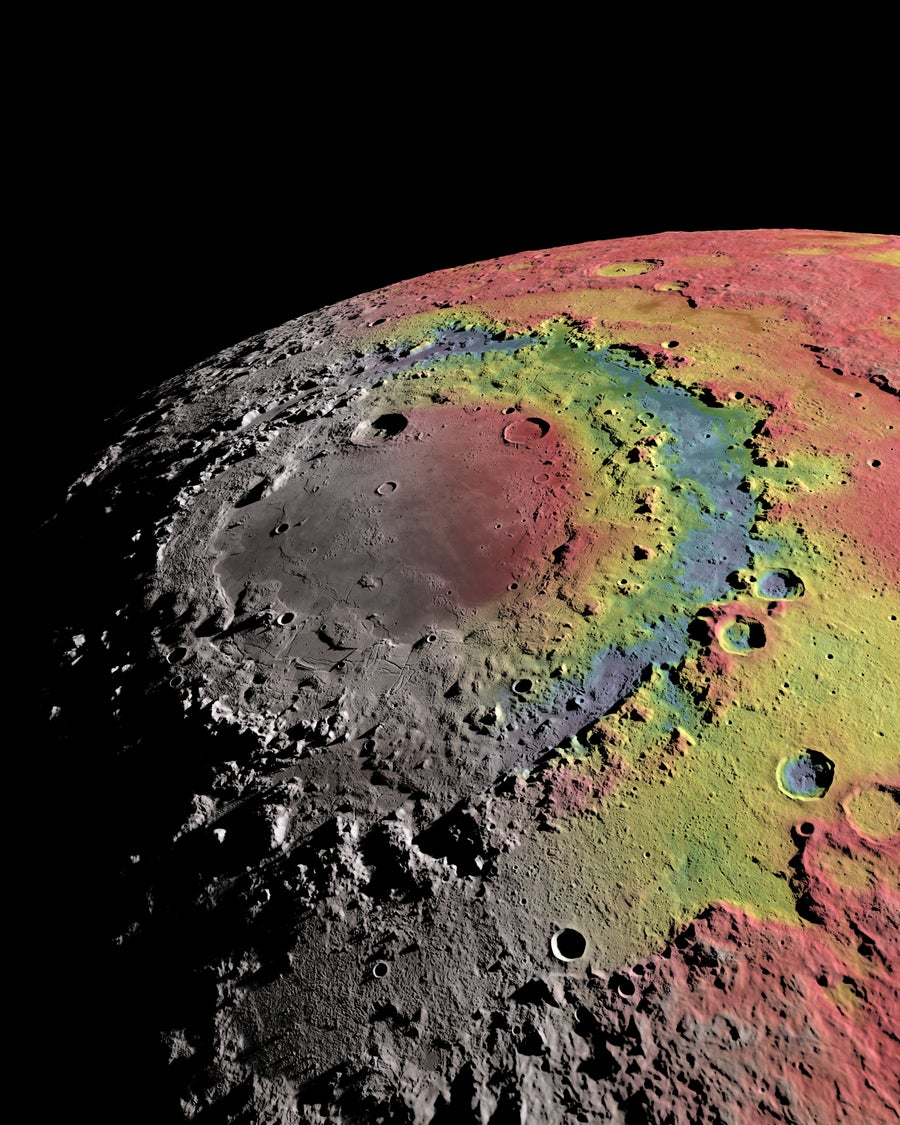 A visualization of the moon’s Orientale basin, a region closely studied by the Artemis II crew during their lunar flyby. Gravitational data from NASA’s Gravity Recovery and Interior Laboratory (GRAIL) mission are depicted in false colors on this image’s right side, and chart the basin’s subsurface structure. NASA’s Scientific Visualization Studio


 .
.

 James' World 2