February 28, 2014
Mohenjo
Science
amazon, Asteroid Capture, Asteroid Capture Mission, Asteroid Mission, Asteroids, business, Business News, Hotels, huffingtonpost, human-rights, medicine, mental-health, NASA, NASA Mission, rapid response system, research, robotic spacecraft, Science, Science News, Slideshow, Space Rock, Space Rocks, technology, Technology News, travel, unsuitable candidates, vacation
Click link below picture
.
NASA has set up a “rapid response system” to pick the best candidates for its ambitious asteroid-capture mission.
The space agency aims to use a robotic spacecraft to haul a near-Earth asteroid into a stable lunar orbit, where astronauts would visit it in the future. It’s not as easy as just picking a space rock and going, however. Many asteroids are too big to be moved easily or are in unstable orbits. Others are too distant for telescopes to figure out what they’re made of, which could make them unsuitable candidates.
.
.
.
Click link below for story and slideshow:
.
__________________________________________
June 1, 2013
Mohenjo
Science
1998 QE2, amazon, Asteroid 1998 QE2, Asteroid Flyby, Asteroid Live, Asteroid-Webcast, Asteroids, astronomy magazine, bob berman, business, Hotels, huffingtonpost, lincoln near earth asteroid research, lincoln near earth asteroid research program, magazine columnist, NASA, Near-Earth Asteroids, research, Science, Science News, Slideshow, Slooh, Space, space lovers, Space Rock, technology, Technology News, travel, vacation, Video
FROM

Click link below picture
.
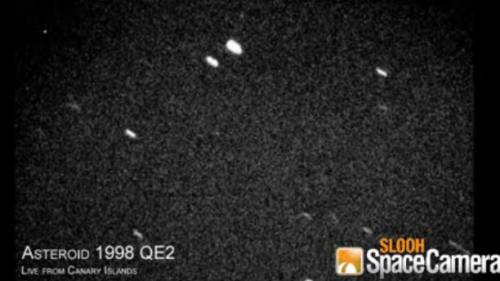
The gigantic space rock scientists call 1998 QE2 will miss earth, but that doesn’t mean you have to miss it: As asteroid 1998 QE2 zips by Earth today (May 31), with its newly discovered moon in tow, astronomers and space-lovers alike can watch the flyby live in the video above.
The SLOOH SpaceCamera webcast starts at 4:30 p.m. EDT, tracking the near-Earth asteroid’s close approach live from the Canary Islands.
Astronomers discovered the 1.7-mile-long space rock in 1998 as part of the MIT Lincoln Near Earth Asteroid Research program near Socorro, N.M.
“It will be fun to actually watch it change position,” Bob Berman, Astronomy magazine columnist, said in a written statement. “Although it will not come nearer than 14 moon distances, that’s still about ten times closer than Mars can ever get. As Slooh’s Space Cameras image it directly that afternoon, we will all be reminded that asteroids of this size have changed the biosphere of our planet in the past, and even set the stage for the present dominion of humans.”
.
.
.Click link below for view:
http://www.huffingtonpost.com/2013/05/31/asteroid-1998-qe2-flyby-slooh-space-camera-video_n_3367800.html?ref=topbar
.
____________________________________________________
May 21, 2013
Mohenjo
Science
1998 QE2, amazon, Asteroid 1998 QE2, Asteroid Flyby, Asteroids, Astronomy, business, climate, current-events, distance between earth and the moon, Environment, goldstone radar, high resolution images, Hotels, huffingtonpost, jet propulsion laboratory, Jpl, NASA, Near-Earth Asteroids, Near-Earth Objects, radar telescopes, research, Science, Science News, Slideshow, Space, Space Rocks, technology, Technology News, travel, vacation, Video
FROM
Click link below picture
.
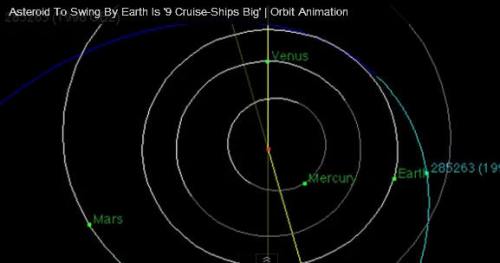
A gigantic asteroid will fly by our planet at the end of this month, making its closest approach for at least the next two centuries on May 31. But, don’t worry, it won’t get closer than about 3.6 million miles, which is around 15 times the distance between Earth and the moon.
Astronomers plan to use radar telescopes to get a good look at the space rock, named Asteroid 1998 QE2, between May 30 and June 9.
“Asteroid 1998 QE2 will be an outstanding radar imaging target at Goldstone and Arecibo [observatories] and we expect to obtain a series of high-resolution images that could reveal a wealth of surface features,” radar astronomer Lance Benner, the principal investigator for the Goldstone radar observations from NASA’s Jet Propulsion Laboratory, said in a written statement.
.
.
.Click link below for story, video, and slideshow:
http://www.huffingtonpost.com/2013/05/18/asteroid-1998-qe2-earth-video_n_3294388.html?ref=topbar
.
____________________________________________________
April 10, 2013
Mohenjo
Science
4.56 billion years old, amazon, annual Lunar & Planetary Science Conference, anthony irving, Asteroids, business, climate, Earth, Green Meteorite, Hotels, huffingtonpost, innermost planet, lunar and planetary science conference, Mars, Mercury, Mercury Meteorite, Meteorite, meteorite samples, Meteorites, NASA, NWA 7325, planetary science conference, Planets, research, Science, Science News, Slideshow, Solar System, Space, Space Rocks, technology, Technology News, Texas, The Woodlands, travel, vacation, Video
FROM
Click link below picture
.
Scientists may have discovered the first meteorite from Mercury.
The green rock found in Morocco last year may be the first known visitor from the solar system’s innermost planet, according to meteorite scientist Anthony Irving, who unveiled the new findings this month at the 44th annual Lunar and Planetary Science Conference in The Woodlands, Texas. The study suggests that a space rock called NWA 7325 came from Mercury, and not an asteroid or Mars.
NWA 7325 is actually a group of 35 meteorite samples discovered in 2012 in Morocco. They are ancient, with Irving and his team dating the rocks to an age of about 4.56 billion years.
.

.
.Click link below for story, slideshow, and video:
http://www.huffingtonpost.com/2013/03/31/mercury-meteorite-green-rock-morocco_n_2979678.html?utm_hp_ref=mostpopular
.
___________________________________________________
April 25, 2012
Mohenjo
Technical
Asteroid Mining, Asteroids, cape canaveral florida, Environment, Eric Schmidt, Google Inc, huffingtonpost, James Cameron, Larry Page, Planetary Resources, Planetary Resources Asteroid, Planetary Resources Company, Planetary Resources Inc, rare minerals, Reuters, Science, Technology News, Video
FROM


Click link below slideshow
.
CAPE CANAVERAL, Florida (Reuters) – Google Inc executives Larry Page and Eric Schmidt and filmmaker James Cameron are among those bankrolling a venture to survey and eventually extract precious metals and rare minerals from asteroids that orbit near Earth, the company said on Tuesday.
.
This slideshow requires JavaScript.
.
.Click link below for story and video:
http://www.huffingtonpost.com/2012/04/24/planetary-resources-googl_n_1447871.html?icid=maing-grid7|myaol|dl11|sec1_lnk3%26pLid%3D154700
.
_____________________________________________________

 James' World 2