If Box CEO Aaron Levie made one thing clear during the company’s second annual developer conference Wednesday it’s that startup developers should be paying very close attention to the cloud-based company.
To sweeten the pitch, the company not only unveiled a suite of new developer tools — including a “Developer Edition” of the platform — but announced new partnerships with two venture capital firms, who have pledged $40 million in funding to startups with Box-enabled services.
While startups may seem like an unlikely match for the company, which is still trying to prove it can meet investors’ expectations, Box is hoping that powering a new generation of business software startups will strengthen the relationships it already has with its Fortune 500 and other larger business customers.
BMW is developing a remote-control valet parking system for cars that can be operated by a smartwatch.
The sensor-filled BMW i3 car, which will be on display at the 2015 International CES in Las Vegas in January, integrates with smartwatch and can essentially self-park. According to the company, a driver could activate the “Remote Valet Parking Assistant” via an app, which then guides the vehicle to a parking spot all by itself.
The car works with the help of laser sensors that scan the surrounding environment so it can move without running into anything. It will work in tandem with a digital site plan, so the car has a map of the environment, too.
The iPhone’s answer to the BlackBerry keyboard, the Ryan Seacrest-backed Typo, is back. Like the first model, the Typo 2 turns your Apple smartphone into one with a QWERTY keyboard.
But the second version is a bit different — and this makes sense, considering Typo was hit with a lawsuit and pulled off the market for having a design too close to BlackBerry’s existing keyboard.
Seacrest and Typo cofounder Laurence Hallier developed the concept after realizing how some people lug around two phones: one for typing and correspondence and an iPhone for most everything else. The two developed the case for BlackBerry fans who’ve resisted switching to the iOS because of loyalty to a physical keyboard.
In the space between somewhat practical vehicles like the Segway and completely fad-driven curios like the Tamagotchi, there exists a middle ground of outlandish gadget that almost seems to make sense, but is weird enough that you might be too embarrassed to use it in public.
It’s still early days, but that appears to be the case with Acton’s RocketSkates, which look like a joint creation by the art departments of Judge Dredd and Willy Wonka & the Chocolate Factory. Offering to motorize your feet, they are a recent Kickstarter success story. And depending on your temperament, the RocketSkates either look like a glimpse at the future, or an expensive prank.
Do they work as described? A demonstration video indicates that, yes, you can use the RocketSkates to traverse the city at fairly rapid speeds. But there are limitations.
Ian Burkhart had barely finished his freshman year of college when he broke his neck.
Standing on top of a cliff in North Carolina’s Outer Banks, which overlooked an orange sandbar jutting into the Atlantic Ocean, he dove hands-first toward the deceptively shallow water below.
“It happened so fast. There was this loud snap,” he says.
The impact with the sandbar broke his vertebrae at what’s called the C5 level, paralyzing his body from the elbows down. He spent the next four months recovering. Doctors told him he’d never be able to use his arms again.
.
Image: The Ohio State University
Ian Burkhart shares a smile with Chad Bouton, research leader from Battelle. Bouton and his team at Battelle pioneered the Neurobridge technology, working closely with doctors from The Ohio State University Wexner Medical Center, which allowed Burkhart to become the first patient ever to move his paralyzed hand with his own thoughts.
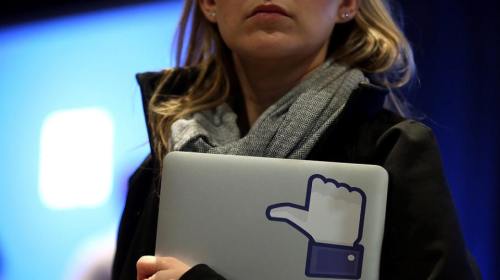
Facebook remains the most popular social media platform among marketers, but less than half agree that it’s actually effective, according to Social Media Examiner’s 2014 Social Media Marketing Industry Report.
Nearly 100% of professionals polled reported using the network in business-to-consumer marketing while 89% said they used it to communicate with other businesses. Despite these astronomical numbers, 57% of the marketers either don’t think their Facebook posts make a difference or aren’t sure.
Twitter came in as the second most popular site — 83% of marketers reported using the microblogging service — while LinkedIn took third. Only 28% take advantage of Instagram while a mere 1% have incorporated Snapchat into their work. The top six platforms have stayed relatively steady since 2012.
.
Image: Justin Sullivan/Getty Images
.
.
Click link belowfor article plus chart by Statista:
Film and Writing Festival for Comedy. Showcasing best of comedy short films at the FEEDBACK Film Festival. Plus, showcasing best of comedy novels, short stories, poems, screenplays (TV, short, feature) at the festival performed by professional actors.

 Image:Richard Drew/Associated Press


 BlackBerry Type keyboard for iphone


 Image: The Ohio State University

 James' World 2