Our mushy brains seem a far cry from the solid silicon chips in computer processors, but scientists have a long history of comparing the two. As Alan Turing put it in 1952: “We are not interested in the fact that the brain has the consistency of cold porridge.” In other words, the medium doesn’t matter, only the computational ability.
Today, the most powerful artificial intelligence systems employ a type of machine learning called deep learning. Their algorithms learn by processing massive amounts of data through hidden layers of interconnected nodes, referred to as deep neural networks. As their name suggests, deep neural networks were inspired by the real neural networks in the brain, with the nodes modeled after real neurons — or, at least, after what neuroscientists knew about neurons back in the 1950s, when an influential neuron model called the perceptron was born. Since then, our understanding of the computational complexity of single neurons has dramatically expanded, so biological neurons are known to be more complex than artificial ones. But by how much?
To find out, David Beniaguev, Idan Segev, and Michael London, all at the Hebrew University of Jerusalem, trained an artificial deep neural network to mimic the computations of a simulated biological neuron. They showed that a deep neural network requires between five and eight layers of interconnected “neurons” to represent the complexity of one single biological neuron.
The math wizards at Numberphile have brought back an age-old multiplying algorithm known as halves and doubles, peasant math, Egyptian math, or—as math presenter Johnny Ball describes it—Russian multiplying.
To do the method, begin by writing the two numbers you want to multiply at the top of two columns. In the left column, you progressively halve the number and take the integer floor of any “and a half” values, all the way down to 1. In the right column, you double the number as many times as there are digits in the left column…
Some content on this page was disabled on April 15, 2025 as a result of a DMCA takedown notice from Guardian Media Group. You can learn more about the DMCA here:
Your phones and computers hold more than you might realize. The files that you can view by default on Windows, macOS, Android, and iOS are by no means everything that’s stored on those systems.
These hidden files are typically used by the operating system and the applications you’re running to store data that you don’t normally need access to—indeed, data that can interfere with the smooth running of your device if it’s edited in the wrong way or deleted.
User settings and app configurations are often saved as hidden files, for example. Programs need these files to run, but users don’t really need access to them. Hidden file caches are common as well, temporary stores of data to speed up software operations.
This guide comes with a warning then—you edit or delete hidden files from your devices at your own risk, and you really shouldn’t have to do anything with these files anyway.
Viewing them can be useful, though, in terms of troubleshooting problems you might be having with your phone or laptop, or for trying to work out exactly where all your digital storage space has got to. Here’s how to make these files visible.
.
Hidden files are typically used by the operating system and apps you use to store data. You don’t normally need access to them, but it can be helpful. Photograph: Getty Images
When I lived in the Bay Area, I used to get together with my friend Jaron Lanier to explore the implications of spectacularly weird thought experiments.
Outlandish thought experiments have been essential in the intellectual history of science, but the point isn’t the weirdness itself. The payoff of thinking about strange things like Schrödinger’s cat, the infamous cat that is alive and dead at the same time, is not necessarily that we should then “believe” in the existence of such a cat. Instead, we can hope that uncommon ideas will shed light on the murky margins of our thoughts; in the case of Schrodinger’s cat, in dealing with the question of superposition. The point is not to confuse or bamboozle people, but to eventually find a way to think that makes more sense and is a little less murky.
The bizarre notion I want to consider here came from a discussion of the search for alien life forms. There are a variety of ways to look for signs of alien life in the universe, usually involving a large array of telescopes. One approach is founded on the hope that perhaps astronomers will get lucky and chance upon an alien radio broadcast. But in the thought experiment, Lanier and I explored, we considered a different and far more dramatic possibility.
Suppose that there are lots of alien civilizations running hugely capacious quantum computers of the sort that Google and others are just beginning to build here on Earth. This leads to a question of high weirdness: Would an extreme amount of very distant quantum computation result in any astronomically observable effect? Could we humans see evidence of a universe teeming with quantum computers by carefully examining the night sky?
We thought about various ways this might be possible, but in the end, we focused on one wonderful possibility. So here it is: First, alien quantum computers could explain the mystery of dark energy because computation by multitudes of alien creatures across the universe bends (or rather unbends) the universe as a whole. Because we can observe the effect of dark energy, accelerating the expansion of the universe, this implies that we have already seen evidence that our universe is alive beyond us—we just haven’t recognized it as such! And we found, fortunately, that contemplating this almost imponderable notion has a human-scale practical payoff: It helps us clarify how we think about plausible relationships between gravity and quantum information. (If you think this is strange, you should read some of the competing ideas. One recent paper suggests that dark energy is actually a sign that time is about to cease to be time and turn into space instead. We’d then be frozen out of time, but be four-dimensional. Compared to that, our proposal, aliens and all, is practically tame.)
Let’s go through the argument step by step: What is a quantum computer, and why would aliens be using them?
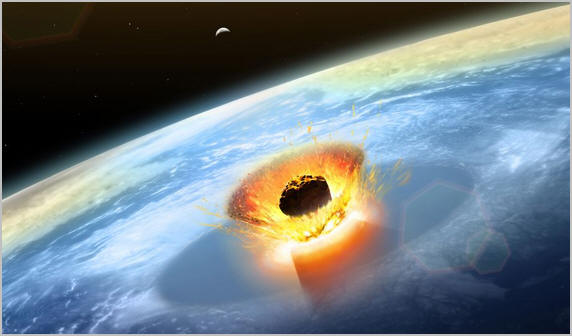
About 66 million years ago, an estimated 6-mile-wide (9.6 kilometers) object slammed into Earth, triggering a cataclysmic series of events that resulted in the demise of non-avian dinosaurs.
Now, scientists think they know where that object came from.
According to new research, the impact was caused by a giant dark primitive asteroid from the outer reaches of the solar system‘s main asteroid belt, situated between Mars and Jupiter. This region is home to many dark asteroids — space rocks with a chemical makeup that makes them appear darker (reflecting very little light) compared with other types of asteroids.
Match the following figures – Albert Einstein, Thomas Edison, Guglielmo Marconi, Alfred Nobel, and Nikola Tesla – with these biographical facts:
Spoke eight languages
Produced the first motor that ran on AC current
Developed the underlying technology for wireless communication over long distances
Held approximately 300 patents
Claimed to have developed a “superweapon” that would end all war
The match for each, of course, is Tesla. Surprised? Most people have heard his name, but few know much about his place in modern science and technology.
The 75th anniversary of Tesla’s death on Jan. 7, 2018, provides an opportunity to review the life of a man who came from nowhere yet became world-famous; claimed to be devoted solely to discovery but relished the role of a showman; attracted the attention of many women but never married; and generated ideas that transformed daily life and created multiple fortunes but died nearly penniless.
.
The inventor at rest, with a Tesla coil (thanks to a double exposure). Photo from Dickenson V. Alley, Wellcome Collection, CC BY.
Film and Writing Festival for Comedy. Showcasing best of comedy short films at the FEEDBACK Film Festival. Plus, showcasing best of comedy novels, short stories, poems, screenplays (TV, short, feature) at the festival performed by professional actors.

 ktsdesign/Shutterstock








 James' World 2