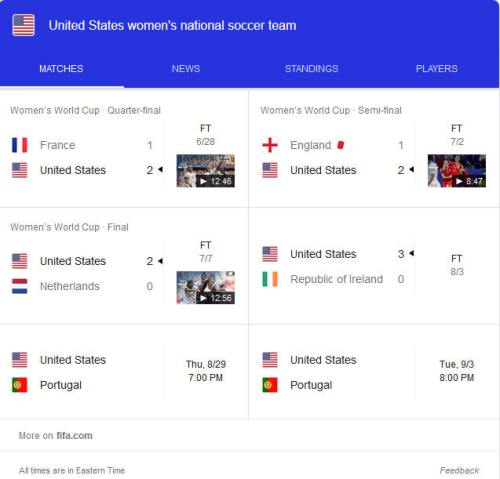
The judge in the United States women’s soccer team’s gender discrimination lawsuit has set a May 5, 2020 trial date in the case, an accelerated timeline that could see the team’s bid for equal pay become entangled with its preparations for next summer’s Tokyo Olympics.
The date, set on Monday by Judge R. Gary Klausner of United States District Court for the Central District of California, is at least six months earlier than the players and U.S. Soccer, their employer and the defendant in the suit, had requested. Both the players and U.S. Soccer, which runs the national team and pays the salaries and bonuses of its players, had sought to delay the trial until later in the year in order to avoid both the Olympic tournament and the conclusion of the players’ domestic league seasons.
Instead, Judge Klausner set a date that is 11 weeks before the opening match of the Olympic women’s tournament. The United States still has to qualify for the Games, but most believe that is a formality: the squad, the reigning World Cup champion, has reached five of the six Olympic finals and has left with the gold medal four times.
.
The world champion United States women’s team has sued U.S. Soccer for gender discrimination.CreditCreditFranck Fife/Agence France-Presse — Getty Images
In the preface to “The Geographical Reader for the Dixie Children,” Marinda Branson Moore, a teacher who founded a girls’ school in North Carolina, noted that she wanted to teach children about the world without it going over their heads. “The author of this little work, having found most of the juvenile books too complex for young minds, has for some time intended making an effort to simplify the science of Geography,” she wrote. “If she shall succeed in bringing this beautiful and useful study within the grasp of little folks, and making it both interesting and pleasant, her purpose will be fully accomplished.” The book was published in 1863, the same year as the Emancipation Proclamation and in the midst of the Civil War. Teachers could review the lessons with suggested questions in the back of the book. Part of Lesson IX’s suggestions read:
Q. Which race is the most civilized? A. The Caucasian. Q. Is the African savage in this country? A. No; they are docile and religious here. Q. How are they in Africa where they first come from? A. They are very ignorant, cruel and wretched.
More than a century and a half later, textbooks no longer publish such overt racist lies, but the United States still struggles to teach children about slavery.
.
Nap McQueen, the author’s great-grandfather, photographed in Texas around 1936.From the Smithsonian’s Museum of African American History and Culture
Sometime in 1619, a Portuguese slave ship, the São João Bautista, traveled across the Atlantic Ocean with a hull filled with human cargo: captive Africans from Angola, in southwestern Africa.The men, women and children, most likely from the kingdoms of Ndongo and Kongo, endured the horrific journey, bound for a life of enslavement in Mexico. Almost half the captives had died by the time the ship was seized by two English pirate ships; the remaining Africans were taken to Point Comfort, a port near Jamestown, the capital of the English colony of Virginia, which the Virginia Company of London had established 12 years earlier. The colonist John Rolfe wrote to Sir Edwin Sandys, of the Virginia Company, that in August 1619, a “Dutch man of war” arrived in the colony and “brought not anything but 20 and odd Negroes, which the governor and cape merchant bought for victuals.” The Africans were most likely put to work in the tobacco fields that had recently been established in the area.
Authorities this weekend announced they had foiled three potential mass shootings after arresting three men in different states who expressed interest in or threatened to carry them out.
All three cases were brought to authorities’ attention thanks to tips from the public.
Thirteen people were arrested and four were injured, as over 1,000 right-wing demonstrators and counter-protesters descended on downtown Portland on Saturday, police said.
There were “at least 13 arrests,” in six hours, Portland Police Lieutenant Tina Jones said in a statement. “We are aware of four individuals who have been evaluated by Portland Fire medics,” the statement said.
Jones also said that one person had been taken to a hospital and that “Portland Fire medics report that all known injuries are considered to be minor.”
On Tuesday, Donald Trump gave a speech to the employees at Royal Dutch Shell’s petrochemical plant in Beaver County, Pennsylvania, the largest construction site in the state. An estimated 5,000 workers attended, and according to the Pittsburgh Post-Gazette, they were free to choose between hear the president’s speech or not getting paid for the day.
Per the Post-Gazette:
“Your attendance is not mandatory,” said the rules that one contractor relayed to employees, summarizing points from a memo that Shell sent to union leaders a day ahead of the visit to the $6 billion construction site. But only those who showed up at 7 a.m., scanned their ID cards, and prepared to stand for hours—through lunch but without lunch—would be paid.”NO SCAN, NO PAY,” a supervisor for that contractor wrote.
According to the Post-Gazette, any employee who chose not to come would receive an “excused but unpaid” absence, and would not qualify for overtime that week. A Shell spokesman explained to the paper that employees have a 56-hour workweek with 16 hours of overtime built in, and missing a day of work would disqualify them from receiving time-and-a-half pay for those 16 hours, effectively costing them even more money than the lost day to skip the Trump speech.
.
US President Donald Trump speaks to 5000 contractors at the Shell Chemicals Petrochemical Complex on August 13, 2019 in Monaca, Pennsylvania.Jeff Swensen/Getty
Film and Writing Festival for Comedy. Showcasing best of comedy short films at the FEEDBACK Film Festival. Plus, showcasing best of comedy novels, short stories, poems, screenplays (TV, short, feature) at the festival performed by professional actors.

 CreditCreditFranck Fife/Agence France-Presse — Getty Images





 James' World 2