September 27, 2022
Mohenjo
Business, Enthralling, Human Interest, Photographs
amazon, business, Business News, current-events, Future, Hotels, human-rights, medicine, mental-health, research, Science, Science News, technology, Technology News, travel, vacation

Click the link below the picture
.
Iceland is a Nordic island country in the North Atlantic Ocean and the most sparsely populated country in Europe. Iceland’s capital and largest city is Reykjavík, which (along with its surrounding areas) is home to over 65% of the population. Iceland is the biggest part of the Mid-Atlantic Ridge that rises above sea level, and its central volcanic plateau is erupting almost constantly. The interior consists of a plateau characterized by sand and lava fields, mountains, and glaciers, and many glacial rivers flow to the sea through the lowlands. Iceland is warmed by the Gulf Stream and has a temperate climate, despite a high latitude just outside the Arctic Circle. Its high latitude and marine influence keep summers chilly, and most of its islands have a polar climate.
According to the ancient manuscript Landnámabók, the settlement of Iceland began in 874 AD when the Norwegian chieftain Ingólfr Arnarson became the first permanent settler on the island. In the following centuries, Norwegians, and to a lesser extent other Scandinavians, emigrated to Iceland, bringing with them thralls (i.e., slaves or serfs) of Gaelic origin.
The island was governed as an independent commonwealth under the native parliament, the Althing, one of the world’s oldest functioning legislative assemblies. Following a period of civil strife, Iceland acceded to Norwegian rule in the 13th century. The establishment of the Kalmar Union in 1397 united the kingdoms of Norway, Denmark, and Sweden. Iceland thus followed Norway’s integration into that union, coming under Danish rule after Sweden seceded from the union in 1523. The Danish kingdom forcefully introduced Lutheranism to Iceland in 1550.
In the wake of the French Revolution and the Napoleonic Wars, Iceland’s struggle for independence took form and culminated in independence in 1918 with the establishment of the Kingdom of Iceland, sharing through a personal union the incumbent monarch of Denmark. During the occupation of Denmark in World War II, Iceland voted overwhelmingly to become a republic in 1944, thus ending the remaining formal ties with Denmark. Although the Althing was suspended from 1799 to 1845, the island republic has been credited with sustaining the world’s oldest and longest-running parliament.
Until the 20th century, Iceland relied largely on subsistence fishing and agriculture. Industrialization of the fisheries and Marshall Plan aid following World War II brought prosperity, and Iceland became one of the wealthiest and most developed nations in the world. It became a part of the European Economic Area in 1994; this further diversified the economy into sectors such as finance, biotechnology, and manufacturing.
Iceland has a market economy with relatively low taxes, compared to other OECD countries, as well as the highest trade union membership in the world. It maintains a Nordic social welfare system that provides universal health care and tertiary education for its citizens. Iceland ranks high in democracy and equality indexes, ranking third in the world by median wealth per adult. In 2020, it was ranked as the fourth-most developed country in the world by the United Nations’ Human Development Index, and it ranks first on the Global Peace Index. Iceland runs almost completely on renewable energy.
Icelandic culture is founded upon the nation’s Scandinavian heritage. Most Icelanders are descendants of Norse and Gaelic settlers. Icelandic, a North Germanic language, is descended from Old West Norse and is closely related to Faroese. The country’s cultural heritage includes traditional Icelandic cuisine, Icelandic literature, and medieval sagas. Iceland has the smallest population of any NATO member and is the only one with no standing army, with a lightly armed coast guard. Wikipedia
.
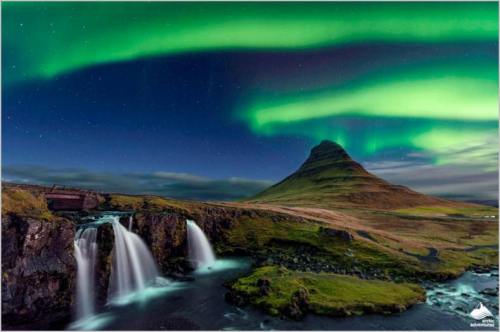 An image from Iceland
.
.
Click the link below for images:
.
__________________________________________
September 26, 2022
Mohenjo
Business, Enthralling, Human Interest, Photographs
amazon, business, Business News, current-events, Future, Hotels, human-rights, medicine, mental-health, research, Science, Science News, technology, Technology News, travel, vacation
Click the link below the picture
.
Why Visit Yuanyang Rice Terraces?
1. Core Area of Honghe Hani Rice Terraces: Among the 5 rice terrace sites in the world recognized by UNESCO as a collective World Heritage Site, Honghe Hani Rice Terraces in Yunnan, with Yuanyang Rice Terraces sited at its core, is the only one you will find in the vast China.
2. Splendid Rice Terraces Scenery: Yuanyang Rice Terraces has a long history of more than 1,300 years. Till now, there are more than 3,000 flat and evenly spaced terraces. They are all carved following the mountains’ original contour lines, forming a splendid landscape!
3. Photographer’s Dream: Thanks to its unbeatable size, gorgeous colors, and unique shapes with a strong three-dimensional effect, Yuanyang Rice Terraces has long been a dream for photograph lovers. And its mesmerizing sunrise and sunset can easily occupy your camera storage. chinadiscovery com
.
 An image from Yuanyang County Rice Terraces
.
.
Click the link below for images:
.
__________________________________________
September 24, 2022
Mohenjo
Business, Enthralling, Human Interest, Photographs
amazon, business, Business News, current-events, Future, Hotels, human-rights, medicine, mental-health, research, Science, Science News, technology, Technology News, travel, vacation
Click the link below the picture
.
Logan is a city in Hocking County, Ohio. The population was 7,152 at the time of the 2010 census. It is the county seat of Hocking County. Logan is located in southeast Ohio, on the Hocking River 48 miles southeast of Columbus. The current mayor of Logan is Republican Greg Fraunfelter, who began a four-year term in January 2016 and was re-elected in 2019.
Logan is the county seat of Hocking County, Ohio. Residents named the town in honor of Chief Logan of the Mingo Indian tribe. He and his band lived in this area at the time of European-American settlement. Ohio Governor Thomas Worthington established the community in 1816.
Logan was incorporated as a city in 1839.
Logan was the first city in the state of Ohio to install a double roundabout. Located at the interchange of Ohio State Route 664 and U.S. Route 33, the roundabouts were officially opened to traffic on December 4, 2013.
According to the United States Census Bureau, the city has a total area of 4.93 square miles (12.77 km2), of which 4.79 square miles (12.41 km2) is land and 0.14 square miles (0.36 km2) is water.
.
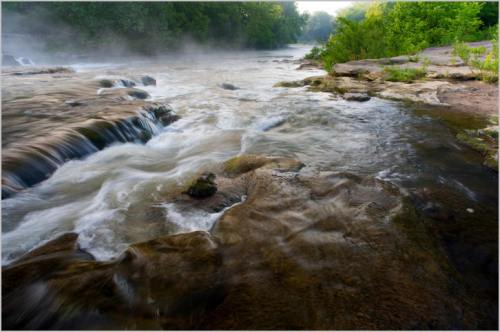 An image from Logan, Ohio
.
.
Click the link below for images:
.
__________________________________________
September 24, 2022
Mohenjo
Business, Food For Thought, Human Interest, Photographs, Political, Science, Technical
amazon, business, Business News, current-events, Future, Hotels, human-rights, medicine, mental-health, research, Science, Science News, technology, Technology News, travel, vacation
Some content on this page was disabled on April 15, 2025 as a result of a DMCA takedown notice from Guardian Media Group. You can learn more about the DMCA here:
https://wordpress.com/support/copyright-and-the-dmca/
September 23, 2022
Mohenjo
Business, Enthralling, Human Interest, Photographs
amazon, business, Business News, current-events, Future, Hotels, human-rights, medicine, mental-health, research, Science, Science News, technology, Technology News, travel, vacation
Click the link below the picture
.
A forest is an area of land dominated by trees. Hundreds of definitions of forest are used throughout the world, incorporating factors such as tree density, tree height, land use, legal standing, and ecological function. The United Nations’ Food and Agriculture Organization (FAO) defines a forest as, “Land spanning more than 0.5 hectares with trees higher than 5 meters and a canopy cover of more than 10 percent, or trees able to reach these thresholds in situ. It does not include land that is predominantly under agricultural or urban use.” Using this definition, Global Forest Resources Assessment 2020 (FRA 2020) found that forests covered 4.06 billion hectares (10.0 billion acres; 40.6 million square kilometers; 15.7 million square miles), or approximately 31 percent of the world’s land area in 2020.
Forests are the predominant terrestrial ecosystem of Earth and are found around the globe. More than half of the world’s forests are found in only five countries (Brazil, Canada, China, the Russian Federation, and the United States of America). The largest share of forests (45 percent) are in the tropical latitudes, followed by those in the boreal, temperate, and subtropic domains.
Forests account for 75% of the gross primary production of the Earth’s biosphere and contain 80% of the Earth’s plant biomass. Net primary production is estimated at 21.9 gigatonnes of biomass per year for tropical forests, 8.1 for temperate forests, and 2.6 for boreal forests.
Forests at different latitudes and elevations, and with different precipitation and evapotranspiration form distinctly different biomes: boreal forests around the North Pole, tropical moist forests and tropical dry forests around the Equator, and temperate forests at the middle latitudes. Areas at higher elevations tend to support forests similar to those at higher latitudes, and the amount of precipitation also affects forest composition.
Almost half the forest area (49 percent) is relatively intact, while 9 percent is found in fragments with little or no connectivity. Tropical rainforests and boreal coniferous forests are the least fragmented, whereas subtropical dry forests and temperate oceanic forests are among the most fragmented. Roughly 80 percent of the world’s forest area is found in patches larger than 1 million hectares (2.5 million acres). The remaining 20 percent is located in more than 34 million patches around the world – the vast majority less than 1,000 hectares (2,500 acres) in size.
Human society and forests influence each other in both positive and negative ways. Forests provide ecosystem services to humans and serve as tourist attractions. Forests can also affect people’s health. Human activities, including unsustainable use of forest resources, can negatively affect forest ecosystems. Wikipedia
.
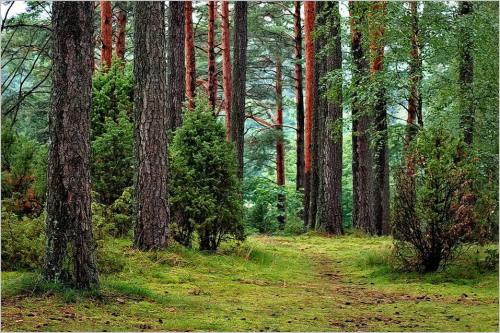 An image from Forest Trees
.
.
Click the link below for article:
.
__________________________________________
September 22, 2022
Mohenjo
Business, Enthralling, Human Interest, Photographs
amazon, business, Business News, current-events, Future, Hotels, human-rights, medicine, mental-health, research, Science, Science News, technology, Technology News, travel, vacation
Click the link below the picture
.
Lagazuoi is a mountain in the Dolomites of northern Italy, lying at an altitude of 2,835 meters (9,301 ft), about 18 kilometers (11 mi) southwest by road from Cortina d’Ampezzo in the Veneto Region. The mountain is part of the “Natural Park of the Ampezzo Dolomites”.
It is accessible by cable car and contains the Rifugio Lagazuoi, a mountain refuge situated beyond the northwest corner of Cima del Lago.
The mountain range is well known for its wartime tunnels and First World War mine warfare. The extensive tunnels were built by the Italian troops trying to wrest control from Austro-Hungarian troops who also built tunnels. The tunnels are now open as a de facto museum. Wikipedia
.
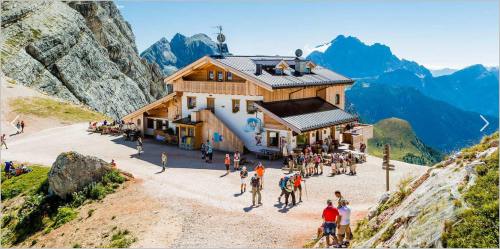 An image from Lagazuoi Refuge, Cinque Torri, Italy
.
.
Click the link below for images:
.
__________________________________________
September 21, 2022
Mohenjo
Business, Enthralling, Human Interest, Photographs
amazon, business, Business News, current-events, Future, Hotels, human-rights, medicine, mental-health, research, Science, Science News, technology, Technology News, travel, vacation
Click the link below the picture
.
The Canyons of the Escalante is a collective name for the erosional landforms created by the Escalante River and its tributaries—the Escalante River Basin. Located in southern Utah in the western United States, these sandstone features include high vertical canyon walls, numerous slot canyons, waterpockets (sandstone depressions containing temporary rainwater deposits), domes, hoodoos, natural arches, and bridges. This area—extending over 1,500 square miles (3,885 km2) and rising in elevation from 3,600 ft (1,097 m) to over 11,000 ft (3,353 m)—is one of the three main sections of the Grand Staircase–Escalante National Monument, and also a part of the Glen Canyon National Recreation Area, with Capitol Reef National Park being adjacent to the east.
The headwaters of the Escalante River are located on the slopes of the Aquarius Plateau, in Utah’s Garfield County, just west of the town of Escalante. The Escalante River begins at the confluence of Birch Creek and North Creek, with the flow of Pine Creek added just below the town. The river runs a total distance of 80 mi (130 km) from the Birch/North Creek confluence before emptying into the Colorado River in Kane County. The lower section of the river, southeast of Coyote Gulch, is now beneath the surface of Lake Powell.
Numerous side canyons also feed the main river, accounting for the large size of the basin. From the west, the major tributaries are Harris Wash, Twentyfive Mile Creek, Coyote Gulch, Fortymile Gulch, and Fiftymile Creek, along with the smaller Phipps, Fence, and Scorpion, Davis, Clear, and Indian Creeks. Most of these larger creeks flow from the top of the Kaiparowits Plateau or from the base of its eastern edge, the Straight Cliffs Formation. An even greater number of tributaries flow in from the north and east, including Death Hollow and Calf Creeks, the combined Boulder and Deer Creeks, The Gulch, Wolverine and Silver Falls Creeks, and Choprock, Moody, Stevens, and Cow Canyons. Streams from the north flow from Boulder Mountain, while those from the northeast originate in the Circle Cliffs area, near the Waterpocket Fold in Capitol Reef National Park.
The sandstone layers now exposed in the Canyons of the Escalante were deposited during the Mesozoic era, 180 to 225 million years ago, when this area was part of a large area of dunes. Near the end of the Cretaceous period, about 80 million years ago, the entire western section of North America entered an era of uplift and mountain-building, an event known as the Laramide orogeny. More recently, additional uplift formed the Colorado Plateau province. These episodes of uplift raised the Aquarius Plateau to the extent that erosional solid forces were acting on the Escalante River Basin. Wetter climates during the recent ice ages of the Pleistocene period contributed to the deep cutting of the canyon walls.
Sandstone exposed in canyons nearer to the Colorado River is typically from the Glen Canyon Group. The dark red cliffs of Coyote Gulch, for example, are composed of Navajo Sandstone. The lighter sandstone domes of Dance Hall Rock and Sooner Rocks are formed from the higher Entrada sandstone layer. Due to the tilting of layers throughout the area, sandstone exposed at higher elevations near the town of Escalante (e.g. Deer Creek) may be from a lower layer, Wingate Sandstone. Wikipedia
.
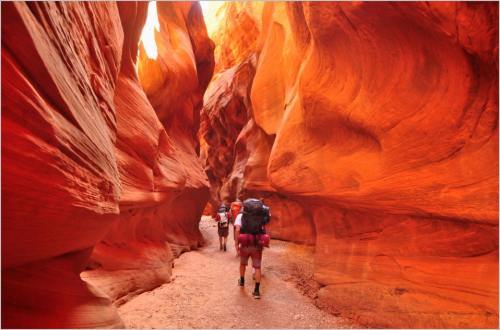 An image from Canyons Of The Escalante
.
.
Click the link below for images:
.
__________________________________________
September 20, 2022
Mohenjo
Business, Enthralling, Human Interest, Photographs
amazon, business, Business News, current-events, Future, Hotels, human-rights, medicine, mental-health, research, Science, Science News, technology, Technology News, travel, vacation
Click the link below the picture
.
The koala or, inaccurately, koala bear (Phascolarctos cinereus) is an arboreal herbivorous marsupial native to Australia. It is the only extant representative of the family Phascolarctidae and its closest living relatives are the wombats. The koala is found in coastal areas of the mainland’s eastern and southern regions, inhabiting Queensland, New South Wales, Victoria, and South Australia. It is easily recognizable by its stout, tailless body and large head with round, fluffy ears, and large, spoon-shaped nose. The koala has a body length of 60–85 cm (24–33 in) and weighs 4–15 kg (9–33 lb). Fur color ranges from silver grey to chocolate brown. Koalas from the northern populations are typically smaller and lighter in color than their counterparts further south. These populations possibly are separate subspecies, but this is disputed.
Koalas typically inhabit open Eucalyptus woodland, as the leaves of these trees make up most of their diet. Because this eucalypt diet has limited nutritional and caloric content, koalas are largely sedentary and sleep up to twenty hours a day. They are asocial animals, and bonding exists only between mothers and dependent offspring. Adult males communicate with loud bellows that intimidate rivals and attract mates. Males mark their presence with secretions from scent glands located on their chests. Being marsupials, koalas give birth to underdeveloped young that crawl into their mothers’ pouches, where they stay for the first six to seven months of their lives. These young koalas, known as joeys, are fully weaned around a year old. Koalas have few natural predators and parasites but are threatened by various pathogens, such as Chlamydiaceae bacteria and the koala retrovirus.
Because of its distinctive appearance, the koala along with the kangaroos are recognized worldwide as symbols of Australia. They were hunted by Indigenous Australians and depicted in myths and cave art for millennia. The first recorded encounter between a European and a koala was in 1798, and an image of the animal was published in 1810 by naturalist George Perry. Botanist Robert Brown wrote the first detailed scientific description of the koala in 1814, although his work remained unpublished for 180 years. Popular artist John Gould illustrated and described the koala, introducing the species to the general British public. Further details about the animal’s biology were revealed in the 19th century by several English scientists. Koalas are listed as a vulnerable species by the International Union for Conservation of Nature. Among the many threats to their existence are habitat destruction caused by agriculture, urbanization, droughts, and associated bushfires, some related to climate change. In February of 2022, the koala was officially listed as endangered in the Australian Capital Territory, New South Wales, and Queensland.
The word koala comes from the Dharug gula, meaning no water. Although the vowel ‘u’ was originally written in the English orthography as “oo” (in spellings such as coola or koolah — two syllables), later became “oa” and is now pronounced in three syllables, possibly in error.
Adopted by white settlers, “koala” became one of several hundred Aboriginal loan words in Australian English, where it was also commonly referred to as “native bear”, later “koala bear”, for its supposed resemblance to a bear. It is also one of several Aboriginal words that made it into International English, alongside e.g. “didgeridoo” and “kangaroo.” The generic name, Phascolarctos, is derived from the Greek words phaskolos “pouch” and arktos “bear”. The specific name, cinereus, is Latin for “ash-colored”.
The koala was given its generic name Phascolarctos in 1816 by French zoologist Henri Marie Ducrotay de Blainville, who would not give it a specific name until further review. In 1819, German zoologist Georg August Goldfuss gave it the binomial Lipurus cinereus. Because Phascolarctos was published first, according to the International Code of Zoological Nomenclature, it has priority as the official name of the genus. French naturalist Anselme Gaëtan Desmarest proposed the name Phascolarctos fuscus in 1820, suggesting that the brown-colored versions were a different species than the grey ones. Other names suggested by European authors included Marodactylus cinereus by Goldfuss in 1820, P. flindersii by René Primevère Lesson in 1827, and P. koala by John Edward Gray in 1827. Wikipedia
.
 An image of a Koala, Phascolarctos Cinereus, Young on Tree, Germany
.
.
Click the link below for images:
.
__________________________________________
September 19, 2022
Mohenjo
Business, Enthralling, Human Interest, Photographs
amazon, business, Business News, current-events, Future, Hotels, human-rights, medicine, mental-health, research, Science, Science News, technology, Technology News, travel, vacation
Click the link below the picture
.
Seealpsee is a lake in the Alpstein range of the canton of Appenzell Innerrhoden, Switzerland. At an elevation of 1,143.2 m, the surface area is 13.6 hectares (34 acres). The lake can be reached by foot from Wasserauen or from Ebenalp. It is a popular tourist destination. A network of routes around Ebenalp connects Seealpsee with other notable sights in the Appenzell Alps, such as the Wildkirchli and Säntis.
The Berggasthaus Forelle am Seealpsee, with a large open-air terrace, dominates the western end of the lake.
.
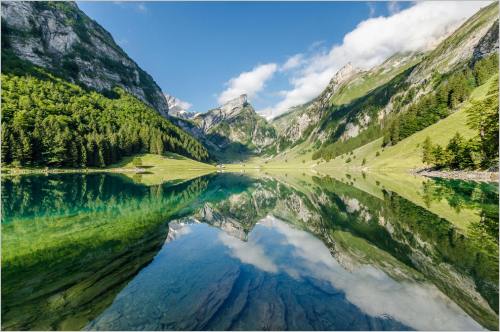 An image from Seealpsee, Switzerland
.
.
Click the link below for images:
.
__________________________________________
September 17, 2022
Mohenjo
Business, Enthralling, Human Interest, Photographs
amazon, business, Business News, current-events, Future, Hotels, human-rights, medicine, mental-health, research, Science, Science News, technology, Technology News, travel, vacation
Click the link below the picture
.
Charles-François Daubigny; 15 February 1817 – 19 February 1878) was one of the painters of the Barbizon school, and is considered an important precursor of impressionism.
He was also a prolific printmaker, mostly in etching but also as one of the main artists to use the cliché verre technique.
Daubigny was born in Paris, into a family of painters; taught the art by his father, Edmé-François Daubigny [fr], and his uncle, miniaturist Pierre Daubigny (1793-1858).
Initially, Daubigny painted in a traditional style, but this changed after 1843 when he settled in Barbizon to work outside in nature. Even more important was his meeting with Camille Corot in 1852 in Optevoz (Isère). On his famous boat Botin, which he had turned into a studio, he painted along the Seine and Oise, often in the region around Auvers. From 1852 onward he came under the influence of Gustave Courbet.
In 1866 Daubigny visited England, eventually returning because of the Franco-Prussian war in 1870. In London, he met Claude Monet, and together they left for the Netherlands. Back in Auvers, he met Paul Cézanne, another important Impressionist. It is assumed that these younger painters were influenced by Daubigny.
His most ambitious canvases are Springtime (1857), in the Louvre; Borde de la Cure, Morvan (1864); Villerville sur Mer (1864); Moonlight (1865); Auvers-sur-Oise (1868); and Return of the Flock (1878). He was named by the French government as an Officer of the Legion of Honor.
Daubigny died in Paris. His remains are interred at cimetière du Père-Lachaise (division 24). His followers and pupils included his son Karl [fr] (whose works are occasionally mistaken for those of his father), Achille Oudinot [fr], Hippolyte Camille Delpy, Albert Charpin, and Pierre Emmanuel Damoye.
The life of Daubigny was adapted into a graphic novel by Belgian comics writer Bruno de Roover and artist Luc Cromheecke. It appeared under the title De Tuin van Daubigny (The Garden of Daubigny, 2016). Wikipedia
.
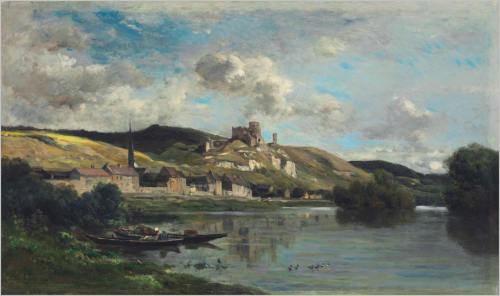 An image of a painting by Charles-Francois Daubigny
.
.
Click the link below for images:
.
__________________________________________
Older Entries
Newer Entries
 James' World 2