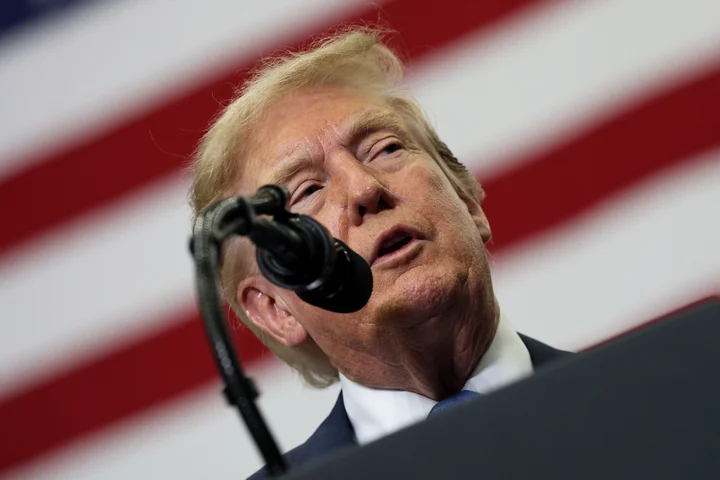
The California teacher and engineer accused of opening fire outside the White House Correspondents’ Association Dinner believed it was his duty to target Trump administration officials, according to a note he sent family members about 10 minutes before the Saturday attack.
Cole Tomas Allen, 31, who lives in the Los Angeles suburb of Torrance, is the armed suspect federal authorities subdued near the packed ballroom at the Washington Hilton, where President Donald Trump and other White House officials gathered with journalists, a federal official familiar with the case told NBC News.
Allen was armed with a shotgun, handgun, and knives when he rushed a security checkpoint and ran toward the ballroom where the black-tie dinner was being held, authorities said. He exchanged gunfire with law enforcement and was tackled to the ground.
Acting Attorney General Todd Blanche said on “Meet the Press” on Sunday that authorities believe “the suspect traveled by train from Los Angeles to Chicago, and then Chicago to Washington, D.C., where he checked into the hotel where the correspondents’ dinner was at in the last day or two.”
The suspect’s writings
Just moments before the attack, Allen sent family members a note apologizing to his parents, colleagues, students, bystanders, and others for what he was about to do, according to a transcript of some of Allen’s writings provided to NBC News by a senior administration official.
“I don’t expect forgiveness,” Allen wrote. “Again, my sincere apologies.”
In the note, Allen criticized Trump without mentioning him by name. He wrote about lax security at the hotel, saying he had expected more.
He also described his “expected rules of engagement,” writing: “Administration officials (not including Mr. Patel): they are targets, prioritized from highest-ranking to lowest.” He appeared to be referring to FBI Director Kash Patel.
Later, he added: “I experience rage thinking about everything this administration has done.”
The senior administration official said that Allen’s brother contacted the New London Police Department in Connecticut when he received the note.
The department confirmed being contacted at around 10:49 p.m. Saturday, just over two hours after the shooting, “by an individual who expressed concern about the incident that occurred at the White House Correspondents’ Association Dinner earlier in the evening.” Police contacted federal law enforcement, and the caller was interviewed by authorities.
Allen’s sister told the Secret Service and Montgomery County Police after the shooting that her brother had a tendency to make radical statements, and he had referred to a plan to do “something” to fix the issues with today’s world, the senior administration official said.
A Bluesky account believed to belong to Allen and verified by NBC News included recent posts or reposts that were critical of Trump and his administration’s policies, as well as of the U.S. war with Iran and Russia’s war with Ukraine.
Described as a ‘borderline genius.’
The suspect, who was not shot but was taken to a local hospital, is expected to be charged in federal court on Monday. In a press briefing shortly after the attack, Trump called the suspected shooter a “whack job” and a “lone wolf.”
Public records and interviews show that Allen was a trained engineer who once interned for NASA, and participated in the Nerf club and Christian fellowship at his prestigious California university, before more recently developing video games and working as a part-time teacher.
Allen attended Pacific Lutheran High School in Gardena, California, where he was known for his inquisitiveness and intellect, a former volleyball teammate told NBC News. While he had not seen Allen recently, he remembered Allen as a “borderline genius” and “super stable.”
“Other people study hard,” said the ex-teammate, who spoke on the condition of anonymity out of fear it could affect his career. “He didn’t have to study. It would just come to him. He was really, really smart.”
Before he embarked on a cross-country journey, Cole Tomas Allen offered the people in his life a series of explanations for his absence, according to writings that the authorities say he left behind.
He had a personal emergency, he told his colleagues and the students he was tutoring. He told his parents simply that he had an interview.
But Mr. Allen appears to have had a much different and much darker plan when he set out on a train from California to Washington, according to two senior law enforcement officials who say he is now in custody, accused of charging through security outside the White House Correspondents’ dinner and opening fire.
Now, those who knew Mr. Allen are struggling to reconcile the man they knew with the shocking act of political violence that he has been accused of perpetrating.
The suspect, who the authorities have not publicly named but who was identified by the two officials as Mr. Allen, 31, of Torrance, Calif., is expected to be charged with multiple crimes in a court appearance on Monday.
The writing the authorities attributed to Mr. Allen bounced between remorse for the deception of friends and family and gratitude for a lifetime of love and support. In it, he displayed outrage at the policies put in place by the White House, and alluded to allegations of sexual misconduct, saying that he is “no longer willing” to allow a “traitor to coat my hands with his crimes” — an apparent reference to President Trump, though the writing does not mention him by name.
The two law enforcement officials who shared the writings with The New York Times asked not to be named because they had not been authorized to disclose the information.
It was uncertain on Sunday whether Mr. Allen had obtained legal counsel, and close relatives declined to discuss his arrest or did not respond to requests for comment.
The writing said the suspect had come to the Washington Hilton looking for members of the Trump administration.
“Administration officials (not including Mr. Patel): they are targets, prioritized from highest-ranking to lowest,” the writing reads, apparently referring to Kash Patel, the F.B.I. director. It was not clear from the writing why Mr. Patel was mentioned by name.
The language seemed foreign to Mr. Allen’s neighbors, former classmates, and tutoring clients in Torrance, a suburb of Los Angeles. There, the home he shared was swarmed shortly before midnight Saturday by a S.W.A.T. team from the Federal Bureau of Investigation.
Mr. Allen was a registered “no party preference” voter — the California equivalent of an independent. His sole political contribution in available records appears to have been $25 to the campaign for Kamala Harris, the Democratic presidential nominee in the fall of 2024.
“He seemed like a completely average guy,” Max Harris, a senior at a local high school who had been tutored for several months by Mr. Allen, said late Saturday night as he stood near the crowd of federal authorities and onlookers who had gathered outside the modest, two-story house where Mr. Allen lived in Torrance.
“Like, I never would have expected anything like this from a guy like him.”
Mr. Allen was listed as a tutor with C2 Education, which issued a statement Sunday that said they were cooperating with law enforcement. “Violence of any kind is never the answer,” the organization said.
The authorities have said that the suspect in the Saturday attack was taken into custody shortly after charging through a security checkpoint and exchanging gunfire with federal law enforcement officials inside the Washington Hilton. He was armed with knives, a shotgun, and a handgun, authorities have said.
The suspect is initially expected to be charged with two counts of using a firearm and one count of assault on a federal officer using a dangerous weapon, Jeanine Pirro, the U.S. attorney for the District of Columbia, said on Saturday. He is scheduled to be arraigned on Monday in Federal District Court, and additional charges are expected, she said.
Mr. Allen was born the oldest of four siblings in Los Angeles County.
As of Saturday night, Mr. Allen’s father was listed online as an elder at Grace Torrance, which describes itself as a Protestant church in the Reformed tradition.
In 2013, Mr. Allen enrolled at the California Institute of Technology, or Caltech, an elite research university in Pasadena, Calif. At that time, according to federal data, Caltech admitted less than 11 percent of its undergraduate applicants.
.
Investigators worked outside the California home of a man who is being held in connection to an attack at the White House correspondents’ dinner. Credit…Damian Dovarganes/Associated Press
When researchers in Uganda set up camera traps to monitor African leopards (Panthera parduspardus) and spotted hyenas (Crocuta crocuta) in a national park last year, they had no idea that they would record so much more than just those animals. Several of the traps, placed outside a cave known to host Egyptian fruit bats (Rousettus aegyptiacus), caught on video a multitude of creatures feasting on the winged mammals. The bats are known carriers of Marburg virus, which can transfer into humans and cause a fatal haemorrhagic fever, so the footage offers real-time insight into how disease can spread.
Scientists know that bats can transmit viruses to humans either directly, or through an intermediate animal, from forensic detective work and other studies. The team in Uganda thinks this is the first time that potential intermediate animals have been caught on camera in a known hotspot for Marburg virus, which is in the same family as Ebola virus. “It is certainly the first in such a well-documented form,” says Gábor Kemenesi, a field virologist at the University of Pécs in Hungary, who was not involved in the study.
The researchers, who published their findings today in the journal Current Biology after posting them in a Zenodo preprint 10 months ago, reported videoing 10 species scavenging on or catching bats at Python Cave in Uganda’s Queen Elizabeth National Park. They saw blue monkeys (Cercopithecus mitis) dipping into the cavern to grab bats, a fight between a crowned eagle (Stephanoaetus coronatus) and a Nile monitor (Varanus niloticus) over two bats captured by the eagle, and a leopard standing almost upright to snag bats from the cave. This might be the first confirmation that leopards hunt live bats. “It’s never been seen,” says study author Alexander Braczkowski, who is the scientific director of the Kyambura Lion Project in Kampala. “Sometimes he would eat 30, 40 bats in a night.”
Dangerous visits
Even more astounding is that the team caught on video more than 200 people — tourists, trainees from a local wildlife institute and children with school groups — approaching the cave during the four-month period when the cameras were active. Only one visitor, a tourist, wore a mask. This is despite warnings posted around the cave about Marburg virus, which has no proven treatment or vaccine.
“I was pretty shocked,” says Elke Mühlberger, a virologist at Boston University in Massachusetts. Contact with caves is the largest known contributor to humans contracting Marburg virus. According to an unpublished analysis shared with Nature by Adam Hume, a virologist at Boston University, 43% of the 21 outbreaks of Marburg confirmed since 1967 have been associated with visits to a cave. For 29% of the outbreaks, cave contact has been ruled out; the remainder have unknown origins.
Bats in Python Cave have, in fact, been linked directly to outbreaks of Marburg. An outbreak in 2007 at Kitaka mine, 50 kilometres from the cave, was traced to bats that fly to the cave. And two tourists who visited the cave in 2007 and 2008 became infected. One of them died. There are conflicting accounts of whether both the tourists went into the cave or merely peered into it; the surviving tourist tells Nature that they went about 3 metres into the cave and “peered in for at least 30 minutes.” Jonathan Towner, a viral ecologist at the US Centers for Disease Control and Prevention (CDC) in Atlanta, Georgia, who has visited and sampled the site extensively, says that they probably came into contact with bat faeces or urine as the animals flew.
Warning signs
These incidents prompted the building of a partially enclosed viewing platform 30 metres from the cave entrance in 2011, and the placement of warning signs to keep visitors away. “From a tourism standpoint, you obviously don’t want your visitors potentially becoming infected,” says Trevor Shoemaker, an epidemiologist at the CDC who was stationed in Uganda during the construction and consulted on the project.
And yet, visitors are openly flouting the rules and approaching to within “a few metres,” says Braczkowski. This wasn’t obvious before the team set up its camera traps, says Bosco Atukwatse, an ecologist with the Kyambura Lion Project and an author on the study. The area looked “really undisturbed,” says Atukwatse, who has since informed park management of the team’s findings.
The Uganda Wildlife Authority, which manages Python Cave and its surrounding wildland, did not respond to Nature’s request for comment.
Seeing all the animals on camera, and suddenly piecing in Python Cave’s connection to Marburg virus history — “that was the holy crap moment for the whole team,” Braczkowski says. “It’s not just a bat roost.”
.
Researchers caught an African leopard on camera eating bats from a cave in Uganda. It might be the first confirmation that leopards eat live bats. Bosco Atukwatse/VSPT Kyambura Lion Project
The man arrested after shots were fired inside the hotel where the White House Correspondents’ Dinner was being held on Saturday night has been named by law enforcement officials as Cole Tomas Allen.
The 31-year-old suspect is from Torrance in the Los Angeles region, California.
After he was detained by security agents inside the Washington Hilton hotel, he told law enforcement officials he wanted to shoot officials in the Trump administration, two sources told CBS, the BBC’s US news partner.
In Sunday’s interview with NBC’s Meet the Press, acting US Attorney General Todd Blanche said the motive of the suspected shooter was still under investigation, but that “preliminary” findings suggested he was targeting administration officials, “likely” including President Donald Trump.
Blanche said investigators were now looking at reports that the alleged gunman had assembled the weapon in the hotel, stressing that he “didn’t get very far”.
“He barely broke the perimeter,” Blanche said, adding that the suspect likely travelled by train from Los Angeles to Chicago, and then to Washington DC.
Citing its sources, CBS also said that at least five to eight gunshots were fired during the incident. CCTV footage posted by Trump shows a person rushing past security officers, who then turn and chase him.
At an earlier news conference, police said that security officials and the suspect exchanged fire, without saying how many shots were fired.
Washington interim police chief Jeffery Carroll said the suspect was not struck by gunfire but was taken to hospital for evaluation.
The suspect was a guest at the Washington Hilton hotel where the correspondents’ dinner was taking place, Carroll said, adding that he was “armed with a shotgun, a handgun, and multiple knives”.
“At this point, it does appear he is a lone actor, a lone gunman,” the police chief said.
Trump later posted a close-up photo showing a shirtless man on the floor with his hands cuffed behind his back with Secret Service standing around him.
Pictures later emerged showing FBI agents and police searching an area at a California address believed to be linked to the alleged gunman.
BBC Verify has been looking into the online presence of the suspect.
Los Angeles County’s voter registration records appear to show he had registered no party preference.
According to a Federal Election Commission record, seen by BBC Verify, in October 2024, Allen donated $25 (£18) to the fundraising platform ActBlue with the money earmarked for Kamala Harris’ presidential campaign.
Allen describes himself as a mechanical engineer, game developer and teacher on LinkedIn.
According to his profile, he studied mechanical engineering at the California Institute of Technology (Caltech) a highly competitive university, where he took part in its Christian fellowship.
He graduated with a masters in computer science in 2025 from California State University, Dominguez Hills, marking the milestone by sharing a photo of himself in graduation robes to LinkedIn. He also developed and released a game called “Bohrdom” to the gaming platform Steam.
On Facebook, photos of Allen – which BBC Verify has matched to those of his arrest at the Washington Hilton hotel – show him smiling in family photographs at Christmas and graduation events.
In December 2024, he was named teacher of the month by C2 Education, which offers tutoring and college test preparation to students, according to the organisation’s Facebook post.
He has been a part-time teacher there since 2020, his LinkedIn profile says.
Jeanine Pirro, US attorney for Washington, said the suspect was now facing two charges – using a firearm during a crime of violence and assault on a federal officer using a dangerous weapon.
She added that he would be formally charged on Monday in federal court.
.
President Trump shared this photo, appearing to show the shirtless suspect on the floor of the Washington Hilton hotel
For most of American history, Supreme Court justices have done their best to stay out of the news. But more often in recent years, as the court itself has become a political lightning rod, justices have drawn scrutiny — for questionable ethical conduct, for perceived spats among their ranks or for what were seen as overtly political remarks.
In the past few weeks, two Supreme Court justices offered comments that were greeted with outrage and condemnation.
The episodes were unrelated, but together they offer a revealing glimpse of the state of the Supreme Court, on the verge of momentous rulings in the weeks ahead. Only one justice issued a public apology — the wrong justice.
In the first instance, during an event at the University of Kansas, Justice Sonia Sotomayor, one of the court’s three liberals, made critical personal remarks clearly aimed at a conservative justice, Brett Kavanaugh (though she never mentioned him by name). The remarks focused on a ruling from the emergency docket last fall in which the court voted to allow racial profiling by “roving patrols” of immigration officers in Los Angeles.
Let’s stipulate that Supreme Court justices should resist the temptation to take personal swipes at one another (or anyone else) in public. But even if Justice Sotomayor’s comments were ill advised, they were pointed and narrow.
In the other instance, Justice Clarence Thomas, another conservative, chose to use a national platform to unleash his contempt for “progressivism” — both as a historical reform movement and as a modern political identity shared by tens of millions of Americans.
His remarks, at the University of Texas, Austin, ostensibly to mark the 250th anniversary of the Declaration of Independence and broadcast live on C-SPAN, dealt yet another blow to the institutional integrity of the Supreme Court, which is suffering nearly record-low public-approval ratings.
Justice Thomas has often seemed to take a perverse pleasure in thumbing his nose at concerns regarding his professional conduct. (At the Austin event, he made a point of acknowledging Harlan Crow, the billionaire Republican donor who has lavished numerous, and until recently undisclosed, luxury gifts on the justice over the years.)
But even by his standards, these remarks demonstrate a shocking lack of judgment. They display the sort of ideological arrogance and intellectual incoherence that have become characteristic of the right wing of the court under Chief Justice John Roberts. This is particularly true in some of the most high-profile cases the court is currently considering, such as those concerning the administrative state.
Justice Thomas’s attack on progressivism, which he claimed “seeks to replace the basic premises of the Declaration of Independence and hence our form of government,” is the latest expression of his longstanding disdain for a movement that he blamed for, among other horrors, the rise of “Stalin, Hitler, Mussolini and Mao.”
Putting aside the historical illiteracy of these claims, what his attack on “progressivism” ignored was that the Progressive Era resulted in no fewer than four amendments to the Constitution, including one that allowed Americans to vote directly for senators and another that gave women the right to vote. These reforms were, by definition, supported by supermajorities of both Congress and Americans in every part of the country. In both process and substance, they were not an attempt to replace the Declaration and its egalitarian ideals, they were a triumph of democracy and a vindication of it.
But Justice Thomas’s attack was not limited to progressives from another century. He spoke in the present tense, going after those who “can mouth the words of the Declaration and parrot its principles” but who fail to grasp the true meaning of the phrase “all men are created equal.” No one, apparently, is equal to Clarence Thomas in understanding the Declaration.
The harm of Justice Thomas’s comments becomes that much more glaring when held up against those of Justice Sotomayor.
In her Kansas talk, Justice Sotomayor took aim at a shadow-docket ruling by the court last September that temporarily allowed immigration officers to consider race and apparent ethnicity in deciding to arrest and detain people they suspected to be illegal immigrants. The court offered no explanation for its ruling, but Justice Kavanaugh wrote separately to justify what he called “brief investigative stops.” (Critics of this policy would come to refer to them as “Kavanaugh stops.”)
Justice Sotomayor emphasized the drastic real-world consequences of these “brief” stops for working-class targets, then went after Justice Kavanaugh in personal terms: “This is from a man whose parents were professionals and probably doesn’t really know any person who works by the hour or the piece like I do.”
It was perhaps an unfair dig at a colleague. At worst, Justice Sotomayor violated the court’s informal code of silence, which restrains the justices from attacking their colleagues in public. Or so we are led to believe. You might recall Justice Antonin Scalia’s constant and withering mockery of justices he disagreed with. In his dissent from the court’s 2015 ruling legalizing same-sex marriage, Justice Scalia wrote that he would “hide my head in a bag” before signing on to such an opinion, which he described as a collection of “straining-to-be-memorable passages” filled with “the mystical aphorisms of the fortune cookie.”
The point is that the justices are grown-ups, and a little intemperate criticism, even from a colleague, is a small price to pay for having one of the most powerful jobs in the world.
Still, in the aftermath of these recent episodes, Justice Sotomayor called her remarks “inappropriate” and said that she had personally apologized to Justice Kavanaugh.
Justice Thomas has apologized to no one.
We’ve come to expect diatribes against entire swaths of the country from the Trump administration, but to hear a Supreme Court justice do it is somehow more chilling.
All Supreme Court justices are at risk of huffing their own fumes. It comes along with the lifetime appointment, the endless cosseting and flattery. It’s easy for them to forget that they play a unique role in American life, and are held to a higher standard of behavior than the rest of us. In 2016, Justice Ruth Bader Ginsburg made inappropriate and highly prejudicial public comments about Donald Trump, then a presidential candidate. (She also said she regretted those comments. Why does it always seem to be the women who have the courage to say that they made a mistake?)
These days, the Supreme Court sometimes feels as if it is slowly coming apart, the victim of both its own members’ arrogance and the hardball politics that Senate Republicans used to pack the court with right-wingers over the past decade.
Now, in these latest incidents, two justices gave us two visions of the court. One was of a court that would work for America: tough-minded, passionate and willing to admit error. The other was of the court we have: smug, unapologetic and gleefully divisive.
Meanwhile, the millions of Americans who are no less devoted than Justice Thomas to the egalitarian principles of the Declaration must wonder where they might go for an apology.
More than 100 retired NASA astronauts have banded together to form a new nonpartisan organization dedicated to promoting U.S. constitutional principles. The group, Astronauts for America, said in an open letter released on Tuesday that its members “believe deeply in the principles that have propelled our nation for 250 years,” such as the rule of law, checks and balances, and the peaceful transition of power.
“I think we’ve all been getting concerned for quite a number of years about not being comfortable with the way some things are going,” says Astronauts for America co-founder and former astronaut Linda Godwin. “It was powerful to find out that a lot of us felt the same way, and there’s a stronger voice together.”
Godwin flew on NASA’s space shuttle four times between 1991 and 2001 and also served on the International Space Station during that period. She says that many astronauts have become concerned over the recent decline in public trust in government and science, and the now heightened levels of political polarization.
“Civil discourse is not working well right now, and it’s enough of a concern that we just wanted to speak up now,” she says. “In our time as astronauts, we learned that when you see something, you speak up.”
In the open letter, Astronauts for America highlighted how cooperation, regardless of political beliefs, is vital to the success of NASA’s mission.
The group plans to release scorecards rating national political candidates on how well they adhere to the Constitution and the rule of law. The group also plans to meet with policymakers to lobby for “evidence-based leadership,” Astronauts for America said in a statement.
The astronauts who have signed on to support the organization span several generations of crewed spaceflight. Among the members are Apollo 9’s Rusty Schweickart, former deputy director of NASA’s Johnson Space Center and retired astronaut Ellen Ochoa, and former astronaut Scott Kelly, who is the brother of fellow retired astronaut and current Democratic senator Mark Kelly of Arizona. While all the group’s members have been to space, Godwin says that it is a diverse and nonpartisan coalition.
“We see the same core values of respecting our Constitution and rule of law as extending across all parties,” she says. “We can have people on both sides that are not doing a good job at representing the people, particularly in Congress, which is the closest thing to the voice of the American people.”
Remember when Hulu was free, and Netflix was $8 per month? Streaming TV isn’t the deal it used to be, with price hikes, extra user fees, and sports packages that can bring your monthly streaming bills shooting up to $200 or more.
Every year, we’ve seen costs rise for services like Netflix, Peacock, Philo, and Disney’s platforms, where the average price for just an ad-based plan starts at $9 per month. Slim packages like DirecTV’s Genre Packs and YouTube TV’s skinny offerings beef up the bundle game, but all of these extra choices put me in the position of a coach trying to figure out who to cut.
CNET’s latest survey found that on average, we’re spending more than $200 a year on subscriptions we’re not using.
If you’re holding onto six different streamers just to keep up with a couple of shows, it might be time to rethink your setup. You don’t have to cancel everything — just get strategic. Here’s the simple system I use to cut down my streaming costs without sacrificing the shows I love.
Rotate your streaming subscriptions
Whether you’re streaming exclusively or do it while still holding on tightly to the cable cord, you can save cash. With monthly plans, it’s easy to subscribe to a streaming service and cancel if prices rise or if you’re bored with the content.
According to Deloitte’s 2026 Media Trends report, the average US household spends $71 per month on four streaming services — totaling about $850 per year. People cancel their streaming subscriptions mainly due to price and availability — or lack of — engaging content. Media companies refer to this behavior as “churn.” We’re calling this the rotation method, and we recommend that you try it.
The incentive? You save your coin and avoid content droughts. Let’s say a series like X-Men ’97 or Dutton Ranch is set to premiere on a streaming service. Find the total episode count and wait until all episodes are available at once on a platform. You cancel Netflix, Hulu, Disney Plus, or other services and then resubscribe once all the episodes are available to catch up. Alternatively, you can start streaming a show midseason to cut costs.
The downside? You won’t have immediate access to every show you want to watch and will have to wait until the full season airs. And since many streaming services release new episodes weekly, you might not be caught up at the same time as your friends. If you’re someone who prefers to watch episodes immediately when they drop, you may decide it’s worth it to have multiple subscriptions at a time. If you have patience, however, you can save some money.
The strategy can also work if you have a live TV streaming service to watch a particular sport or major event like the Super Bowl or World Cup. Once the season wraps, cancel the service or move to a cheaper platform with fewer channels, like Sling TV.
Need help figuring out the best way to rotate? Follow the tips below to learn how to churn your streaming subscriptions until your wallet feels content.
Tip No. 1: Cancel your subscription before getting charged
Set calendar reminders for your billing cycle and upcoming TV show or movie release dates. Give yourself enough warning to begin or end a subscription. Apps such as JustWatch and TV Time help you track when and where TV shows and movies appear on a streaming service. And JustWatch added a tracker specifically for sports. If you have a smart home device from Google or Amazon, you can set reminders for specific dates and allow a voice assistant like Alexa to notify you of an upcoming bill or streaming release date.
Tip No. 2: Sign up for streaming service deals
Look for discounts on streaming services. For example, Starz regularly offers months-long deals that slash its $11-per-month price. You can also take advantage of the Disney Bundle, which provides access to Disney Plus, Hulu, and ESPN Plus in a single package for a reduced price. Lastly, be sure to look for student discounts and check with your mobile carrier or grocery memberships to see which ones offer free or discounted streaming subscriptions.
.
Disney Plus/Apple TV/Netflix/Peacock/Paramount Plus/HBO Max/Jeff Hazelwood/CNET
As President Trump struggles to negotiate or intimidate his way out of the war he began with Iran, he is confronting the complicated legacy of his decision, eight years ago, to cancel what he has called “a horrible, one-sided deal.”
That Obama-era agreement suffered from flaws and omissions. It would have expired after 15 years, leaving Iran free after 2030 to make as much nuclear fuel as it wanted. But once Mr. Trump withdrew from the deal in 2018, the Iranians went on an enrichment spree much sooner, leaving them closer to a bomb than ever before.
Now, Mr. Trump’s negotiators are dealing with the consequences of that decision, which he made over the objections of many of his national security advisers at the time. Underscoring the challenges, Mr. Trump abruptly called off on Saturday a round of nuclear talks with Iran in Pakistan.
Much recent attention has focused on Iran’s half-ton of uranium that has been enriched to a level just shy of what is typically used in atom bombs. The majority of it is thought to be buried in a tunnel complex that Mr. Trump bombed last June. But those 970 pounds of potential bomb fuel represent only a small fraction of the problem.
Today, international inspectors say, Iran has a total of 11 tons of uranium, at various enrichment levels. With further purification, that is enough to build up to 100 nuclear weapons — more than the estimated size of Israel’s arsenal.
Virtually all of that cache accumulated in the years after Mr. Trump abandoned the Obama-era deal. That is because Tehran lived up to its pledge to ship to Russia 12.5 tons of its overall stockpile, about 97 percent. Iran’s weapon designers were left with too little nuclear fuel to build a single bomb.
Now, matching or exceeding that diplomatic accomplishment is one of the most complex challenges facing Mr. Trump and his two lead negotiators, his son-in-law Jared Kushner and his special envoy, Steve Witkoff, whose planned travel to Pakistan for another session of negotiations was canceled at the last minute by Mr. Trump. Central to the negotiations is the American demand that Iran halt further enrichment and that it hand over the fuel stockpile it has built up over the past eight years; Iran is resisting on both fronts.
Mr. Trump is acutely aware that whatever he can negotiate with the Iranians will be compared with what Mr. Obama achieved more a decade ago. While the two countries are still exchanging proposals, and could well come up empty-handed, Mr. Trump is already judging his own, yet-to-be-negotiated agreement as superior.
“The DEAL that we are making with Iran will be FAR BETTER,” Mr. Trump wrote on his social media site on Monday. The Obama-era deal “was a guaranteed Road to a Nuclear Weapon, which will not, and cannot, happen with the deal we’re working on.”
Based on Mr. Trump’s often-shifting objectives for the conflict with Iran, Mr. Kushner and Mr. Witkoff face a daunting list of negotiation topics, many of which the Obama team failed to address. They have to find a way to limit Iran’s ability to rebuild its arsenal of missiles. (The 2015 deal never addressed Iran’s missile capability, and Tehran ignored a United Nations resolution imposing limits.)
They need to find a way to fulfill Mr. Trump’s mandate to protect anti-regime protesters, whom Mr. Trump promised to help in January when they took to the streets. In fact, those protests were among the triggers for the American military buildup that ultimately led to the Feb. 28 attack.
And they must negotiate a reopening of the Strait of Hormuz, which the Iranians shut down after the American-Israeli attacks, a move Mr. Trump was clearly unprepared for. Now Iran has discovered that a few inexpensive mines and threats to ships have given it huge leverage over the global economy, pressure it can dial up or down in ways that nuclear weapons cannot.
But it is the fate of the atomic program that lies at the negotiations’ heart. As in the 2015 talks, the Iranians declare they have a “right” to enrich under the Nuclear Nonproliferation Treaty, one they refuse to give up. But that still leaves room for “suspension” of all nuclear efforts for some number of years. (Vice President JD Vance demanded 20 years when he met his Pakistani interlocutors two weeks ago, only to have Mr. Trump declare a few days later that the right period was “unlimited.”)
William J. Burns, the former C.I.A. chief who played a lead role in the Obama-era negotiations, said in The New York Times on Friday that a good deal would require “tight nuclear inspections, an extended moratorium on the enrichment of uranium and the export or dilution of Tehran’s existing stockpile of enriched uranium in exchange for tangible sanctions relief.”
He also called for the Trump administration to delineate every term. “Unless the lines are clearly drawn and strictly monitored,” Mr. Burns said, “the Iranians will paint outside them.”
That is exactly what happened when Mr. Trump pulled out of the Obama agreement in 2018 and replaced it with nothing. At the time, Iran did not have a single bomb’s worth of uranium. Then it started enriching with a vengeance.
In the current war, Mr. Trump has spoken publicly about a possible raid to seize Iran’s half ton of near-bomb grade material, which could make roughly 10 weapons. But he has not talked about the overall 11-ton cache and the threat it poses to the United States and its allies.
It is hardly a new problem. In 2006, Iran began enriching uranium on an industrial scale. While it described its aims as peaceful and civilian in nature, its aggressive moves convinced experts that Tehran wanted to build a bomb.
.
In February, in preparation for a possible war with the United States, Iran moved missile launchers into positions within striking distance of Israeli and American military forces. Credit…Arash Khamooshi for The New York Times
As the youngest child, I’ve always known my place in the familial order. There’s less pressure but also lower expectations. It means having more lenient and older parents, but also, at times, feeling overlooked. And now I feel a bit vindicated.
Scientists have long been fascinated by how birth order can affect every aspect of who we are, from personality to sexual orientation. Now researchers have comprehensively looked at how birth order affects the likelihood of various health conditions.
In a wide-ranging preprint study that looked for 569 conditions across more than 10 million individuals and more than five million families, researchers found that firstborns were more likely to be diagnosed with neurodevelopmental conditions such as autism and attention deficit hyperactivity disorder (ADHD), as well as allergies. Additionally, firstborns were more likely to have childhood psychoses and acne. Those born second, on the other hand, were more likely to be diagnosed with substance use disorders, shingles, and gastrointestinal disorders.
The findings have not yet been peer-reviewe,d but have been submitted to Nature Health.
Amanda Montañez; Source: “Birth Order and Disease Risk across the Human Phenome: Evidence from 10 Million Siblings,” by Benjamin Kramer et al. Preprint posted to medRxiv on March 27, 2026 (data)
The age gap between siblings also appears to matter. “It seems that smaller age differences [between siblings] are protective against quite a few diseases,” at least relative to larger age gaps, says study co-author Andrey Rzhetsky, a professor of medicine and genetics at the University of Chicago.
Sibling age gaps of less than four years were associated with a lower rate of allergies and asthma—likely because kids who are closer in age interact more often, sharing germs that improve their microbiome. The so-called hygiene hypothesis suggests that lower exposure to allergens in early life makes it more likely that children will develop allergies and asthma—and according to Rzhetsky, this phenomenon is the reason why firstborns and only children are more likely to have these conditions. Firstborns’ immune system may not be exposed to germs from other children in the house as much as that of their younger siblings, especially if the oldest children don’t go to daycare, so they are more likely to overreact to allergens.
The study’s strength is in its large sample size and design, which compared siblings both with their own family members and with siblings within other families to control for socioeconomic status and genetics, says Rodica Damian, an associate professor of social psychology at the University of Houston, who was not involved in the study. “I’m confident that the results that [the researchers] see are probably there, but it’s important to note that they didn’t measure actual disease occurrence,” Damian adds.
Another limitation was that, rather than reviewing the prevalence of health conditions, the researchers looked at administrative insurance claims data, which may reflect that parents are more likely to seek a diagnosis for conditions such as autism, ADHD, and allergies for their firstborn than they are for their subsequent child. “You can’t get a diagnosis if you don’t seek it,” Damian notes. And with children born second, parents might be less inclined to visit their doctor for subtle symptoms.
Additionally, the way a person interacts with the health care system might have nothing to do with their likelihood of developing a condition. The study didn’t include uninsured families or those on Medicaid, which means it skewed wealthier and healthier because poorer families may not have access to high quality health care, says Julia M. Rohrer, who studies birth order at Leipzig University in Germany and was not involved in the study.
Nevertheless, Rohrer says, the rigor of the data analysis is apparent. For example, the researchers looked at how “reproductive stoppage”—when parents stop having children after their first child has a severe challenge—affected the data. After excluding those who didn’t have a second child from the group, the increase in autism diagnoses was still present. (Autistic people have a wide range of presentations and support needs.) “The researchers were methodologically thorough. They’re not just trying to tell a nice story but to really get at the right answer,” Rohrer adds.
With regard to second children and the increased incidence of substance use disorders, Damian takes issue with the idea that this association is linked to increased risk-taking behavior in those born second, as the study authors hypothesize. Previous research has shown no link between birth order and risk-taking behavior. Rather, it’s more likely the result of younger siblings being exposed to alcohol and drug use earlier on by their older siblings, she adds.
The variations between siblings identified in the study are small, but at the population level, they can have an effect. “It could be that all of these small effects of birth order come together to make a difference,” Rohrer says.
In 2026, frugality might feel to some more like a survival strategy than a lifestyle choice. A recent survey by price comparison site, Lenspricer, found that people across the country are adopting “broke behaviors,” from skipping delivery fees to delaying purchases, to cope with the rising cost of living.
The online survey of just over 3,000 adult U.S. respondents highlights an interesting trend. People across the country are making strategic (though often small) adjustments to fine-tune their spending and hopefully save money in the long run.
Yet the real “win” may not be just saving $5 on a pickup order; it’s leveraging those good (or bad) frugal habits to create a tax-advantaged strategy.
For instance, you can reinvest your savings from a delivery into a health savings account (HSA) or maximize your contributions to a 529 plan for your kid’s education. Lowering your tax bill can also help cover increased expenses and grow wealth in other areas, like retirement.So here’s how to turn “broke planning” habits into legitimate wealth-building in 2026.
1. Obsessively turning off lights
California, New York, and North Carolina are just a few states that lead the nation in saving on electricity by “obsessively” turning off lights, according to the Lenspricer survey.
Although switching off lights might save the annual household $25 to $172 per year (depending on bulb wattage, hours of operation, and utility rates), the “tax advantage” may be in your home’s infrastructure.
How to turn “energy efficient” habits into potential tax savings:
Electric vehicle (EV) charger installation. Installing a home charging station before June 30, 2026, could net you a tax credit of up to 30% of the cost (capped at $1,000), provided your addition is eligible.
Adding insulation to walls and ceilings to improve energy efficiency. You may obtain cost savings by reducing “leakage” of hot air inside a cool house, or vice versa.
For the second bullet, if your home upgrades follow the IRS rules for “medically necessary,” they may be deductible on next year’s federal return. However, be sure the renovations meet the federal tax agency’s strict eligibility requirements.
2. Reusing something you probably shouldn’t have
Residents in high-tax state Massachusetts reportedly admitted to reusing items they probably shouldn’t.
While this may include innocuous items like washing and reusing plastic containers or cutlery, it can also extend to potentially dangerous behaviors, like wearing prescription contacts past expiration.
But in the tax world, “recycling” can be a high-pay-off plan.
How to “reuse, recycle” in a tax strategy:
Roth conversions. Early retirement years (between retirement and age 73) are typically lower-income, making them perhaps ideal to “reuse” lower federal tax brackets to convert traditional IRA funds to a Roth IRA.
Tax-loss harvesting. “Recycle” your investment losses by netting them against capital gains to lower your taxable income. However, you’ll want to watch the wash sale rule if you plan on repurchasing any securities.
3. Waiting weeks for a sale
Maryland and Iowa residents are more likely to practice the “wait-and-see” purchase method, according to the Lenspricer survey. This means they’re waiting days, even weeks, to see if an item will go on sale before making a purchase. You can use a similar practice for deductions on federal income taxes.
How to turn “waiting for the sale” habits into a tax strategy:
Bunching deductions. Between new rules for 2026 charitable deductions and a higher standard deduction, next year’s return might be harder to itemize compared to years past.
You can potentially navigate around this obstacle by “waiting” and stacking two years’ worth of charitable donations or medical expenses into a single tax year, thus perhaps surpassing the thresholds.
4. ‘Doomscrolling’ your bank app
New Jersey, Florida, and Tennessee residents — to name a few — may check their banking apps like they’re social media, according to the Lenspricer survey.
Even though staying on top of your finances is prudent, “financial doomscrolling” to the point of obsession can increase feelings of anxiety and stress and even impair decision-making.
Fortunately, in 2026, you can hand over that anxiety to a well-planned tax strategy.
How to help minimize the “doomscrolling” habit for your taxes:
Use the IRS tax withholding estimator. If you faced an underpayment penalty (or abnormally high tax refund) during the 2026 tax season, you can use the withholding estimator to maximize your tax home pay this year. That can give you more funds in your pocket (or save you from a large surprise tax bill later), without anxiously wondering whether you’re paying the “right” amount of tax throughout the year.
Leverage automated investment platforms to handle decisions like tax-loss harvesting for you. Look for platforms that offer investment oversight and tax planning, which could free you from manual daily tracking of tax-oriented goals.
Film and Writing Festival for Comedy. Showcasing best of comedy short films at the FEEDBACK Film Festival. Plus, showcasing best of comedy novels, short stories, poems, screenplays (TV, short, feature) at the festival performed by professional actors.