October 8, 2025
Mohenjo
Business, Food For Thought, Human Interest, Political, Science, Technical
amazon, business, Business News, current-events, Future, Hotels, human-rights, medicine, mental-health, research, Science, Science News, technology, Technology News, travel, vacation

Click the link below the picture
.
When the top two Democrats in Congress sat down with President Trump in the Oval Office last week a day before the government was to shut down, they warned him that the coming fight was going to be politically painful for him and his party.
If Republicans failed to agree to extend expiring Obamacare subsidies, as Democrats were demanding as a condition of any government funding deal, Mr. Trump and the G.O.P. would bear the brunt of the blowback from voters, Senator Chuck Schumer and Representative Hakeem Jeffries, the two minority leaders from New York, told the president.
Prices would spike for around 20 million Americans, they explained, including for many Trump voters.
Mr. Trump did not dispute the point, saying that Mr. Schumer and Mr. Jeffries were probably right, according to three people briefed on the private conversation who spoke on the condition of anonymity to describe it. But he quickly added that he and Republicans would deflect blame back onto Democrats.
A White House official said that Mr. Trump had disputed the argument by responding that everyone would make their own case to the public as to who was at fault.
The exchange helps explain why Democrats believe they have the political upper hand in the shutdown fight, and why they are refusing to back down from their demands, at least for now. They believe that Mr. Trump, who has long been sensitive to the political perils of health care issues for Republicans, could be the key to winning a commitment on the expiring subsidies that could end the crisis.
Democrats are keenly aware that Republicans in Congress are divided on extending the subsidies, with some of them, including those from competitive states and districts, sounding the alarm about the coming premium increases.
“I made the point that the damage that’s being done to the health care of everyday Americans is hurting people who voted for him, and that is the reality,” Mr. Jeffries recently told reporters as he described the case he had made to Mr. Trump in the Oval Office that day. “It’s hurting everybody, but it’s certainly hurting people who voted for him.”
Data backs up his point. According to KFF, a health policy research group, more than half of all people receiving insurance through the Affordable Care Act live in congressional districts represented by Republicans, with particularly high concentrations in southern states such as Florida, Georgia, Mississippi, and South Carolina, all of which have not expanded Medicaid under the 2010 law.
And Mr. Trump’s longtime pollster, John McLaughlin, warned this summer in an op-ed that circulated widely among Republicans in Washington that a potential tax hike on more than 24 million working-class Americans could spell “potential political catastrophe for the G.O.P.”
Still, despite Mr. Trump’s professed openness to a deal, and that of some rank-and-file Republicans, there is little appetite among G.O.P. leaders to extend the Affordable Care Act tax credits, which Democrats enacted in 2021 during the coronavirus pandemic as a temporary measure to allow more Americans to obtain health coverage.
Speaker Mike Johnson and Senator John Thune, the South Dakota Republican and majority leader, have both said that significant changes would need to be made to how they are distributed before any extension could be brought to the floor.
It is possible that the renewed subsidies could be approved in the House and Senate by Democrats and a minority of Republicans, but that is a scenario that both leaders would be eager to avoid.
The Republican leaders have also insisted that they would not negotiate with Democrats until they vote to reopen government, creating the stubborn impasse. Democrats say they need a commitment on health care well beyond a promise of future negotiations, and they say Republicans have so far offered nothing close to that in informal discussions, let alone any formal talks.
With Republicans on Capitol Hill resisting, Democrats see Mr. Trump and his natural inclination to cut a deal as providing a potential off-ramp as the shutdown drags on.
“I’d like to see a deal made for great health care,” Mr. Trump told reporters at the White House on Monday. “I’m a Republican, but I want to see health care much more so than the Democrats.”
The remarks made Republicans on Capitol Hill nervous, and Mr. Trump quickly walked them back on Tuesday after speaking with Mr. Johnson.
“I think Schumer is incapable of making a deal,” Mr. Trump said. “They are a mess. They’re a party that has no leadership — and they have no policy.”
But Democrats are mostly holding firm, a sign of confidence that they are on the right side of the shutdown politics. As of Tuesday, not a single additional Democrat had crossed over to support Republicans’ stopgap bill to reopen the government, aside from the three aligned with Democrats who did so last week.
Republicans had built their strategy for resolving the shutdown around the idea that they could break off anxious Democrats as the closure took a toll on federal services, and eventually push the spending bill through to passage.
Instead, Senator Angus King of Maine, an independent who caucuses with Democrats and broke ranks last week to back the G.O.P. bill, openly mused on Monday about withdrawing that support.
“The best they’ve been able to tell us so far is that they’re open to conversations about solving the A.C.A. problem,” Mr. King said of Republicans. “That doesn’t cut it.”
Mr. Thune on Tuesday said that Senate Democrats were being “bludgeoned” by the left to hold the line, and that he still held out hope that more would join Republicans.
“They’re under enormous pressure from their leadership, but there are going to have to be some brave souls who are courageous enough to come out and deliver the votes to open up the government,” he said.
In the House, Representative Marjorie Taylor Greene, the far-right Republican from Georgia, chimed in with an improbable plug for Democrats’ position, saying that while she opposed the Affordable Care Act, she had learned that her “own adult children’s insurance premiums for 2026 are going to DOUBLE” if Congress failed to act.
But even Republicans who would back an extension of the subsidies say that they would only consider talks once the government is reopened.
Senator Susan Collins, Republican of Maine and the chairwoman of the Appropriations Committee, said she had been privately circulating her own multipart proposal for ending the shutdown, but that negotiations centered on the Obamacare subsidies could begin only after the government were reopened.
“There would be a commitment to having that discussion,” she said of the A.C.A. subsidy extension.
.

Senator Chuck Schumer of New York, the minority leader, with other Democratic senators at the Capitol on Tuesday. Credit…Tierney L. Cross/The New York Times
.
.
Click the link below for the complete article:
.
__________________________________________
October 7, 2025
Mohenjo
Business, Food For Thought, Human Interest, Political, Science, Technical
amazon, business, Business News, current-events, Future, Hotels, human-rights, medicine, mental-health, research, Science, Science News, technology, Technology News, travel, vacation

Click the link below the picture
.
With each turn of the news cycle, you may wonder how anyone in their right mind, seeing what they’re seeing, could still hold differing political views from your own. I wrestle with some of these feelings myself. When I talk with people on the other side of a debate, I’m often tempted to push them to see things how I do. Or I may stay close to issues where I know we agree, so we can have a conversation that feels safe and easy.
But there is a third option for navigating these conversations: curious exploration. My and my colleagues’ research into the ways brain activity across people aligns or diverges as they converse suggests that seeking to persuade may not be the most fruitful way to approach a conversation. Instead, an open attitude, allowing ourselves to traverse a range of ideas and to learn from other people’s experiences, may be both more enjoyable and productive.
In recent years, neuroscientists have identified an important phenomenon: brain synchrony, in which brain activation in two or more people increases and decreases in similar regions at similar times. When people’s brain activity is in sync, it seems to indicate a common interpretation and understanding of what they are experiencing. For example, when one person tells a story, and another understands it in the same way, the listener’s brain aligns with the speaker’s and even begins to anticipate what will come next. On the other hand, when people interpret the same story in markedly different ways, perhaps because they’ve been given different background information, their brain activity is less synchronized than people who are given the same background facts and therefore share the same assumptions coming in.
These insights apply not only to hearing stories or watching movies but also to responding to news media and political content. Strong political speeches can bring people’s brains into sync with one another, for instance. But people get their news from politically polarized sources, which means that they encounter news coverage of different events and receive diverging analyses of the same events. This shapes their views of those issues and creates conflicting background assumptions when they encounter new political stories. In parallel, studies show divergence in brain responses when people with different political views engage with the news, as though they were making sense of different stories altogether. In research initiated by the late Emile Bruneau at the University of Pennsylvania, who died in 2020, and carried forward by Nir Jacoby, now at Dartmouth College, our team scanned the brains of participants who identified as Democrats or Republicans while they watched video clips of people talking about policies. We found that participants’ brain activation in social and emotional processing systems was more aligned with people from their own party than it was with those from the opposing party.
All of this work hints that our interactions might be more harmonious if we were more in sync with one another. But evidence from a new technique called functional magnetic resonance imaging (fMRI) hyperscanning, which can track brain activity during real conversations, complicates that idea. This method is exciting because it allows researchers to observe two brains in action at the same time. With hyperscanning, we can see how people’s brains respond to one another during real-time conversation. My collaborators and I have been using it to understand the dynamics of good conversations—exchanges where people enjoy themselves, reach consensus on how to solve hard problems or help each other navigate emotional challenges. We’ve discovered that even if one’s goal is to simply enjoy the conversation, sticking to safe topics where everyone is on the same page might not be the best solution. In a hyperscanning study, our team, including psychologists Lily Tsoi of Caldwell University, Shannon Burns of Pomona College, Sebastian Speer, and Diana Tamir, both at Princeton University, gave friends and strangers instructions to get to know each other better. We found that the conversations participants enjoyed the most were not those where their brain activity stayed perfectly in sync the whole time.
Strangers, on average, gradually increased their neural synchrony over the course of a conversation, whereas friends typically started out more in sync with one another early on. Then something interesting happened: after starting off more in sync, friends’ patterns of brain activity in regions that process social interactions began to diverge. They covered more topics and explored wider ground than strangers and, on average, enjoyed the conversations more. Strangers explored fewer topics and had less enjoyable conversations. But some pairs of strangers showed a pattern more like friends. These pairs seemed to use synchrony as a jumping-off point for exploring more ideas rather than an end. In turn, these pairs of strangers, whose brain activity diverged as the discussion unfolded, also rated their conversations as more enjoyable.
And in conversations where people needed to discuss their differences of opinion, we encountered a similarly intriguing finding. In still unpublished work, our team studied what happened as people discussed policy issues, such as the future of higher education and environmental concerns. We coached these participants to enter these conversations in one of two ways: with a goal to compromise or a goal to persuade. When people came into the conversation looking to compromise, we found, this led to more expansive exploration (for example, covering more topics, mental states, and brain patterns). Ultimately, this more expansive exploration led to greater consensus about how to solve large societal problems. On the other hand, the people who came in trying to persuade their partner explored less in their conversations and were ultimately less successful in achieving a shared vision for a path forward.
Recently, I tried to put these findings into practice while speaking with a colleague who held different views than I did and learned how events that had unfolded in his job and community had shaped his opinions and decisions. Although the conversation was tiring and did not end in complete agreement, it renewed our connection to each other and left me open to talking more.
To be sure, individual conversations in isolation can’t fix society’s polarization. Institutions—including media, industry, and government—play a major role in shaping culture, assumptions, and divides. Still, these institutions are also composed of people, and conversations are a key tool for reimagining the world we want together. Our findings suggest one set of possibilities for people navigating conversations with those across divides. We can be more open, curious, and exploratory when speaking with others, rather than avoid controversies or start off pushing our viewpoint.
.

Kaptnali/Getty Images
.
.
Click the link below for the complete article:
.
__________________________________________
October 7, 2025
Mohenjo
Business, Food For Thought, Human Interest, Political, Science, Technical
amazon, business, Business News, current-events, Future, Hotels, human-rights, medicine, mental-health, research, Science, Science News, technology, Technology News, travel, vacation

Click the link below the picture
.
Mosquitoes bite, suck your blood, and leave you with itchy bumps and possibly a horrible infection. Mosquito-borne pathogens include malaria, West Nile virus, Zika virus, Chikungunya virus, and dengue. No wonder so many of us want to learn how to kill mosquitoes for good.
While you might fantasize about living in a mosquito-free world, eradicating them would actually be disastrous for the environment. Adult mosquitoes are food for other insects, birds, and bats, while larval mosquitoes support aquatic ecosystems. The best we can hope for is to limit their ability to transmit disease, repel them, and kill them within the confines of our yards and homes.
Mosquito-killing products bring in the big bucks, so it should come as no surprise that there is a wealth of misinformation out there. Before you get sucked into buying a product that simply won’t work, get educated about what does and does not kill these blood-sucking pests.
Key Takeaways: How to Kill Mosquitoes
- The best way to kill and control mosquitoes is to consistently apply more than one method. Some methods may only target adults, while others may only target larvae.
- Effective ways to kill mosquitoes include removing breeding grounds, encouraging predators, applying an agent containing BTI or IGR, and using traps.
- Insect repellents and bug zappers don’t kill mosquitoes.
- Pesticide-resistant mosquitoes may survive spraying, plus the chemical kills other animals and may persist in the environment.
How Not to Kill Mosquitoes
First things first when learning how to kill mosquitoes: You need to understand the difference between repelling them and killing them. Repellents make a location (like your yard or skin) less attractive to mosquitoes, but don’t kill them. So, citronella, DEET, smoke, lemon eucalyptus, lavender, and tea tree oil might keep the insects at bay, but won’t control them or get rid of them in the long run. Repellents vary in effectiveness, too. For example, while citronella may deter mosquitoes from entering a small, enclosed area, it doesn’t really work in a wide-open space (like your backyard).
There are a host of methods that actually do kill mosquitoes, but aren’t great solutions. A classic example is a bug zapper, which kills only a few mosquitoes, yet attracts and kills beneficial insects that keep the mozzy population down. Similarly, spraying pesticides is not an ideal solution because mosquitoes can become resistant to them, other animals get poisoned, and the toxins can cause lasting environmental damage.
Source Reduction
Many species of mosquitoes required standing water to breed, so one of the most effective methods of controlling them is to remove open containers and repair leaks. Dumping containers of standing water kills the larvae living in them before they get a chance to mature.
However, removing water may be undesirable or impractical in some cases. Further, some species don’t even need standing water to reproduce! The Aedes species, responsible for transmitting Zika and dengue, lays eggs out of water. These eggs remain viable for months, ready to hatch when sufficient water becomes available.
Biological Methods
A better solution is to introduce predators that eat immature or adult mosquitoes or infectious agents that harm mosquitoes without affecting other wildlife.
Most ornamental fish consume mosquito larvae, including koi and minnows. Lizards, geckos, dragonfly adults and naiads, frogs, bats, spiders, and crustaceans all eat mosquitoes.
Adult mosquitoes are susceptible to infection by the fungi Metarhizium anisoplilae and Beauveria bassiana. A more practical infectious agent is the spores of the soil bacterium Bacillus thurigiensis israelensis (BTI),. Infection with BTI makes the larvae unable to eat, causing them to die. BTI pellets are readily available at home and gardening stores, easy to use (simply add them to standing water), and only affect mosquitoes, black flies, and fungus gnats. The treated water remains safe for pets and wild animals to drink. The disadvantages of BTI are that it requires reapplication every week or two and it doesn’t kill adult mosquitoes.
Chemical and Physical Methods
There are several chemical methods that target mosquitoes without the risks to other animals that come with spraying pesticides.
Some methods rely on chemical attractants to lure mosquitoes to their doom. Mosquitoes are attracted to carbon dioxide, sugary scents, heat, lactic acid, and octenal. Gravid females (those carrying eggs) may be attracted to traps laced with a hormone released during the egg-laying process.
The lethal ovitrap is dark, water-filled container, typically with a small opening to prevent larger animals from drinking the water. Some traps use chemicals to bait the traps, while others simply provide a convenient breeding ground. The traps may be filled with predators (e.g., fish) or with dilute pesticide to kill larvae (larvicide) and sometimes adults. These traps are highly effective and affordable. The disadvantage is that multiple traps must be used to cover an area (about one every 25 feet).
Another chemical method is the use of an insect growth regulator (IGR), added to water to inhibit larval development. The most common IGR is methoprene, which is supplied as a time-release brick. While effective, methoprene has been shown to be mildly toxic to other animals.
Adding a layer of oil or kerosene to water kills mosquito larvae and also prevents females from depositing eggs. The layer alters the surface tension of the water. Larvae can’t get their breathing tube to the surface for air, so they suffocate. However, this method kills other animals in the water and makes the water unfit for consumption.
Physical Methods
You don’t have to be an expert to know how to kill mosquitoes with this method. One example of a physical method of killing mosquitoes is swatting them with your hand, a fly swatter, or an electric swatter. Swatting works if you’ve only got a few mosquitoes, but it’s not particularly helpful if you’re being swarmed. While bug zappers aren’t ideal outdoors because they can unnecessarily kill beneficial insects, electrocuting indoor insects isn’t generally considered objectionable. Just remember, you need to bait a bug zapper to attract mosquitoes because they don’t care about the pretty blue light.
Because mosquitoes are not strong fliers, it’s also easy to suck them onto a screen or into a separate trap using a fan. Mosquitoes caught using a fan die from dehydration. Screen traps may be made at home by fastening window screening fabric over the back of a fan.
The Bottom Line
If you’re serious about killing mosquitoes, you’ll probably need to use a combination of methods to control them. Some of the most effective strategies target either the larvae or the adult. Others kill mosquitoes at all stages of their life cycle, but may miss some of the insects.
If you live in a wetland area and get a significant influx of mosquitoes from outside your property, you won’t be able to kill all of the local population. Don’t despair! Scientists are developing ways to make mosquitoes sterile or lay eggs that won’t mature. In the meantime, you’ll need to combine repellents with lethal measures to enjoy the outdoors.
.
:max_bytes(150000):strip_icc()/dead-mosquito---2-157293242-5a9edac0fa6bcc0037220151.jpg) Most people believe the only good mosquito is a dead mosquito. doug4537 / Getty Images
Most people believe the only good mosquito is a dead mosquito. doug4537 / Getty Images
:max_bytes(150000):strip_icc()/tombstone-drawn-by-dead-mosquito-489008121-5a9fe6986bf0690036c5dce9.jpg) You may need to use a combination of methods to kill mosquitoes. Stefano Petreni / EyeEm / Getty Images
You may need to use a combination of methods to kill mosquitoes. Stefano Petreni / EyeEm / Getty Images
.
.
Click the link below for the complete article:
.
__________________________________________
October 7, 2025
Mohenjo
Business, Food For Thought, Human Interest, Political, Science, Technical
amazon, business, Business News, current-events, Future, Hotels, human-rights, medicine, mental-health, research, Science, Science News, technology, Technology News, travel, vacation
Click the link below the picture
.
As Israel prepared to mourn on the second anniversary of the Oct. 7 Hamas-led attack, talks to end the devastating war in Gaza were expected to continue on Tuesday in Egypt, with the focus on a hostages-for-prisoners swap proposed by the Trump administration.
The grim anniversary falls on Sukkot, a Jewish harvest festival. Most businesses across Israel will be closed for the holiday, and the government has delayed formal commemorations until later this month. As a consequence, the mood is expected to be subdued.
Some relatives of hostages gathered outside Prime Minister Benjamin Netanyahu’s residence on Monday night to hold a holiday prayer service and to call for an end to the conflict.
Einav Zangkauer, whose son Matan is a captive in Gaza, addressed President Trump in a video from the event. “Please end this nightmare,” she said. “Please make it happen.”
She was referring to a plan to end the war and bring home the hostages that President Trump unveiled last month, being discussed in Egypt this week. And Ms. Zangkauer was expressing a sentiment shared by many.
“Everyone wants it to happen,” President Trump said on Monday evening at a briefing in the White House, speaking of his peace proposal. “Even Hamas.”
But much still remains unresolved.
The indirect talks between Israel and Hamas, mediated by the United States, Qatar, and Egypt, are likely to focus on two aspects of Mr. Trump’s 20-point proposal: exchanging Israeli-held Palestinians for captives, and an Israeli pullback from parts of Gaza.
Israel believes that about 20 hostages are still alive in Gaza, and also seeks the remains of about 25 others. Secretary of State Marco Rubio told Fox News Sunday that Hamas had “agreed to the president’s hostage release framework.”
Under that plan, the hostages will be exchanged for 250 Palestinians prisoners serving life sentences and 1,700 Gazans jailed by Israel during the war. For every hostage whose remains are released, Israel will also release the remains of 15 Gazans.
While the plan calls for the release of the hostages within 72 hours of Israel agreeing to it, that would be logistically difficult, experts say. And the two sides have yet to agree on which Palestinian prisoners will be released.
The White House press secretary, Karoline Leavitt, told reporters at a briefing on Monday that the teams were in Egypt to discuss that exchange. “They’re going over the list of both the Israeli hostages and also the political prisoners who will be released, and those talks are underway,” she said.
“All sides of this conflict agree that this war needs to end,” she said, “and agree to the 20-point framework that President Trump proposed.” The talks, she added, were an “incredible achievement.”
On Friday, Hamas said it was willing to release the hostages. But Hamas has not addressed major points in the American peace plan, among them demands that it has objected to in the past. The proposal, for example, calls on the group to disarm and for it to have no role in the governance of Gaza — both key Israeli positions that Hamas has long rejected.
Questions also remain about the withdrawal of Israeli forces from positions in Gaza.
In a social media post on Saturday, Mr. Trump said that Israel had already agreed to an initial withdrawal line within Gaza for the first phase of the deal.
“When Hamas confirms, the Ceasefire will be IMMEDIATELY effective, the Hostages and Prisoner Exchange will begin, and we will create the conditions for the next phase of withdrawal,” he pledged.
But Hamas may still seek to negotiate those lines.
In previous talks on ending the conflict, Hamas agreed to Israeli troops withdrawing into a buffer zone near Gaza’s border with Israel. But Mr. Trump’s plan would leave Israeli forces deeper in Gaza, and Hamas has signaled that it may object to elements of the plan.
In a speech to Israelis over the weekend, Prime Minister Benjamin Netanyahu tried to cast the Trump plan as a victory. He said the stage for a possible deal to end to the war had been set by his decision to keep up the pressure on Hamas with a devastating military campaign, which drew condemnation from much of the world. He also cited diplomatic efforts.
Members of Mr. Netanyahu’s far-right coalition have long objected to a deal and have threatened to dissolve his government if he agrees to one. The prime minister has sought to appease them, but he is also under pressure from many Israelis who want a hostage deal and an end to the conflict, as well as from the international community, not least Mr. Trump.
On Saturday, Mr. Trump posted images of Israelis rallying in Tel Aviv for a hostage deal. He added no comments, but the images appeared to speak for themselves.
Defying Mr. Trump does not appear to be an option, even for Mr. Netanyahu. By Saturday, the Israeli military was limiting its actions to what Israeli officials called defensive operations and responses to immediate threats.
Hamas, too, is under pressure to end the war.
Many Palestinians in Gaza see the Trump proposal as their best hope after nearly two years of extreme privation and repeated displacement. Much of Gaza has been destroyed, tens of thousands of Palestinians have been killed, including thousands of children, and Mr. Trump has said that Israel will have a green light to destroy Hamas if the group does not agree to a deal.
Mr. Trump demanded on social media that Israel stop bombing Gaza to allow the agreement with Hamas to move forward. The Israeli military instructed its forces to focus on defense, curbing military operations in the Gaza Strip, according to Israeli officials.
The fighting on the ground has nonetheless continued. The Israeli military said that it launched multiple attacks on Sunday against what it described as militants threatening troops. Emergency workers in Gaza said that they had been unable to reach some of those killed because they were in combat zones.
Israel and Hamas have held indirect talks off and on throughout the war, with negotiations generally falling apart. Mr. Rubio conceded on Sunday that the war was not yet over and that there was work to be done, but he said this time could be different.
“What gives you hope here is that at least there is now a framework for how all this can come to an end,” he said.
Ms. Leavitt on Monday declined to give a deadline for the discussions but said “the Administration is working very hard to move the ball forward as quickly as we can.”
.

.
.
Click the link below for the complete article:
.
__________________________________________
October 6, 2025
Mohenjo
Business, Food For Thought, Human Interest, Political, Science, Technical
amazon, business, Business News, current-events, Future, Hotels, human-rights, medicine, mental-health, research, Science, Science News, technology, Technology News, travel, vacation
Click the link below the picture
.
Scientists moved a step closer to understanding the complex causes of autism this week. Although all of the headlines went to US President Donald Trump’s poorly evidenced statements that the painkiller acetaminophen is linked to the neurodevelopmental condition, his White House autism event brought welcome — and largely overlooked — news to scientists: the US National Institutes of Health (NIH) is investing US$50 million in an unusual autism-research effort.
Trump and Jayanta Bhattacharya, director of the NIH, announced on 22 September that 13 research groups will receive funding under the Autism Data Science Initiative (ADSI), a Trump administration programme to fund studies that explore how interacting genetic and environmental factors contribute to autism. “This is where the field needs to be going in searching for the complex causes of autism,” says Helen Tager-Flusberg, who studies autism at Boston University, Massachusetts.
The funded projects range from studies on environmental exposures during pregnancy to experiments on brain cells. Funding was also awarded to efforts to replicate the projects’ results and so ensure that they are robust.
Researchers, although pleased by the aims of the funded work and the rigour of the methods, have some concerns about the project. Several ADSI-funding recipients say that they are expected to complete their projects relatively quickly — within three years instead of the usual five — and some say that they are alert to political interference with their results. Trump prompted fierce pushback from scientists with his statements about acetaminophen earlier this week, given the lack of convincing evidence to support a link with autism. “We should wait until the research happens before announcing an answer,” says Jason Stein, a neuroscientist at the University of North Carolina, Chapel Hill, who received an ADSI grant.
“This is not political interference, but rather a bold, science-driven effort to deliver meaningful answers more quickly,” said a spokesperson for the US Department of Health and Human Services (HSS), which oversees the NIH.
Quick turnaround
The NIH announced the ADSI in May and invited researchers to submit grant applications for research into the causes of autism, its growing prevalence, and potential interventions. Some researchers expressed concern that applicants had only a month to submit proposals — much less time than usual — and it was unclear who was reviewing the grants and with what criteria. Some worried that the funding would be channelled to researching the discredited idea promoted by Trump’s health secretary, Robert F. Kennedy Jr, that vaccines are linked to autism. “Some people thought: maybe we should steer clear of this,” says Judith Miller, a psychologist who studies autism at the Children’s Hospital of Philadelphia in Pennsylvania.
In the end, nearly 250 research teams applied, and no awards were granted to projects that focus explictly on autism and vaccines.
Several of the projects will involve exposomics: the study of the array of environmental factors to which a person is exposed. Miller is leading a three-year, $4.3-million project combining genome and exposome data to seek factors associated with autism. The project will draw on previously collected data on more than 100,000 children, including about 4,000 autistic children, and connect those to maternal-health records. The research team plans to use information on where participants live to add in data on air quality, access to green spaces, and other environmental markers. “We haven’t been able to bring this type of data all together in a clinical population,” before, Miller says.
Replication requirement
Stein and his team, by contrast, are examining autism using brain organoids grown from the stem cells of autistic and non-autistic children. The researchers plan to expose the tissue to substances that epidemiological studies have linked to autism — such as valproic acid, a drug used to treat epilepsy — and examine how this affects gene activity.
The team expects to be asked by the NIH to look at acetaminophen or other substances, too, says Joseph Piven, a psychiatrist at University of North Carolina, Chapel Hill, who is also working on the organoid project. “As long as they have some detectable level of epidemiological evidence, I think that’s a valid question to go forward,” he says.
The ADSI is building in replication efforts from the start. Judy Zhong, a population-health scientist at Weill Cornell Medicine in New York City, has received around $5 million from the ADSI for a centre that will require other ADSI-funded investigators to hand over their computer models so that their results can be independently replicated. “It is very unusual,” Zhong says.
Collaborative approach
But researchers are still worried about political interference in autism research. Some point to the announcement earlier this month that the HHS would award a contract to Rensselaer Polytechnic Institute in Troy, New York, to search for an association between vaccines and autism in databases. “Is this the best use of funds to support another investigation, on what appears to be a largely settled question?” says Craig Newschaffer, an autism researcher at Pennsylvania State University in University Park.
Some researchers would like to see more funding for research that helps autistic people to lead healthy and fulfilling lives — a primary focus of only 2 of the 13 ADSI grants. Katharine Zuckerman, a paediatrician at Oregon Health & Science University in Portland, will be using her $4.25-million grant to look for factors in childrens’ lives — such as regular doctor’s visits or attending quality schools — that correlate with outcomes that autistic people say are important to them, such as sleep or good mental health. Like the other ADSI projects, this will be done in consultation with the autism community.
“Looking at the cause of autism is important, but I think that it’s also important that we address the concerns of autistic people who are here today and what we could do to improve their lives,” Zuckerman says.
.

Confocal light micrograph of a synaptic conjugation between three-dimensional (3D) human embryonic stem cell (hESC)-derived brain organoids grown on an organ-on-chip (OOC) system. An OOC is a multi-channel 3D microfluidic cell culture. Organoids are miniature, simplified versions of organs grown in the laboratory. These organoids are being grown to study neural tube formation and neuronal development. Arthur Chien/Science Source
.
.
Click the link below for the complete article:
.
__________________________________________
October 6, 2025
Mohenjo
Business, Food For Thought, Human Interest, Political, Science, Technical
amazon, business, Business News, current-events, Future, Hotels, human-rights, medicine, mental-health, research, Science, Science News, technology, Technology News, travel, vacation

Click the link below the picture
.
Key Takeaways
- Breakthrough ideas rarely follow a straightforward path. They often emerge from connecting unexpected skills and experiences.
- If you’re looking to apply your skills and past knowledge to new frontiers, you should draw on your background, stay focused on the mission, and curate expertise early.
Most founder stories begin with a business plan, a pitch deck, or a stint in a Silicon Valley accelerator. Mine started in a garage, working as a mechanic before moving into large-scale solar construction. That unconventional path gave me a perspective I believe many entrepreneurs share: The best ideas rarely follow a straightforward path. They come from connecting unexpected skills and experiences. Whether you build in energy, finance or technology, the real opportunity lies in spotting links that others overlook.
As industries evolve, founders are increasingly asked to combine insights from different fields. The next breakthrough can come from anywhere. My story is one version of that pattern: years in construction, side ventures in cycling and crypto, as well as a growing conviction that blockchain and renewable energy could merge into something bigger. The important point is that these connections are available to anyone willing to look for them
NFTs beyond the hype
For me, the clearest connection between seemingly separate paths came in the form of NFTs. They showed how a digital tool could unlock real-world solutions when applied differently.
For many, NFTs are shorthand for speculation and hype. They recall headlines of digital art selling for millions during a bubble, but at their core, NFTs are simply verifiable certificates of ownership. They are secure, transparent and impossible to counterfeit. Those qualities give them value far beyond collectibles.
Renewable energy is a prime example. Historically, solar infrastructure has been locked behind institutional walls. You needed significant capital, specialized contracts, and relationships in a closed network. By linking NFTs to renewable projects, individuals could hold digital certificates that represent direct participation in the infrastructure powering their communities. Instead of being abstract shareholders in a utility, people could have verifiable claims tied to specific assets — be it a solar farm in Spain or a wind project in Japan.
This points to a broader principle for founders: Technologies often outgrow the reputations they start with. Something like NFTs, which were dismissed as frivolous in one context, can become transformative in another. The pattern is common. Artificial intelligence was once a niche academic field before becoming the backbone of entire industries. Cloud computing was once seen as insecure and unreliable, but today no modern business can operate without it. Hype cycles can distract, but they can also be early signals of where long-term value will emerge. Leaders must learn to separate noise from substance and recognize when a tool is finally ready for serious application.
Blockchain as an equalizer
Blockchain itself grew from speculation, but its biggest benefit lies in offering access. Traditional finance and infrastructure projects often operate like exclusive clubs, requiring large amounts of money, insider knowledge, and legal support. Blockchain lowers these barriers. It makes processes transparent, allows direct participation, and removes unnecessary intermediaries.
In renewable energy, that means individuals and small groups can help finance and accelerate the transition alongside corporations and governments. Participation is no longer limited to the few who already sit inside the system. That is the equalizing force blockchain brings — and it is the type of structural change founders should be looking for in their own industries.
Advice for founders
From my own journey, three lessons stand out for anyone looking to apply their expertise to new frontiers:
1. Draw on your background, however unconventional. Skills picked up in unrelated fields often prove essential later. Steve Jobs famously credited a college calligraphy class with shaping the typography of the Macintosh. In my case, running construction sites taught me how to manage risk, coordinate teams, and solve problems under pressure — skills that proved invaluable when I later moved into blockchain. Founders often underestimate their own experience, but the truth is that most breakthroughs are not born from a blank slate. They are built on layers of past knowledge, applied in new ways.
2. Stay focused on the mission. Every industry has hype cycles, but blockchain is especially noisy. New tokens, fads, and shortcuts appear daily. The temptation to chase quick wins is strong, but they rarely build lasting businesses. Innovation requires a clear mission and the patience to execute it. Founders who withstand the noise are those who anchor themselves to a long-term vision. That discipline not only creates stronger companies, but it also builds credibility with partners, regulators, and investors who are looking for stability in a volatile field.
3. Curate expertise early. Great founders are not experts in everything; they are curators of expertise. To bring my project to life, I brought in specialists from day one. Identifying gaps early and filling them before they become roadblocks is essential. It saves time, prevents costly mistakes, and accelerates execution. The best founders see themselves less as lone visionaries and more as architects — assembling the right team and letting them excel in their respective domains.
.
 Entrepreneur
.
.
Click the link below for the complete article:
.
__________________________________________
October 6, 2025
Mohenjo
Business, Food For Thought, Human Interest, Political, Science, Technical
amazon, business, Business News, current-events, Future, Hotels, human-rights, medicine, mental-health, research, Science, Science News, technology, Technology News, travel, vacation
Click the link below the picture
.
How will the renewed scrutiny of late-night comedy affect “Saturday Night Live,” its approach to political satire and its lampooning of the Trump administration? Judging from the 51st season premiere of “S.N.L.,” the answer so far is: not much.
“S.N.L.” began its new season this weekend in customary fashion, with a sketch that featured the cast member James Austin Johnson in his recurring role as President Trump.
This time, he was interrupting a speech by Defense Secretary Pete Hegseth to warn that he was “keeping my eye on ‘S.N.L.,’ making sure they don’t do anything too mean about me,” and to remind them: “Daddy’s watching.”
Should you need a refresher, a few things happened during the “S.N.L.” offseason: the show parted ways with five of its cast members, including longtime performers like Heidi Gardner and Ego Nwodim, and it hired five new featured players, among them the comedian Kam Patterson and Ben Marshall, a creator and star of its Please Don’t Destroy videos.
Bad Bunny, the season premiere host, was announced as the Super Bowl LX halftime show headliner, drawing the ire of government officials like Kristi Noem, the secretary of homeland security, who said that “ICE enforcement” would attend the Super Bowl and would be “all over” the event.
And — oh yes — the category of late-night TV comedy became unexpectedly volatile: In July, CBS announced that “The Late Show With Stephen Colbert” would go off the air next May, citing economic factors. And Disney pulled the ABC late-night show “Jimmy Kimmel Live!” for a few broadcasts in September, amid controversy over remarks that Kimmel made on the show about the fatal shooting of Charlie Kirk, the right-wing activist.
“S.N.L.” addressed some of these controversies in its opening sketch, in which the Weekend Update co-anchor Colin Jost played Secretary Hegseth, speaking to U.S. military officers at Marine Corps Base Quantico in Northern Virginia. (“Thanks to failed liberal policies, our Army has never been gayer,” Jost said in his speech. “And yet, it’s also never been fatter. Make that make sense.”)
Jost’s lecture was soon overtaken by Johnson, who declared that “S.N.L.” had “better be careful, because I know late-night TV like the back of my hand.” As he said this, Johnson turned over his hand to show what looked like a bruise noticeably disguised by makeup.
“Not looking great right now,” he said, quickly clasping that hand with the other. “Oops! Don’t look at that. Gonna cover this up for the rest of my life.” Johnson also warned that “S.N.L.” would have to be on its “best behavior” or else it would have to answer to his “attack dog,” the F.C.C. chairman, Brendan Carr. (Mikey Day played Carr in a brief appearance, boogieing onto the stage to Rockwell’s “Somebody’s Watching Me.”)
As its 51st season got underway, Johnson said that “S.N.L.” should have “called it at 50, right?”
“It’s so sad to see something get old and confused and yet still demand your constant attention,” he said. “Oh well.”
Opening monologue of the week
Bad Bunny (who was also the musical guest of the “S.N.L.” season finale in May) used his own opening monologue to comment on his recent three-month residency in San Juan and the announcement that he would be performing at the Super Bowl halftime show. “I’m very happy and I think everyone is happy about it,” he said. “Even Fox News.” He then played a montage of Fox News hosts whose words had been edited together to say, “Bad Bunny is my favorite musician, and he should be the next president.”
Speaking to the audience in Spanish at one point, Bad Bunny said in part that his Super Bowl gig was exciting “to all the Latinos and Latinas in the whole world” and marked a milestone that no one could take away or erase.
.

James Austin Johnson, returning as President Trump and stealing the spotlight from Defense Secretary Pete Hegseth (Colin Jost), who was lecturing a gathering of generals and admirals.Credit…NBC Universal, via YouTube
.
.
Click the link below for the complete article:
.
__________________________________________
October 5, 2025
Mohenjo
Business, Food For Thought, Human Interest, Political, Science, Technical
amazon, business, Business News, current-events, Future, Hotels, human-rights, medicine, mental-health, research, Science, Science News, technology, Technology News, travel, vacation
Click the link below the picture
.
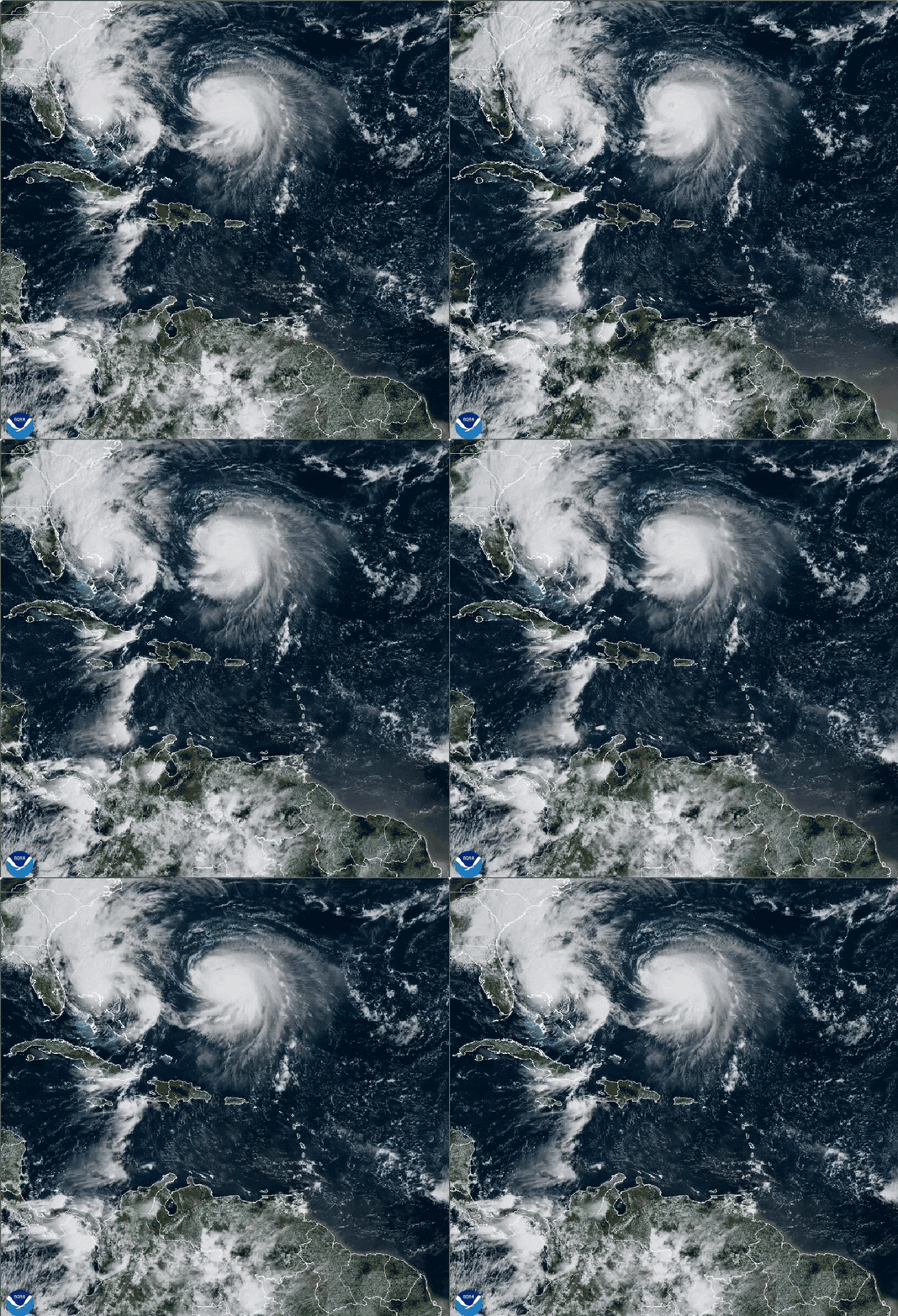
The U.S. Southeast will likely avoid the worst effects from Tropical Storm Imelda—all thanks to another tropical cyclone.
Imelda and Hurricane Humberto have been churning over the northeastern Caribbean, between the Bahamas and Bermuda, for several days. Last Friday, the forecasts were highly uncertain about Imelda’s path and future strength: the possibilities ranged from the storm making landfall in the Carolinas, which would bring torrential rain and floods, to it not making landfall in the U.S. The latter now looks to be the likely scenario. That’s because Imelda dawdled in its development while Humberto quickly exploded into a major hurricane, which has influenced how much the two storms “feel” each other—essentially a flavor of what is called the Fujiwhara effect. (The East Coast will still feel rip currents from Imelda, though, and the storm could pose a threat to Bermuda as it takes a sharp eastward turn in the coming days.)
The higher-than-usual level of forecast uncertainty can be explained partly by the fact that storms in the Atlantic don’t typically form this close to each other. Tropical cyclones are influenced by the larger atmospheric environment, and adding another storm system makes that environment more complex. Meteorologists were also unclear about exactly where the center of Imelda would ultimately form, which made it difficult to know how that center would interact with other features in the atmosphere.
To get a sense of the atmospheric picture last Friday, it’s helpful to remember that the atmosphere is three-dimensional, with various low- or high-pressure areas or wind currents at various altitudes. In this case, there was a low-pressure area higher up in the atmosphere over the Southeast, an area of high pressure that is quasi-permanently centered roughly over Bermuda, and the two storms—Humberto and what would become Imelda, then called Potential Tropical Cyclone Nine. What wasn’t clear was whether Imelda would form quickly enough and in the right place for it to interact with that upper-level low, which would push it more rapidly north and toward a U.S. landfall. “Hurricanes are governed by the surrounding wind flow, and the quicker [the storm] gets stronger, the more it gets influenced by winds higher up in the atmosphere,” says Alan Gerard, a retired National Weather Service meteorologist, who runs the consulting company Balanced Weather.
But Imelda was very slow to become organized into a full tropical storm, so it has crept northward slowly, leaving it in the perfect spot to feel the pull of Humberto. “Essentially what happens is: you’ve got [westerly] winds around Humberto from the cyclone, and Imelda just gets caught up in that and follows behind,” Gerard says.*
This is a form of the Fujiwhara effect, says University of Miami hurricane researcher Brian McNoldy. In 1921, Japanese meteorologist Sakuhei Fujiwhara theorized that two vortices spinning through fluid (which is exactly what tropical cyclones are) could come close enough to each other to begin orbiting a common central point. If such storms move even closer, they can eventually merge into one, which happened with Hurricanes Hilary and Irwin in the eastern Pacific in 2017.
Imelda and Humberto aren’t close enough for that to happen, but the Fujiwhara effect can take other forms once the distance between two storms is within about 800 miles, and each can “feel” the other, McNoldy says. “The centers of Imelda and Humberto are now just 600 miles apart, and their outer circulations are already communicating,” McNoldy wrote in an e-mail to Scientific American. “Model forecasts bring them even closer together in the coming couple of days.”
Humberto is weakening the quasi-permanent ridge over Bermuda and opening up a path to pull Imelda behind it. Essentially, “Imelda is caught up in Humberto’s wake,” Gerard says.
Though this reduces the risks to the U.S., the interaction could mean that Imelda will pose more of a direct threat to Bermuda than Humberto will; the latter will travel a few hundred miles to the north of the islands.
.
 NOAA/NESDIS/STAR
.
.
Click the link below for the complete article:
.
__________________________________________
October 5, 2025
Mohenjo
Business, Food For Thought, Human Interest, Political, Science, Technical
amazon, business, Business News, current-events, Future, Hotels, human-rights, medicine, mental-health, research, Science, Science News, technology, Technology News, travel, vacation

Hmmmm… Does Trump want civil war?
Click the link below the picture
.
Confidence among Trump supporters about the nation’s trajectory is slipping, according to new polling.
YouGov/Economist polling shows that at the start of September, 75 percent of Trump voters said the country was headed in the right direction, while just 17 percent believed it was on the wrong track. By the end of the month, those numbers shifted to 70 percent and 22 percent, respectively—a net negative swing of 10 points.
The YouGov/Economist poll is not the first to show that Republicans are growing increasingly pessimistic. The latest Gallup poll showed a fall in optimism about the direction of the country among Republicans to 68 percent in September, from 76 percent in August.
And according to AP-NORC, the share of Republicans saying the U.S. is headed in the wrong direction has surged from 29 percent in June to 51 percent in September. Among Republicans under 45, that number leapt by 30 points to 61 percent.
A Marquette poll from this month also reflected declining optimism, showing Republican satisfaction with the country’s direction falling from 79 percent in July to 70 percent in September.
The drop in optimism comes after a turbulent September for the Trump administration. The killing of conservative activist Charlie Kirk rattled parts of the movement, while the White House faced backlash over what critics described as a crackdown on free speech following the decision by ABC News to take the Jimmy Kimmel show off air after his remarks about Kirk. The month closed with a bitter standoff in Washington that led to a government shutdown, fueling further uncertainty.
Concerns About Political Violence
The death of Charlie Kirk has ignited concerns among Republicans about political violence, according to polling.
A Quinnipiac poll found that a majority of Republicans (60 percent) believe the U.S. is in a political crisis. YouGov polling also found that 67 percent of Republicans think political violence is a very big problem.
And a Marquette survey shows that Republicans see political violence as a serious problem, but they overwhelmingly blame the left for it. More than half of Republicans (57 percent) say left-wing violence is the bigger issue, while only 3 percent point to right-wing violence. At the same time, they are less likely than Democrats to connect aggressive political language to an increased risk of violence—just 39 percent of Republicans say heated rhetoric makes violence much more likely, compared to 63 percent of Democrats.
Meanwhile, Gallup polling shows that the fallout from Kirk’s assassination has shifted Americans’ sense of national priorities. Gallup found mentions of crime or violence as the country’s top problem rose from 3 percent in August to 8 percent in September, the highest in five years. Concern about national unity doubled from 5 percent to 10 percent, the highest since the aftermath of January 6.
But partisan divides are clear. Republicans drove most of the increase in concern about crime, jumping from 6 percent to 14 percent, while independents fueled the spike in unity concerns, climbing from 5 percent to 13 percent.
Republicans have responded with near-uniform outrage and grief to the assassination of Kirk, describing his killing as both a personal tragedy and a political turning point.
Trump was among the first to speak out, calling Kirk’s death a “dark moment for America” and praising him as “a tremendous person” who devoted his life to the conservative cause.
Within days, he ordered flags to be flown at half-staff and announced that Kirk would receive the Presidential Medal of Freedom posthumously. At a memorial service in Arizona, Trump elevated Kirk as a “martyr for American freedom” and placed blame on the “radical left” for creating what he described as the climate of hostility that led to the shooting.
Other Republican lawmakers struck similar notes. Senate Majority Leader John Thune and Senator Mike Lee both praised Kirk’s influence on the conservative movement and condemned the violence that ended his life, calling the assassination a reminder of America’s increasingly dangerous political climate.
Vice President JD Vance also echoed Trump’s framing, urging supporters to treat the killing not just as an act of violence, but as part of a broader cultural battle, warning that those who mocked Kirk’s death online were contributing to the same climate the president condemned.
But Peter Loge, director of the Project on Ethics in Political Communication at George Washington University, told Newsweek that it is exactly this kind of rhetoric that is contributing toward the growing sense of dissatisfaction with the country’s trajectory.
.
 President Donald Trump walks from Marine One after arriving on the South Lawn of the White House, Tuesday, Sept. 30, 2025, in Washington. (AP Photo/Alex Brandon)
.
.
Click the link below for the complete article:
.
__________________________________________
October 5, 2025
Mohenjo
Business, Food For Thought, Human Interest, Political, Science, Technical
amazon, business, Business News, current-events, Future, Hotels, human-rights, medicine, mental-health, research, Science, Science News, technology, Technology News, travel, vacation

Click the link below the picture
.
Prime Minister Benjamin Netanyahu of Israel took much personal credit this weekend for an emerging plan to free all remaining hostages from Hamas and end the two-year war in Gaza.
But it was abundantly clear to Israelis, and to Palestinians and others in the region, that the one calling the shots was President Trump.
Mr. Netanyahu asserted in a brief, televised address to the nation on Saturday that the plan was the result of a diplomatic move that he had coordinated over weeks, and jointly presented, with Mr. Trump and his team.
Mr. Trump told it a bit differently. In a conversation on Saturday with a leading Israeli correspondent for Axios and for Israel’s most popular news channel, the president suggested that he had strong-armed a somewhat reluctant Mr. Netanyahu into accepting the terms.
“I said, ‘Bibi, this is your chance for victory,’” Mr. Trump related, referring to Mr. Netanyahu by his nickname. “He was fine with it,” Mr. Trump continued, adding, “He’s got to be fine with it. He has no choice. With me, you got to be fine.”
Mr. Netanyahu is in no position to defy Mr. Trump while facing international censure over Israel’s conduct in the war and growing international isolation, analysts say, increasing its reliance on the United States.
“Trump doesn’t threaten Netanyahu; he orders him,” wrote Nahum Barnea, a prominent Israeli political columnist, in Sunday’s Yedioth Ahronoth, a mainstream Hebrew daily, in an article with the headline “He’s the Boss.”
The turn of events in recent days “clearly illustrated that state of affairs to everyone,” Mr. Barnea continued, referring to Mr. Trump’s ultimatum to Hamas on Friday to accept the proposal, followed hours later by the president’s interpretation of a highly qualified acceptance by the militant group as an unqualified yes.
Israelis then learned from Mr. Trump, via a social media post on Saturday, that Israel had already agreed to an initial withdrawal line within Gaza for the first phase of the deal, which proposes exchanging about 20 living hostages and the bodies of about 28 believed to be dead for 250 Palestinian prisoners serving life terms and hundreds more Gazans detained during the war.
Once Hamas signs on, Mr. Trump announced in the same post, a cease-fire would “IMMEDIATELY” go into effect.
For months, Mr. Netanyahu has been engaged in a delicate balancing act. He has been determined to fulfill his pledge of total victory over Hamas, whose attack on Israel on Oct. 7, 2023, ignited the war, and to ensure his own political survival by appeasing his far-right coalition partners who oppose any deal that leaves Hamas standing.
At the same time, the humanitarian crisis in Gaza, where tens of thousands of Palestinians have been killed and hunger has run rampant, has stirred global wrath. Polls have shown that a majority of Israelis, long skeptical of the chances of a “total victory,” favor ending the war in order to get the hostages back. And Mr. Trump’s patience appears to have worn thin.
“It doesn’t look like Hamas is leaving, and it doesn’t look like the total victory he promised,” Mitchell Barak, an Israeli pollster who worked as an aide to Mr. Netanyahu in the 1990s, said of the prime minister. “I think he realized his credit with Trump ran out.”
Unlike the defiant stance Mr. Netanyahu often took against the Biden administration or President Barack Obama, Mr. Barak said, “For the first time, Netanyahu cannot disregard the wishes of an American president, because of the way Trump operates. Trump is unpredictable and will not fall in line with the Israeli position.”
That has become more evident in recent days as Mr. Trump has weighed his relations with Mr. Netanyahu against his interests and ties with other countries in the region, including Turkey, whose leader, President Recep Tayyip Erdogan, has used harsh rhetoric against Israel, and Qatar, a country that Mr. Netanyahu recently accused of harboring terrorists.
Only two months ago, Mr. Netanyahu’s government approved a plan to expand the war by taking control of Gaza City, a risky decision that went against the recommendations of the Israeli military. Israeli leaders described the city as one of Hamas’s last bastions and presented the operation as an essential step toward wiping out the group’s military and governing capabilities.
.
 Prime Minister Benjamin Netanyahu of Israel at the White House following a meeting with President Trump last week.Credit…Doug Mills/The New York Times
.
.
Click the link below for the complete article:
.
__________________________________________
Older Entries
Newer Entries
 James' World 2