About half of working women reported feeling stressed “a lot of the day,” compared to about 4 in 10 men, according to a Gallup report published this week.
The report suggests that competing demands of work and home comprise part of the problem: working women who are parents or guardians are more likely than men who are parents to say they have declined or delayed a promotion at work because of personal or family obligations, and mothers are more likely than fathers to “strongly agree” that they are the default responders for unexpected child care issues.
And 17% of women overall report having to address personal or family responsibilities at work “daily” or “several times a day,” compared with 11% of men overall.
“There’s been much attention and discussion about promoting women’s well-being and helping women succeed as leaders in the workplace. But at the same time, we’re seeing record levels of stress, of worry, of burnout for women,” said Gallup managing director Ilana Ron Levey at an event on Wednesday presenting the research findings, which were based on four separate surveys of nearly 20,000 adults working full time or part time, conducted between February 2023 and October 2024.
But changing workplace culture and prioritizing well-being can improve the problem, according to Karen Guggenheim, creator of the World Happiness Summit and CEO of WOHASU, the organizing body behind the event and other well-being initiatives.
“Why do we have to choose? Why are we creating environments where people have to make a choice between being the most amazing parent, partner, friend, daughter, sister, whatever, and also thriving at work?” she said, adding: “Investing in women well-being isn’t just good business – it’s a blueprint for societal progress.”
The survey, which also found that working mothers are nearly twice as likely to say they have considered reducing their hours or leaving their job altogether because of child care issues compared to working fathers, also highlights the fallout of the country’s child care crisis weeks ahead of the start of President-elect Donald Trump’s second administration.
Trump has said that child care is “something you have to have in this country” and suggested that his plans to tax imports from foreign nations at higher levels would cover the cost of child care reform, although his campaign website does not mention the issue among the administration’s priorities. Vice President-elect JD Vance has criticized efforts by the Biden administration to control rising costs in child care centers, arguing that doing so encourages parents to go back to work and neglects those who prefer to care for their children at home.
Regarding prohibitively high child care costs —- which can exceed the cost of rent for some families, according to a Department of Labor report published last month — Vance suggested parents should lean more on family members for care.
But juggling work and family responsibilities can be draining for both men and women, who are about as likely to report thinking about work during personal time, the Gallup report found.
Yet researchers also found that employers can significantly improve well-being by supporting work-life balance: Women who say they are able to maintain a healthy balance between work and personal commitments are more likely to be engaged at work, and less likely to be actively looking for a new job, the report says.
Organizations can take action by establishing informed policies, programs, and resources, positioning managers to be the support system employees need, and prioritizing a culture of well-being, explained Kristin Barry, director of hiring analytics at Gallup.
And with women comprising nearly half of the workforce and the narrowest workforce participation gender gap in U.S. history, “turning a blind eye to this challenge women are facing means we are not going to accomplish our goals,” Barry said.
.
FILE – A display of clothes is organized at a retail store on Nov. 25, 2022, in New York. (AP Photo/Julia Nikhinson, File)
Bold hues of red, orange, yellow, blue, and purple help plants and animals communicate with their own species and others in their efforts to survive. Vivid orange dart frogs warn predators of their toxicity. Different birds use a rainbow of plumage to attract mates. Flowers in a rainbow of colors lure birds and bees to disperse pollen and seeds.
The coloration of living things has evolved slowly: colorful fruitlike seeds started dotting an otherwise bland landscape around 300 million years ago, vibrant flowering plants appeared 100 million years later, and animals—namely cockroaches and butterflies—started sporting bolder pigmentation 70 million years after that. But now, in a puzzling twist, new research shows that animals’ ability to perceive many colors came long before the colors themselves existed for them to see.
A recent study in Biological Reviews found that color vision dawned about 500 million years ago—against a drab backdrop of browns and grays and muted shades of some other colors. And it wasn’t until around 400 million years later that bright colors expanded across vertebrates and arthropods (a group of invertebrates with an exoskeleton, such as insects and spiders). “There was this long lag time between the explosion of color and the origins of color vision,” says John J. Wiens, a co-author of the study and a professor of ecology and evolutionary biology at the University of Arizona.
Researchers previously pinpointed the origination of various coloration using a diagram called a phylogenetic tree, which maps organisms’ genetic relationships to one another. This, coupled with fossils that happened to include preserved pigments, allowed evolutionary biologists to trace bright coloration back to the first types of organisms to carry this feature. Wiens and his co-author Zachary Emberts, an integrative biologist at Oklahoma State University, took that work further, analyzing genes that encode protein receptors in animals’ visual system to determine when a species could perceive color. By analyzing the timeline of color vision and that of conspicuous coloration, the study showed that hundreds of millions of years elapsed between the development of the former and the latter.
An evolutionary trait almost always occurs for a reason; this raises the question of why animals would gain the ability to see distinctions in bright color long before they would need to. According to the new study, color vision likely played an important role in early species’ ability to see whether a plant had living green leaves or dead brown ones or to pick a predator out of the background. Color vision also probably proved especially important underwater, where vertebrate species first evolved, for differentiating hues that resulted when light was filtered through the liquid. “In a marine environment, there’s a lot of motion where light is moving, so color vision would have been especially helpful in navigating underwater,” Wiens says.
The study’s scope is impressive but doesn’t tell the whole story of color vision, says Innes C. Cuthill, a professor of behavioral ecology at the University of Bristol in England, who was not involved in the research but provided comments for the manuscript. This research focused on trichromatic color vision—the type of visual color perception that humans possess; it didn’t look at ultraviolet (UV) vision, which most insects have. Bees, for example, use UV light to distinguish different flowers. “The colors that we see aren’t what matters to most animals,” Cuthill says.
Wiens acknowledges that many aspects of color vision are still a mystery. “There’s a very long fuse before this explosion of color occurred,” he says, “and we don’t really know why.”
.
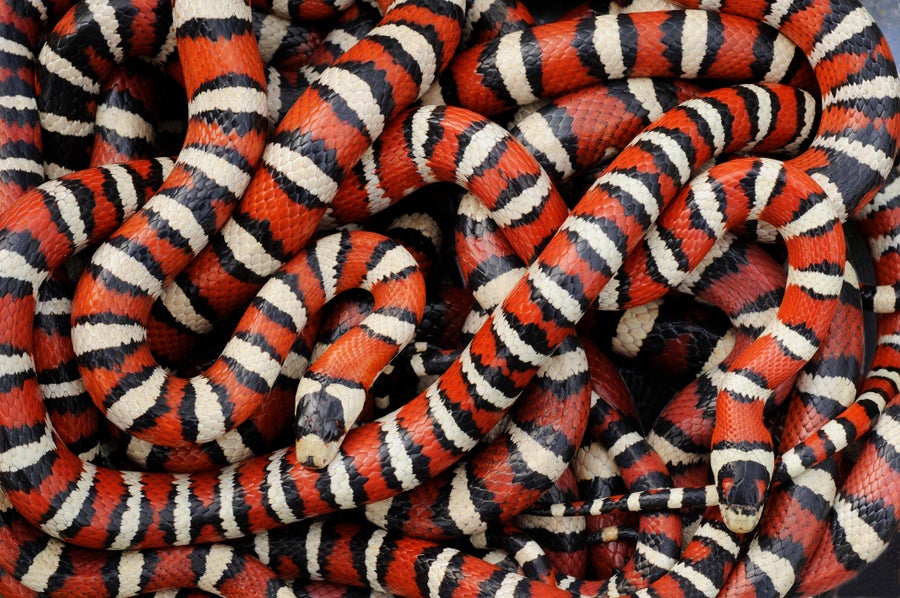
The nonvenomous Arizona mountain kingsnake, which resembles a venomous coral snake, has a survival advantage by warning off would-be predators that avoid colorful coral snakes. Daniel Heuclin/Nature Picture Library/Alamy Stock Photo
In the United States, strokes are a top cause of death and a major cause of disability, according to the American Stroke Association. This is a scary reality, especially since many of the stroke risk factors are pretty silent (like high cholesterol and high blood pressure) ― until they’re not.
But just because some of the risk factors aren’t always obvious doesn’t mean strokes can’t be controlled. In fact, it’s estimated that 80% of strokes are preventable through lifestyle changes like exercise, diet, and more, according to the Centers for Disease Control and Prevention.
No one knows that more than the experts who treat the issue. Stroke doctors say they think a lot about the key ways to lower their risk (and their patients’ risk) of stroke.
“I like to think of it more proactively — what I could do to prevent stroke,” said Dr. Anthony Kim, a vascular neurologist and medical director of the University of California at San Francisco Stroke Center.
Below, stroke doctors share the habits they personally avoid ― and why you should avoid them, too.
Have A Sedentary Lifestyle
According to Dr. Arthur Wang, director of endovascular neurosurgery at Tulane University School of Medicine, one of the modifiable risk factors for stroke is having a sedentary lifestyle.
While there isn’t one across-the-board definition of a sedentary lifestyle, overall, it means spending too much time sitting or lying down and not enough time exercising or moving around.
“It’s been shown that regular physical activity helps keep your blood vessels clog-free. It stops the buildup of plaque in the arteries,” Wang said. “And so we generally recommend that people get probably 30 minutes of moderate exercise maybe five times a week.”
This could mean going for walks, runs, biking, gardening, or joining a group workout class — there is no wrong way to get moving.
Ignore High Blood Pressure
“It turns out that a lot of the same things that we would recommend for a healthy lifestyle also reduce the risk of both heart disease and stroke,” Kim said. “But if there’s one factor that is the most impactful it would be blood pressure, blood pressure, blood pressure.”
Elevated blood pressure, particularly over time, can lead to problems, he said: High blood pressure is the biggest modifiable
stroke risk facto
“If you took a magic wand and waved it and suddenly eliminated high blood pressure from the U.S. population, there would be 60% fewer strokes,” Kim said. “It’s by far the leading risk factor for stroke and we call it the silent killer because oftentimes, patients don’t feel it; you have to have it checked and monitored and treated.”
If you took a magic wand and waved it and suddenly eliminated high blood pressure from the U.S. population, there would be 60% fewer strokes.Dr. Anthony Kim, University of California, San Francisco, Stroke Center
.
It’s important to lead an active lifestyle, eat nutritious foods, and manage things like your blood pressure, doctors say.
Have you experienced that awkward moment when you meet a new colleague, notice a visible disability, and suddenly, all you know about everyday social interaction seems to go out the window? You are not sure what to say, what not to say, or where to look (or not to look). You worry about being inappropriate.
Or maybe it’s not a new colleague. Instead, someone you’ve been around a lot develops a serious health condition. Again, suddenly, you don’t know how to interact, what to ask, what not to ask. You are walking on eggshells.
Discomfort around disability is well-documented. But how do we make sure the discomfort does not turn into discrimination?
The Elephant in the Room: Disability Discomfort
Most of us have some underlying anxiety when it comes to interacting with disabled people. It’s not that we’re cruel or indifferent—it’s that we’re afraid of doing or saying something wrong. We might not fully understand what a person’s experience is like, and this lack of understanding contributes to awkward tension. Worse yet, the elephant grows bigger as we try to avoid it.
Disability discomfort isn’t malicious, but it has serious consequences. When discomfort takes over, it often leads to avoidance. Conversations become shorter—or don’t happen at all. Invitations to coffee, team outings, or professional opportunities dry up. Over time, a disabled colleague may find themselves excluded, not because anyone intended harm, but because discomfort made inclusion feel “too complicated.”
This is how discomfort-driven discrimination happens. It’s not always about overt prejudice. Sometimes, it’s about the small ways people signal, “I don’t know how to interact with you, so I won’t.”
Discomfort is Normal. Discrimination is Not
Let’s clear something up: Feeling awkward around disability doesn’t make you a bad person. Most of us were raised in societies where disability was rarely discussed or openly visible. Where most parents taught their kids to avert their eyes in the face of visible disability and did their darnest to hide their own non-apparent conditions.
So when you encounter disability, your brain fumbles. That fumbling is okay. What’s not okay is letting that discomfort stop you from treating someone with the same respect, dignity, and humanity you extend to everyone else.
How to Turn Awkwardness Into Allyship
So, what can you do when disability awkwardness strikes? Here are some tips to help you navigate these moments with grace—and ensure your discomfort doesn’t unintentionally hurt someone else.
Of all the adjectives that come to mind when you think about scientific research, “cute” probably isn’t at the top of the list. But scientists make plenty of “aw”-inspiring findings every year, from dog facial expressions to the invention of “frog saunas.” Here, Scientific American rounds up a few of our favorite discoveries from this year that are downright adorable.
Singing in Their Sleep
Some people talk in their sleep. Dogs “sleep bark.” Certain birds, it turns out, practice their singing while they snooze. Scientists had previously noticed that some birds seemed to make movements that resembled lip-syncing (beak-syncing?) while they dozed. To see what was a going on, researchers implanted electrodes in the brains of Zebra Finches and Great Kiskadees. The finches, which tend to learn new sounds and songs, seemed to silently rehearse their tunes, whereas the Great Kiskadees, with their more limited repertoire, did not.
s touching heads as a way to communicate with one another.
David Merron Photography/Getty Images
Mighty Morphin’ Melons
Belugas are pretty adorable on their own, but it gets even better: These whales have a mass of fat tissue on their forehead called a “melon” (yes, that’s the technical term), which they move around to communicate with one another. Researchers monitored belugas at Connecticut’s Mystic Aquarium and found that they morph their melon in distinctive ways, such as shaking it or pushing it forward or back. What the whales are communicating isn’t yet clear, but certain morphs could be used to flirt or to signal aggression.
Bear Hugs?
“If not friend, why friend-shaped?” So goes the Internet meme that wants to know why bears looks so cuddly when they are definitely not an animal you’d be advised to hug.
Scientific American editors spoke with experts about why we have an affinity for bears. Some of it likely comes from their role in our cultures (in folklore, for example), as well as humans’ and bears’ similar preferences for where to live and what to eat. The animals’ particular physical features might draw us in, too. Bears have a big nose you kind of want to “boop,” like you would a dog’s, as well as fluffy fur and rounded ears. And their chubby face may trigger our nurturing reflexes by reminding us of our own babies.
.
Close-up of playful European brown bear (Ursus arctos arctos) cubs in the woods of Finland. Dgwildlife/Getty Images
Please give us the elevator pitch of your business. I am Corry Banks, founder and operator of Modbap Modular, a Black-owned boutique manufacturer of electronic musical equipment based in Southern California. We’re dedicated to crafting innovative and performance-focused instruments tailored to the unique approaches of DJs and beatmakers. By combining modular synthesis with beat-making styles like boom bap, Modbap Modular aims to expand the boundaries of beat-making composition and empower musicians to experiment with their craft. We take pride in making our instruments accessible, as they are available in over 40 electronic music stores worldwide, including locations in North America, Europe, and Asia.
When did it launch and what is your role/title? Modbap was launched in the fall of 2020, specifically on 10/10/2020. By the time it hit the market, I had been working on my initial product for about a year. The beginning of the pandemic delayed the launch by a few months, but we pushed through. My official and on-paper role is President of Modbap Modular. I’ve come to realize that I am a product designer, and it is one of the most gratifying things that I’ve ever done.
What inspired you to create this business? Well, I am a beatmaker. I make boombap beats. I spent some years blogging about it and all the related topics like music equipment. I also have a background in IT and a degree in electronics. Somehow, all these things converged to sort of push me in the direction of creating something that I wanted but didn’t seem to exist in the marketplace. I realized that I was uniquely positioned to fill a void for the types of products that I design and that I aspire to design.
My “aha moment” was truly a “Wait, THAT’S it!!” kind of experience. I was preparing for a live beat set featuring my original compositions. As I took stock of all the gear I needed for my performance, I realized it was overwhelming—far too much stuff! I found myself wishing that a particular device could fit into my Eurorack performance case instead. So, I decided to share my thoughts on Instagram, posting a photo of that device with the caption, “Someone needs to make something like this in Eurorack format.” Just like that, I deleted the post, grabbed my sketchbook, and got to work.
Please tell us one “holy @#$!” moment on your business journey. That moment and the most memorable day for me was the launch day of my first product. I was hosting a weekly beatmakers podcast called BeatPPL Podcast. I announced on my social media that I had exciting news about the launch of the first Modbap product. I’d made the product available for preorder, and the plan was to go live, share the announcement, and showcase the production-ready final prototype of the product. The launch exceeded my expectations, and by the end of the weekend, I found myself needing to revise my initial purchase order with the manufacturer three or four times to meet the demand. It was an exhilarating moment, but I also had to pause and ask myself, “Am I really ready for this?” I was confident that the product was solid and ready to succeed, but I suddenly found myself confronted with the responsibility of running a company and making a genuine effort to make it work. Ultimately, I felt prepared for the challenge, and it has been a continuous and rewarding learning experience.
At a press conference last week at NASA headquarters in Washington, D.C., agency leadership announced that lingering hardware issues have forced NASA to push back Artemis II—a four-person crewed flight in an Orion spacecraft around the moon and back to Earth—from September 2025 to April 2026.
Most observers had already considered a 2025 launch unlikely. That Orion craft’s ride into space—NASA’s Space Launch System (SLS) rocket—isn’t fully assembled at the agency’s Kennedy Space Center in Florida. That places it behind the pace set by its predecessor, the uncrewed Artemis I mission. Artemis I launched in November 2022, after its SLS had been fully assembled about a year in advance.
“The safety of our astronauts is always first in our decisions; it is our North Star,” said NASA administrator Bill Nelson in a press conference at the agency’s headquarters. “We do not fly until we are ready. We do not fly until we are confident that we have made the flight as safe as possible for the humans onboard. We need to do this next test flight, and we need to do it right—and that’s how the Artemis campaign proceeds.”
That said, agency officials are also thinking bigger about the program’s planned missions.
As originally conceived, Artemis II was a 2020s version of the 1968 mission Apollo 8, a no-frills journey around the moon and back to Earth to prove out NASA’s ability to send people safely to and from the lunar vicinity. But now that development of SpaceX’s Starship rocket is progressing rapidly, NASA officials are considering increasing the scope of Artemis II. Starship is intended to land NASA astronauts on the moon’s surface during the subsequent Artemis III mission, making the private rocket a crucial pillar of the public space agency’s ambitious plans for crewed lunar return.
NASA is now exploring the possibility of launching a Starship in parallel with Artemis II, with an eye toward possibly rehearsing the sorts of maneuvers that will need to be performed between Starship and Orion during Artemis III, which would be the first crewed moon landing attempt since 1972.
“We always want to look for ways to exploit new technology [and] new capabilities that, even five years ago, seemed like they were a bit out of reach,” said Reid Wiseman, Artemis II’s commander, at last week’s press conference. “You’re going to ask an astronaut to do more on their mission? Bring it on.”
.
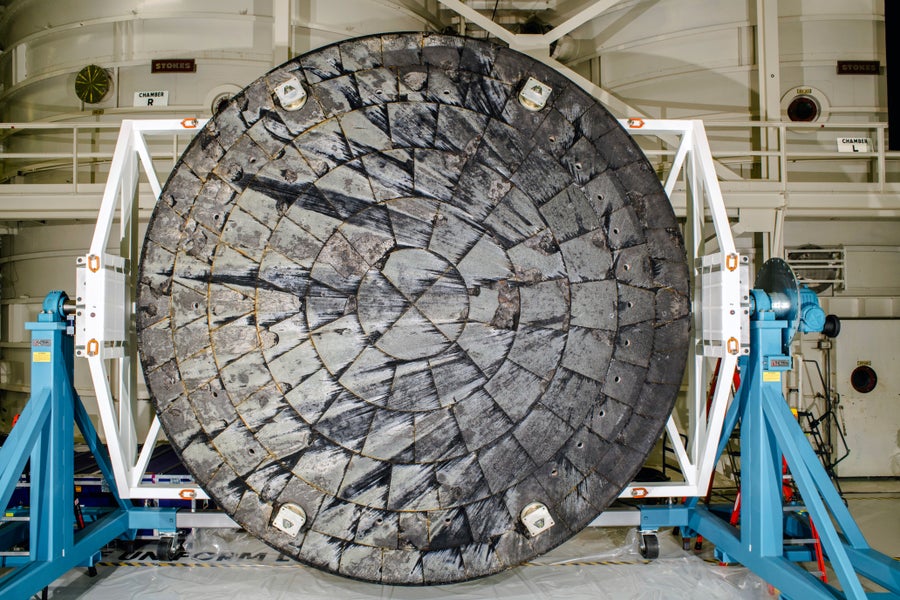
The damaged heat shield of NASA’s Orion crew spacecraft, as seen after the Artemis I lunar test flight. The scorching temperatures of atmospheric reentry eroded the heat shield more than expected, contributing to delays for the Artemis program. NASA
The first time I thought about leaving the US was in mid-2020. I was frustrated with how the pandemic was handled and was looking for a reason to leave the country.
I was born in New York and grew up around the East Coast. I attended college in North Carolina, where I studied math and economics, but dropped out in my third year in 2017.
Around the time, I became interested in Silicon Valley — it felt like a meritocratic place where people could take their own path. After leaving college, I worked as a baseball analyst and traveled between Seattle and San Francisco.
When the pandemic hit, I dropped plans to move to San Francisco. I thought the city was declining, and I preferred my lifestyle in Seattle. I was working for a startup with two Indian cofounders. When they
decided to pursue the business full time, they faced visa challenges and had to move back to India. So, in 2021, I tagged along to visit India for the first time, traveling to Mumbai and Bengaluru.
On that trip, I met my wife, an American teacher in India. I also stumbled upon the idea for what would eventually become Commenda — the company I cofounded.
I came up with the idea for my company in India
I was talking to local founders in Mumbai who faced challenges registering or expanding their businesses in other countries. There are hundreds of multilateral trade agreements between countries and thousands of bilateral trade agreements, and no tool for businesses to navigate them.
There are 8,760 hours every year, and the average person will spend about 1,992 of them at work, or more than a fifth of their lives. Your relationship with your job is usually defined by your relationship with your coworkers and your boss—especially your boss, who has a lot of control over your day-to-day experience at your job, and thus a lot of control over one-fifth of your life (or more). A toxic boss can make life a misery.
When your boss is openly campaigning to get rid of you, it’s bad enough—but at least you know what’s happening. Sometimes a boss doesn’t want to come out and fire you, so they decide to manage you out instead. “Managing out,” sometimes called “quiet firing,” is a technique wherein your boss makes your job so intolerable you voluntarily quit, saving them the trouble of justifying your termination. It can make you miserable, but you can at least take steps to protect yourself. Here’s what you can do if you’re being managed out of your job.
The Signs
The first step in defending yourself from being managed out of your job is to recognize the signs that it’s happening. While these might seem obvious in a list (or in retrospect), in reality, they can often happen subtly, over a period of time. Here’s what to look for:
Negative dynamic. You don’t have to be besties with your boss, but in a normal, functioning work environment there’s at least a superficial sense of camaraderie. If your boss becomes unexpectedly (and inexplicably) cold and hostile toward you, it might indicate that you’ve become a problem they’d very much like to go away all by itself.
Reduction of responsibility. If you’re being given less to do, not being invited to meetings, and left off of email chains and Slack chats, your first reaction might be to enjoy the extra time and reduced stress. But this is often the result of a manager hoping you’ll take the hint and go away. Check in with your co-workers: If they’re just as busy as ever, or busier, that’s a clear sign you’ve been cut out.
Lack of reward. If you haven’t received a raise or promotion—or even a compliment—in some time, it could be a sign that your manager has checked out on your career and is just hoping you move on to a new role somewhere else.
Micromanaging. A manager who suddenly scrutinizes everything you do and comes up with regular lists of complaints and errors made might be making it clear that you’re not wanted. Good managers will usually try to help an employee address mistakes or missing skills instead of simply making them feel incompetent—if there’s no support, only constant disdain, they might be sending you a message.
Impossible tasks. Your manager hasn’t said anything negative, but they’ve given you performance goals or tasks that no one could possibly meet? They might be hoping you give up and move on.
f you see one or more of these signs, you might be in the midst of a campaign to manage you out. Here’s what you need to do.
Investigate
Your first step is to try to determine what’s changed—why your boss is suddenly eager for you to go away. The most efficient way to accomplish this is to set up a meeting with your boss, framed either as a formal performance review or a more informal check-in. While your boss probably won’t outright admit they want you to quit, you might be able to at least figure out why you’re suddenly unwanted.
This is crucial because some reasons for being managed out can be addressed. If budgets have shrunk, and your boss is trying to cut heads without having to fire someone, you might offer to take on extra duties, or find a way to transfer to a different project or department—and they might even help you do so, since it would solve their problem. If there’s a performance-related reason for the animosity that hasn’t made it into your reviews, that might also be addressable, and if your boss doesn’t think you’re capable, you might be able to change the tone of the conversation by having a plan to upskill. And it’s always possible that the quiet firing is due to some kind of misunderstanding that has led to a personal animosity, and the air could be cleared.
If there’s no clear answer and the only thing your conversation confirms is that your boss would be happy to see less of you, there’s value in that certainty, at least.
Modern humans have lived on Earth for more than 300,000 years, but we’re still discovering tons about this massive breathing rock we call home. From its deep 4.5-billion-year history to its current mysteries, here are six mind-blowing things we’ve learned about Earth in 2024.
Life-Giving Catastrophes
The news begins with an event that occurred 3.26 billion years ago, when a massive asteroid—some 50 to 200 times larger than the one that drove the nonavian dinosaurs extinct—slammed into the young Earth. This “S2 impact” devastated the planet and its early, simple life, new research shows. But it also triggered key changes that would allow organisms to eventually thrive, in particular by sending crucial nutrients into the ocean. Despite the apocalyptic nature of the impact, then, the bacteria that managed to survive might have ultimately become better off than they were before the collision.
Ancient Seafloor Found Suspended below Pacific Ocean
The Pacific Ocean is massive and hides some impressive secrets. One we learned about this year is a slab of seafloor dating back some 250 million years, shortly before the emergence of the earliest known dinosaurs. Researchers discovered the slab trapped some 410 to 660 kilometers below Earth’s surface. The ancient rock is slowly descending within a strange blob of Earth’s outer core that protrudes into the planet’s rocky mantle.
“Dark Oxygen” from the Seafloor
A favorite genre of scientific discovery is the one that begins with data so strange that researchers think something is wrong with their instruments. That’s what happened to a team studying oxygen levels on the seafloor in a region of the Pacific Ocean called the Clarion-Clipperton Zone. “I literally told my students, ‘Throw the sensors in the bin. They just do not work,’” said Andrew Sweetman, who studies seafloor ecology and biogeochemistry at the Scottish Association for Marine Science, in an interview with ScientificAmerican. It turns out the sensors were fine, and they alerted researchers to a strange process by which metallic deposits on the seabed produce mysterious “dark oxygen.”
What Caused This “Unidentified Seismic Object”?
In September 2023 earthquake sensors around the world reported a strange, monotonous hum unlike any seismic signal ever before detected—and it lasted for nine days. Scientists classified the source of the hum as an “unidentified seismic object” and then set to work trying to identify it. Just this year they determined that the signal was caused by a massive landslide in Greenland’s Dickson Fjord. The landslide triggered a tsunami, followed by a seiche, or a wave that sloshed back and forth within the confined fjord for more than a week.
Earthquakes Forge Gold Nuggets
Large gold nuggets found in Earth’s crust puzzled geochemists, who understood how dissolved gold seeping into cracks in the mineral quartz could create small deposits but not how larger ones could come to be. New research, however, suggests that earthquakes might do the job via a phenomenon called the piezoelectric effect—by which certain materials can produce an electric charge when exposed to mechanical stress. Quartz is piezoelectric, so scientists tested whether forces similar to seismic waves could generate enough charge to make gold nanoparticles start to build up. Preliminary results suggest this effect is enough.
Film and Writing Festival for Comedy. Showcasing best of comedy short films at the FEEDBACK Film Festival. Plus, showcasing best of comedy novels, short stories, poems, screenplays (TV, short, feature) at the festival performed by professional actors.





 [Source Photo: Ivan Samkov/Pexels]



 Spencer Schneier


 James' World 2