
Click the link below the picture
.
At a press conference last week at NASA headquarters in Washington, D.C., agency leadership announced that lingering hardware issues have forced NASA to push back Artemis II—a four-person crewed flight in an Orion spacecraft around the moon and back to Earth—from September 2025 to April 2026.
Most observers had already considered a 2025 launch unlikely. That Orion craft’s ride into space—NASA’s Space Launch System (SLS) rocket—isn’t fully assembled at the agency’s Kennedy Space Center in Florida. That places it behind the pace set by its predecessor, the uncrewed Artemis I mission. Artemis I launched in November 2022, after its SLS had been fully assembled about a year in advance.
“The safety of our astronauts is always first in our decisions; it is our North Star,” said NASA administrator Bill Nelson in a press conference at the agency’s headquarters. “We do not fly until we are ready. We do not fly until we are confident that we have made the flight as safe as possible for the humans onboard. We need to do this next test flight, and we need to do it right—and that’s how the Artemis campaign proceeds.”
That said, agency officials are also thinking bigger about the program’s planned missions.
As originally conceived, Artemis II was a 2020s version of the 1968 mission Apollo 8, a no-frills journey around the moon and back to Earth to prove out NASA’s ability to send people safely to and from the lunar vicinity. But now that development of SpaceX’s Starship rocket is progressing rapidly, NASA officials are considering increasing the scope of Artemis II. Starship is intended to land NASA astronauts on the moon’s surface during the subsequent Artemis III mission, making the private rocket a crucial pillar of the public space agency’s ambitious plans for crewed lunar return.
NASA is now exploring the possibility of launching a Starship in parallel with Artemis II, with an eye toward possibly rehearsing the sorts of maneuvers that will need to be performed between Starship and Orion during Artemis III, which would be the first crewed moon landing attempt since 1972.
“We always want to look for ways to exploit new technology [and] new capabilities that, even five years ago, seemed like they were a bit out of reach,” said Reid Wiseman, Artemis II’s commander, at last week’s press conference. “You’re going to ask an astronaut to do more on their mission? Bring it on.”
.
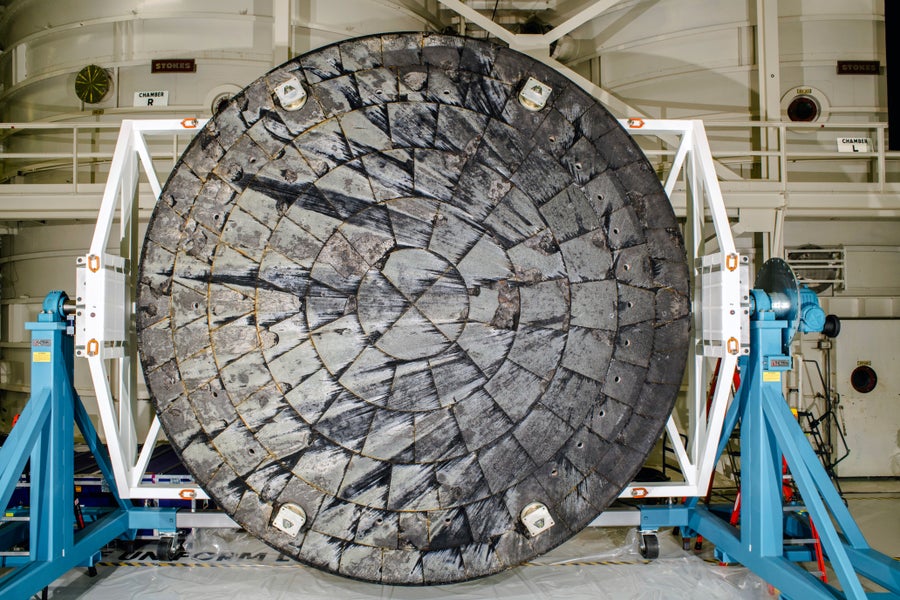
The damaged heat shield of NASA’s Orion crew spacecraft, as seen after the Artemis I lunar test flight. The scorching temperatures of atmospheric reentry eroded the heat shield more than expected, contributing to delays for the Artemis program. NASA
.
.
Click the link below for the complete article:
.
__________________________________________


Leave a comment