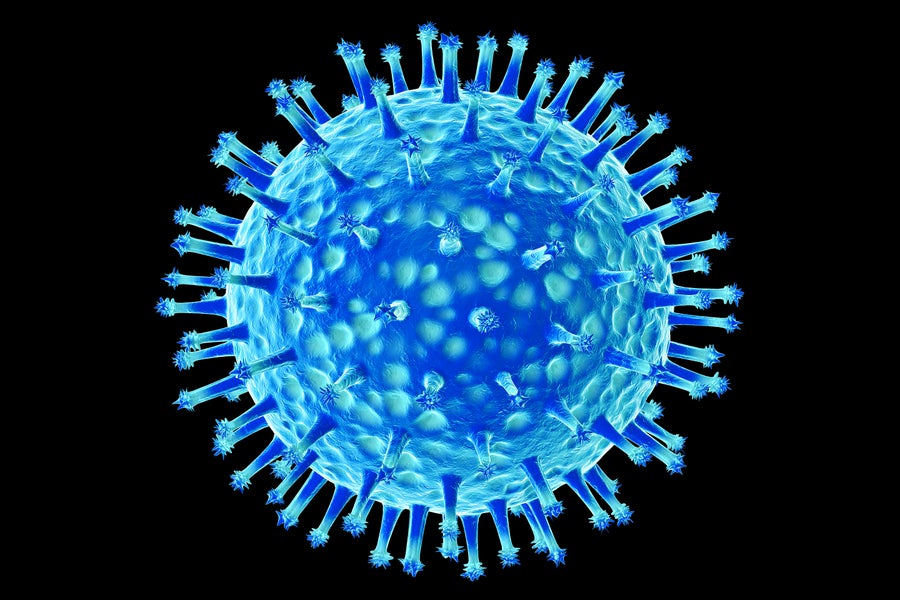
Imagine that the next time you catch a stomach bug and antibiotics fail to work, you knock back a vial of clear liquid. The solution teems with bacteriophages, viruses resembling tiny rocket ships. These benign microbes exclusively dock onto and destroy bacteria, and your infection clears in a matter of days. Such a future is within reach, journalist Lina Zeldovich writes in her new book The Living Medicine: How a Lifesaving Cure Was Nearly Lost―And Why It Will Rescue Us When Antibiotics Fail. The book chronicles the history of a decades-old, sometimes finicky approach to infection that U.S. science has long dismissed in favor of antibiotics.
As microbes develop cleverer and cleverer ways to evade antibiotics, some scientists have returned to bacteriophages, scooping them from wastewater and testing their pathogen-killing abilities in the laboratory and clinic. Experimental trials are now underway to test bacteriophage therapies against superbugs such as Shigella, vancomycin-resistant Enterococcus, and a strain of Escherichia coli implicated in Crohn’s disease. And some food industry producers already use Food and Drug Administration–approved “phage sprays” to decontaminate their supply of, say, lettuce or sausage. (No medical uses of the treatment have yet been approved for the U.S. public.)
Scientific American spoke with Zeldovich about the differences between bacteriophages and antibiotics, the history of bacteriophage experimentation, and the therapy’s potential future regulation and use in the U.S.
How worried should the average person be about antimicrobial resistance?
Many scientists whom I interviewed for the book told me they are very worried that the next pandemic is going to be bacterial because we’re losing our antibiotic armor. In 2019 I found a statistic that said that every 15 minutes, someone in the U.S. dies from an antibiotic-resistant infection. I just couldn’t wrap my mind around that. And COVID only made things worse because people were sicker and used more antibiotics. The United Nations has made some dire predictions that if we continue business as usual and don’t find any viable alternatives to defunct antibiotics by 2050, we’ll start losing millions of people to infection.
What’s driving this resistance? Antibiotic overuse, or reliance on a single type of therapy?
Resistance is an inevitable side effect of evolution: the organisms we want to outcompete will always develop their own defenses. But we also certainly overuse antibiotics in medicine and in agriculture. In the mainstream media, there’s a lot of emphasis on people demanding antibiotics that aren’t necessary. But Big Agriculture plays a much bigger role. When you feed cows, pigs, or chickens antibiotics, they then poop them out into the environment, where the medications continue causing damage. They kill certain soil bacteria but not all. So successful mutants appear in the soil and the water. And then they can arrive on our plates, where we consume them and get sick from them and have no viable treatments left. Hospitals are also superbug breeders because they require sterile environments.
What possible solutions are scientists exploring, and where do bacteriophages fit among them?
Phages are viruses that only infect bacteria. Their biological machinery does not match that of our cells, but it near perfectly matches bacterial machinery. The virus attaches itself to bacteria, squeezes inside, multiplies, and then bursts the cell. Bacteria can develop resistance to a phage that preys on it, but because of evolution, the phage can also evolve more mechanisms to attach to the bugs. Phages and bacteria have evolved alongside each other for millions of years. There are trillions of phages in nature. Scientists who work on them say they’re an inexhaustible resource.
Former president Jimmy Carter was touring villages in Ghana during the late 1980s when he first encountered people with Guinea worm disease. This tropical disease involves an infection with parasitic worms that eventually emerge through a person’s skin, and the 39th U.S. president was shocked by the plight of people infected by them. “Once you’ve seen a small child with a two- or three-foot-long live Guinea worm protruding from her body, right through her skin, you never forget it…,” he later wrote. “In just a few minutes, [former first lady] Rosalynn and I saw more than 100 victims, including people with worms coming out of their ankles, knees, groins, legs, arms, and other parts of their bodies.
”Carter died Sunday, December 29, in Plains, Ga., after entering hospice care in mid-February 2023. His efforts to eradicate this horrific disease improved the lives and well-being of many of the world’s poorest people. Guinea worm cases were averaging 3.5 million per year globally around the time Carter first toured Ghana. But thanks in large part to the efforts of the Carter Center, a nongovernmental organization (NGO) founded by the former president and former first lady Rosalynn Carter, who died in November 2023, the disease has been nearly stamped out. Surveillance data put the global tally at just 13 cases in 2022 spread across Chad, Ethiopia, South Sudan, and the Central African Republic, according to Sharon Roy and Vitaliano Cama, scientists at the U.S. Centers for Disease Control and Prevention, who work with the Carter Center. Should caseloads dwindle to zero, Guinea worm will become only the second human disease in history (after smallpox) to be eradicated. These efforts are a credit to Carter’s “bold vision, leadership and ability to create political will for supporting Guinea worm eradication in affected countries,” Cama says.
The Carter Center set out to eradicate Guinea worm disease in 1986, shortly after the World Health Organization (WHO) targeted it for global elimination and five years after Carter left office. The disease is spread by drinking stagnant water infested with tiny fleas called copepods that contain Guinea worm larvae. While the fleas die in the human gut, Guinea worms—which are impervious to stomach acid—survive and start mating. Over the course of a year, a pregnant female worm will grow into an adult that migrates toward the host’s skin. A blister soon forms, and when it bursts, the worm begins to slither its way out of the body. To relieve the burning pain this causes, infected victims will often dunk their affected body parts into water—in some cases, the same ponds or lakes that other people drink from. The submerged worms respond by releasing eggs that hatch into larvae, which are consumed by copepods, and the parasitic life cycle starts anew.
There aren’t any vaccines or treatments for Guinea worm disease, and people cannot develop immunity against it. The traditional strategy for extracting an emerging worm has been to wind it around a stick, tugging on it a few centimeters per day. It’s important not to pull too fast, because if the worm breaks apart, remnants in the body can cause secondary infections. But the best defense is prevention.
To move toward eradication, the Carter Center organized NGOs, national health ministries, and donors around a single overarching goal: to provide affected villages with clean drinking water. A few simple interventions proved highly effective. Village-based volunteers and supervisory health staff built protective walls around wells and other water sources to block people from wading in and seeding new infections. The Carter Center supplied villages with fine-mesh cloths that strain fleas out of drinking water, as well as filtered straws for personal use. Stagnant water was treated with a larvicide called temephos (which the WHO considers acceptable for use in drinking water), and rumored infections were tracked down and investigated.
Meta might not be the first company that comes to mind when you think of generative AI, but they are a big part of the current artificial intelligence race. The company has its own AI model, Llama, has added “Meta AI” to all of its big products—whether you like it or not (you don’t). Meta even wants you to try making your own AI bot. It’s safe to say the company is all-in on AI.
But even for a company so committed to AI, this latest story is simply bizarre. It turns out the company has been experimenting with AI-generated user accounts on its platforms since 2023. The Instagram versions of these pages are currently going viral, but they’re also available on Facebook. The accounts are verified, and each is equipped with a unique personality, but they’re completely fraudulent. Each is entirely made up, with posts of AI-generated images.
It’s all very weird, but also not all that new—the profiles were created more than a year ago, and appear to have largely been abandoned. And now that the profiles are getting a lot of online backlash, Meta is actively deleting their content.
Meta’s AI users are an off-putting bunch
It’s not hard to see why the internet has embraced hating these fake people. Take “Liv” (username “himamaliv”), who purports to be a “proud Black queer momma of 2 & truth-teller.” Liv is, of course, not real, nor is the life she posts about on her Instagram. But that doesn’t stop Liv: The creator has posts about raising strong girls, ice skating with her family, and “soaking up all the sun and fun” with “the kiddos.” Each post sports a corresponding image—the beach post shows children playing in the sand, while the ice skating post shows skaters on an ice rink—but all of these images are AI generated.
To Meta’s credit, each picture sports a Meta AI watermark to denote the image isn’t actually real, but it doesn’t make these posts any less creepy. Why is an AI-generated “mother” posting an AI-generated image of her “kids” playing at the “beach?” Who benefitted from the AI-generated coat drive she is proud to have spearheaded?
In her second oldest post, from Sept. 26, 2023, she says “My backyard is my happy place…I’ve thrown so many birthday parties, cookouts, and girls nights in this space that I’ve lost count. Forever grateful for the life I live,” complete with an AI-generated image of a picnic spread. The thing is, Liv has not thrown birthday parties, cookouts, or girls nights in this space. This space doesn’t exist. The life Liv is so grateful to live doesn’t exist.
Liv is following 18 accounts at the time of writing. Thirteen of them appear to be similar AI-generated pages. For example, there’s Becca (dogloverbecca), who posts AI-generated dog content; Brian (hellograndpabiran), who advertises himself as “everybody’s grandpa;” and Alvin the Alien (greetingsalvin), who is, um, an alien.
But not all the posts are AI-generated. Some of them have videos posted to their accounts as well, and while AI-generated video can certainly be convincing these days, I don’t think these videos are AI generated—at least, not all of them. Carter, the AI dating coach, had a cooking video from January 2024 that appeared very much to be real, but it seems Meta nuked all the content. Still, who posted them? To what end?
Viral samples from a patient in Louisiana who was hospitalized with severe H5N1 avian influenza show genetic mutations that could make the pathogen spread more easily among humans, the Centers for Disease Control and Prevention announced in a statement issued on Thursday.
The mutations were found in samples taken from the patient—but not in those from the backyard poultry that were believed to be the source of the infection. This suggests the changes occurred within the patient. While this development has not changed the CDC’s official assessment of risk to the general public, it does indicate that the H5N1 virus is capable of adapting to human airways.
“The detection of a severe human case with genetic changes in a clinical specimen underscores the importance of ongoing genomic surveillance in people and animals, containment of avian influenza A(H5) outbreaks in dairy cattle and poultry, and prevention measures among people with exposure to infected animals or environments,” the CDC statement said.
On December 18 the CDC confirmed the patient in Louisiana had been hospitalized with the first known severe H5N1 infection in the U.S. this year. The virus has been spreading among wild birds for several years. It was detected in U.S. dairy cows in March, and it has since infected hundreds of herds across 16 states. The Louisiana patient’s viral sequence matches a
different strain of the virus called D1.1, which has been detected in wild birds and poultry in the U.S.
The mutations seen in the Louisiana patient’s samples are confined to the virus’s hemagglutinin gene, which encodes proteins that help the virus bind to cells and infect them. These mutations are only rarely seen in people; a few have been reported in severe human cases, all outside of the U.S. One of the changes was detected in viral samples from a teenager in Canada who was hospitalized with a severe H5N1 infection in November. The Louisiana patient’s samples did not show any changes in the N1 neuraminidase section of the virus’s genome or other sections that could make the pathogen less susceptible to antiviral drugs. The sequences are also similar to those of existing H5N1 strains that can be used to make vaccines if needed.
A total of 65 confirmed human H5N1 infections have been detected in the U.S. so far this year. Most have been linked to exposure to infected cattle or poultry, and the majority have been mild. Infections have occurred in several other animals, including pet cats that may have consumed raw milk or meat from sick animals. The virus recently killed more than half of the big cats at a wildlife sanctuary in Washington State.
Against all expectations, Donald Trump won his second term in office. It’s a victory he can thank, in part, Gen Z men for.
Voting data from The Wall Street Journal indicates that Trump overperformed among Generation Z, born between 1997 and 2012, compared with his marks from 2020 and made far greater gains among men than women.
Despite what many pundits (including myself) thought, it turns out the Trump-Vance campaign’s frat-bro conservatism strategy worked, and was a big part of what won them the White House.
Against all expectations, Donald Trump won his second term in office. It’s a victory he can thank, in part, Gen Z men for.
Voting data from The Wall Street Journal indicates that Trump overperformed among Generation Z, born between 1997 and 2012, compared with his marks from 2020 and made far greater gains among men than women.
Despite what many pundits (including myself) thought, it turns out the Trump-Vance campaign’s frat-bro conservatism strategy worked, and was a big part of what won them the White House.
Between 2020 and 2024, Gen Z men shifted 15 percentage points rightward, the largest age/gender swing in this election. Women of the same age range moved 7 points in the same direction.
Opinion:Republicans have a Gen Z problem
But it wasn’t just the shift in men that pushed Trump over. He saw spikes in minority voters, according to NBC News data.
Trump overperformed recent preelection polls, which indicated he had about a 20-point disadvantage among Gen Z, and even more of a deficit among likely Gen Z voters.
A big part of that shift has to do with the economy, the No. 1 issue for Gen Z as a whole and one they trust Trump with more than Vice President Kamala Harris: 31% of Gen Z said the economy was their priority before the election, an issue that voters have long preferred Trump on, despite some recent tightening of the polls on the issue.
.
Supporters watch former President Donald Trump campaign for reelection in Raleigh, N.C. on Nov 4, 2024
December’s spate of drone sightings seen in New Jersey and spreading nationwide, sure looks familiar. As does its associated media frenzy—culminating in memes and conspiracy theories about so-called “mystery drones.” The episode bears an eerie resemblance to the UFO phenomenon, or the unidentified anomalous phenomena (UAP) one, that spiked in recent years and has led to significant congressional attention and legislation.
In a way, this is progress. The reason this outbreak looks so familiar is that such drone sightings would previously have been identified as UAP ones. It’s only after years of concerted efforts in education, and transparency by U.S. Department of Defense officials, that UAP sightings have rightfully evolved into common drone identification. That is not to say that the drone sightings are any less of a concern, but fortunately, we can address them without the contagion of the UFO community and the conspiracies associated with it.
Unfortunately, our response has been no less irrational.
A New Jersey state assemblyman has accused federal officials of “lying to us” about drones on CNN. The president-elect suggested we “shoot them down!!!” which is almost (but only almost, sadly) needless to say, a bad idea. So is wasting resources to investigate nonsensical notions of advanced technology related to Iran or, again, aliens. Calls for shooting objects down not only have obvious safety issues but fail to recall that Congress and the White House limited such strikes over U.S. territory after the incidents involving the Chinese high-altitude balloon and other balloons, based on concerns about civilian safety.
There are a couple of things we need to make clear about the drone sightings. First, many of the sightings remain mistaken interpretations of manned aircraft or satellites such as Starlink ones. The real drone sightings fall into two classes: those that are in restricted airspace, and those that are in legal airspace. Restricted airspace surrounds airports as well as national security areas such as Air Force and Navy bases. Most sightings reported fall within the latter category and have been assessed as having no immediate national security or flight safety risk, although the public finds them annoying.
One fact that many people tend to overlook, or at least don’t readily rationalize, is that these drones have lights on them. That lights are present on various flying objects including drones (also known as unmanned aerial vehicles, or UAVs) is a fact I often referred to in my last job, heading a Pentagon office investigating UAP sightings. Lights on a drone are for collision avoidance. They are a safety feature. Flying drones with lights ensures they can be seen; if they were meant to be unnoticed, the operators would turn off or disable the lights. In September 2023, the FAA changed the rules to allow drones to fly at night this way, and this is likely a contributing factor to the increase in sightings. The public and elected officials in Congress continue to believe lights in the sky are scary, however, particularly when they mistake crewed aircraft for drones.
Congressional officials and that unfortunate source of information, social media, continue to make unfounded claims of drone technologies far ahead of U.S. capabilities. The most recent example being the assertion that drones flew from an Iranian mother ship off the coast of the U.S. and demonstrated seven or eight hours of battery life. That fantastic assertion requires there to be evidence that the drones originated from an Iranian ship and were tracked continuously to the U.S. cities. There are no such tracks. The more rational explanation is that they originated near the place of the sighting, that is from domestic operators.
However, that doesn’t mean some drone operations aren’t ill-intentioned.
Several hypotheses (apart from mistaken identity) might explain these drones in legal airspace. They might be academic, professional or hobbyist domestic operators exploring a new technology. YouTube overflows with drone footage from amateur photographers all over the world. Flying in urban settings, in legal airspace, for photography, or maybe even some research such as high resolution thermal or pollution measurements is very plausible. Or they are commercial. Increased commercial activity is unavoidable as industry advances drone technology for delivery, remote sensing, and communications.
Google CEO Sundar Pichai told employees last week that “the stakes are high” for 2025, as the company faces increased competition and regulatory hurdles and contends with rapid advancements in artificial intelligence.
At a 2025 strategy meeting on Dec. 18, Pichai and other Google leaders, donning ugly holiday sweaters, hyped up the coming year, most notably as it pertains to what’s coming in AI, according to audio obtained by CNBC.
“I think 2025 will be critical,” Pichai said. “I think it’s really important we internalize the urgency of this moment, and need to move faster as a company. The stakes are high. These are disruptive moments. In 2025, we need to be relentlessly focused on unlocking the benefits of this technology and solve real user problems.”
Some employees attended the meeting in person at Google’s headquarters in Mountain View, California, and others tuned in virtually.
Pichai’s comments come after a year packed with some of the most intense pressure Google has experienced since going public two decades ago. While areas like search ads and cloud produced strong revenue growth, competition picked up in Google’s core markets, and the company faced internal challenges including culture clashes and concerns about Pichai’s vision for the future.
Additionally, regulation is now heavier than ever.
In August, a federal judge ruled that Google illegally holds a monopoly in the search market. The Justice Department in November asked that Google be forced to divest its Chrome internet browser unit. In a separate case, the DOJ accused the company of illegally dominating online ad technology. That trial closed in September and awaits a judge ruling.
That same month, Britain’s competition watchdog issued a statement of objections over Google’s ad tech practices, which the regulator provisionally found are impacting competition in the U.K.
“It’s not lost on me that we are facing scrutiny across the world,” Pichai said. “It comes with our size and success. It’s part of a broader trend where tech is now impacting society at scale. So more than ever, through this moment, we have to make sure we don’t get distracted.”
A Google spokesperson declined to comment.
Google’s search business still has dominant market share, but generative AI has served up all sorts of new ways for people to access online information, and has brought with it a host of new competitors.
OpenAI’s ChatGPT kicked off the hype cycle in late 2022, and investors including Microsoft have since propelled the company to a $157 billion valuation. In July, OpenAI announced it would launch a search engine of its own. Perplexity is also promoting its AI-powered search service and recently closed a $500 million funding round at a $9 billion valuation.
.
Alphabet CEO Sundar Pichai gestures during a session at the World Economic Forum (WEF) annual meeting in Davos, on January 22, 2020.
“Entry number 123!” The resonant words of Larry Mellinger, a senior attorney at the U.S. Department of the Interior, were followed by murmurs from the assembled crowd. An official from the U.S. Fish and Wildlife Service (FWS) moved slowly across the stage, holding up a seven-by-10-inch painting before each of five expert judges. Behind the judges, a screen displayed the same image writ large: a pair of bizarre yet beautiful ducks. With its bright orange bill, dense green feathers behind the nostril, and round patch of silvery-white feathers surrounding the eye, the Spectacled Eider is unlikely to be confused with any of the other four species that were eligible for this year’s contest. The colorful drake was pictured next to its brown-feathered mate in the early morning light, snowcapped Alaskan mountains rising in the far background.
This was the scene at the Bruce Museum in Greenwich, Conn., on September 20, when the judging of the 2024 Federal Duck Stamp Contest was poised to reach its climax. Over the previous two days, the auditorium had been packed with artists and spectators—a melting pot of flannel-clad veterans, aspiring young artists barely out of high school, curious onlookers, and even an adorable Seeing Eye puppy-in-training. The Duck Stamp Contest defies stereotypes: one is just as likely to spot a gray beard or a shock of bright blue hair in the audience. Additional thousands had been watching online, the live chat of the FWS YouTube channel bubbling with comments such as “I love the lighting on the neck here,” “eiders always look a little bit suspicious,” and even “Something about that Brant [goose] cheek is giving IDGAF brat energy.”
In the first round of judging, a field of 239 artworks was winnowed to 85. In the second round, 15 finalists were selected. Now everything was on the line. One of these paintings would appear on the 2025 Duck Stamp. The winner receives a sheet of 25 stamps signed by the Secretary of the Interior. It is a modest prize, to be sure, but victory conveys instant stature in the field of wildlife art. And print sales are so lucrative that the winning painting is often called “The Million-Dollar Duck.”
For the 338th time at the event, Mellinger intoned, “Please vote.” One by one, judges raised their numbered placard in an old-school process reminiscent of the judging for cold war–era Olympic figure skating. Four judges held up a 5, and one raised a 4. The audience gasped—the painting of the Spectacled Eiders had scored 24 out of a maximum of 25 possible points! Six more paintings were judged, but none surpassed that score.
For two days, the artists had been anonymous, but now it was revealed that the Spectacled Eiders were the work of Adam Grimm. This is Grimm’s third win, and his previous winning paintings of a Mottled Duck and a pair of Canvasbacks are currently on display in a gallery upstairs from where the competition was held, in an exhibition titled “Conservation Through the Arts: Celebrating the Federal Duck Stamp,” on view through February 9, 2025.
Duck Stamp Art on Display
As I stood in the back of the auditorium, listening to the thunderous applause fade away, I took a moment to reflect on my personal journey into the universe of the Duck Stamp. As recently as 2021, my familiarity with the Duck Stamp was limited to a vague awareness that its purchase is required to hunt waterfowl. Then I met Richie Prager. A conservationist and former Duck Stamp judge, he spent many years assembling a world-class collection of Duck Stamps before turning to a much more difficult task: tracking down the original art behind each stamp. Prager managed to acquire an astonishing 61 original artworks, along with many associated preliminary drawings and prints. Ultimately, he decided to donate them to the Bruce Museum, and Duck Stamp history became my life for the next three years. As science curator at the museum, I worked to organize an exhibition that showcases the art and artists behind the stamp.
.
The 1997 Duck Stamp featured a painting of a Canada Goose by Robert Hautman. Patrick Sikes/The Bruce Museum
David Maass’s painting of a pair of Wood Ducks appeared on the 1974 Duck Stamp. David A. Maass
Throughout the coming months and years, you will start hearing, seeing, and reading more about something called agentic AI. As someone who has worked in technology, specifically AI, for decades, I can assure you that it isn’t a buzzword or a fad. Agentics is the way of the future for all of us.
Agentic AI refers to artificial intelligence (AI) software that can work autonomously, without much human supervision. It understands natural language, sets goals for itself, plans workflows, makes decisions, adapts to changing circumstances, and, finally, learns and improves from interactions. Let’s go deeper into how this will change the way you perform your work daily.
Will your job be replaced?
The short answer is that it’s very unlikely. I am sure you have seen news stories or read headlines stating AI will automate 60% to 70% of work. But, the fact of the matter is that of every job that currently exists in the world, only 5% could be completely automated. But, you will need to reskill or upskill your current abilities and talent to maintain a thriving career in the years to come.
A digital coworker
When any of us hear the word “coworker,” we think of our friends at the office, people we see on virtual calls, or bump into in the breakroom. Those people will still be a part of your daily work life, but you will have some new coworkers who were the thing of science fiction in the not-too-distant past. Sooner rather than later, you will begin working alongside agentic agents.
These digital coworkers are already a part of our day-to-day as software robots trained to perform specific tasks, your chatbots you interact with daily. Agentic coworkers are the next evolution. Agentic agents take AI from knowledge to action. Put simply, if I wanted to redesign my company’s website, a GPT would tell me how I could do it. An agentic coworker would build me the website.
Say goodbye to mindless tasks
Working in customer service or sales typically entails a lot of answering the same questions endlessly, and only helping customers truly in need or interested in doing business infrequently. For you, this means wasting so much of your time and intellect on issues that should be resolved by technology. This is what agentic AI will do for you. The calls that make it to your phone will be customers in need of creative problem-solving and innovative thinking.
These digital coworkers are already a part of our day-to-day as software robots trained to perform specific tasks, your chatbots you interact with daily. Agentic coworkers are the next evolution. Agentic agents take AI from knowledge to action. Put simply, if I wanted to redesign my company’s website, a GPT would tell me how I could do it. An agentic coworker would build me the website.
Agentic makes you smarter
You need your brain back, 100% of it. Your best tools aren’t AI, or Excel, or PowerPoint. Your greatest tool and asset is your mind. Agentic AI will not solve every issue that arises in your day-to-day work, but it will eliminate multiple pain points every day. This will free employers and employees alike for innovation, creativity, and personal and business growth. With digital agents providing support 24 hours a day you will see that operational costs go down while efficiency goes up. Then you can simultaneously leverage intelligent task management systems to reset priorities for yourself, the rest of the staff, and an entire business.
Business travel facilitated
When building and navigating your career, you will undoubtedly be called upon to travel to interview, meet clients, entertain prospects, and oversee production or projects. Agentic AI has the potential to change business travel forever. You must learn to leverage AI agents to book your flight and hotel with personalized choices that fit your travel budgets, personal preferences, wants, and needs. If you’re meeting a potential client or partner, they will one day be able to recommend where to eat, possible gifts to bring, and attire that suits not only the situation, but the culture as well. AI will make check-in, security, and boarding at airports quicker and less stressful. Facial recognition matched to ID instantly coordinated with your ticket. The security line will cease to be a line, simply a hall you walk through.
.
[Photos: Alex Knight/Pexels; Tara Winstead/Pexels]
It’s a conversation that Marian Betz admits can feel awkward at first. Broaching it might even be viewed as questioning the adequacy of someone else’s parenting. But Betz, the mother of two teenage girls in Denver, Colo., says that because of the ubiquitous nature of firearms in American homes, she regularly asks other parents about securing guns. In fact, she has done so since her kids started having playdates and sleepovers a decade ago.
Many parents either don’t realize they should ask about guns or feel too embarrassed to do so. A study released last month in Pediatrics found that more than 60 percent of the Illinois parents that the researchers surveyed had never asked another parent whether there was an unlocked firearm in that person’s home before allowing their child to visit for a playdate. It’s a startling statistic when you consider that, among children aged 14 and under, almost 20 percent of unintentional firearm-related deaths occur at a friend’s home.
Betz, a professor of emergency medicine at the University of Colorado School of Medicine and an expert in the prevention of firearm injury and suicide, has seen firsthand the harm that guns can do when they’re left unlocked in the home. In all, 2,526 kids and teens died from gunshots wounds in the U.S. in 2022, according to a report released in September from the Johns Hopkins Center for Gun Violence Solutions.
A simple conversation can go a long way in preventing accidental deaths. Betz frames questions about guns as one of several safety topics parents should discuss with one another before playdates, including everything from food allergies to unsupervised pool access, marijuana, alcohol and adult supervision. But the most important discussion is about access to unlocked firearms. Betz taught herself to have these conversations because she contends that you can’t accurately predict who might be a gun owner. “Our stereotypes about gun owners can be wrong,” Betz says. “In a country where up to 40 percent of adults live in a house with a gun, you can’t just go by the political yard sign or their chosen TV news station.”
While non-gun owners might think that asking about guns feels overbearing, research, perhaps surprisingly, shows that gun owners welcome the conversation, says Nick Buttrick, a psychologist who studies the symbolism of gun ownership at the University of Wisconsin–Madison. People in focus groups who own guns say that talking about gun safety is actually really important to them. “The anticipated friction stops people from having the conversation,” Buttrick says, “but when they actually have it, they’re received with a lot more positivity than they might have imagined.”
Non-gun owners, he adds, may feel out of their depth when it comes to asking about safe gun storage because they might not know what it entails. The ideal practice is called triple-safe storage: a gun that is locked up and unloaded with ammunition stowed away separately. Knowing what you’re looking for before you ask can ease preconversation anxiety, Buttrick says.
Additionally, a study published in PNAS on April 8 found that within the gun-owning community, there is widespread discomfort with insecure firearm storage. In the study, even Republican gun owners didn’t want their neighbors
to have quick access to unlocked, loaded firearms. And that if a person knew someone living close by didn’t store their gun in a safe or at least with a chamber lock on a pistol, they were less likely to be willing to socialize with that neighbor, says Justin Sola, lead study author and an assistant professor of sociology at the University of North Carolina at Chapel Hill. This consensus held true for both “red” and “blue” voters, whether or not they were gun owners themselves. “There’s a penalty that people assess toward their neighbors if they don’t store their guns safely,” Sola says. He contends that there’s a universal aversion to unsafe storage that both gun owners and non-gun owners can agree on, all of which can make these conversations between parents easier.
Another good strategy is not to ask whether an individual has a gun but to assume they do and go straight to asking whether that gun is locked up, says Paul Nestadt, an associate professor of psychiatry at Johns Hopkins University, whose research focuses on gun death and suicide prevention. The question isn’t whether you should judge someone for owning guns; it’s whether those guns are locked up in a way that keeps kids from having any access to them. “Asking something more innocuous like ‘How do you store your gun?’ makes people feel less defensive, so they’re more likely to be honest,” Nestadt says. If they don’t have a gun, they can just say so—and if they do, the data show that they’re more likely than you might expect to want to talk about how they store it, he adds.
.
A child opens a gun safe. imageBROKER.com GmbH & Co. KG/Alamy Stock Photo
Film and Writing Festival for Comedy. Showcasing best of comedy short films at the FEEDBACK Film Festival. Plus, showcasing best of comedy novels, short stories, poems, screenplays (TV, short, feature) at the festival performed by professional actors.



 Photo by John Angelillo/UPI/Alamy Stock Photo

 Matthias Kulka/Getty Images

 Valentyn Semenov/Alamy Stock Photo
 Alphabet CEO Sundar Pichai gestures during a session at the World Economic Forum (WEF) annual meeting in Davos, on January 22, 2020.


 [Photos: Alex Knight/Pexels; Tara Winstead/Pexels]
 James' World 2