The horses, a rumor of thundering hoofs and distant roars disappearing into the fog at the first turn, made an invisible loop around Pimlico Race Course’s liquid track, then suddenly reappeared out of the gauzy mist and came heaving and splashing down the homestretch. Out in front was the strapping chestnut colt named Justify, his white blaze the first thing to come into view. But behind him — and keeping pace, if not gaining — was a pack of rivals.
As he has across the entirety of his brief and meteoric career, Justify answered the challenge and prevailed Saturday, winning the 143rd Preakness Stakes and keeping alive his Triple Crown hopes.
Tested like never before, Justify, an overwhelming 2-5 favorite, ran neck-and-neck with rival Good Magic for much of the race, seized the lead coming out of the last turn and held off late-charging Bravazo down the stretch for a half-length victory, the smallest by far of his five career wins. Tenfold also closed hard and finished third by a neck. Good Magic faded to fourth.
.
Justify, with jockey Mike Smith aboard, holds off second-place Bravazo (8) and Tenfold (6) to capture the Preakness, giving him the first two legs of the Triple Crown. (Amber Searls/USA Today Sports)
Part of Vittorio Sebastiano’s job is to babysit a few million stem cells. The research professor of reproductive biology at Stanford University keeps the cells warm and moist deep inside the Lorry I. Lokey Stem Cell Research Building, one of the nation’s largest stem cell facilities. He’s joined there by an army of researchers, each with their own goals. His own research program is nothing if not ambitious: He wants to reverse aging in humans.
Stem cells are the Gary Oldman of cell types. They can reprogram themselves to carry out the function of virtually any other type of cell, and play a vital role in early development. This functional reprogramming is usually accompanied by an age reset, down to zero. Sebastiano figures that if he can separate these different kinds of reprogramming, he can open up a whole new kind of aging therapy. Nautilus caught up with him last month.
Recent projections show that by 2050, two-thirds of the global population will live in cities.Which makes it imperative that our future cities aren’t vast urban hellscapes but are instead smart urban centers with a dash of sci-fi: devices, roads, and lampposts all talking to each other – making life in cities safer and smoother. And this transformation…is already beginning
Some content on this page was disabled on April 15, 2025 as a result of a DMCA takedown notice from Guardian Media Group. You can learn more about the DMCA here:
Nineteen-ninety-eight changed the course of technology, which is to say that it changed the course of history. A nearly bankrupt relic of ’80s tech nostalgia released a gumdrop-shaped PC called the iMac. An innovative search engine originally known as BackRub became a company with an even stranger name. A fast-growing online bookstore hatched a plan to start selling, well, everything.
In hindsight, these were tectonic shifts, but they hardly registered as tremors compared to the earthquake emanating from Washington, D.C. On May 18, 1998, the U.S. Justice Department and 20 state attorneys general filed an antitrust suit against the most powerful tech company in America: Microsoft.
The then-23-year-old giant, which ruled the personal computer market with a despotic zeal, stood accused of using monopoly power to bully collaborators and squelch competitors. Its most famous victim was Netscape, the pioneering web browser, but everyone from Apple to American Airlines felt threatened by late-’90s Microsoft. The company was big enough to be crowned America’s most valuable firm, bold enough to compare attacks on its domain to Pearl Harbor, and, eventually, bad enough to be portrayed as a (semifictionalized) cadre of hypercapitalist murderers in a major motion picture. The “don’t be evil” optics that colored the rise of today’s tech giants (and have recently lost their efficacy) were a direct response to Microsoft’s tyrannical rule.
Having the sense to take a shortcut, the most direct route from point A to point B, doesn’t sound like a very impressive test of intelligence. Yet according to a new report appearing today in Nature, in which researchers describe the performance of their new navigational artificial intelligence, the system’s ability to explore complex simulated environments and find the shortest route to a goal put it in a class previously reserved for humans and other living things.
The surprising key to the system’s performance was that while learning how to navigate, the neural net spontaneously developed the equivalent of “grid cells,” sets of brain cells that enable at least some mammals to track their location in space.
For neuroscientists, the new work seems to offer important clues about how grid cells in living brains make us better navigators. It also shows how neural nets could contribute greatly to future neuroscience studies: Neil Burgess, a cognitive neuroscientist at University College London who was not involved with the study, suggested that the systems should “provide fertile ground for understanding how and why the human brain works as it does.”
Your 20s seem like the perfect age between childhood and adulthood. You’re out of school, finally, so you’ll have more freedom than ever before, and you won’t be pinned down with responsibilities from late-career advancements, serious relationships, or children. On top of that, since the life expectancy in the United States is now nearly 80, it feels like you have plenty of time to make up for any mistakes you make now.
That may be true, to some extent, but you’re also vulnerable in your 20s. Some of the financial mistakes you make in your 20s could end up haunting you the rest of your life.
Twenty six percent of adults in the United States have not read even a portion of a book within the last year. It’s an unfortunate reality considering that researchers have found that consuming the written word is exceptionally good for people. Here’s what studies have found.
Reading fiction helps you be more open-minded.
It’s because the same brain regions are activated when you experience something in real life as when you get into the heads of characters and imagine walking in their shoes. Researchers have actually found that this practice of seeing the world from the perspectives of others helps people be more empathetic and better understand different ways of thinking.
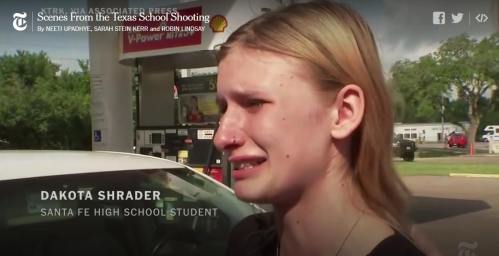
A nation plagued by a wrenching loop of mass school shootings watched the latest horror play out in this small Southeast Texas town Friday morning, as a young man armed with a shotgun and a .38 revolver smuggled under his coat opened fire on his high school campus, killing 10 people, many of them his fellow students, and wounding 10 more, the authorities said.
By the end of the day, a 17-year-old suspect, Dimitrios Pagourtzis — an introvert who had given off few warning signs — had surrendered and been taken into custody. Law enforcement officials said they found two homemade explosive devices left at the school during the rampage.
It was the worst school shooting since the February assault on Marjory Stoneman Douglas High School in Parkland, Fla., where a young man with an AR-15 rifle left 17 people dead and prompted a wave of nationwide, student-led protests calling on lawmakers to tighten gun laws.
.
At least 10 people are dead after a school shooting in Santa Fe, Tex.
By NEETI UPADHYE, SARAH STEIN KERR and ROBIN LINDSAY on Publish Date May 18, 2018. Photo by Stuart Villanueva/The Galveston County Daily News, via Associated Press. Watch in Times Video »
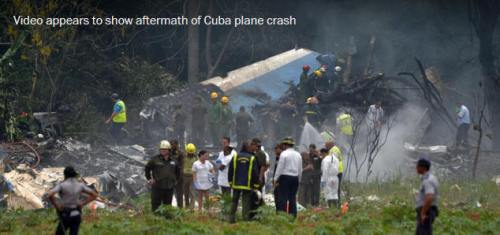
An aging airliner crashed Friday shortly after takeoff on a domestic flight in Cuba, officials and Cuban news media reported, leaving more than 100 people dead in an accident that highlighted the precarious state of the country’s commercial aircraft fleet.
The plane, a Boeing 737-200 leased by state airline Cubana de Aviación from a small Mexican carrier and operated by a Mexican crew, went down in a field within a couple of miles of Havana’s José Martí International Airport. There were conflicting accounts of the exact number of people on board; Cuban media reported that as many as 105 passengers were listed, plus up to nine foreign crew members.
The Cuban state-run newspaper Granma did not immediately provide a death toll but said that only three people survived the crash, which occurred at 12:08 p.m. Eastern time. It said the three were hospitalized in critical condition. The paper said that apart from the crew and about five foreign passengers, the people on board were Cuban citizens.
Film and Writing Festival for Comedy. Showcasing best of comedy short films at the FEEDBACK Film Festival. Plus, showcasing best of comedy novels, short stories, poems, screenplays (TV, short, feature) at the festival performed by professional actors.

 Justify, with jockey Mike Smith aboard, holds off second-place Bravazo (8) and Tenfold (6) to capture the Preakness, giving him the first two legs of the Triple Crown. (Amber Searls/USA Today Sports)


 City of tomorrow
/cdn.vox-cdn.com/uploads/chorus_image/image/59774405/microsoft_antitrust_getty_ringer.0.jpg)


 7 Money Mistakes
 Daily Habit of Reading Books

 Cuba plane crash
 James' World 2