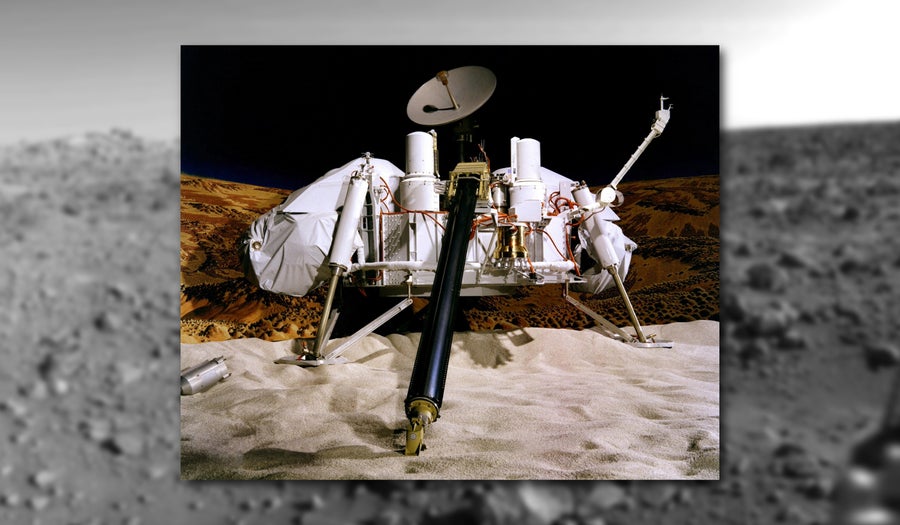
On July 20, 1976, NASA’s Viking 1 lander became the first spacecraft to safely touch down on Mars. Shortly after, it beamed back our first close-up image of the surface—a drab view of pebbles strewn at the lander’s feet.
“I don’t think we’d have been surprised if there were blades of grass,” recalls Tom Young, Viking’s mission director. Scientists had speculated for years about what scenes would await Viking 1 and its twin, Viking 2, which landed elsewhere on Mars a few weeks later. Most thought any Martians would, at most, be simple, small life-forms—although Carl Sagan had impishly suggested that polar-bear-sized creatures could populate the landscape.
Humans have imagined other inhabited worlds for millennia. And we’ve even “discovered” life on Mars more than once across the last century or two. Yet each time we’ve built sharper tools and taken a closer look, all those claims have evaporated, much like the Red Planet’s ancient seas. By the time the Viking landers launched, we knew there were no signs of life that could be seen from orbit.
But there was still hope that perhaps something stirred there—hope enough to launch the Viking landers on an audacious mission to look for it. Their results, however, weren’t conclusive. Most experts agree the twin spacecraft failed to find definitive signs of organisms in scoops of Martian soil, but some scientists continue to believe they did.
Even now, a half-century later, the outcome of those investigations fuels debate, and the Viking landers remain the only missions ever sent to the surface of another world to search for extant alien life. The ambiguity that wafted from their soil samples has become emblematic of the uncertainty that plagues the greater search for extraterrestrial life—not just on Mars and our sun’s other worlds but across the observable universe. Our knowledge of life’s physical limits and the unearthly forms it might take remains so incomplete that we could all too easily declare a discovery where none truly exists—or fail to recognize genuine extraterrestrial biology hidden in plain view.
As a result, astrobiologists have, for decades, defaulted to a conservative burden of proof that leans into two aphorisms coined by Sagan when he wasn’t musing about Martian polar bears: life, he and his co-authors wrote, should be considered a “hypothesis of last resort,” largely because “extraordinary claims require extraordinary evidence.”
But what if Sagan had it all wrong? If we live in a universe where life is common and not extraordinary at all, setting such an extraordinarily high bar for its discovery beyond Earth can backfire. What if life’s fingerprints have been on Mars all along, and we were too cautious to admit that we’d found them?
Already, a growing pile of evidence suggests ancient Mars could very well have been an inhabited planet—and may still be. Our search for life there is a bit like bobbing for apples blindfolded—except we don’t know what an “apple” might feel like, and the apples may exist only in scattered pieces. What’s needed, many scientists argue, is a clearer way of separating signs of “life” from “nonlife,” a quantitative method that leverages statistics and probabilities to guide our interpretations of biology’s potential fingerprints.
“There’s all these different lines of evidence that keep coming together that make me go, ‘Gosh, it’s becoming more and more difficult to explain everything on Mars abiotically,’” says Amy Williams, an astrobiologist at the University of Florida. “I’m not yet ready to say that we’ve found evidence for life, but I think the story is building to help us understand what that potential is—to put a probability on that instead of just saying ‘yes’ or ‘no.’”
Present-day Mars is marginally habitable at best, but 3.5 billion years ago the planet was almost certainly a more life-friendly world. Ancient Mars was warmer, with a thicker atmosphere and a global magnetic field that protected its surface from cosmic radiation; seas and lakes filled its basins, and rivers tumbled through its valleys. Over eons, Mars lost its magnetic field and, with it, those bodies of water and thick, insulating atmosphere.
Yet across the sweep of Mars’s lifetime, organic compounds—life’s building blocks—have rained down on the planet, delivered by meteorites and cosmic dust.
“If we live in a universe where life takes advantage of watery environments when there’s juicy chemistry going on—which is the way I picture the universe, but that’s unvalidated intuition—then something should have started happening in some of those places on Mars,” says astrobiologist David Grinspoon of the Planetary Science Institute. “So there’s this predisposition to think, ‘Either there should have been an origin of life on Mars—or we’re really wrong about something on Earth.’”
Since 2012 NASA’s Curiosity rover has been searching for signs of ancient habitable environments in Gale Crater. And in 2021 the agency’s Perseverance rover touched down in Jezero Crater with the goal of looking specifically for ancient biosignatures, not present-day life. Now, based on the results of those robotic explorations, many experts suspect that ancient Mars was indeed a biological world, even if they can’t yet prove it.
“The evidence for habitable environments and life on early Mars is getting stronger every time we look at it,” says Chris McKay, an astrobiologist at NASA’s Ames Research Center.
.
A model of NASA’s Viking 1 Mars lander (inset) against a panoramic view of the Martian surface snapped by Viking 1 on July 20, 1976. NASA/JPL-Caltech
What a captivating and thought-provoking article! It beautifully traces humanity’s enduring fascination with the possibility of life beyond Earth, blending the history of the Viking missions with the evolving science of astrobiology. The narrative keeps the reader engaged while raising profound questions about how we define life and whether our own assumptions may be limiting our discoveries.
I especially appreciated the discussion around Carl Sagan’s famous principle, “Extraordinary claims require extraordinary evidence.” The article thoughtfully explores the possibility that our cautious scientific standards, while essential, might also make us overlook subtle signs of extraterrestrial life. That balance between skepticism and curiosity is what makes science so compelling.
In the world, human beings are facing various problems. People who are full of greed, anger, and ignorance are seen to be fighting with each other in words and deeds. As the fighting continues, various problems such as civil wars, wars of aggression, and wars of aggression are occurring. As world peace is being destroyed, humans are facing unbearable problems. Innocent children and women are not getting the rights they deserve and deserve. I can't think of one thing every time. What is it? The United Nations. If we look at the responsibilities and duties of the United Nations, I think it is not suitable for solving the problems that are happening in the world today. In fact, the United Nations and the World Security Council, such an organization must rule the world, must be able to give orders, and must have various ways to obey orders. There must be no organization that can influence more than that organization. There should be experts from each country. They can even dominate the superpowers like the US, China, and Britain. Only then will global peace be achieved quickly. Now, if a country with power develops more militarily, economically, or socially than its own country, then powerful countries will jealously seek out enemies and wage war. Or they will attack with fighter jets. In this, innocent people are losing their lives. No one understands the value of a life. You should think about how to achieve global peace by controlling these. If the US continues to be the permanent president of the UN, world peace will never be achieved. If you think carefully, no one sees that they are working for the common good, but for their own benefit, for the benefit of their own country. The permanent president of the UN and the Security Council has rejected this, As a young Rohingya, I have come to realize that only by electing the president and secretary from among the countries in the world through a secret ballot system and governing the world fairly can we achieve global peace. The United Nations and the Security Council are organizations in which any country must govern, give orders, and make them obey their orders. For example, only when a defendant is tried in court can we hold the leaders of the countries in check and control them, can we achieve global peace smoothly. Otherwise, it will not be easy for powerful countries to use various excuses to end this war every year, every year, for the benefit of themselves and their countries. No country's leaders pay any attention to the words of the United Nations and the Security Council. If we look at it in practice, look at the Rohingya issue. Myanmar is a small country. Even that country has been under siege for 8 years. What action can be taken? Why is the UN and the Security Council Powerless? Without such Power, how can the organization bring about global peace? Everyone should think about it. Whether there is a veto or a strong one, all countries in the world can only achieve global peace if they are subject to the UN and the Security Council. Seek peace in the quiet embrace of nature. Peace is an indispensable need of the human race. It is not as if one person can kill another person, and it is as if one country can attack another country, but instead of trying to build peace, we must try to destroy the peace now, and the world is getting hotter and is on the verge of collapse. I especially appeal to all the world experts to urgently try to bring about peace in all parts of the world. Mr, Noor Muhamed Arkhan Rohingya Youth Myanmar
Film and Writing Festival for Comedy. Showcasing best of comedy short films at the FEEDBACK Film Festival. Plus, showcasing best of comedy novels, short stories, poems, screenplays (TV, short, feature) at the festival performed by professional actors.



Jul 30, 2026 @ 05:09:49
What a captivating and thought-provoking article! It beautifully traces humanity’s enduring fascination with the possibility of life beyond Earth, blending the history of the Viking missions with the evolving science of astrobiology. The narrative keeps the reader engaged while raising profound questions about how we define life and whether our own assumptions may be limiting our discoveries.
I especially appreciated the discussion around Carl Sagan’s famous principle, “Extraordinary claims require extraordinary evidence.” The article thoughtfully explores the possibility that our cautious scientific standards, while essential, might also make us overlook subtle signs of extraterrestrial life. That balance between skepticism and curiosity is what makes science so compelling.
LikeLike