
Click the link below the picture
.
Last year, less than a month after being named acting administrator of NASA, U.S. Secretary of Transportation Sean Duffy made an eyebrow-raising announcement to the world: NASA was going to put a nuclear reactor on the moon. As part of strengthening U.S. national security in space, he said, this reactor would be designed, built, flown and delivered to the lunar surface by 2030. To many observers, this declaration sounded wild. Why would you want to put a nuclear reactor on the moon?
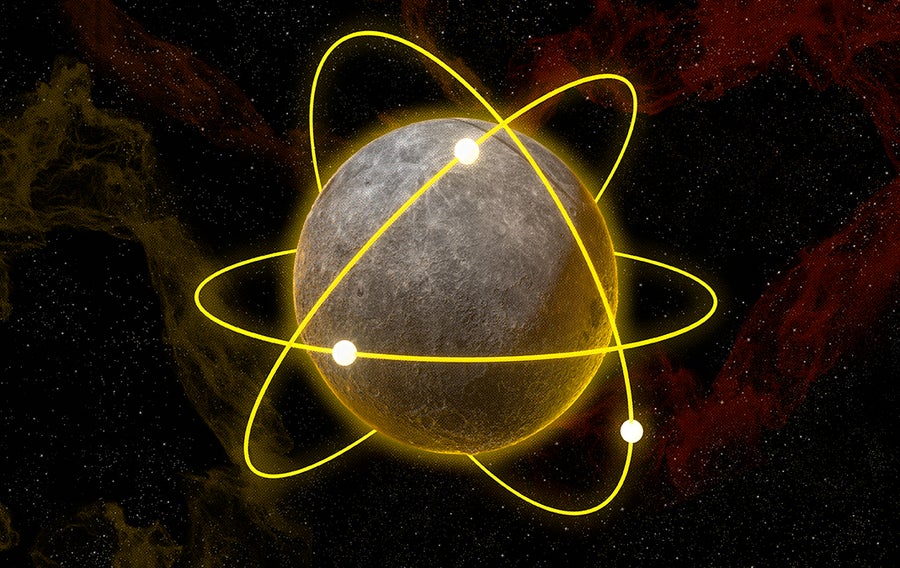
The thing is, if America (or any spacefaring nation) wants to establish a permanent presence on the moon—an inhabited station that can operate during the frigid and lengthy lunar night—solar power won’t cut it. Through its Artemis program, which just sent four astronauts on a trip around the moon, NASA wants to transform our planet’s argent companion into a scientific outpost, a mining site, and a rocket launchpad pointed at Mars. To do that, nuclear power is the sole option. “It’s the only way we can sustain a lunar base properly long-term,” says Simon Middleburgh, co-director of the Nuclear Futures Institute at Bangor University in Wales. It’s no wonder, then, that China and Russia are teaming up to put their own nuclear reactor on the moon by 2035 to electrify what they call the International Lunar Research Station—their planned base on the lunar south pole. Sooner or later, from one nation or another, “nuclear power on the moon will happen,” Middleburgh says. “It’s inevitable.”
Nuclear power plants are safer than many suspect. But putting reactors in space is a concept with a checkered history. One notorious reactor caused an international incident in 1978 after it came apart in Earth’s atmosphere. And nobody has ever designed a reactor for the moon, a hostile volcanic desert subject to extreme temperature swings, frequent asteroid strikes, and protracted quakes.
Experts questioned both the timing and the scale of the nuclear power plant Duffy is proposing. Placing a reactor capable of powering 80 American households on the lunar south pole—an environment no human has yet set foot in—by 2030 sounds rushed, if not impossible. And the last thing anyone wants is for the U.S. to barrel through the conception, construction, launch, and landing of a lunar nuclear reactor. “I think the worst-case scenario might be [that] in the quest to be first we skip important design and safety steps,” says Bhavya Lal, a professor of space policy at the RAND School of Public Policy and former acting chief technologist and associate administrator for technology, policy and strategy at NASA. “It’s good to be first—competition is good—but we need to do it right.”
If the U.S. does succeed, its nuclear-powered moon base could become a solar system–exploring foothold among the stars. But mistakes can happen. And whether you’ve accidentally spray-painted an ancient reserve of water ice with radioactive waste or fatally stranded your astronauts in the lunar darkness without any power, a nuclear disaster on the moon would be, in Middleburgh’s words, “a humanity-defining shit show.”
Katy Huff wants to clear something up: uranium, the infamous radioactive element used to power nuclear plants and, with some tweaking, give most nukes their annihilative terror, is dull—at least in a manner of speaking.
Huff, a nuclear engineer at the University of Illinois at Urbana-Champaign, was the assistant secretary for nuclear energy in the Biden administration. Nuclear power is her jam. But it’s important to know that unused nuclear fuel is “radiologically very boring,” she said during a recent video call. “It’s not particularly radioactive.” She gestured to an object on her desk. “I have some uranium in that cardboard box right there.” The fact that you can hold uranium in your hand without consequence may come as a surprise to many. “You can pick it up. It’s toxic more than anything else; it’s like lead,” Middleburgh says. “So don’t eat it.”Uranium becomes dangerous—and helpful—when you chuck it into a nuclear reactor and fire neutrons at it. The impact causes the uranium’s unstable atomic nuclei to snap apart and emit more neutrons, which cause more nuclei to rupture—and voilà, you have a heat-emitting nuclear fission reaction. As long as the reaction doesn’t spiral out of control, you can use the heat to turn a fluid (often water) into steam. That steam rotates a turbine, which makes electricity.
You don’t want to hold the uranium fuel after it’s been blasted with neutrons. “Then it breaks apart and becomes fission products that are highly radioactive, which is why nuclear waste is dangerous,” Huff says. But because that nuclear cascade can continue for a very long time, it’s a fabulous power source—particularly in space, where it won’t need refueling for years, maybe decades.
The concept of nuclear power in space isn’t new. Starting in the 1960s, both the U.S. and the Soviet Union sent plenty of radioisotope thermoelectric generators, or RTGs, into space to power all kinds of things, from Earth-orbiting satellites and the Apollo-era scientific experiments on the moon to Mars rovers and deep-space probes. Plutonium, uranium’s ferocious chemical cousin, was often used in these devices. RTGs, though, are not nuclear reactors. They are more like nuclear batteries: screaming-hot radioactive caches providing a small but lasting source of heat that can produce electricity.
But an RTG would be insufficient to power a moon base. Astronauts need more than just energy to keep the lights on. They need a constant source of heat in the night and a way to vent that heat when the mercury soars during lunar daytime. If they want machines that can extract precious water from the lunar soil—water for hydrating both astronauts and crops and, crucially, to be electrically split into hydrogen and oxygen gas to make rocket fuel—then they’ll need oodles of electricity to power them.
.
Tavis Coburn
.
.
Click the link below for the complete article:
.
__________________________________________


Leave a Reply