
Hmmmm … Really!
Click the link below the picture
.
In the balmy cloud forests of Central America, the operatic calls of Alston’s singing mouse, a small, short-tailed rodent famous for its courteous communication, can often be heard echoing through the trees.
These minuscule mice, each of which weighs less than a lightbulb, sing unique, chirp-filled songs to one another that can last as long as 16 seconds. Both sonic and ultrasonic sounds flow from the mouse’s mouth, creating a song reminiscent of the buzzing of a cicada. What’s more, the mice never interrupt each other; they hold their tiny tongues until their conversational partner is done singing.
Scientists have long wondered what enables these mice to have such uncannily complex conversations without the help of human brains. But as it turns out, our brains may not be so different.
In a new study published Wednesday in the journal Nature, researchers found that a simple expansion of existing neural pathways allowed these mice to broaden their vocal repertoire — the same mutation believed to have paved the way for the development of human language.
By studying the brains of Alston’s singing mice and their non-singing (but closely related) lab mouse cousins, researchers at the Cold Spring Harbor Laboratory on Long Island were able to determine what evolutionary changes in the brain had given rise to the singing mouse’s cordial and symphonic songs. Now, scientists are wondering if the same method can be used to figure out the neurological basis for other animal behaviors.
“This is relevant far beyond singing mice,” said Mirjam Knörnschild, a behavioral ecologist who studies bioacoustics at the Museum of Natural History Berlin. Dr. Knörnschild, who was not involved with the study, said it could “inform work on vocal turn-taking, vocal learning and vocal flexibility in other mammals, including bats, primates and humans.”
In 2019, Arkarup Banerjee, a biologist at Cold Spring Harbor Laboratory, and his colleagues discovered that the back-and-forth serenades of Alston’s singing mice sound strikingly similar to our conversations. But at the time, he couldn’t make sense of it. Dr. Banerjee had examined the brains of Alston’s singing mice and non-singing lab mice, and they seemed more or less identical.
Scientists once believed that complex behaviors, such as tool use and peer-to-peer communication, required specialized neural circuitry. But when Dr. Banerjee went looking for such dedicated neural hardware in Alston’s singing mice, he didn’t find any.
“It didn’t seem like things were that different,” Dr. Banerjee recalls.
This prompted Dr. Banerjee and colleagues to set out in search of what gave these singing mice their vocal prowess. In their effort to find out, the researchers used a technique called Multiplexed Analysis of Projections by Sequencing, or MAPseq. This method allows scientists to map thousands of individual neurons by infecting them with a virus that delivers unique RNA bar codes into each cell. When scientists genetically sequence tissue from across the brain, the bar codes reveal a detailed map of where each neuron connects throughout the brain.
When the researchers used MAPseq on the brains of dozens of mice from both species, the differences became clear. The singing mice had approximately three times the number of neurons sending signals from the motor cortex to two specific downstream regions of the brain. While that may sound like a stark difference, the scientists say it’s more akin to “a relatively subtle change in brain wiring,” said Anthony Zador, a neuroscientist at Cold Spring Harbor Laboratory and co-author of the study.
According to Dr. Zador, the fact that such subtle neural changes can result in the development of a whole new vocal behavior “raises interesting questions about how much rewiring was involved in the evolution of human language.”
In addition to challenging our understanding of the evolution of our most novel behavior, the findings of this study may help scientists learn more about the neurological basis for many animal behaviors.
“This work hits on an important unanswered question in neuroscience: What gives some animals exceptional abilities that others don’t have?” said David Schneider, a professor of neuroscience at New York University who was not involved with the study.
Before this study, scientists had never used MAPseq to compare the brains of two closely related species with remarkably different behavior. Experts say their success in doing so has opened up a world of scientific possibilities.
“This study gives us a road map for how to think about and quantitatively test ideas about the evolution of brain structure,” said Steven Phelps, a professor of integrative biology at the University of Texas, Austin, who was not involved with the study.
As the study came to a close, Dr. Banerjee said he couldn’t get a quote from Charles Darwin’s 1871 book “The Descent of Man” out of his head: “The difference in mind between man and the higher animals, great as it is, certainly is one of degree and not of kind.”
“There’s increasing evidence that there may be some profound truth to this idea,” Dr. Banerjee said. As his study has demonstrated, even tiny changes in the brain can have profound impacts on behavior. When you keep that in mind, he said, “suddenly the development of things like language in humans doesn’t seem that mysterious.”
Explore the Animal Kingdom
A selection of quirky, intriguing, and surprising discoveries about animal life.
Birds of a Feather Learn Together: In a study, Australian cockatoos figured out that a new food was OK to consume by observing one another, a vivid example of “social learning” in animals.
Swimming With Orcas: Only two places in the world allow tourists to enter the water with the ocean’s apex predator. But the safety of both species is a growing concern.
Legal Protection for Snails?: Scientists are debating the classification of threatened mollusks that an Indigenous community in Mexico relies on for their way of life.
Salmon High on Cocaine: Scientists in Sweden made an unexpected discovery when they exposed the fish to the illegal drug as well as another substance.
Bruce the Parrot: In 2021, a disabled parrot made headlines worldwide for creating his own prosthetic beak. Now, he has become the alpha male of his group by learning to joust.
Female Anglerfish: The deep-sea fish ended up with glowing lures not just to snag meals, but also to attract mates, a new study finds.
.
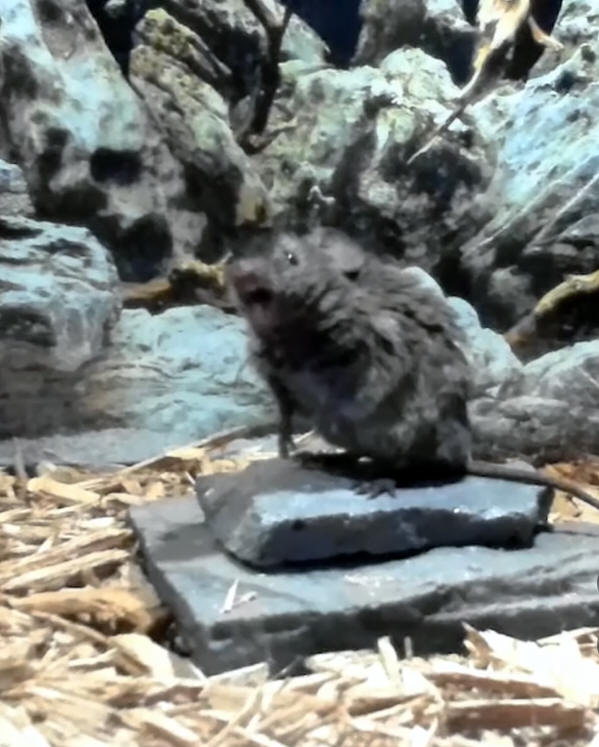 Scientists at the Cold Spring Harbor Laboratory on Long Island mapped the neurons of two species of mice to better understand how their brain wiring helps them vocalize. CreditCredit…Isko et al., Nature 2026
.
.
Click the link below for the complete article:
.
__________________________________________


Leave a comment