
Click the link below the picture
.
Humans are creatures of Earth and, in turn, at the mercy of Earth’s gravity. When we leave the confines of our home planet and enter the microgravity environment of space, our brain and body change. Studies have shown how microgravity can affect astronauts: it can throw off their balance, blur their vision, change the shape of their heart, and nudge the position of their brain inside their skull. And now a new study shows that microgravity, colloquially referred to as zero g, affects astronauts’ motor skills, too. Understanding these changes is critical for the future of human space exploration.
“It’s so important to interact with our environment,” says Philippe Lefèvre, senior author of the new study and a professor of biomedical engineering at the Catholic University of Louvain in Belgium. Unlike on Earth, in space, if an astronaut lets an object slip from their grasp, the consequences are not just different (that object doesn’t drop to the floor) but also possibly dire.
“This study highlights the brain’s remarkable ability to adapt to its physical environment,” says Lionel Bringoux, a professor at Aix-Marseille University in France, who also researches the effects of gravity on motor ability but was not involved in the new paper.
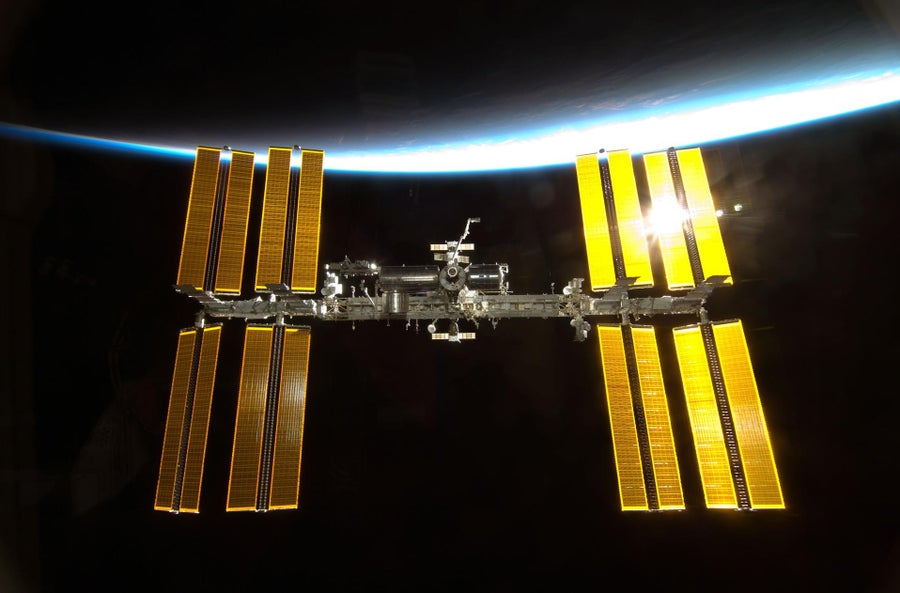
The new research involved 11 astronauts who lived onboard the International Space Station for at least five months. While on the station, they performed a series of experiments that tested how their rhythm and grip changed while they manipulated objects in zero g. Lefèvre and his colleagues found that astronauts tended to move slower in weightlessness and to grip an object more firmly than they would on Earth, as if the object was heavier than they knew it to be.
That was a surprise, Lefèvre says: “The fact that we were exposed to gravity from early childhood for years and decades, we cannot forget it, even after five to six months.” The astronauts knew that the object would feel weightless in zero g, but their brain predicted that it would feel as heavy as it would on Earth. And if the object was moving at speed, the astronauts would grab it and grip it even more tightly, he adds.
Bringoux says that this finding suggests “astronauts tend to apply a larger safety margin” than is strictly necessary for holding on to and moving objects to prevent any unexpected slips. It also suggests that astronauts reach an “optimal” level of adaptation to their weightless surroundings—their sensorimotor skills change enough to ensure they can safely and accurately hold on to and move things around in microgravity but not more than that.
The team ran further experiments to see how the astronauts’ motor skills readapted to the planet’s gravitational force just a day after they returned to Earth—both their grip and ability to move an object at a steady rhythm recovered quickly. “The adaptation that we had to gravity for decades [means] we do not fully adapt to microgravity, but the advantage is that when we go back to Earth, we readapt that very quickly to the Earth’s environment,” Lefèvre says. All in all, the study, which was published on Monday in the Journal of Neuroscience, took about 20 years from when it was first proposed to be completed.
Knowing how human brains adapt to different gravitational environments will be crucial for future space missions—although it’s an open question whether future astronauts traveling to the moon or Mars will show the same adaptations, Lefèvre says. There is some gravity on these worlds, and that could introduce risks, he adds. “Maybe the astronaut will feel gravity, and they will just go back to Earth mode, which is not appropriate because gravitational force [on Mars] is reduced,” he says.
“Studying these differences helps us anticipate and better prepare astronauts for such conditions,” Bringoux agrees.
.
 NASA
NASA
.
.
Click the link below for the complete article:
.
__________________________________________
 James' World 2
Apr 22, 2026 @ 08:55:06
Thanks for sharing.
LikeLike
Apr 22, 2026 @ 09:34:58
Thank you sir! My brain 🧠 doesn’t fully adapt on earth, no space Flight for me.
LikeLiked by 1 person