
Click the link below the picture for a multitude of updates not included here!
Click the link below the picture
.
Here’s the latest.
The United States and Israel attacked Iran on Saturday in a major assault that threatened a broader regional conflict, with President Trump vowing to devastate the country’s military, eliminate its nuclear program, and bring about a change in its government.
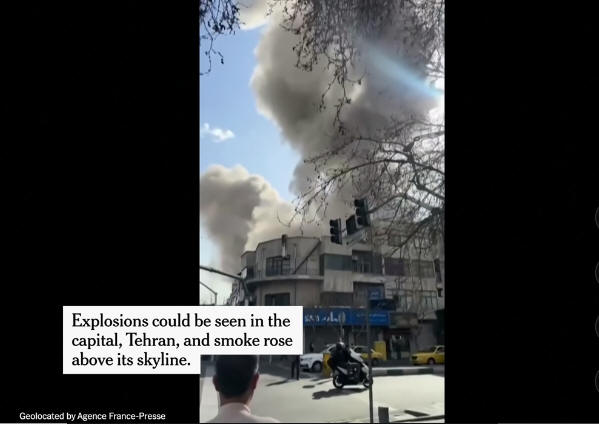
Waves of large explosions shook the Iranian capital, Tehran, starting around 9 a.m. local time — 1 a.m. in Washington — and continued into the evening. Witnesses described chaos in the streets as people rushed to seek shelter, find loved ones, or flee the city.
Several residential buildings in Bahrain’s capital Manama were targeted this evening, according to the Gulf kingdom’s Ministry of Interior. “Civil Defense continues with firefighting and rescue operations at the affected sites,” the ministry said in a statement, without elaborating further. Videos being shared on social media on Saturday night, and verified by The New York Times, appeared to show a moving object striking a residential apartment building in the capital Manama, causing a large explosion.
The New York Police Department said it was enhancing its presence at sensitive locations in the city, including at diplomatic and religious sites, in light of the strikes in Iran. Gov. Kathy Hochul said the State Police was taking similar precautions across New York. No specific, credible threats to the city or state have been identified, the governor said.
‘Under this rubble, students are buried’: Iran says dozens killed in strike on school.
Dozens of people, probably most of them children, were killed in a strike that hit a girls’ elementary school in southern Iran, according to Iranian health officials and state media.
It was one of two strikes that appear to have hit schools since U.S. and Israeli warplanes launched their attack on Iran around 10 a.m. local time. Saturday is the start of the workweek in the country, and many Iranians had already dropped off their children and headed into their offices as explosions began to shake the capital and many cities across Iran.
Netanyahu takes his shot at regime change in Iran.
The joint U.S.-Israel attack on Iran is, in one sense, a long-held aspiration for Prime Minister Benjamin Netanyahu of Israel. He has been portraying the Islamic Republic, a sworn enemy of his country, as a singular threat to Israel, the region, and the world for more than three decades.
Now, an emboldened Israel and its strongest ally, the United States, have declared the aim of the war as nothing less than paving the way for the overthrow of Iran’s government by encouraging Iranians to rise up against the Islamic Republic.
The Israeli military published a warning urging those present at an “industrial complex” in Isfahan, a major city in central Iran, to evacuate. It also told residents of a nearby area to remain in their homes until the morning hours.
Hundreds of Shiite Muslims marched in various parts of Pakistan to express their support for Iran. Many Pakistani Shiites, a sizable religious minority in their country, look to Iran for religious guidance and, at times, political support. “When Iran is attacked, we feel our faith, our identity, and our very existence are being targeted,” said Asghar Jaffer, a Shiite student activist in Karachi.
Iranian attacks on Israel shine a light on shelter shortage.
Sirens warning of incoming Iranian missile fire have sent people in Israel running to public and private bomb shelters, and fortified rooms in their homes.
But the missile barrages have also highlighted a shortage of protected spaces in a country that has been preparing for war with Iran for decades.
Several dozen protests opposing the U.S.-led strikes in Iran are planned in cities across the United States as part of a national day of action today. The sponsors of the demonstrations, a coalition of organizations, including Answer Coalition, a group that opposes war and racism, said they were protesting the Trump administration’s “illegal attack” on the country.
“The people of this country reject another endless war,” the sponsors wrote in their call to action.
Mai Sato, a Japanese legal scholar and the U.N. special rapporteur on human rights in Iran, called the U.S.-Israeli strikes “unlawful” because they were launched without authorization from the U.N. Security Council. The Council will convene an emergency meeting later today. She said in a social media post that military intervention is not a solution to the nuclear issue and “does nothing to address why people took to the streets. It is for the Iranian people to shape their own future.”
The Strait of Hormuz, a global shipping lane, has been “effectively closed,” according to Tasnim, the news outlet affiliated with the Iran Revolutionary Guard Corps, or IRGC, the county’s most powerful military force.
“The IRGC has warned various vessels that, due to the insecure conditions around the strait resulting from the U.S. and Israeli military aggression and Iran’s responses, passage through the strait is currently unsafe,” Tasnim quoted the IRGC as saying.
The Israeli military said it struck roughly 500 targets across Iran since this morning, including air defense systems and missile launchers. It said the targets included a surface-to-surface missile launch site in the area of Tabriz, in western Iran. The strikes allowed the Israeli Air Force to “expand its aerial superiority” in Iranian skies, the military added.
The U.S. Maritime Administration, a government agency, has advised American commercial ships to stay away from the Persian Gulf area, including the Strait of Hormuz. “It is recommended that vessels keep clear of this area if possible,” the agency said. Jordan’s Public Security Directorate said it handled 54 reports of falling debris that caused material damage but no injuries.
The Israeli military just said it began another wave of attacks on Iranian aerial defense and missile launches in central Iran. Iran’s state broadcaster, IRIB, is reporting explosions in Garmdareh, west of Tehran, as well as the northwestern city of Urmia near the Turkish border, the southern port city of Bushehr, and Qom, south of Tehran.
The authorities in Dubai said that four people were injured and taken to a hospital after an “incident” in the Palm Jumeirah area, an artificial island off the coast of the city, adding that the site was secure and the resulting fire under control. Videos shared on social media that were verified by The New York Times appeared to show an object landing close to one of the buildings that line the main road of the Palm Jumeirah, causing an explosion. The conflict in the Middle East has quickly threatened the flow of oil out of the Middle East, which could make oil and other fuels more expensive. Oil analysts expect prices to jump when markets open on Sunday evening. Shipping companies have stopped sending their tankers through the Strait of Hormuz, the narrow passage through which at least 20 percent of daily oil production travels, according to oil industry analysts. “Nobody’s going to enter right now,” said Angeliki Frangou, the chief executive of Navios Maritime Partners, a Greek shipping company with vessels in the region, referring to the strait.
The foreign ministry of Saudi Arabia said in a statement that it successfully intercepted Iranian attacks aimed at the Riyadh region and the Eastern Province. The kingdom will “take all necessary measures” to defend itself, “including the option of responding to aggression,” it said.
The White House press secretary, Karoline Leavitt, said on social media that President Trump has spoken on the phone with Prime Minister Benjamin Netanyahu of Israel. She said Trump also monitored the military assault in Iran “overnight at Mar-a-Lago alongside members of his national security team.”
Here’s what members of Congress are saying about the U.S.-led attacks on Iran.
Members of Congress are weighing in on the United States’ attack on Iran, and Republicans and Democrats are significantly at odds.
Republicans largely praised President Trump for what they said was a critical operation targeting a country that had long threatened the United States and its allies. Many circumvented the issue of whether the president needed authorization from Congress to carry out an extended military operation.
Kuwait’s state media said a drone struck the country’s main airport on Saturday, citing the civil aviation authority. It said the drone caused minor injuries to workers at the airport’s Terminal 1 building.
The Emirates defense ministry said on Saturday evening that it had intercepted a “new wave” of Iranian missiles launched toward the country, and that “fragments from the interceptions” had fallen in areas across the cities of Abu Dhabi and Dubai. The defense ministry statement said there were no injuries at those sites. A White House official said the Pentagon notified members of the Armed Service Committees early Saturday morning after the strikes began. Some members of the committees said they were not notified, including Senator Jack Reed, Democrat of Rhode Island and the ranking member of the Senate Armed Services Committee.
Gideon Saar, Israel’s foreign minister, said that military action against Iran was urgently needed “despite the significant risks involved.”
“Delay would have allowed the Iranian regime to reach a level of immunity for its nuclear program, as well as to engage in the mass production of long-range ballistic missiles,” he said in an English-language statement.
In a letter to the U.N. Security Council, Iran’s foreign minister, Abbas Araghchi, asked for the council to intervene and said Israel and the United States had violated international law in attacking Iran. “The United States and the Israeli regime shall bear full and direct responsibility for all ensuing consequences, including any escalation arising from their unlawful actions,” Mr. Araghchi said in the letter. “All bases, facilities, and assets of the hostile forces in the region shall be regarded as legitimate military objectives within the framework of Iran’s lawful exercise of self-defense.”Ursula von der Leyen, the president of the European Union’s executive arm, announced on social media that she would convene a special security update meeting on Monday on the situation in Iran. She said that it is “of the utmost importance that there is no further escalation through Iran’s unjustified attacks on partners in the region.”Prime Minister Keir Starmer of Britain has said in a televised statement that British planes “are in the sky today” in the Middle East “as part of co-ordinated regional defensive operations to protect our people, our interests, and our values.” Mr. Starmer said Iran should refrain from further strikes, give up its weapons program, and end repression of its people, adding: “This is the route back to the negotiating table.”
.
 .
.
.
Click the link below for the complete article:
https://www.nytimes.com
.
__________________________________________
 James' World 2
Mar 01, 2026 @ 00:56:59
Praying
LikeLike
Mar 01, 2026 @ 01:15:54
Thanks, because the world seriously needs pray.
LikeLike