
Click the link below the picture
.
For American football fans, the Super Bowl is the crescendo of the sporting calendar. Even if your team doesn’t make the big night, watching the game is undeniably exciting, eliciting a combination of yelling, cursing, crying, drinking, praying, cheering, and—for some lucky fans—jubilation. That emotional roller-coaster is part of the fun, right? Well, not to rain on anyone’s parade, but the science suggests that big sports events like the Super Bowl could carry some hidden health risks.
All the excitement, unfortunately, doesn’t come without some physiological effects. Watching a game can raise your blood pressure and heart rate—and sporting events are linked to higher rates of cardiac events, such as heart attacks.
In one recent study, researchers found that fans of the German soccer team Arminia Bielefeld—which competed in the German Cup finals for the first time ever in 2025—saw their stress levels rise by 41 percent during the game compared with regular days. The results were published on Thursday in Scientific Reports.
“This was a game of a century, kind of a Cinderella story,” says Christian Deutscher, a sports economics professor at Bielefeld University and an author on the study. Using smartwatch data, the researchers monitored fans’ heart rates and stress levels for 10 days before the game and for 10 weeks afterward. Over the course of the study, the day of the game was “by far” the highest-stress day, Deutscher says.
Fans who consumed alcohol tended to have higher heart rates, as did fans who watched the game in person compared to those who watched it on television. And after a heart-wrenching loss to VfB Stuttgart, stress levels among the Arminia Bielefeld fans stayed elevated throughout the day, the study found.
The results echo similar experiments involving American sports fans. In one 2009 study, for instance, researchers saw an increase in cardiovascular-linked deaths in Los Angeles in the days after the Rams lost the 1980 Super Bowl. And when the Raiders, then based in L.A., won the Super Bowl four years later, there was a decrease in all deaths.
The Super Bowl phenomenon parallels another holiday trend—the spike in heart attacks during Christmas and New Year, says Keith Churchwell, a former president of the American Heart Association. “For people with underlying disease,” the stress of these events “puts them at higher risk,” he says. At the same time, people are more likely to forget to take their medications for things like high blood pressure, heart rate, or cholesterol. Sports betting can amp up the stress, too, he says.
Watching sports in general isn’t harmful, however. Indeed, there’s solid evidence that sports fandoms can have positive psychological effects. “Like any pastime, there’s going to be pros and cons,” says Daniel Wann, a psychology professor at Murray State University. “Sports fandom is not unique in that.”
According to Wann, people who identify with a local sports team often feel a greater sense of connection to others, which is correlated with higher levels of collective self-esteem and lower levels of loneliness. In a 2024 study, Wann and his colleagues surveyed sports lovers about what they get out of being a fan and found that many felt a keen sense of belonging.
“It gives you this ability to meet this innate need we have to belong,” Wann says. “We are very much social creatures.”
To enjoy this Sunday’s Super Bowl safely, Churchwell recommends fans make sure they take their regular medications, avoid drinking too much, and eat the healthiest foods possible—and get a good night’s sleep the night before.
For those of us most invested in the game—looking at you, Seattle and New England—a Super Bowl loss can hit hard. To ward off any negative mental health outcomes, Wann recommends that viewers try to remember their team’s entire season and keep in mind why they’re a fan.
“It doesn’t make the outcome less important,” Wann says, “but it gives them other reasons to understand that the outcome is not the only thing that’s important.”
.
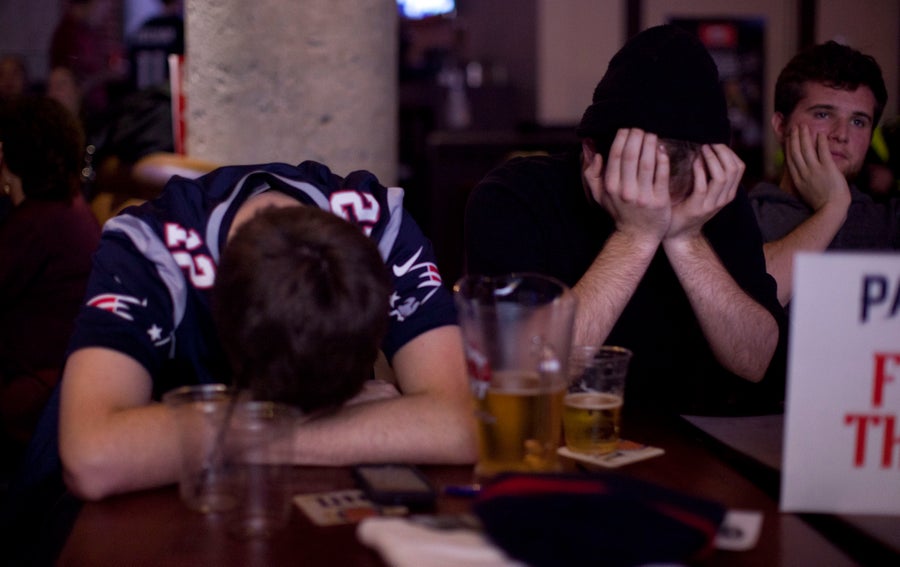
Fans watch the Patriots face off against the Seattle Seahawks in Super Bowl XLIX on February 1, 2015, Boston Globe/Getty
.
.
Click the link below for the complete article:
.
__________________________________________
 James' World 2
Feb 08, 2026 @ 06:46:56
Your article made me think of the health effects of daylight saving times on our health.:”Daylight saving time transitions are associated with modest increases in acute myocardial infarction (AMI) risk following the spring shift, when clocks move forward and an hour of sleep is lost. Meta-analyses show a pooled relative risk of approximately 1.04-1.05 for AMI in the weeks after the spring transition.” 1.Daylight Saving Time Transitions and Risk of Heart Attack.
Deutsches Arzteblatt International. 2024. Hurst A, Morfeld P, Lewis P, Erren TC.
2.Daylight Saving Time and Acute Myocardial Infarction: A Meta-Analysis.
Journal of Clinical Medicine. 2019. Manfredini R, Fabbian F, Cappadona R, et al.
LikeLike
Feb 08, 2026 @ 07:08:14
Thanks for your input, I personally also, find the time changes stressful 🙃.
LikeLiked by 1 person
Feb 08, 2026 @ 06:48:19
Additionally: “The spring shift is associated with a 13% increased risk of out-of-hospital cardiac arrest and elevated rates of ischemic stroke in the days immediately following the transition.”-Daylight Savings Time and Acute Myocardial Infarction.
JAMA Network Open. 2025. Rymer JA, Li S, Chiswell K, et al.New
LikeLike