
Click the link below the picture
.
An eon ago, when only microbes dwelled on Earth, a pair of black holes some 1.3 billion light-years beyond the solar system spiraled toward each other until they crashed. The two became one big black hole that rang out in far-reaching undulations of spacetime called gravitational waves.
These ripples finally reached Earth in January 2025, where they registered in the Laser Interferometer Gravitational-Wave Observatory (LIGO) experiment as the most precise direct measurements of gravitational waves ever made. These measurements confirmed a 54-year-old theorem from the late physicist Stephen Hawking about how black holes grow when their mass increases. The waves also confirmed a bizarre property of black holes known as the “no-hair” theorem. Scientists announced the findings in a paper published today in Physical Review Letters.
The black holes involved in the smash-up contained about 33 and 32 times the mass of the sun, respectively. As they fell toward each other and coalesced, the resulting gravitational waves spread out into the universe in all directions; the fraction that trickled into LIGO’s detectors was a signal that researchers named GW250114. Studying the particular features of this signal allowed them to determine the black holes’ initial sizes, as well as the fact that the resulting larger black hole contained about 62 times the mass of the sun. The waves also revealed that the original black holes had a combined surface area of about 240,000 square kilometers (roughly the size of Oregon), whereas the final black hole had an area of some 400,000 square kilometers (roughly the size of California).
These measurements confirm a prediction Hawking made in 1971 about black hole event horizons—the boundaries beyond which nothing, not even light, can escape from their gravitational grasp.
Researchers previously tried to test these predictions with gravitational waves, but the comparatively weaker signals left a lot of uncertainty in the conclusions. The new tests offer a much greater level of confidence, says theoretical physicist Feryal Özel of the Georgia Institute of Technology, who was not involved in the research. “If we found any evidence of violation of either the area theorem or of the Kerr solution, then one or both of the assumptions would have to be changed,” she says. “In other words, either general relativity would need to be modified, or the objects are not black holes.”
This latest announcement from LIGO comes almost exactly 10 years after the project saw its first gravitational waves. The precision of the recent measurements was only possible now, after scientists have tweaked and tuned LIGO to be roughly four times as sensitive as it was when it started. It can now identify distortions in spacetime smaller than one ten-thousandth the width of a proton.
.
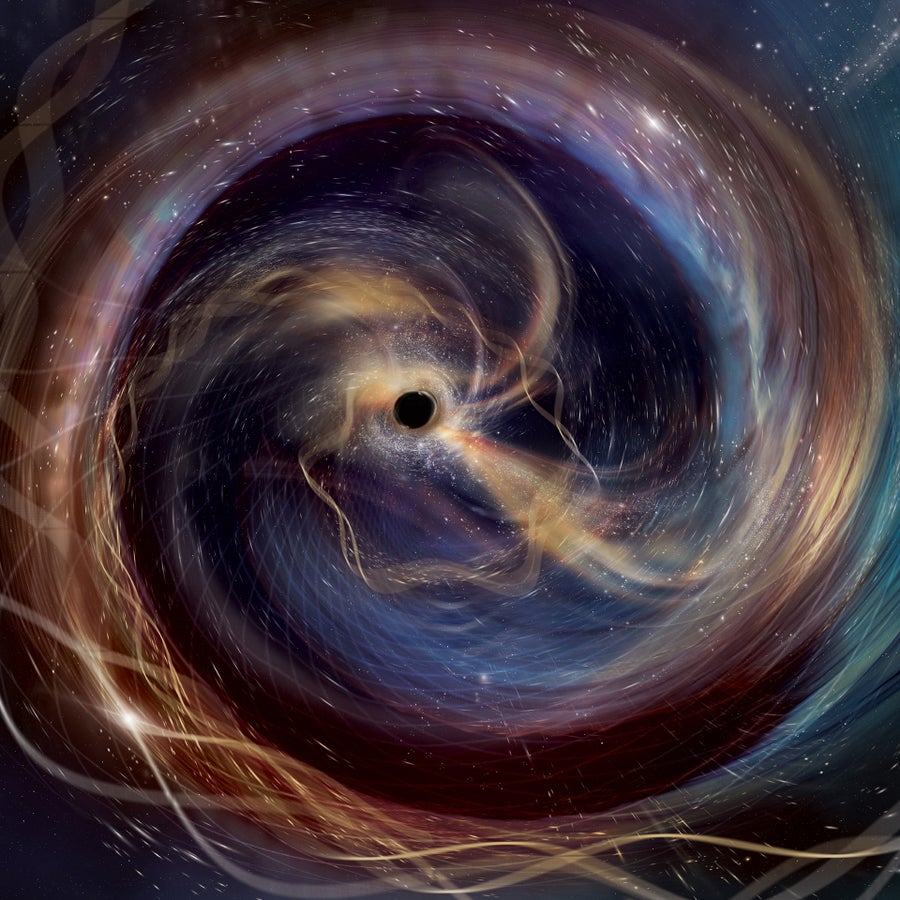 An illustration imagines GW250114, a powerful collision between two black holes observed in gravitational waves by the LIGO experiment, from the perspective of one of the black holes as it spirals toward its cosmic partner. Aurore Simonnet (SSU/EdEon)/LVK/URI
.
.
Click the link below for the complete article:
.
__________________________________________
 James' World 2
Leave a comment