
Click the link below the picture
.
To grow its economy, China is betting big on artificial intelligence, cloud computing, and other digital technology—and a big part of that bet involves rapidly building data centers to boost computing power. But these massive collections of servers gobble up growing amounts of energy, and each one cycles through hundreds of thousands of gallons of water a day to carry away the heat they generate.
That means these facilities—in China and beyond—will increasingly compete with water demand linked directly to human survival, from agriculture to daily drinking. Many companies have sited their data centers in some of the driest regions of the world, including Arizona, parts of Spain, and the Middle East, because dry air reduces the risks of damage to the equipment from humidity, according to an investigation by the nonprofit journalist organization SourceMaterial and the Guardian. Partly to address water concerns, China is now putting a data center in the wettest place there is: the ocean. This June construction began on a wind-powered underwater data center about six miles off the coast of Shanghai, one of China’s AI hubs. [Read more: What Do Google’s AI Answers Cost the Environment?]
“China’s ambitious approach signals a bold shift toward low-carbon digital infrastructure, and it could influence global norms in sustainable computing,” says Shabrina Nadhila, an analyst at energy-focused think tank Ember, who has researched data centers.
Keeping Data Centers Cool
Data centers store information and perform complex calculations for businesses, whose increasing automation is steadily ramping up such needs. These facilities consume vast amounts of electricity and water because their servers work nonstop and in close proximity—and they generate waste heat as a by-product, which can damage equipment and destroy data. So they need to be constantly cooled.
Instead, undersea data centers use pipes to pump seawater through a radiator on the back of server racks to absorb heat and carry it away. Hailanyun—the company sometimes referred to as HiCloud, that is behind the Shanghai data center—says an assessment conducted with the China Academy of Information and Communications Technology shows its project uses at least 30 percent less electricity than on-land data centers, thanks to natural cooling.
The Shanghai center will also be connected to a nearby offshore wind farm that is set to supply 97 percent of its energy, says Hailanyun spokesperson Li Langping.
The project’s first phase is designed to contain 198 server racks—enough to hold 396 to 792 AI-capable servers—and is slated to begin operation in September, Li says. It is expected to provide enough computing power to complete the equivalent of training GPT-3.5—the large language model that OpenAI released in 2022 and used to fine-tune ChatGPT—in the space of a day, he adds. Yet Hailanyun’s Shanghai center is small compared with a typical land-based one: a medium-scale data center in China normally has up to 3,000 standard racks, while a superscale version can contain more than 10,000.
Leapfrogging the U.S.
At the core of Hailanyun’s $223-million Shanghai gambit is a technology that Microsoft pioneered more than a decade ago under an effort called Project Natick, in which the company sank a shipping-container-sized capsule holding more than 800 servers 117 feet below the surface off the coast of Scotland. After hauling up the pod two years later, Microsoft found that underwater data centers “are reliable, practical and use energy sustainably.”
The experiment also resulted in fewer broken servers compared with on-land data centers because the vessel was sealed off and filled with nitrogen, which is less corrosive than oxygen, Microsoft said in a 2020 press release. The lack of people also meant that the equipment avoided physical contacts or movements that may otherwise cause them damage in an on-land center, the company said.
But Microsoft has reportedly shelved Project Natick. A company spokesperson did not answer questions about whether or not the project was terminated. Instead, they provided a statement: “While we don’t currently have data centers in the water, we will continue to use Project Natick as a research platform to explore, test, and validate new concepts around data center reliability and sustainability.”
Hailanyun aims to leapfrog American companies: if the Shanghai project is successful, Li expects his company to springboard toward large-scale deployments of offshore, wind-powered undersea data centers with the support of the Chinese government.
Zhang Ning, a postdoctoral researcher at the University of California, Davis, who specializes in next-generation low-carbon infrastructure, notes that Hailanyun has moved from a pilot project conducted in Hainan in December 2022 to commercial rollouts in less than 30 months—“something Microsoft’s Project Natick never attempted.”
Environmental Concerns
In spite of the apparent benefits of underwater data centers, some concerns remain—especially over potential environmental impacts. Microsoft researchers found their pod had caused some localized warming in the sea, though the impact was limited. “The water just meters downstream of a Natick vessel would get a few thousandths of a degree warmer at most,” they wrote.
.
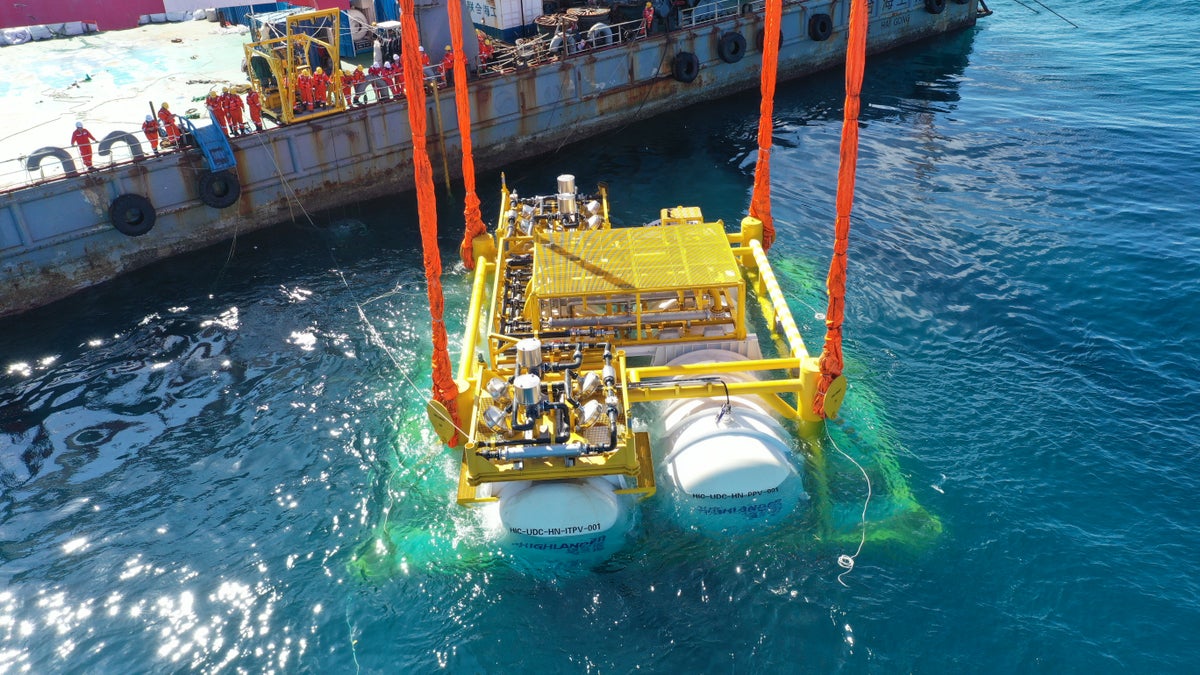
The underwater data center pictured here was a pilot project off the coast of Hainan. Another, more advanced, one is now being built off Shanghai. Shanghai Hailanyun Technology
.
.
Click the link below for the complete article:
.
__________________________________________
 James' World 2
Jul 30, 2025 @ 07:49:56
So interesting… but a little bit scary!
LikeLiked by 1 person
Jul 30, 2025 @ 09:58:33
It ses to take a lot of energy to keep computers running AI cool!
LikeLiked by 1 person
Jul 31, 2025 @ 03:02:52
Yeah – I was all for the fun of it at the start, but am slowly pulling back – I have two daughters and keep thinking of their future…
LikeLike
Jul 31, 2025 @ 10:31:56
If laptops get too hot they can catch fire. It’s according to what they are running. If they are getting real hot you should unplug it.
LikeLiked by 1 person
Jul 31, 2025 @ 10:36:25
If laptops get to hot they can catch fire. It depends on what they are running. If yours gets to hot you should unplug it.
LikeLiked by 1 person
Aug 01, 2025 @ 05:06:58
Good to know – thank you – will do!!
LikeLike
Aug 01, 2025 @ 09:26:58
👍
LikeLiked by 1 person
Jul 30, 2025 @ 17:32:11
or to male the waters warm… 🙂
LikeLike
Jul 31, 2025 @ 00:05:07
Wow, that’s a thought. 🤔
LikeLike