
Click the link below the picture
.
In 2021, a multidisciplinary team of researchers claimed that a Tunguska-sized airburst, larger than any such airburst in human history, destroyed a Bronze Age city near the Dead Sea. The story went viral. This alleged destruction of Tall el-Hammam around 1650 BCE, with reports of melted pottery and mudbricks, pointed to the Bible, the team concluded in Scientific Reports, noting “what could be construed as the destruction of a city by an airburst/impact event.”
News outlets from Smithsonian to the Times in Britain covered the report. It had all the ingredients—with authors touting its connection to the biblical cities of Sodom and Gomorrah—to make it pure clickbait gold. On the day it was published, one of the co-authors posted links on his blog to their three press releases. A week later, he asserted that it was “the most read scientific paper on Earth” based on 250,000 article accesses.
Science, however, is not a popularity contest, and the “cosmic outburst” story indeed holds a different lesson than the one first supposed, about how the public should hear incredible claims. In April, just before the study passed the 666,000 mark, Scientific Reports retracted the finding, writing that “claims that an airburst event destroyed the Middle Bronze Age city of Tall el-Hammam appear to not be sufficiently supported by the data in the Article,” and that “the Editors no longer have confidence that the conclusions presented are reliable.” Independent scientists (I was one of them) had alerted them to faulty methodology, errors of fact, and inappropriate manipulation of digital image data. One study co-author responded to the retraction in an online post with claims that the editor had caved to harassment by skeptics, concluding that the “court of public opinion is much more powerful than a shadowy hatchetman spamming a corrupt editor’s inbox.”
Public opinion does influence policy decisions and funding priorities in science. People are interested in new medical cures and new starry discoveries, which helps explain why we have a NASA and an NIH. That’s why it is important for the public to be scientifically literate and well informed. But scientific facts are determined by the scientific method, logic, and evidence, all presented in peer-reviewed publications that require reproducible results. Scientists don’t vote on findings, but they do achieve consensus by convergence on understandings based on multiple studies across many fields.
The Sodom airburst paper instead represented the nadir of “science by press release,” in which sensational but thinly supported claims were pitched directly to the media and the public. Press releases, rife with references to Sodom and biblical implications, appeared to be focused as much on titillation as on science.
A meme, in its original definition, is a self-propagating unit of cultural information that is highly fit in the evolutionary sense. Like genes, memes can be engineered. Science by press release can be an effective first step in the creation and laundering of such memes into the public’s collective consciousness. The authors of the Sodom airburst paper did this well. Their press releases were quickly picked up and repeated by both online clickbait media and mainstream media.
The Sodom airburst meme was so successful that it achieved pop culture status and public acceptance within a year of the paper’s publication, in this “Final Jeopardy!” question: “A 2021 study suggested that an asteroid that struck the Jordan Valley c. 1650 B.C, gave rise to the story of this city in Genesis 19.” (Winning answer: “What is Sodom?”)
.
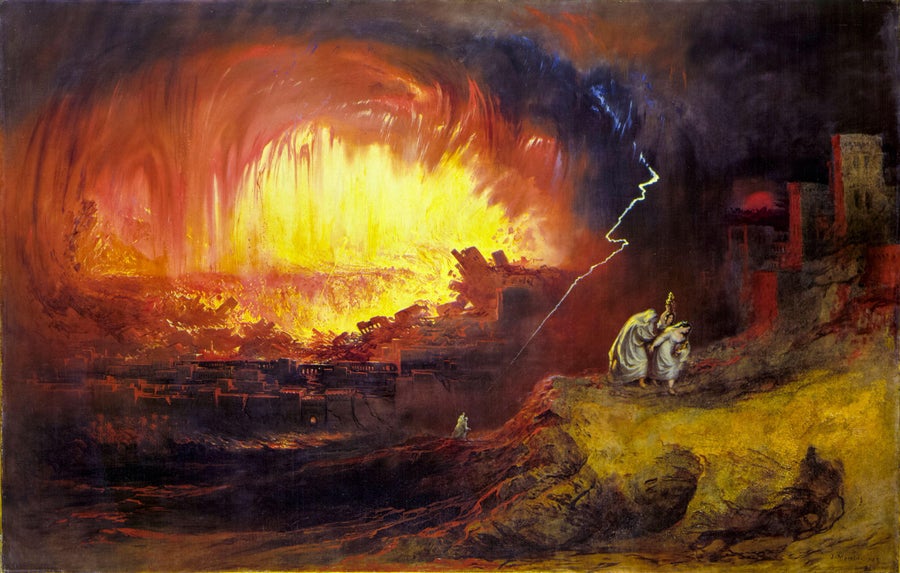
The Destruction Of Sodom and Gomorrah, painting by John Martin, 1852. incamerastock/Alamy Stock Photo
.
.
Click the link below for the complete article:
.
__________________________________________


Leave a comment