
Click the link below the picture
.
The neuron, the specialized cell type that makes up much of our brains, is at the center of today’s neuroscience. Neuroscientists explain perception, memory, cognition, and even consciousness itself as products of billions of these tiny neurons busily firing their tiny “spikes” of voltage inside our brain.
These energetic spikes not only convey things like pain and other sensory information to our conscious mind, but they are also in theory able to explain every detail of our complex consciousness.
At least in principle. The details of this “neural code” have yet to be worked out.
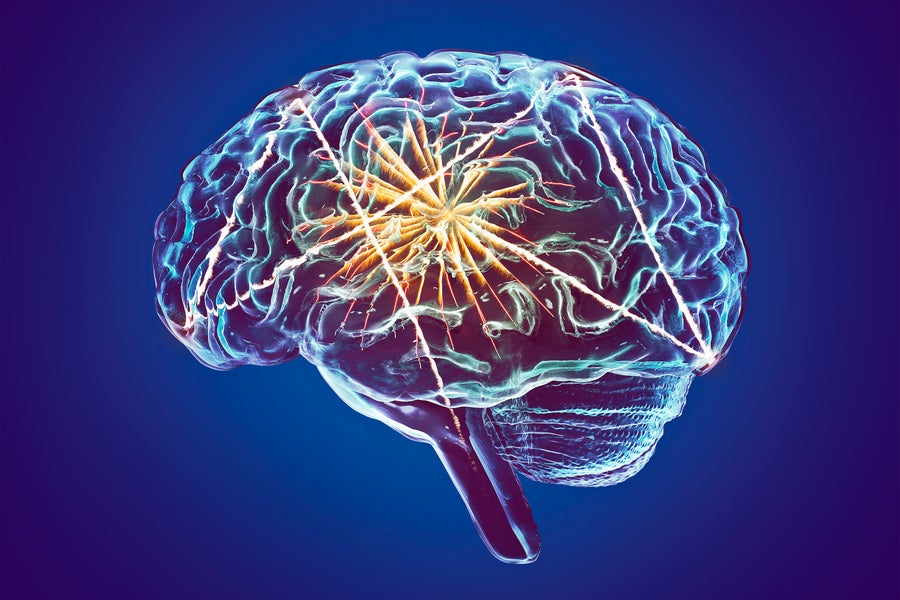
While neuroscientists have long focused on spikes travelling throughout brain cells, “ephaptic” field effects may really be the primary mechanism for consciousness and cognition. These effects, resulting from the electric fields produced by neurons rather than their synaptic firings, may play a leading role in our mind’s workings.
In 1943 American scientists first described what is known today as the neural code, or spike code. They fleshed out a detailed map of how logical operations can be completed with the “all or none” nature of neural firing—similar to how today’s computers work. Since then neuroscientists around the world have engaged in a vast endeavor to crack the neural code in order to understand the specifics of cognition and consciousness.
To little avail. “The most obvious chasm in our understanding is in all the things we did not meet on our journey from your eye to your hand,” confessed neuroscientist Mark Humphries in 2020’s The Spike, a deep dive into this journey: “All the things of the mind I’ve not been able to tell you about, because we know so little of what spikes do to make them.”
Brain researchers have long acknowledged that there are a number of ways other than firing by which neurons could communicate, including the little-known mechanism known as ephaptic coupling. This coupling results from electromagnetic (EM) fields at the medium and large scales of the brain interacting, alongside much smaller scale fields accompanying synaptic spikes (which themselves result from a type of highly localized EM field activity) operating at nanometer scales.
Retinal neurons, for example, operate without any neural firing. These cells employ a type of electrodiffusion, the diffusion of charged particles without synapses, the connection points between neurons. Electrodiffusion passes along a signal to the optic nerve at very fast rates and with high bandwidth. We couldn’t see without this.
The “ephaptic” in ephaptic coupling simply means “touching.” Though not well-known, ephaptic field effects result from the textbook electric and magnetic interactions that power our cells. Intriguing experimental results suggest these same forces play a bigger role in the brain than one suspected and perhaps even in consciousness.
Ephaptic field effects first came to my attention in a significant way with a remarkable 2019 paper from the Case Western Reserve laboratory of Dominique Durand. That lab demonstrated that the mouse cortex was affected without synaptic connections—by definition, ephaptic field interactions. This remarkable effect was found by the Durand team after they cut a slice of mouse hippocampus in half and then measured the voltage potential going up and down the slice. There wasalmost no change in that measured voltage even after the slice was fully severed, demonstrating a strong influence from ephaptic fields.
The influence did, they found, wane after a certain distance, as we’d expect. Once the cut slices were separated by 400 microns or more, the ephaptic field effect mostly disappeared.
These results were considered so remarkable by peer reviewers that they required the Durand lab to replicate the results not once but twice before they approved publication of the paper. One scholar stated at the time of the paper’s publication that the findings of Chiang and colleagues “should probably (and quite literally) electrify the field.”
.
 Hiroshi Watanabe/Getty Images
.
.
Click the link below for the article:
.
__________________________________________


Leave a comment