
Click the link below the picture
.
It’s a very strange experience to watch a play in which you are a character—and to shake hands with the person who plays you. I did both this July while attending a performance of Kyoto at the Swan Theatre in Stratford-upon-Avon in England. The moment meant more, of course, than just a glimpse of oneself on history’s stage. The play shows how science won out over climate denial in a critical face-off between scientists and industry over the future of the planet.
Kyoto is a play about the Kyoto Protocol—an agreement made more than 25 years ago that, as summarized by the United Nations, committed “industrialized countries and economies in transition to limit and reduce greenhouse gases (GHG) emissions in accordance with agreed individual targets.” Written by Joe Murphy and Joe Robertson, the play is a co-production of Good Chance and the Royal Shakespeare Company that provides a dramatic retelling of a historic meeting in Kyoto, Japan, in December 1997, where the protocol was finalized.
At this meeting, a key Intergovernmental Panel on Climate Change (IPCC) scientific assessment helped to inform the international emissions reduction negotiations—the Working Group I part of the IPCC Second Assessment Report, which was completed in 1995 and published in early 1996. I was convening lead author of chapter eight, “Detection of Climate Change and Attribution of Causes.” The role of the IPCC, back in 1995 and today, was to advise the governments of the world on the science and impacts of climate change, as well as on strategies for mitigating and adapting to those impacts.
In 1990 the first IPCC scientific assessment had concluded that the jury was still out on whether a human-caused climate change signal could be identified in real-world climate data. The 1995 assessment’s chapter reached a very different conclusion, encapsulated in 12 simple words: “The balance of evidence suggests a discernible human influence on global climate.” This was a powerful, historic statement from cautious scientists and a rather conservative organization.
Multiple factors contributed to this dramatic transition. Advances in the science of climate fingerprinting, for example, made a big difference in climate research during the five years between the two reports.
Fingerprinting seeks to understand the unique signatures of different human and natural influences on Earth’s climate. This uniqueness becomes apparent if we probe beyond a single number—such as the average temperature of Earth’s surface, including land and oceans—and look instead at complex patterns of climate change. Patterns have discriminatory power and allow scientists to separate the signature of human-caused fossil-fuel burning from the signatures of purely natural phenomena (such as El Niño and La Niña climate patterns, changes in the sun’s energy output, and effects of volcanic eruptions).
Kyoto describes some of the fingerprint evidence that was presented during a key meeting in Madrid in November 1995, ahead of the Kyoto face-off dramatized in the performance. The “discernible human influence on global climate” conclusion was finalized in Madrid, where the participants included 177 delegates from 96 countries, representatives from 14 nongovernmental organizations, and 28 lead authors of the IPCC Second Assessment Report. As a lead author of the evidence chapter, I was there among them in that Madrid plenary room. So were several of the other characters in Kyoto, including the play’s central one—Donald Pearlman, who was a lawyer and lobbyist for the Climate Council, a consortium of energy interests.
Pearlman and I were on opposite sides of the Madrid chessboard. My efforts were directed toward synthesizing and assessing complex science and ensuring that the science was accurately represented in the IPCC report. His were directed toward delaying international efforts to reduce emissions of heat-trapping greenhouse gases. Such reductions were bad for the business interests he represented and for the revenues of oil-producing countries, such as Saudi Arabia and Kuwait.
Pearlman, who passed away in 2005, understood the singular importance of the Madrid “discernible human influence” conclusion. He knew it was the scientific equivalent of the Biblical handwriting on the wall. The jury was no longer out. Human-caused fingerprints had been identified in records of Earth’s surface and atmospheric temperature. Humans were no longer innocent bystanders in the climate system; they were active participants. Burning fossil fuels had changed the chemistry of Earth’s atmosphere, thereby warming the planet and sending Earth’s vital signs into concerning territory. The Madrid conclusion meant that the days of unfettered fossil-fuel use and carbon pollution were numbered.
.
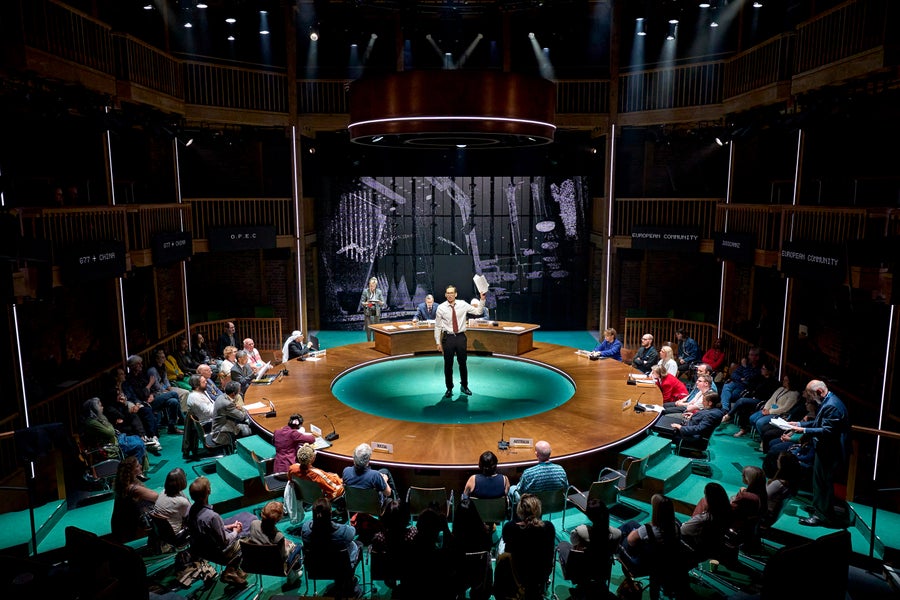
Kyoto production photo at the Swan Theatre, June 17, 2024. Manuel Harlan/RSC
.
.
Click the link below for the article:
.
__________________________________________


Aug 08, 2024 @ 23:35:30
Thanks for sharing this idea Anita
LikeLike