
Click the link below the picture
.
In a solar system full of wonders, Jupiter’s Great Red Spot still stands out.
This lushly red oval is obvious even through small telescopes, looking like a baleful eye staring out from the enormous gas giant planet. The Great Red Spot (or GRS) is so huge that you could drop the entire Earth into it and our planet would plunge through without touching the sides.
It’s been around for centuries and holds many mysteries, but we’re learning more about it all the time. Research recently published in the journal Geophysical Research Letters indicates that the GRS isn’t as old as once thought and implies that while it may yet last for many years to come, its days are numbered.
The GRS is Jupiter’s most iconic feature. I’d say “surface” feature, except Jupiter doesn’t really have a surface; what we see is actually clouds atop an atmosphere that’s thousands of kilometers deep. The GRS is in reality a spot of remarkably vast and persistent weather churning in the planet’s clouds; technically speaking, it’s an anticyclonic vortex—a counterclockwise-rotating high-pressure system—with gases spinning around the center at speeds of 450 kilometers per hour. That’s about as fast as the highest wind speeds ever recorded in a tornado on Earth!
This giant storm—the largest known in the solar system—is made up of two regions. One is an oval made up of reddish gases, and the other is a surrounding whiter, thinner band of gas (called the Hollow). The GRS lives in Jupiter’s South Equatorial Belt, one of the many bands across the planet’s face that give it a striped appearance. These bands are latitudinal wind patterns akin to the jet stream on Earth, but they are more complicated because of Jupiter’s lack of surface, the enormous convective currents of gases rising and falling through the atmosphere and immense air-bending forces from the giant planet’s rapid nine-hour-and-55-minute rotation.
Unlike Earth’s hurricanes that can wander across sizable swaths of our planet, storms on Jupiter tend to stay in their latitudinal lane, confined by powerful jet streams. That confinement also sustains the GRS, making the storm extremely long-lived, but its actual age has been an ongoing astronomical enigma.
In 1665 Italian astronomer Giovanni Cassini spotted—so to speak—a dark oval on Jupiter’s face. It was seen on and off again until 1713, and the recorded location of this “permanent spot” was the same as that of the current GRS. Cassini is credited with discovering it, though it may have been seen by another astronomer in 1632; if that is true, it lasted at least 80 years.
Despite astronomers’ ongoing monitoring of Jupiter, however, after 1713 this spot seems to have disappeared. The next known sighting of a storm at that latitude dates to 1831, well over a century later, when astronomers reported a dark spot there. (It wasn’t described as red until the 1870s!) This spot—our familiar, beloved GRS—has been continuously observed ever since, making it nearly 200 years old.
.
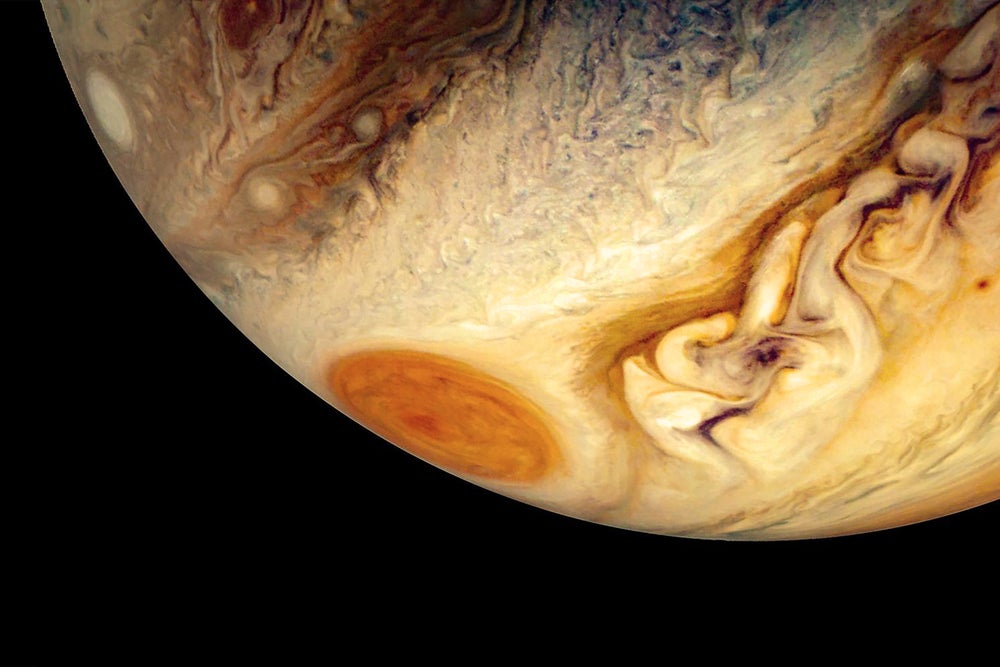
A view of Jupiter’s south temperate belt and Great Red Spot, as captured by NASA’s Juno spacecraft on December 30, 2020. NASA/JPL-Caltech/SwRI/MSSS/Navaneeth Krishnan (CC BY 4.0)
.
.
Click the link below for the article:
.
__________________________________________


Jul 18, 2024 @ 05:56:01
Nice post
LikeLike
Jul 18, 2024 @ 07:47:41
Thank you sir!
LikeLiked by 1 person